Tag Archives: healthy

What I Learned from the 10 Holiday Survival Tips Workshop

Do you wish there was a way to have all of your favorite foods of the holiday season. Well, sit down and brace yourself – it IS possible!

Welcome Vanessa, NMC’s nutrition student and mentee, who  shares below what she learned from attending the live event showcasing the 10 Holiday Survival Tips from the “Love Yourself Healthy through the Holidays” Plan.

The holidays are fast approaching and I’ve already been daydreaming about the rich, indulgent foods that only are made at this time of year. They are calling my name! How do I choose what to eat? Do I go all in with my favorites, like green bean casserole or pumpkin pie, at every party… or do I not indulge in my favorite foods because I know how many more parties I will have to go to?

After seeing Coach Alexia talk about her 10 holiday tips to enjoy a guilt-free holiday, I walked away with three new ideas for how to enjoy everything about the holidays this year.

First, it is important to take the time to catch up with my family and friends. This is the only time of year that I get to see my aunt and uncle that live out west. I always say that I will plan a trip and I never do. If I take this time to catch up with them then I take the focus off the food and can reconnect with my family. As a bonus, while I’m chatting away, my mouth is too busy to chew!

Second, keeping my hands full will help keep me from eating too much. This year at the holiday party, I’m going to keep a drink in one hand and my phone in the other hand to have ready for taking pictures. With both hands full there is no space for me to hold a plate of snacks and mindlessly eat during the party.

Third, and most importantly, I gained new confidence for going into the holidays. With these 10 new strategies, I know can get through the season worry free (maybe even a little lighter!). The holidays are a time of family, friends, laughter and tons of food and this year I can now make my plan so I can eat, drink and be merry!

Happy Holidays from Vanessa!

Check out the entire Love Yourself Healthy through the Holidays Plan so you can make a plan and not be so uncomfortable after your holiday meals that you have to reach under the table and try to unbutton your pants while hoping no one notices!


Does An Apple A Day Really Keep The Doctor Away?

In honor of American Heart Month, we are celebrating apples for heart health! Check out our newest recipe (Cinnamon Roasted Apples) and read on to learn why affordable, delicious apples are a great choice for your health and how to always pick the best apple from the bunch.

First, where did this “apple a day” idea come from?  The expression originated in the United Kingdom, specifically, Pembrokeshire in Southern Wales. The original proverb was “To eat an apple before going to bed, will make the doctor beg his bread.” We found record of it first being published in the February 1866 edition of Notes and Queries magazine.

apple-a-day

While there wasn’t really research done on apples way back then, they got it right about the possible health benefits of apples. Research shows many possible health benefits associated with apples due to some of the wonderful little phytochemicals (plant compounds) that are found in apples. For example, apples have:

  • Phenolic Compounds which may have antimicrobial properties and are associated with reduced risk of tooth decay
  • Flavonoids (specifically quercetin) which is associated with reduced risk of lung and colorectal cancer
  • Pectin, phytosterols and polyphenols which are associated lowering cholesterol levels which can reduce risk of cardiovascular disease
  • Flavonoids which may improve endothelial function (basically the ability of your blood vessels to expand and contract when they are supposed to) in people who are at risk for cardiovascular disease – which may reduce their risk for cardiovascular disease

So, yeah. apples, which happen to be the 2nd most eaten fruit (yay!) pack a powerhouse of nutrition-rich, health-promoting goodies!

All this being said. Please don’t rely on apples when you need to visit the doctor! 

Good news – apples are available year-round and believe it or not, every single state in the USA grows apples. This could be thanks in part to Johnny Appleseed (remember him?) who planted apple trees on his trek as the United States were settled. And we are happy he did as the crabapple is the only apple native to North America.

Let’s talk real life here. You’re in the grocery store and looking at a huge selection of different types of apples. How do you know which apple to choose?

Well, we always say the best choice is the one you enjoy the most, so feel free to grab your favorite type of apple and call it a day!

After that, look to your food budget… which brings more good news: apples are affordable. If your food budget is your main concern, choose the least expensive type of apple.

If you want more details though…

In terms of picking out a good-quality apple, select ones that are firm, show no signs of bruising or decay, and don’t have broken or shriveled skin.

Great tasting apples should be ripe when picked, to maintain consistent flavor, texture, and make them last longer. You can speed up ripening by leaving them at room temperature, then store in the refrigerator when they are ripe.

There are many varieties of apples, each variety with its own distinct characteristics. For example, the Red Delicious, is excellent eaten fresh or in a salad, but does not do well in roasting. Some apples that are good for baking and/or roasting are the Fuji, Gala, Golden, Granny Smith, and the Rome Beauty. Click for more information on the different types of apple varieties and what they are best suited for.

Nutritionally:

One medium apple has just under 100 calories, 25 grams of carbohydrates, 4.5 grams fiber, and 14% of the daily value for Vitamin C. It has no fat, very little protein (1/2 gram), no cholesterol, and only 2 mg of sodium (yes, natural foods have sodium – check out our series of videos on salt!).

Don’t peel your apples! Pectin and about 2/3 of the nutritional goodness (fiber and antioxidants) are in the skin. Also, be careful when juicing. There are approximately 2 1/4 apples in an 8-ounce glass of juice so you can really get a lot of calories and natural sugars by juicing and won’t register fullness the same way you would if you ate 2 apples.

The N.E.W. Motivation Coaching criteria for heart healthy foods includes (1) has fiber, (2) low saturated/trans fat, (3) low sodium, (4) low added sugars, and (5) not too high in calories. Apples are a perfectly heart-healthy choice!

Post a comment and let us know your favorite type apple or apple recipe! We are partial to the Honeycrisp variety and love us some good apple pie… and our Recipes Page has our Cinnamon Roasted Apple recipe which mimics the flavor of apple pie! YUM!

This blog was researched and written by Millie Yeamans, UNF Nutrition Student and edited by Alexia Lewis RD. We support RD2BE students!

Have-you-had-an-apple-today

References:

  1. The Meaning And Origin Of The Expression: An Apple A Day Keeps The Doctor Away. Phrases.org.uk. https://www.phrases.org.uk/meanings/an-apple-a-day.html. Accessed February 13, 2018.
  2. Kalinowska M, Bielawska A, Lewandowska-Siwkiewicz H, et al. Apples: Content of phenolic compounds vs. variety, part of apple and cultivation model, extraction of phenolic compounds, biological properties. Plant Physiol Biochem. 84 (2014) 169-188. http://dx.doi.org/10.1016/j.plaphy.2014.09.006
  3. Boyer J, Liu RH. Apple phytochemicals and their health benefits. Nutr J. 2004;3:5. https://nutritionj.biomedcentral.com/articles/10.1186/1475-2891-3-5/.
  4. Bondonno N, Bondonno C, Croft K, et al. Flavonoid-rich apple improves endothelial function in individuals at risk for cardiovascular disease: a randomized controlled clinical trial. Mol Nutr Food Res. 2018 Feb;62(3).  https://www.pubfacts.com/detail/29086478/Flavonoid-Rich-Apple-Improves-Endothelial-Function-in-Individuals-at-Risk-for-Cardiovascular-Disease
  5. Drake BH, Shertzer JK. Selecting, Storing, and Serving Ohio Apples. https://ohioline.osu.edu/factsheet/HYG-5507. Published February 25, 2010. Accessed February 13, 2018
  6. McWilliams M. Fruits. Food Fundamentals. 10th ed. Pearson Education; 2014:120.
  7. Commodity Apples. https://www.agmrc.org/commodities-products/fruits/apples/commodity-apples. Accessed February 14, 2018.
  8. Apple Facts. https://extension.illinois.edu/apples/facts.cfm. Accessed February 14, 2018.
  9. Apples, raw, with skin. http://nutritiondata.self.com/facts/fruits-and-fruit-juices/1809/2. Accessed February 14, 2018.


Salt: Where Does the Salt in Your Diet Come From?

This is Video/Blog # 2 in our Series: All About Salt.

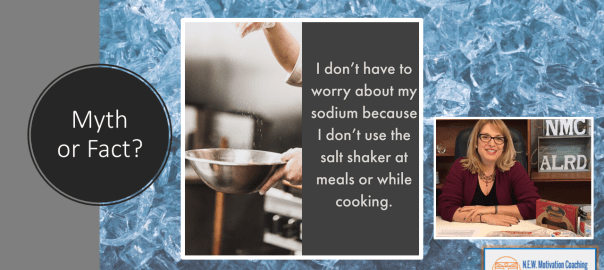
Myth or Fact? I don’t have to worry about my sodium because I don’t use the salt shaker at meals or when cooking?

When my clients want to reduce sodium in their diets, they typically focus on the salt shaker. They believe if they don’t add salt to their food at the table or when they are cooking, it is enough to keep their salt intake low.

Is it enough?

This is a MYTH!

Wait. What? Why???

Most of the salt in the average American diet – a whopping 71% according to the Centers for Disease Control and Prevention – comes from processed foods and restaurant foods – not from the salt we add during cooking or sprinkle on to our cooked steaks or vegetables!

In fact, the foods with hidden sources of salt are the biggest offenders since many do not realize they are so high in salt. The American Heart Association has dubbed these foods the “Salty Six.”

The Salty Six includes:

  • Breads
  • Deli lunch meats
  • Sandwiches
  • Pizza
  • Soups
  • Processed chicken products.

And, if they asked me, I would make it the Salty Seven and added

  • Sauces and condiments

Can you Trust the Food Packaging Claims?

You can always look at the nutrition information label to find the milligrams (mg) per serving – just be sure to notice how much is considered one serving of the food per the label.

Those nutrition claims on food packages are a little trickier. Let’s quickly go over what those nutrition claims really mean.

First, realize that some of the claims are based off comparing the lower sodium version to the regular version.

If you see “reduced sodium” on the label, that means there is at least 25% less salt than the regular version. So, if your food is a salty one – like soup that can have 2000 mg in one can, then reduced sodium may still have 1500 mg which is not what I would consider low in sodium at all.

Claims that mean low sodium include “low sodium” with 140 mg or less per serving, “very low sodium” with 35 mg or less per serving, and “salt / sodium free” which means less than 5 mg per serving.

Finally, “no salt added” means just that – salt was not added during the food processing. The food may or may not be high in salt naturally.

Check out the video where I review some food packages and talk about the salt in some common foods – including what you just might be eating for lunch today!

So getting rid of the salt shaker may not be enough to get you to your salt intake goals.

Which may make you wonder… just how much salt should I actually eating? I will answer that question with our next video!

To get these when they are released – subscribe to my YouTube Channel

Slide7

All About Salt: Sodium

I just finished sharing some information over on the N.E.W. Motivation Coaching Facebook page about salt and decided to post the information and links to the videos here.

Myth or Fact? Sea Salt has less sodium than Table Salt?

First up, we addressed a great question we hear from our clients a lot – does sea salt have less sodium than table salt.

This is such a confusing topic and I’ll share with you why this is so confusing.

One reason is there are nutritional differences in the different types of salts which is due to the source of the salt and how it is processed.

Sea salt comes, of course, from the sea and is typically processed through evaporation, meaning the food manufacturer takes the water away and what is left is your sea salt. Because of this processing, it has different minerals than table salt and may contain potassium, magnesium, phosphorus, and other trace minerals.

Table salt typically comes from salt mines and is stripped of minerals during processing but… typically it comes with added iodine since we used to have a pretty big goiter problem back in 1920s and this is how the powers that be decided to fix the problem. Nutritionally, 1 teaspoon of table salt has no calories and has very small traces of minerals found in sea salt. If you look at the label for table salt, you may see additives. Typically, calcium silicate is in there to prevent clumping and potassium iodide is the vehicle to get the iodine in salt.

But the big question is: DOES SEA SALT HAVE LESS SODIUM?

Slide1-less-sodium

And the answer is YES… and NO!

Oh, don’t you hate that! Well, this will help. Here’s why:

By weight, sea salt does NOT have less sodium than table salt!

However… by volume (when you grab a pinch or use a measuring spoon), sea salt HAS less sodium!

This is because sea salt – and kosher salt – usually has larger crystals so less fits in a spoon due to how the crystals fall against each other leaving little pockets of air in between them. Table salt is very fine and so there are no little pockets of air as the granules nest next to each other.

To compare:

  • 1 teaspoon of table salt has 2325 mg of sodium
  • 1 tsp of sea salt has between 1200 – 2360 mg
  • 1 tsp of kosher salt has between 2000 – 2360 mg

So it really all depends on how those little salt crystals settle.

Hopefully, now it makes a little more sense to you.

So… which one should you choose?

Well, Salt is a flavor enhancer which means it brings out the flavors and makes food more delicious. So, yeah, use a little salt when you cook!

Salt is also important in baking since baking is pretty much just a delicious form of chemistry so it is important to be precise to get good baked goods. For baking, follow the recipe to decide which type of salt to use.

For other cooking, professional and home chefs tend to prefer larger crystals but if you need the salt to dissolve a smaller crystal would be a better choice.

When it comes down to the nutrition, there is not much difference between the different types of salt and there are no magical health and healing properties in the more expensive or organic salts. However, the trace minerals or other fancy things that may be added to the more expensive salts may change the flavor.

In the end, choose whichever type of salt you prefer that best fits your budget.

Butternut Squash Agnolotti

This is a #HelloFresh meal delivery review of the Butternut Squash Agnolotti with Kale in a Sage Brown Butter Sauce. HelloFresh provided a Meal Delivery Box containing three meals to me free of charge. This post is therefore #sponsored. As always, all opinions in my reviews are mine and I if love it or hate it, I’ll let you know.

Okay, first, do you love every single word in the recipe name? OMG yes! Butternut is a good friend of mine and a long-time Thanksgiving meal staple growing up. If you don’t know agnolotti, it is a type of ravioli – ravioli and I also go way back thanks to Chef Boyardee and this great restaurant in Brooklyn that I believe was called Cinzino’s (or something like that…). Then add kale (yes, how cliché, an RD who loves kale, I know), and brown butter sauce – heaven!!! Yes, please, get in my belly! Um, so it is safe to say I was just a bit excited going into this recipe.

The flavors of the pine nuts and butternut squash is what took this dish over the top for me. I love pine nuts but they are so expensive, even when bought in bulk so you can just get a small portion! All the pine nuts were used in the recipe but there was a fair amount of leftover kale, which was sliced into thin strips making it quick to cook and got rid of the thicker stems that can be so fibrous and chewy. I’m a fan of leftover ingredients and this kale was an addition to the next day’s salad.

Butternut-Agnolotti-2-HelloFresh-October-2017

I did make one mistake (as usual!) since I was multi-tasking with filming and taking pictures while I cooked. I added the whole 1-cup of reserved pasta water to the sauce when the recipe clearly says to start by adding 1/4 cup and add more as needed. Whoops! No harm, no foul as I just cooked the sauce down longer to evaporate some of the extra water (and left some liquid behind in the pan when serving…).

Nutritionally, one serving has 640 calories, 15 grams of saturated fats, 59 carbs, 9 grams of fiber, and 24 grams of protein.

What would I change? 

Since I’m currently typically eating five times a day (yep!), this dish is simply too much food/calories for one meal for me. This meal would fit nicely into many people’s meal plans with a satisfying number of calories and fairly balanced nutrition – or it could be split into two servings (bonus – no cooking the second night!) and served with a veggie side to get more bites per meal.

What did I love? 

This is one of HelloFresh’s 20-Minute Meals and it is such an easy recipe to make! The only chopping is to slice a shallot and mince garlic. That’s it! Chopping and prep work is the worst part of cooking to me so this is a big check in the win column for this recipe.

Lessons Learned?

Read the directions. Then read the directions. Then read them again.

HelloFresh provided a Meal Delivery Box containing three meals to me free of charge. This post is therefore #sponsored. As always, all opinions in my reviews are mine and I if love it or hate it, I’ll let you know.


A Gift: Enjoy the Holidays without Sabotaging Your Health

I am beyond excited to announce a gift to you from me and N.E.W. Motivation Coaching. Because I am so unhappy with the Diet Culture / Weight Loss wheels turning as we come to the end of another year, I am giving away – yes free – both a video course and a booklet this year. 

Survival-Guide-Image

Unfortunately, December is a month when many feel overwhelmed with stress and give up on their health goals believing they will return to healthy habits in January when they make their resolutions.

There is some good in this actually.

If you look at the research on willpower, it indicates that people are not as successful at white-knuckling it / sucking it up / using their willpower to [insert goal here: stick to their meal plan, exercise daily, go to sleep on time, etc] when they are either stressed or depressed.

The trick is to manage the stress or depression first and then re-focus on health goals. If you are stressed in December, then relaxing on your health goals may be 100% appropriate. 

Giving up entirely to eat like a jerk and couch surf for 4-6 weeks, however, can result in a pretty big back-slide on health complete with weight gain and loss of cardiovascular endurance and muscle mass/strength! Oh, and an increase in blood pressure, cholesterol, blood sugars, and those other health concerns that are totally impacted by your daily food and activity choices.

So, what do we do?

I’ve got an idea: Find a way to both enjoy the holidays and keep some focus on your health goals. It is so very possible to do with a few tricks & tips up your sleeve!

Planning

The free course gives you 5 realistic tips to coast through the holidays while staying true to your health – and weight – goals as well as 3 worksheets and a health coach walks you through making your personal strategy in the videos so you can enjoy the holidays without sabotaging your health!

You also get tips for making traditional holiday foods healthier AND a list of which herbs and spices pair best with which foods so you can reduce fat and sodium without sacrificing flavor.

This course is designed for:

Dieters who are tired of the repeated cycles of weight loss and regain who want to find peace with food, activity, and themselves so they can improve health and weight

Adults with – or at risk for – chronic lifestyle diseases who want to find realistic and enjoyable ways to approach lifestyle changes so they can reduce their risk for chronic diseases and live a healthier life.

People who are confused or overwhelmed with all the conflicting rules and information about nutrition and exercise who want to sort it out so they can find a lasting, realistic plan that works in their unique lives.

True-Health-Requires-Balance

I offered this information last year as an in-person class and just didn’t get to share it with enough people! So this year we are giving it away in order to get this good info into the hands of more people who need this type of support and guidance during the season.

Check it out – try some tips before the next big holiday meal in just a few short weeks – and share this with anyone you think may benefit from it! There is no limit on how many freebies we give away so share it as much as you would like to!

Here is the link text: https://new-motivation-coaching.teachable.com/p/our-favorite-5-tips-to-enjoy-the-holidays-without-sabotaging-your-health

So you know, this is only 50% of the tips we share in our Love Yourself Healthy Plan. We will be sharing more on that soon!

Yes, you can eat the pecan pie AND be healthy.

Abracadabra – you’re thin!

I have to share that I’m feeling kind of sad, angry, and disillusioned. It’s that time of year, I know. That time where every crazy idea about weight loss and getting ripped invades every media outlet in our lives.

I should be used to it; but I’m not.

It makes me sad because of all the bullshit out there.

Just this week, I’ve seen very disturbing ads. Disturbing on one hand because they are utter ridiculousness. Disturbing on the other hand because of people’s reactions to them… or should I say blind faith in them being their magic bullet for weight loss. Oh, yeah, without having to do anything except buy and use this magical new product.

Have you seen the ad for lycra pants with some magical compound woven into the fabric that is absorbed by your skin and melts fat away yet?

Really?

I mean really – think for a moment and tell me if you believe this? If this were true, everyone would know about this magical potion that melts body fat – no work required, just rub it on and abracadabra – you’re thin!

I also just saw and ad for exercises no one over 40 should do because hormones.

What the bloody hell?

I couldn’t watch it all but this charlatan has a whopping 4 studies he is using to back up his claim that women over 40 shouldn’t do cardio because it messes up their hormones (again, what the bloody hell?). Oh and I guess cardiovascular health is not as important as your weight even though heart disease remains the #1 killer in the USA?

Ummm. Okay, let’s move on ignoring this major fact.

The next part was that this guy can show you the 12-minute exercise plan that will keep you burning fat and calories for hours after you exercise (spoiler: pretty much all exercise has this impact – Learn more about EPOC.)

Damn you science.

Yes, hormones are a big part of weight loss and metabolism. But the detox metabolism tea or the 12-minutes of exercise a day aren’t going to fix them or abracadabra – we’d all be thin!

But the worst part for me is the comments. This is what makes me angry.

It’s not what I’d expect of people crying BULLSHIT! No, it’s the vulnerable and hopeless pouring out their health problems in a comment and asking if the program will work for them.

People peddling this bullshit to these people should be ashamed of themselves. 

get-pissed-off

Of course, we also have had the supplements and pills around for decades now. Someone is still making money off them (off of you?) or they wouldn’t still be peddling this particular type of snake-oil.

The claim, as always, is just take these pills, no exercise or food changes required and abracadabra – you’re thin!

At least the shakes let you know you have to give up eating twice a day and instead drink their miracle shakes.

Listen, there is some evidence (as in research, not testimonials) for pills and supplements for weight loss but the fine print is usually along the lines of people losing an extra few pounds (not a lot of weight) when they also exercise and/or change their food. It’s not just the pills, people. And there’s not a big difference in weight lost with the pills.

Do you know what you are risking for that extra 5 pounds off loss with a pill or supplement?

Well, if it’s an over the counter supplement, just liver failure or death because these are not regulated.

If it’s a prescribed medication, then it’s just insomnia, damage to liver or heart valves, increased blood pressure, seizures, and diarrhea – fun!

But hey – 5 more pounds! Woo!

Learn more about weight loss prescriptions and supplements and the difference in how these come to market.

At least with the shakes you know you are going to be starving yourself – no matter how “filling” the shakes claim to be, it’s not food and there is no chewing.

But sure, take in a mere 700-1000 calories a day and you will lose weight… and stall out your metabolism so when you stop the shakes (because come on it is not a life-time plan), all that weight you re-gain is going to be fat instead of muscle now because you have wrecked your metabolism.

They should put that in the ads too #truthinadvertising.

Pyramid-Schemes

Actually, one of my favorite studies on an MLM shake product was provided by a seller and touted as proof that their shakes are different. The punchline? After actually reading the journal article, it turns out they gauged their weight loss shakes a success because the shake users regained less weight after one year than other dieters.

WTH? Regained less weight.

Right. Not actually losing weight… but regaining less weight back. Wow.

This all makes me disillusioned because here I am – hello – peddling health and weight loss through exercise and nutrition changes along with lifestyle management for stress and sleep.

Yawn. Boring.

And what? I expect people to do some work?

Yes. Work smarter, not harder; but work nonetheless.

At any rate, these are some random thoughts from a dietitian health coach as the money-making season begins for weight loss.

I have no real point today.

I’ll sit by and bite my tongue… and hope that someday we can see behind the abracadabra curtain and believe that common sense is sexy again.

A Pumpkiny Good Time

I had so much fun today sharing my new pumpkin recipes at the N.E.W. Motivation Coaching Pumpkin Love Make & Take!

These lucky ladies joined the fun and made a tangy pumpkin vinaigrette, a pumpkin-nilla-chai smoothie with no added sugar (thank you very much!), and some sweeeeeeet and healthy pumpkin power bites.

But I’m really just writing this blog to share the pictures. So, here they are!

A.Carla-SaraA.KelleyA-SaraA-Pumpkin_power-bitesA.Group

For the Love of Pumpkin!

Why do we have such a fascination with pumpkin every autumn? Could it be the childhood memories of pumpkin carving, roasting pumpkin seeds, and the fun of dressing up for Halloween to go trick-or-treating? Or could it be the bombardment of some delicious pumpkin goodies being brought back on the market – hello PSL and Pumpkin Spice Cheerios – I see you!


I am firmly in the pro-pumpkin camp and will share some tidbits from an article I wrote way back in 2012:

Choose a pumpkin that is firm and has no visible damage or soft spots. The whole vegetable can be stored for months in a cool, dark, dry place. There is no need to refrigerate your pumpkins; they keep best around 55 Fahrenheit. Once you cut the pumpkin, however, it begins to deteriorate and only lasts a couple of days.

Pumpkin is a low calorie, fiber-rich, and nutrient-rich starchy vegetable. (Sorry my low-carb friends – pumpkin does not fall into the non-starchy veg category!) Pumpkin rates as a nutrition rock-star due to its vitamin A content. This is from the pigment, beta-carotene, which is a precursor to vitamin A and gives pumpkin its orange color. Vitamin A promotes healthy eyes and vision and is involved with immune function and reproduction. It appears that vitamin A reduces risk of certain cancers in non-smokers and may slow vision loss associated with age-related macular degeneration. While there are concerns with too much vitamin A from supplements, beta-carotene has no adverse health effects except for a change in skin tone to an orange hue. This could be an advantage if you find yourself without a costume for Halloween…

Seeds are typically packed with vitamins and minerals and pumpkin seeds do not disappoint. If you have the calories to spare, you will also get a hefty amount of magnesium, phosphorus, copper, and zinc (all over 50% DV) as well as 25% DV of iron. Only 5 of the 28 grams of fat is saturated fat and there is no trans fat.

My company – N.E.W. Motivation Coaching – is hosting a Pumpkin Love Make & Take Workshop next week and I would love to have you join us if you are local!

Whatever the reason, pumpkin is a delicious and versatile addition to your meals and snacks. And I’m not just talking baked pumpkin deliciousness like pumpkin pie or pumpkin breads… I’m talking some new ways to add pumpkin to your plate with a Pumpkin Vinaigrette, a Pumpkin-Nilla Chai Smoothie, and Pumpkin Power Bites!

Pumpkin-Love

Recipe: Spicy Mexi-Bowl (Gluten-Free!)

Here is another delicious gluten-free, dairy-free, and vegan recipe. This spicy Mexican-inspired quinoa and beans bowl is a quick to prepare, heart-healthy, and nutrition-rich meal that can be made ahead for take-to-work lunches or you can mix up a big batch for a family dinner.  You could even top it with an over-easy egg and make it a breakfast (although it won’t be vegan with that egg on it!).

Spicy-Mexi-Bowl

And, before I forget – if you join up for our email newsletter before October 1, you will get a special offer on the Go Gluten Free or the Get Started Coaching Packages! Join today!

Here is the printer-friendly PDF: Recipe -Spicy Mexi-Bowl

Spicy-Mexi-Bowl

A Mason Jar Meal-Prep Workshop Recipe by Alexia Lewis RD / N.E.W. Motivation Coaching

Makes 1 serving

INGREDIENTS & SUPPLIES

1                          Mason Jar, 2-cup size

1 Tbsp                Red wine vinegar (or to taste)

1 tsp                    Lime juice

1/4 medium      Avocado (Florida), peeled and chopped

7                          Grape tomatoes, halved

1 Tbsp                Red onion, chopped (or to taste)

1 Tbsp                Jalapeño, deseeded and chopped

1/2 cup               Quinoa, cooked

1/2 cup               Black beans, low-sodium canned, rinsed or cooked from dry

1 tsp                   Cilantro, fresh, chopped

DIRECTIONS

  1. Layer all ingredients in mason jar in order listed.
  2. Store refrigerated for 3-5 days depending on quality of mason jar seal
  3. To serve, shake food from jar into a bowl, toss to combine, and enjoy!

Nutrition per serving:

365 calories, 10 grams fat (1.5 grams saturated fat, 0 trans fat), 0 cholesterol, 153 milligrams sodium, 59 grams carbohydrates, 13 grams fiber, 4 grams natural sugar, 14 grams protein.

Notes:

We recommend making four servings at once – that way you use up the whole avocado – and can cook 3/4 cup of dry quinoa which should give you about 2 1/4 cups cooked.