Tag Archives: health

Vitruvian Man Logo

You may have noticed that N.E.W. Motivation Coaching has an updated logo. We kept the Vitruvian man – because reasons below –  but made the graphic simpler and more visually friendly.

Logo-Medium_FINAL

Why Choose this Image?

You may know that the Vitruvian Man is a sketch done by Leonardo Da Vinci which represents the “perfect proportions” for man. The circle and square which surround the Vitruvian Man provide the touch-points for the length of the arms and legs as they move from one position to another.

It’s an art and a science: A multi-faceted approach. Leonardo’s new twist – to place the circle and square on top of each other – combine science and art. This is similar to our approach.

(1) We are firmly grounded in science, research, and evidence-based practice. We know the research and we keep up with new findings. We understand that the plural of anecdote is not data… yet we realize there are always outliers in research studies who may not fit the data trends. In other words, even if the research does NOT support something for a group on the whole, we are open to pursuing alternative paths to health as long as it does not bring you any harm!

(2) Making lifestyle changes that “stick” for the long-term is an art. We won’t throw information at you and tell you to make it work. Information is everywhere and if all it took was having legit info, then everyone would be exactly where they wished they were with health and weight. We do not believe our role is to tell you what you should do, what you should want for your health (or weight), or how to go about it. We instead focus on discovering your uniqueness (including your personal and environmental strengths and challenges) and then tweak, adjust, and experiment to create individualized goals to baby-step you to success. We use coaching and behavior change techniques to challenge you to think in new ways, but you will always make your own decisions.

Many body types can fit. Weight does not determine one’s overall health and yet many continue to focus on this one narrow view to judge their own health and the health of others. We like that a body with little fat and a body with lots of fat can both fit into the circle and square. The image is not body-shaming and embraces that all sizes belong.

What N.E.W. Stands For

Nutrition. The founder is a Licensed Nutritionist which means we can provide you with nutrition coaching and medical nutrition therapy. (More information on the differences here.)

Exercise. As an American Council on Exercise Certified Health Coach, we can get you started with activity and exercise safely.

Wellness. Health is more than food, exercise, and body weight. We work with you on finding health-life balance, improving sleep habits, managing stress, and figuring out all your Plan B’s for when life and situations throw you off course.

If you want more details, check out N.E.W. Motivation Coaching for upcoming workshops, group challenge classes, and individual coaching/counseling.

What do you think of the new logo and what it represents?

An Open Letter to my Dietitian Colleagues

What good is an RD’s opinion?

Our opinions – they do not matter. Hear me out.

What we personally think about alternative sweeteners, grains, and organic foods– this does not matter. We are not the “body of evidence” or the final authority on how people “should” eat. Our opinions may be based on years of research (hopefully) or they may be based on the latest nutrition trend (unfortunately). So, our opinions: they may stink.

Our opinions, however, carry a LOT of credibility.

Our profession touts us as “THE food and nutrition expert” and holds us aside, seemingly on a pedestal when compared to other health professionals and educational tracks. We have years of schooling and internships to teach us to interpret, and sometimes perform, research studies. This training does set us apart and people seek out our opinions; but it does not make our opinion valuable to anyone other than ourselves.

There is a need for education about food and nutrition – many people are misinformed, lack an deep understanding of science and physiology, and have been led to the dark side of junk science and the business of selling health. We cannot be a part of this problem RDs! Please stop telling people what they should eat to be: good, pure, healthy, clean, and angelic. Please stop telling people about how we personally eat and which foods are bad, toxic (really??) and the devil personified.

It’s just food. And our opinions have no place in someone else’s dietary choices (except maybe our partners or children… and boy-hardy don’t they feel lucky to live with RDs #sarcasm).

IMHO-Doesnt-Matter

Our job, our role, what we have been trained and educated to do, is to evaluate the research, separate the invalid bull from the valid conclusions, and share what we, as a field of study, currently know about food and nutrition. Yes, you may have to actually read a bunch of peer-reviewed research studies. #sorrynotsorry.

I learned a valuable lesson during my internship: the opinion of the person asking for your opinion is what really matters. People ask for an RD’s opinion to have their beliefs confirmed or to receive praise for “correct” choices. The trouble is that getting asked for our opinion gives us a launching pad to talk about our ideas – and don’t we all love doing that? Sure we do! But next time, take a beat and say, “That’s an interesting question and I can certainly give you some information; but let me first ask what you think about that?”

I’d wager that the conversation doesn’t come back around to our opinions at all.

Our actions should be in service to our clients.

Let’s try to stop focusing on being right, stop talking so much, and start listening more. Let’s focus on helping people be real with their food choices instead of making them feel “bad” for not eating “right.” Let’s use our expertise to give people evidence-based information instead of our opinions.

Let’s help people in the way that RDs really excel – by knowing and keeping up with the ever-changing body of evidence and by helping people figure out how to apply the information relevant to them to their unique lives in a way that supports a physically and emotionally healthy long-term relationship with food and nutrition.

Now, go forth and be awesome!

Go-Forth-Be-Awesome

Cheese and Strangulation by Bedsheets

I say when your press release gets no press, make your own! We will get to the cheese; but first:

FOR IMMEDIATE RELEASE

Dieting is Making You Bigger

Say Hello to Jacksonville’s Only Health at Every Size® Nutritionist

Jacksonville, Florida – July 2017 – There is a movement growing among health professionals called Health at Every Size® which, among other things, rejects the use of weight as an indicator of health and believes that weight is largely unchangeable by individuals. There is only one registered HAES® practitioner in the Jacksonville area. Search the listings here.

Regardless of what the celebrities and infomercials who promote a Diet Culture say, the fact is that the majority of dieters only temporarily lose weight. In the long-term, they regain the lost weight plus more. Many of them will then go back on a diet – and this weight cycling is detrimental to health. Following restrictive diets and intense work-out plans provides temporary weight loss results at the expense of mental health and self-esteem with the result often being an out-of-whack metabolism and eating binges. Social relationships can also suffer as food rules, good food/bad food beliefs, and guilt or shame about food choices become more consuming.

Many people think if someone is overweight, they are not healthy. The truth is that not everyone who has a large body is sick/unhealthy – and not everyone who has a small body is well/healthy. One cannot make judgements about someone’s health based on their body size. Many larger bodied people are healthy in terms of lab values, freedom from chronic conditions, and ability to exercise and live independently. All the diseases and conditions that obesity supposedly causes are nothing more than associations and correlations – things that happen together – not necessarily one thing causing the other.

For some fun correlations to illustrate this point, see Spurious Correlations and you can “prove” that eating cheese leads to death by strangulation by bedsheets… or that eating margarine leads to happier marriages (or at least less divorce filings)…

Beware-the-cheese

You see my point?

(And if you don’t, I’ve got a heckuva deal on some swampland I can sell you down here in Florida… hit me up!)

As a HAES® practitioner, registered dietitian, and certified health coach, I can offer a welcome change of pace for people who choose to reject the diet culture and prefer to work on improving health through mindful eating, enjoyable exercise, self-acceptance, and realistic, flexible lifestyle habits.

Get more information or see our upcoming events.

HelloFresh Meal Review: Emeril Lagasse’s Herby Dijon Chicken Breasts with Zucchini and Red Potatoes

HelloFresh provided a Meal Delivery Box containing three meals to me free of charge. I was so impressed that I have joined their #affiliate program. As always, all opinions in my reviews are mine and I if love it or hate it, I’ll let you know.

Take advantage of this discount – Get Cooking Today With HelloFresh And Get 50% Off!

I was so excited to make this meal! The pictures on the recipe card look amazing and I (like many others) am more comfortable cooking chicken than I am with cooking fish, which was my first HelloFresh meal.

This recipe was prepared on a work-night and did not take much time from start to finish. All that was needed from my kitchen was olive oil, pans, a strainer, and a small bowl – oh and a cutting board and knife of course! Prep time didn’t take long as there was very little chopping involved, just half a shallot, a few potatoes, home herbs, and a zucchini. Although, I must chop faster than the average person (thank you Food Lab in undergrad nutrition program!) as I found myself waiting on the chicken to cook. I admit to starting Step 3 (cook chicken) before Step 2 (prep/chopping) and the chicken took a little longer to get to temp than expected.

Now, I do not typically cook chicken on the stove-top. So, I will warn those of you who also typically bake or grill you chicken: beware the oil splatter! I have a mesh screen to prevent the splatter but by the time I realized I needed it, the splatter had happened so I let it go. You could easily bake the chicken instead and end up with less cleaning (splatter and one less pan) and this also would be nutritionally less fat and calories if that’s important to you. But you would lose the searing which gives the meat some flavor as well as leaves those tasty little brown bits in the pan to get incorporated into sauce – and the sauce makes this meal!

I’m also kind of a food safety and sanitation freak so be sure to sanitize anything that contacts the raw chicken. I cut all that out of the video but make sure to do that at home! Oh, I also cut out a lot of wine sipping. Oh my gosh, so many edits to take out the wine sipping!

Another random tip is don’t use a non-stick pan for potatoes like I did or they won’t get crusty-crispy. I was smart enough to use a regular pan for the chicken because I knew I wanted those brown bits for the sauce; but I did not bring that logic over to the vegetables pan.

This recipe is definitely more cost effective from #HelloFresh than if you had purchased ingredients from the store! All that was leftover was half a lemon, half a shallot, and some tarragon– bonus. My pictures do not do this dish justice… that’s what happens when drinking wine with dinner – I got too excited about the food and didn’t take good pictures!

Final review: This meal is flavorful yet subtle and is made with familiar foods – I will be making this meal again!

Things I learned

A mesh splatter screen is a useful kitchen gadget

Non-stick pans are not always the best choice

Emeril may have some more recipes out there that I need to try!

Here’s that info again if you want to take advantage of the discount I can offer you to try out HelloFresh! Get Cooking Today With HelloFresh And Get 50% Off!

HelloFresh Meal Delivery Box Arrives

Meal Delivery? You Betcha!

As a practicing dietitian and health coach, I’ve talked to many people over the past six years about how to use food to improve health. People want to eat well and to eat healthy food – but they won’t give up flavor, enjoyment, convenience, or pay too much for that healthy food. I get it. Me too! As I’ve said before (What is This Non-Diet Stuff Anyway?) one of my few food rules is: Never eat something you don’t like! And my professional goal is “Heart Healthy Nutrition Made Easy” as it says in my web site header!

We all know that more meals should be made at home if we want to focus on our health and less meals should come from eating out whether it’s a sit-down, a fast-casual, or a fast-food restaurant. But… after my clients tell me they know this, they follow that up with how they don’t have the time… they don’t know what to make… or they don’t think they have the skills to cook if it involves more than heating something up.

Enter meal delivery services.

HelloFresh Meal Delivery Box Arrives

A few clients have told me about some meal services they have used and how it helps them with eating healthy a few times a week. I get so excited for them finding a solution that works in their lives… but I never thought about using a meal delivery service myself. I mean, after all, I’m the food and nutrition expert,” which means I’m supposed to be able to do it all myself. Sure, in theory, absolutely. (See my ASPIRE strategy for meal planning). But I also work, have a husband I would like to spend more time with, have some hobbies I enjoy, and well, sometimes just don’t have the energy to meal plan, shop, prep, and cook! Sometimes, like you, I just want an evening (or three) to lounge on the couch after a long day, sitting with my hubs and my dogs, and enjoying a nice glass of cold white wine. Why, yes, prosecco would be great, thanks!

So, I went to the Today’s Dietitian Symposium in May and found myself live-tweeting from the education sessions with another dietitian who has the same last name! How cool is this?! I decided we must meet and we did get a chance to say hello and have a quick chat. Turns out the other Lewis RD works with HelloFresh and she gave me information which led to me getting a free HelloFresh delivery box. (Being an RD comes with all kinds of food perks!). I was excited to try it out and, as I’m learning about adding video to my blog, I thought this would be a great way to share my experience with everyone.

Setting up for video - it's a labor of love people!
Setting up for video – it’s a labor of love people!

I was so impressed with the delivery, the ease of making the meals, the convenience, and the level of deliciousness that I became an continue in this relationship. I’ll be posting those blogs/videos very soon and should be posting about one a month going forward. 

You don’t have the time? These recipes take about 30 minutes to make!

You don’t know what to make? Trust me you will be drooling when you look at some of their recipes!

You don’t think you have the skills to make a healthy meal? The step-by-step directions (with pictures yo!) take out all the guess work. In fact, these are a great tool to help you build your cooking skills and confidence that you – yes you – can get a beautiful, healthy, and delicious meal on the table!

Let me know if you have any questions or feel free to comment below!

HelloFresh provided a Meal Delivery Box containing three meals to me free of charge. As always, all opinions in my reviews are mine and I if love it or hate it, I’ll let you know.


What Is this No-Diet / Anti-Diet Thing Anyway?

Now that you are exploring the idea that diets don’t work, are you wondering what that leaves you with if you still want to improve your health and lose weight? It is a scary place to be. Many dieters have been dieting for a very long time and not having the structure and those good/bad thoughts about food and eating habits can result in feeling very lost and uncertain. We certainly are not comfortable trusting our bodies since we are not happy with how our bodies look. We certainly cannot trust our bodies because our bodies are always hungry (um, yeah, because we are starving our bodies on diets!).

Life with no diet plan? No food rules? How will we know what to eat? How will we keep from eating way too much food or binge-eating? We will dive in to the deep end with food and just get bigger!

So many times when I start working with a new client, I hear a very familiar story. It goes something like this:

What I ate yesterday? Oh, well, that was a bad day [laughs] but okay. I got up and I had a cup of coffee with a splash unsweetened coconut milk and honey – I know sugar is bad but honey is natural – and I ate 1 packet of instant oatmeal made with water. I was hungry mid-morning but I was good and didn’t eat until lunch time! For lunch, I had a salad and a diet soda. What was on the salad? Oh, it was just lettuce and tomatoes with one of those tuna packs. No, no dressing or croutons – I can’t eat those! By 4:00 I was so hungry but I drank a lot of water to fill up my stomach and I managed to make it home without eating! For dinner, we had grilled chicken and I had a few broccoli florets. My husband had some rice but I know carbs make me fat so I skipped that. To drink, I had a couple glasses of red wine – I’ve heard that’s good for my heart, right? I was so good yesterday and was so proud of myself but then, I was so bad. I just could not stop eating after dinner. I know I’m not supposed to eat after 6pm… are you sure you want to hear this? Okay, well, first I had some crackers with cheese… and then I had a lo-calorie popsicle… and then I had a big bowl of chopped pineapple… and I was still hungry and well, I knew I blew it at that point and was being bad so I went ahead and ate one of those big microwave bags of popcorn and before bed I had some ice cream! So far today though, I’m being good again and eating right.

It is a way-too-familiar story because it is the pattern of most of the people I talk to who are trying to diet. If you read that again and look for food rules and good/bad language, it will jump out at you. If you total up those calories (sorry, dietitian-brain took over) – or think about how much food was eaten before the after-dinner snacking began  – you know it is not enough to fuel a body! Of course you are hungry. You are starving your body. Yes, I know it’s on purpose because you want to lose weight but it backfires every single time, doesn’t it?

And no, it’s not because you aren’t good enough; aren’t strong enough; didn’t try hard enough. It’s because: physiology. Undereat… undereat…. Ignore hunger… undereat… binge! See you again tomorrow diet!

But without a diet plan, we now are staring into a void. Without the rules, what is left?

break-free-from-dieting

There is a new buzzword out there: anti-diet (or reverse dieting). It has been around for a while but maybe you just haven’t seen it before. Other names you may have heard are no-diet, non-diet, mindful eating, intuitive eating, and some others. It is about listening to your body – and yes, you can trust your body – once it has learned it can trust you not to starve it again… although that may take a little time. Your body has learned that starvation is always coming if you are a repeat dieter. But with time, you can get past that point and get back in sync with your body.

What does a non-diet approach look like? It may be different for different people but here are some ideas – and I’m sure you could add your own ideas to this list once you get the hang of it:

  • Eating foods you like in amounts you desire, which means
    • Eating when you are hungry instead of ignoring your body when it is crying out for fuel and energy
    • Stop eating when you are satisfied from a meal. Yes, this takes practice and it is hard work; but doesn’t that make more sense than eating a set number of calories or points or only green foods?
  • Consider what you want for your health and choose foods that move you in that direction
    • For example, if you are working on lowering cholesterol then eat more foods with fiber and unsaturated fats
  • Focus on quality nutrition by swapping out nutrition-poor foods for more nutrition-rich foods
  • Allow yourself to eat what you really crave and enjoy – have those treats and other foods you love and told yourself you would never eat again
  • Following that, only eat foods that you enjoy. I do have one pretty big food rule that I recommend we all follow: Never eat something you don’t like. Seems elementary but a lot of people choke down “healthy” foods and drinks that they hate
  • Find activity that you truly enjoy regardless of the intensity or “calorie burn” and then do it consistently (and joyfully!)

Answer a question for me: Are these positive guidelines or negative ones?

The diet industry has made people hate themselves into desiring to change by following rigid and ridiculous rules. This approach is all about loving ourselves into change with flexible and enjoyable guidelines!

Think about it. The diet culture banks on you hating your body. You hate your body and so you diet and exercise because your body is wrong, it can’t be trusted, it’s signals must be ignored, and you are not worthy. You must eat a certain way (diet), obsess about food, power through the physical and emotional pain of hunger, and don’t forget to exercise to as a penance for eating. And maybe one day, after you suffer the consequences of “getting yourself back” after having “let yourself go,” you finally can be deserving of love and worthy and valuable.

The no-diet approach is based on loving yourself and realizing that your body is worthy and beautiful, you can trust it and listen to its signals, and if it never changes, you are enough, you are valuable, and you are worthy. You eat because food is nourishing – and delicious – and you get to exercise and move your body in ways that feel good. These things are rewards, not punishments!

And listen, you can still seek to improve your health. There is nothing wrong with that. Do you think those who strive to be millionaires shrug their shoulders and stop trying because the majority of people don’t make it? Heck no. If that were the case, then millionaires would only be born, not self-made. Self-made millionaires seek to improve on their weaknesses and put in the hard work. They read, meditate, get up earlier, work harder, and improve themselves. Do you think they hate themselves until they make their first million? Heck no! (So why do you hate your body until you lose weight?). They believe in themselves, they love themselves, and they know they are worthy of achieving their dreams.

Breaking the diet mindset is not easy work.

A funny thing happens with weight when many people stop dieting… not right away; but over time, people’s weights settle at the weight that is best for their bodies. You may lose weight if your body has a lot of weight on it because you are treating yourself poorly with food and not being active and then you start treating yourself better by eating nutrition-rich food and getting more active; but weight is not the focus. You may gain weight if you’ve been dieting forever and now you break all your “diet rules;” but the research doesn’t indicate that weight is gained with a non-diet approach and weight is not the focus. If you lose weight, great! If you don’t lose weight, great! If your weight doesn’t change, great! Once you can embrace that, you will have flipped off diet culture and be on your way to living a happier, healthier life!

Do you want to learn more? Please join our upcoming Redefining Healthy Book Club: Readings to Break the Diet Cycle and Live the Good Life. We will meet virtually and in-person if you are in the Ponte Vedra, Jacksonville, St. Augustine area of Florida.

Yours in Good Health,

-Alexia Lewis RD

This article is Part 4 of 4 in “Health versus Weight as a Focus for Wellness” which will be published during the month of June 2017.

Part 1: The Continuum of Approaches to Health: Thoughts from a Curvy & Healthy Dietitian Health Coach

Part 2: Who is the Best Health Professional to Help with Creating New Lifestyle Habits?

Part 3: If Diets Don’t Work, How Can a Health Coach Help Me?

References & Resources

T.L.Tylka, R.A. Annunziato, D. Burgard, et al, “The weight-inclusive versus weight-normative approach to health: Evaluating the evidence for prioritizing well-being over weight loss,” Journal of Obesity, vol 2014, article ID 983495, 2014. View at: https://www.hindawi.com/journals/jobe/2014/983495/.

A. Bombak, “Obesity, Health at Every Size, and Public Health Policy,” American Journal of Public Health, vol. 104, no.2, pp. e60-e67, 2014. View at: https://www.ncbi.nlm.nih.gov/pmc/articles/PMC3935663/

If Diets Don’t Work, How Can a Health Coach Help Me?

Have you heard that diets don’t work?

Actually, all diets work. Any way you can dream up to cut calories will usually result in weight loss (assuming no underlying health conditions, sleep and stress are in check, you have a healthy gut microbiome, have not screwed up your metabolism from a history of chronic dieting, etc. etc. etc.). So go for it – paleo, atkins, intermittent fasting, no white foods, whatever – they all work until you stop following them.

Ah, there’s the catch. Who could follow any of them for a lifetime? So, diets only work short term. Health is not a short term proposition. Diets don’t work.

The ugly truth is that an overwhelming majority of dieters regain the lost weight (plus more!). Many others have knocked their metabolism and hormones out of whack (making it easier to gain weight) and may have jeopardized their health physically and emotionally by going on a diet. What’s worse is that weight cycling (the on/off diet lose-and-regain weight cycle) is not at all good for your health.

It’s all doom and gloom for dieting when you look past the initial honeymoon phase when your weight is dropping. Need to have that gall bladder taken out after a low-fat diet? Obsessing about food all the time after calorie counting? Feeling like a failure, unworthy, unlovable after losing and regaining weight again? These are the promises diets should make. #truthinadvertising. You must be crazy if you want to go on a diet. Who wants results like that?

dietsdontwork

Well, a lot of people do. We are all bombarded by diet culture and fitspo and it is natural to want to lose weight, to model what you see, to want to fit in with current societal norms. We live in a shake-pushing weight-shaming world and large-bodied people face discrimination every day. Our beliefs about dieting and weight are so very skewed from media outlets and celebrities and fitness bloggers.  Many blame themselves for not being able to lose weight on a diet (wrong answer) instead of blaming the multi-million dollar industry that is banking on the fact that you will blame yourself instead of the diet plan and spend your money in the diet industry again and again and again.

But, check it. If the majority of diets fail, then at least some dieters are successful, right? I hear the optimist in you. I get it. That next diet, well, it’s so alluring and promising and well, maybe you are in that Miracle Minority who can diet and keep weight off for life! Maybe.  Maybe not.  I’m not a fortune teller. Even though I know the research about diet outcomes, it is not my job to force that on you. So, go ahead if you want to try just one (or three or five) more diets. I’ll still be here when you are ready to try out something different.

How Can I Help You?

If you want to work on your health and wellness, then I want to work with you. This is where the education part of my job is. Let’s talk about why you believe that the next diet is “the one” and let’s work through how you are thinking about dieting – the process and results and struggles – and see where you end up. It is better to for you to explore your options and for me to give you a safe place to unload and investigate some new ideas.

My hope is that you will move towards the anti-diet/non-diet approach. In fact, many people I work do relax their food rules and find a happy place with food and exercise. If you partner with me then you get a coach to educate, explore, discuss, trouble-shoot, brainstorm, encourage, motivate, and challenge you. You get someone on your side working right there next to you until we find what works for you to reach your health goals.

When you are ready to break the diet cycle and focus on your health, I will still be here.

Yours in Good Health,

-Alexia Lewis RD

This article is Part 1 of 4 in “Health versus Weight as a Focus for Wellness” which will be published during the month of June 2017.

Part 1: The Continuum of Approaches to Health: Thoughts from a Curvy & Healthy Dietitian Health Coach

Part 2: Who Is The Best Health Professional to Help with Creating New Lifestyle Habits?

Part 4: What Is This No-Diet / Anti-Diet Thing Anyway?

References

T.L.Tylka, R.A. Annunziato, D. Burgard, et al, “The weight-inclusive versus weight-normative approach to health: Evaluating the evidence for prioritizing well-being over weight loss,” Journal of Obesity, vol 2014, article ID 983495, 2014. View at: https://www.hindawi.com/journals/jobe/2014/983495/.

A. Bombak, “Obesity, Health at Every Size, and Public Health Policy,” American Journal of Public Health, vol. 104, no.2, pp. e60-e67, 2014. View at: https://www.ncbi.nlm.nih.gov/pmc/articles/PMC3935663/

P. Sumithran and J. Proietto, “The defence of body weight: A physiological basis for weigh regain after loss,” Clinical Science, vol. 124, no. 4, pp. 231-241, 2013. View at: http://www.clinsci.org/content/124/4/231.

S. Wolport, “Dieting does not work, UCLA researchers report,” UCLA Newsroom, 2007. View at: http://newsroom.ucla.edu/releases/Dieting-Does-Not-Work-UCLA-Researchers-7832 or the study that was the basis for the article here: https://www.ncbi.nlm.nih.gov/pubmed/17469900.

R.R. Wing and S. Phelan, “Long-term weight loss maintenance,” American Journal of Clinical Nutrition, vol. 82, no. 1, pp. 222S-225S, 2005. View at: http://ajcn.nutrition.org/content/82/1/222S.short.

R. Chastain, “Do 95% of dieters really fail?” Dances with Fat, 2011. View at: https://danceswithfat.wordpress.com/2011/06/28/do-95-of-dieters-really-fail/ (a nice summation with links to more information).

Who Is the Best Health Professional to Help with Creating New Lifestyle Habits?

With so many options for a finding a health professional to help you move towards your health goals, how do you know how to choose? Let me be clear that your medical doctor is your first partner but you only get so much in-person time there! Let your doctor help guide your decisions about what to work on; then find a health professional to find the best strategies to get it done!

First, figure out how you want to approach your goals – do you want to focus on nutrition, on activity, or on a combination of many things: sleep, stress, time management, consistency, overcoming your typical challenges? This will guide you to the best person to help you. Second – and so important – is to find someone who makes you feel comfortable. Finally, make sure they have relevant education and hands-on experience. You want to make sure it is safe before you put your trust and health in someone’s hands!

smileyfaces

Before jumping in to the many types of health professionals you can choose from, let me start with some key differences.

Nutrition Education / Nutrition Recommendations / Medical Nutrition Therapy.

Anyone, even you, can provide nutrition education as long as you are not paid. You can look up credible guidelines (American Heart Association USDA’s Choose My Plate,  etc.) and share the information one-on-one or in a group as “nutrition education” in general terms. Now, if you decide to charge people for the education, you should probably check out the laws in your state because that changes things. In the 46 states in the U.S.A. that have license laws for nutrition , only certain professionals can (legally) make nutrition recommendations or practice Medical Nutrition Therapy. A nutrition recommendation would be giving you a meal plan or recommending a specific food change/supplement. To illustrate the difference, giving education is saying, “What we know about X is Y;” making a recommendation is saying, “If you are concerned about X, you should do Y.”  Medical Nutrition Therapy / MNT is giving recommendations about a dietary/nutrition approach for any health condition from a gluten sensitivity to heart disease or cancer. This does not involve diagnosing health conditions but it does include dietary “treatment” for health conditions.

Exercise Education / Exercise Foundation / Exercise Training.

Exercise education is like nutrition education. Anyone can speak in general terms about credible information regarding exercise and activity if not paid. An exercise foundation is getting someone started with exercise. It may be assessing you for exercise readiness, screening you to find out you should talk to your doctor first, or helping you start a beginner’s program designed by an exercise agency/trainer, such as an easy walking program. It should not make you breathless, involve lifting anything, or be hands-on exercise guidance one-on-one or in a group setting. Exercise training (personal training) is making recommendations by giving you a workout routine they designed or doing hands-on instruction and guidance (leading you through a work out).

As an aside for both of these definitions of terms: many people are more successful when given education and having a discussion with their health professional about how to apply it. Getting a recommendation is what many people think they want, only to find out those recommendations don’t stick for long. We all know that someone else telling you what to do rarely works for long… we tend to start tweaking things or just straight-up stop, right? A health professional skilled in having the conversation with people about behavior and lifestyle changes can be just as – if not more – helpful in the long-term than someone who can make recommendations.

education plus discussion

Types of Health Professionals

Certified Health Coach. If you want to focus in many areas, this is your go-to professional! Just know that there are many different types of coaching certifications with some being intensive and some being laughable – so ask questions. The more intensive certifications can require a NCCA-accredited certification/license or an associate’s degree in a health-related field as a prerequisite, followed by additional education (classes, readings, practical videos, critiqued practice of coaching skills) and a proctored exam. They can coach you in many areas of health and wellness including nutrition education, exercise education (and possibly building your exercise foundation), sleep, stress, time management, consistency, overcoming challenges, etc. They should also be skilled in motivating you to change and dispelling health myths.

Certified Personal Trainer. For exercise, this is your go-to professional! The same agencies that certify Health Coaches may also certify Personal Trainers so the requirements for this certification are similar except that only a high school diploma and current CPR certification are required. Personal Trainers can do exercise education, foundation, and training. They will know how to work around any injuries you have; but they cannot diagnose or treat injuries (that’s medicine) or help with injury recovery (that’s physical therapy). They can lead you through workouts or design an exercise program for you to follow on your own. For nutrition, dig a little deeper into their training. Legitimately credentialed personal trainers will have some education in nutrition and they can obtain extra certifications in nutrition (quality of programs vary); however, they are limited to nutrition education.  They should also be skilled in motivating you to change and dispelling exercise myths.

Registered Dietitian / State-Licensed Nutritionist. For nutrition, this person is your go-to professional! They will have an undergraduate (or master’s) degree in health / nutrition science and have completed 1,200 hours of hands-on practical internships. They can do nutrition education, make recommendations, and provide MNT. “Registered Dietitian” and “Dietitian” are legally protected titles in most U.S. States. “Licensed Dietitian/Nutritionist” is a title for those who have a license from their state’s Department of Health (same as a medical or trades license). In terms of exercise, they can provide exercise education and let you know if your “calories burned” part of the energy equation is low; but they cannot do any exercise foundation or training work with you. They should be skilled in motivating you to change and dispelling nutrition myths.

Nutritionist / Nutritionalist / Nutrition Counselor / Etc. Go make yourself a web page and business card – I’ll wait – congrats you are now a nutritionist! Would you put your health in the hands of someone simply because they have a good eye for design and a compelling way with words? Or because some new and interesting eating or exercise thing they did worked for them? Please be smarter than this. Some “schools” will give people a nutritionist title and it may mean nothing (very little training) or it may be more intensive; either way, unless they are a “licensed nutritionist” they can still only legally do nutrition education in many states. Ask questions before working with someone with this kind of title.

Mental Health Counselor. At times (lots of times), food and exercise issues are rooted in emotional and mental health. The previously listed health professionals help you with the “outside work” (doing things) and can help you work through some of the smaller internal mental challenges with creating new lifestyle habits. They can also help you identify if some more involved “inside work” (thinking things) might be helpful and refer you to a therapist. This is a great person to have on your team; just be sure to find someone state-licensed.

Where do I fit in? I’m so glad you asked!

I am a Certified Health Coach (American Council on Exercise), Registered Dietitian, and State-Licensed Dietitian/Nutritionist (Florida); but my approach is different from many other RDs.

I have had clients tell me they were not interested in working with me because I am an RD; but they gave an RD one last try. After a while, they confessed this to me that all they got before were handouts and food rules and it was not helpful. There was no flexibility; just “here, do this.” Thankfully, I do not speak about all RDs here – as practitioners, we are as different as the people you will find in any other helping field.  You will not get a handout, some food rules, and a plan from me and I will not tell you how you should go about reaching your goals. Someone else’s plan (even mine!) will not work for you for long – and it certainly does not get you near the goal of making changes stick for a lifetime.

My job as I see it is to help you examine your goals and how they fit into your lifestyle, break your food rules, and explore the many options you have to reach your goals. Then we set about finding a few small, flexible, realistic ways for you to move towards those goals. I will not tell you what you should or should not do.

Don’t enough people already try to tell you what to do?

Yours in Good Health,

-Alexia Lewis RD

This article is Part 2 of 4 in “Health versus Weight as a Focus for Wellness.”

Part 1: The Continuum of Approaches to Health: Thoughts from a Curvy and Healthy Dietitian Health Coach

Part 3: If Diets Don’t Work, How Can a Health Coach Help Me?

Part 4: What Is This No-Diet / Anti-Diet Thing Anyway?

References & Resources:

Health Coach Certification, American Council on Exercise: https://www.acefitness.org/fitness-certifications/health-coach-certification/default.aspx

ACSM Certified Personal Trainer, American College of Sports Medicine: https://certification.acsm.org/acsm-certified-personal-trainer

5 Steps to Become a Registered Dietitian Nutritionist, Academy of Nutrition & Dietetics: http://www.eatrightpro.org/resource/career/become-an-rdn-or-dtr/high-school-students/5-steps-to-become-a-registered-dietitian-nutritionist

The Continuum of Approaches to Health: Thoughts from a Curvy & Healthy Dietitian Health Coach

Health is a field overwhelmed with experts and more who claim to be experts.

On one end of the spectrum are those offering quick, easy ways to get skinny and ripped for no effort and a few bucks. And boy, do those “experts” ever look the part – slim, muscular, portraying a “healthy” body – and they want you to know that they have the 30-day challenge, the magic shake, the recipe book, the 15-minute a day work-out, and the supplements that – this time – they promise – can make you be look just like them! Wooo! Hold on a minute though. They are also genetically blessed to fit the current “ideal body” type, they are most likely malnourished and dehydrated from the pre-photo-shoot dieting phase, they are contoured with make-up magic and lighting, and then, finally, because all that is still not “good enough,” they are photo-shopped into “perfection.” You’ve seen all the “before and after” pictures. This can make the even most self-confident people reconsider themselves and hold their bodies up for comparison. Welcome to the Diet Culture.

Then there’s me. I choose not to belong in the diet culture. I do not look the part. I do not promise you fast results or sell you weight-loss, muscle-burning, metabolism-boosting products because no matter how many times you buy the plan, the shake, the pills – in the end, the diet will fail you.

At the other end of the spectrum are the weight-neutral, anti-diet, non-diet, Health at Every Size®, body-positive, and No Body Shame approaches. I embrace these values and know that health can have nothing to do with weight. Yes, I know it is difficult to believe but it is supported by research and my personal clinical experience. Not only have I worked with many clients who have great health by all measures regardless of their body size (larger, smaller, and in between); I also have pretty good health (see blog) regardless of my body size. Weight does not cause poor health; weight is associated with some health conditions. This is not at all the same thing. And – these associations disappear when confounding factors are controlled. And as far as obesity leading to increased mortality (earlier death), that also goes away when metabolic health (good labs) and physical fitness come into the picture. No one has any obligation to (attempt to) control their body size; all bodies are worthy and you are, in fact, “good enough” and deserving of all you want in the body you have right now. Assuming you are not a jerk, in which case I take that back.

Then there’s me. As I started this article series, I was admiring these principles yet clinging to weight loss because (1) that is what people want, and (2) it is difficult to let go of weight-focus after living in diet culture. The more I researched weight loss sustainability and weight’s actual influence on health, the easier the shift to a weight-neutral focus became. I walked into this blog believing there was still some value in including weight as one of many – not the only or the most important – parameters to measure change.  The research flies in the face of that belief so I have changed my professional opinion.

And – oh happy day! Through this process, I have realized that I am not alone. There is a community of health professionals who also believe this. There is an alternative to the diet culture – a safe, evidence-based, real-life, flexible, option to focus on health over weight through a weight-neutral approach.

So, where does this leave me?

When I started writing – confused. Now that I am on the end of the research and writing – angry. I am angry that there is so much pressure, misunderstanding, and stigma surrounding something that we should celebrate – our bodies. I am angry that this was not more of a factor in my education, training, and continuing education. I am angry that such a lie (weight loss is easy and sustainable and oh so important for your health) has been perpetuated and ingrained into every aspect of our American culture.

I am breaking free of the diet culture personally and in my practice. This is not easy because “Hello, my name is Alexia and I am a chronic dieter” since my first week-long fast at the age of 13 who is sitting firmly in the “overweight” category by all measures you could make. I understand wanting to lose weight because I have that desire due to a lifetime of cultural pressure. I do not know what to do now with the pride that has been my friend since I have been tracking my calories (on and off) for the past 10 years. I am not sure where I put all of that right now. But that’s okay.

I am more and more firmly planted in the non-diet culture. I also understand this approach because, regardless of my weight, I am healthy, active, and happy. I have worked with my clients to help them relax their food rules and enjoy delicious food without guilt. I love the freedom and flexibility of a non-diet approach. Now I get to walk the walk – instead of just talk the talk then go home and count my calories (which I have not done since I started this blog series a few days ago so that is a start!).

All I know, and you may have noticed by now, is that I am a (beautiful, messy) work in progress just like you. I know I have passion for helping others with their goals. This is absolutely the right field for me because I am so fulfilled when I get to see people reach goals or when that “something” clicks for them. I get to be their partner in literally changing the path of their lives. It is an honor to be a part of this type of transformation for people and I am grateful for it every day.

I guess that’s bigger than any label I could put on myself.

Yours in Good Health,

-Alexia Lewis RD

This article is Part 1 of 4 in “Health versus Weight as a Focus for Wellness” which will be published during the month of June 2017.

Part 2: Who is Best Health Professional to Help you With Creating New Lifestyle Habits?

Part 3: If Diets Don’t Work, How Can a Health Coach Help Me?

Part 4: What Is This No-Diet / Anti-Diet Thing Anyway?

References:

A. Bombak, “Obesity, Health at Every Size, and Public Health Policy,” American Journal of Public Health, vol. 104, no.2, pp. e60-e67, 2014. View at: https://www.ncbi.nlm.nih.gov/pmc/articles/PMC3935663/

K. M. Flegal, B. K. Kit, H. Orpana, and B. I. Graubard, “Association of all-cause mortality with overweight and obesity using standard body mass index categories a systematic review and meta-analysis,” Journal of the American Medical Association, vol. 309, no. 1, pp. 71–82, 2013. View at http://jamanetwork.com/journals/jama/fullarticle/1555137.

L. Bacon and L. Aphramor, “Weight Science: Evaluating the evidence for a paradigm shift,” Nutrition Journal, 2011. View at https://nutritionj.biomedcentral.com/articles/10.1186/1475-2891-10-9.

Weight Loss: A Long and Winding Road

Expectation: Once I can finally decide to make the changes to lose weight, I should lose weight every week! If it were a line graph it should look like this one:

perceived

Notice that pesky word “should.” Take that word out of your vocabulary.

Should according to whom? THEM???  Who are they? YOU?? Where did you get your information? Most likely from THEM! And if you can’t do what They say you should do, what does that mean? For many, it means they have failed and will never be successful at meeting their goals. And… well, if you’ll never be successful then why even try?

Let’s go get some ice cream.

Next notice that word “never” that flows from “should” thinking. Take that word out of your vocabulary too.

Trying to live up to those ridiculous “shoulds” can lead to all-or-nothing thinking. Do you really think your HEALTH is an all or nothing proposition? Do you really think that a couple of small changes won’t make a difference?

Good news! Small changes DO make a difference!

If you want to set yourself up to restrict (go “on” a diet or be “good”) and then to binge (go “off” a diet or be “bad”) and then repeat again and again… then keep on using “should” and “never.”

And by the way, being mean to animals or rude to service staff make you bad, not eating a snickers bar. Let it go.

If you prefer to be kind to yourself and take advantage of the additive effect of small changes made consistently (did you just let out a big exhale and feel your shoulders drop two inches at that thought?), then let’s talk about what real weight loss looks like.

Reality: Once I finally decide to make the changes to lose weight, it will be a wild, unpredictable, up-and-down ride!

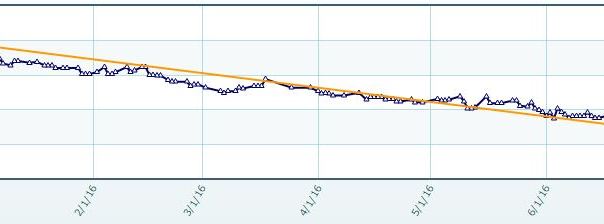
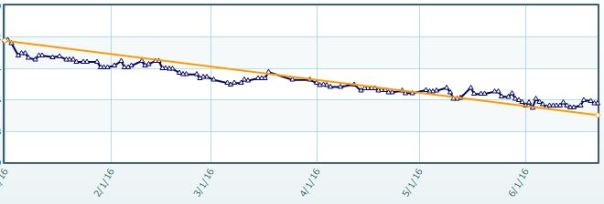
Next is what this can look like – this is my graph of weight loss since January 1.The blue line notes my recorded weights and the orange line is the trend line I was given based on my goal and time-frame – ah, I think I found THEM! (And see, they are telling me what I “should” do!)

actual

Notice that when you zoom out to look at the big picture, there has been an overall loss. Notice too that when you zoom in to look at a few days at a time, there are times where my weight went down steadily and also where it went up. There are some times that are just up and down and up and down. When you do the math, I’ve averaged a 0.75 pound loss a week. I know a lot of people who would also be upset if they lost that small amount of weight in a week.

I’m not upset because it’s slow. It’s slow because I like Food Truck Fridays… and I’ve been spending more time on Yoga (love!) than Cardio…. and sometimes I’m hungry and tired and surf the couch while other times I’m satiated and energetic and active… and I’m not planning on any of that changing anytime soon.

It’s slow because I prefer to work on a healthy comfortable and enjoyable relationship with food and activity instead of an unhealthy restrictive controlling guilt-ridden relationship.

My hope with this post is to help you appreciate your efforts and be kind to yourself and to relax a little with the scale and numbers and restrictive behaviors. Unfortunately, I know that no matter what I say or write, only YOUR thoughts can change your thoughts. My words can only trigger a little sparkle of a new way to think – a little sparkle that I hope you grow into a great big glowing ball of awesomeness.

Because that’s what you are. One great big glowing ball of awesomeness.

Now, who wants to go get some of that ice cream?