Category Archives: Snacks

Are Kodiak Cups Good For A Quick Breakfast?

Updated 03/04/2025. If you need a healthy on-the-go breakfast, you may be wondering… are Kodiak Cups good for a quick breakfast? When I first saw these breakfast cups back in 2020, this kind of convenience food was still fairly new. Add water, microwave, and eat! Why, yes, I think maybe these Kodiak Cups are good for a quick breakfast!

I do want to say thank you to Kodiak Cakes for the RD Kit containing these free products for me to sample. I have not been paid or encouraged to post any kind of information in exchange for these samples. You can see on my disclosure page that I give honest reviews of products and would never let receiving a free product influence my review.

I encourage a balanced breakfast to get the day started – protein, carbs, fats, alla them. But mornings can be hectic. I hear from my patients that fitting in a healthy, balanced breakfast can be a challenge. They don’t have time in the morning to eat breakfast, let alone make one! Life is busy. I get it.

If you like to meal prep, then the problem is solved. But what about those who just aren’t into meal prepping? (No shame!). More and more products like this are hitting the shelves because food manufacturers know we want convenience.

So, let’s put on our nutrition detective hats and explore.

If you have heard of the brand, Kodiak, then you know that higher protein is kinda their jam. And higher protein in grains gets my interest as I’m an occasional macro-tracker. Protein has been having its moment for a long minute now, as it should because protein is important for so many reasons. (Get my take about The Beef on Protein).

I tried the Kodiak oatmeal first and was happy to see they sent the best flavor: maple and brown sugar. (Fight me).

In terms of ease of breakfast, this is a big winner.

I used my electric tea kettle to heat water, added it to the Kodiak Cup, and let it sit covered for the recommended two minutes. You can also add water and microwave. It doesn’t get much easier – or quick – than that.
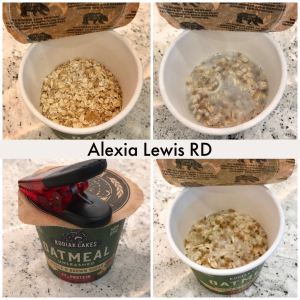
Straight up. I was super concerned about the very small portion, especially since it has about half of the calories of my typical breakfast. But this little cup of oatmeal kept me full until lunchtime. Totally surprised!

This has 230 calories, 14 grams protein, 38 grams carbs, and 3 grams of fat. It has 4 grams of fiber, 12 grams of added sugar, and 200 milligrams of sodium.

I wouldn’t expect a lot of protein from oatmeal and that tracks here. I often recommend adding protein when oats are for breakfast. This can be done with protein powders, as in this product where protein was increased with pea and milk proteins, or with whole foods, such as an egg/egg whites. PS: I have a great pina colada overnight oats recipe.

This also may seem like a lot of carbs to some; but it is oatmeal, soooooo… and 38 grams if completely appropriate for many people. When it comes to grains, always look for a product that has a whole grain as the first ingredient – which this one does.

I’m not one who is afraid of long complicated words on an ingredients list but this one keeps it very simple and I’m sure many “clean eaters” would give this product a thumbs up.

Btw, my definition of clean eating is not eating food that’s fallen on the floor. Just sayin’.

Pros:

  • First ingredient is 100% whole grain oats.
  • Very low in saturated fat (0.5 grams).
  • Super convenient.
  • Good flavor and good consistency, and no aftertaste.
  • Staying power.

Cons:

  • Low in protein (for a meal).
  • High in added sugars.

American Heart Association recommendations for added sugars is set at 25 grams for women and 36 grams for men. At 12 grams, this is 1/2 to 1/3 of the total recommended. I like to find ways to make convenient food fit if it can help people eat in a way they want to. So, this absolutely can fit into a heart-healthy diet as long as you are mindful about added sugars for the rest of the day.

And, personal preference here, I’m not a big fan of pea protein due to a not-too-fun experience involving veganism and pea protein in oatmeal. I’m sure it’s come a long way since then.

Overall thoughts?

Two Forks up! This is delicious, filling, and is heart healthy.

Next, I tried the Cinnamon Maple Flapjack Kodiak Cup.

This serving size made my eyes much happier as it filled up more of the container. But it wasn’t as filling as the oats. Go figure.

It smells amazing and has a good crumb; but I do recommend a spoon instead of a fork as it ends up getting very crumbly as it is eaten. Per my husband, this tastes like smushed up pancakes (count me in!) and it is true the finished product was a little bit dense.

This has 260 calories, 19 grams protein, 39 grams carbs, and 7 grams of fat. It has 3 grams of fiber, 14 grams of added sugar, and 340 milligrams of sodium.

This one is also lower in calories than my typical breakfast, so I added some butter, which made it taste even better. If you’re looking to add calories, you could also add some syrup (but it totally isn’t needed) or top it with an egg.

As with the oats, this is a bit low in protein and high in carbs and this is to be expected from pancakes. Same advice applies here as did with the oats – more protein!

The ingredients list is longer, and the first two ingredients are whole grains. This would likely pass the “clean eating” test for some.

The pancakes do have eight times as much saturated fat as the oatmeal, coming in at 4 grams. The saturated fat here comes from the palm, palm kernel, and palm oil. My guess is that since unsaturated fats are less stable and go rancid more quickly, they balanced out the need for shelf stability with the desire for a nice nutrition profile and landed on saturated oils instead of others.

American Heart Association recommendations for saturated fats puts the maximum intake at 6% of total calories. Using the reference standard on nutrition facts panels of 2,000 calories a day, that comes to 13 grams a day. That puts this product at 1/3 of your saturated fat for the day.

Just like added sugars (btw this one has more than the oats), this can fit into a heart-healthy diet as long as you are mindful about how you eat the rest of the day. I would encourage plant-based eating to keep saturated fats low. Get my suggestions for three plant-based whole foods to boost the protein in a plant-based diet.  

Pros:

  • First two ingredients are whole grains.
  • Tastes good and has a nice crumb like a pancake should
  • Super convenient.

Cons:

  • Low in protein.
  • Higher in saturated fat and added sugars that I would like.
  • Didn’t hold me as long.

Overall thoughts?

One Fork up! Just one because it didn’t hold me until lunchtime.

I will also say a big pro for both of these is the portability, which means you can eat them when you first get up or bring them into the office or when you’re out on the go.

Yes, this dietitian Kodiak Cups are good for a quick breakfast! Just add an egg, okay?

Give these a try and let me know what you think!

Curious about balanced breakfasts that will work for you? Want some help with finding recipes or strategies to meal prep your breakfast? (PS – you don’t have to a whole week at a time!).

Let’s do it!

Click right here to get to Alexia’s provider page with Nourish, choose a date/time and start the scheduling process.

One of the first screens when you start will let you know if your health insurance is accepted by Nourish. Before you finish the booking process, you will enter your insurance information into the Insurance Calculator to get an estimate of the expected costs. If you don’t like the number, just cancel out and you won’t be scheduled.

And, of course, you can reply to this email if you have questions or want to be hooked up with another amazing RD at Nourish. I’m happy to help! 

Graphic with image of Alexia.

Hi there! I’m Alexia and I believe in science, humor, and delicious food.

Heart health is my jam. I love to write and speak publicly on this topic and all aspects of living a heart-healthy lifestyle.

I believe you shouldn’t sacrifice your mental health in pursuit of better physical health. You deserve to be both happy and healthy. You don’t have to choose just one.

I am a master’s level nutritionist who is also a registered and licensed dietitian in multiple states in the USA, a certified personal trainer, and certified health coach. I also invested in becoming a culinary nutritionist and weight management specialist. In other words, I got you.

Does An Apple A Day Really Keep The Doctor Away?

In honor of American Heart Month, we are celebrating apples for heart health! Check out our newest recipe (Cinnamon Roasted Apples) and read on to learn why affordable, delicious apples are a great choice for your health and how to always pick the best apple from the bunch.

First, where did this “apple a day” idea come from?  The expression originated in the United Kingdom, specifically, Pembrokeshire in Southern Wales. The original proverb was “To eat an apple before going to bed, will make the doctor beg his bread.” We found record of it first being published in the February 1866 edition of Notes and Queries magazine.

apple-a-day

While there wasn’t really research done on apples way back then, they got it right about the possible health benefits of apples. Research shows many possible health benefits associated with apples due to some of the wonderful little phytochemicals (plant compounds) that are found in apples. For example, apples have:

  • Phenolic Compounds which may have antimicrobial properties and are associated with reduced risk of tooth decay
  • Flavonoids (specifically quercetin) which is associated with reduced risk of lung and colorectal cancer
  • Pectin, phytosterols and polyphenols which are associated lowering cholesterol levels which can reduce risk of cardiovascular disease
  • Flavonoids which may improve endothelial function (basically the ability of your blood vessels to expand and contract when they are supposed to) in people who are at risk for cardiovascular disease – which may reduce their risk for cardiovascular disease

So, yeah. apples, which happen to be the 2nd most eaten fruit (yay!) pack a powerhouse of nutrition-rich, health-promoting goodies!

All this being said. Please don’t rely on apples when you need to visit the doctor! 

Good news – apples are available year-round and believe it or not, every single state in the USA grows apples. This could be thanks in part to Johnny Appleseed (remember him?) who planted apple trees on his trek as the United States were settled. And we are happy he did as the crabapple is the only apple native to North America.

Let’s talk real life here. You’re in the grocery store and looking at a huge selection of different types of apples. How do you know which apple to choose?

Well, we always say the best choice is the one you enjoy the most, so feel free to grab your favorite type of apple and call it a day!

After that, look to your food budget… which brings more good news: apples are affordable. If your food budget is your main concern, choose the least expensive type of apple.

If you want more details though…

In terms of picking out a good-quality apple, select ones that are firm, show no signs of bruising or decay, and don’t have broken or shriveled skin.

Great tasting apples should be ripe when picked, to maintain consistent flavor, texture, and make them last longer. You can speed up ripening by leaving them at room temperature, then store in the refrigerator when they are ripe.

There are many varieties of apples, each variety with its own distinct characteristics. For example, the Red Delicious, is excellent eaten fresh or in a salad, but does not do well in roasting. Some apples that are good for baking and/or roasting are the Fuji, Gala, Golden, Granny Smith, and the Rome Beauty. Click for more information on the different types of apple varieties and what they are best suited for.

Nutritionally:

One medium apple has just under 100 calories, 25 grams of carbohydrates, 4.5 grams fiber, and 14% of the daily value for Vitamin C. It has no fat, very little protein (1/2 gram), no cholesterol, and only 2 mg of sodium (yes, natural foods have sodium – check out our series of videos on salt!).

Don’t peel your apples! Pectin and about 2/3 of the nutritional goodness (fiber and antioxidants) are in the skin. Also, be careful when juicing. There are approximately 2 1/4 apples in an 8-ounce glass of juice so you can really get a lot of calories and natural sugars by juicing and won’t register fullness the same way you would if you ate 2 apples.

The N.E.W. Motivation Coaching criteria for heart healthy foods includes (1) has fiber, (2) low saturated/trans fat, (3) low sodium, (4) low added sugars, and (5) not too high in calories. Apples are a perfectly heart-healthy choice!

Post a comment and let us know your favorite type apple or apple recipe! We are partial to the Honeycrisp variety and love us some good apple pie… and our Recipes Page has our Cinnamon Roasted Apple recipe which mimics the flavor of apple pie! YUM!

This blog was researched and written by Millie Yeamans, UNF Nutrition Student and edited by Alexia Lewis RD. We support RD2BE students!

Have-you-had-an-apple-today

References:

  1. The Meaning And Origin Of The Expression: An Apple A Day Keeps The Doctor Away. Phrases.org.uk. https://www.phrases.org.uk/meanings/an-apple-a-day.html. Accessed February 13, 2018.
  2. Kalinowska M, Bielawska A, Lewandowska-Siwkiewicz H, et al. Apples: Content of phenolic compounds vs. variety, part of apple and cultivation model, extraction of phenolic compounds, biological properties. Plant Physiol Biochem. 84 (2014) 169-188. http://dx.doi.org/10.1016/j.plaphy.2014.09.006
  3. Boyer J, Liu RH. Apple phytochemicals and their health benefits. Nutr J. 2004;3:5. https://nutritionj.biomedcentral.com/articles/10.1186/1475-2891-3-5/.
  4. Bondonno N, Bondonno C, Croft K, et al. Flavonoid-rich apple improves endothelial function in individuals at risk for cardiovascular disease: a randomized controlled clinical trial. Mol Nutr Food Res. 2018 Feb;62(3).  https://www.pubfacts.com/detail/29086478/Flavonoid-Rich-Apple-Improves-Endothelial-Function-in-Individuals-at-Risk-for-Cardiovascular-Disease
  5. Drake BH, Shertzer JK. Selecting, Storing, and Serving Ohio Apples. https://ohioline.osu.edu/factsheet/HYG-5507. Published February 25, 2010. Accessed February 13, 2018
  6. McWilliams M. Fruits. Food Fundamentals. 10th ed. Pearson Education; 2014:120.
  7. Commodity Apples. https://www.agmrc.org/commodities-products/fruits/apples/commodity-apples. Accessed February 14, 2018.
  8. Apple Facts. https://extension.illinois.edu/apples/facts.cfm. Accessed February 14, 2018.
  9. Apples, raw, with skin. http://nutritiondata.self.com/facts/fruits-and-fruit-juices/1809/2. Accessed February 14, 2018.


For the Love of Pumpkin!

Why do we have such a fascination with pumpkin every autumn? Could it be the childhood memories of pumpkin carving, roasting pumpkin seeds, and the fun of dressing up for Halloween to go trick-or-treating? Or could it be the bombardment of some delicious pumpkin goodies being brought back on the market – hello PSL and Pumpkin Spice Cheerios – I see you!


I am firmly in the pro-pumpkin camp and will share some tidbits from an article I wrote way back in 2012:

Choose a pumpkin that is firm and has no visible damage or soft spots. The whole vegetable can be stored for months in a cool, dark, dry place. There is no need to refrigerate your pumpkins; they keep best around 55 Fahrenheit. Once you cut the pumpkin, however, it begins to deteriorate and only lasts a couple of days.

Pumpkin is a low calorie, fiber-rich, and nutrient-rich starchy vegetable. (Sorry my low-carb friends – pumpkin does not fall into the non-starchy veg category!) Pumpkin rates as a nutrition rock-star due to its vitamin A content. This is from the pigment, beta-carotene, which is a precursor to vitamin A and gives pumpkin its orange color. Vitamin A promotes healthy eyes and vision and is involved with immune function and reproduction. It appears that vitamin A reduces risk of certain cancers in non-smokers and may slow vision loss associated with age-related macular degeneration. While there are concerns with too much vitamin A from supplements, beta-carotene has no adverse health effects except for a change in skin tone to an orange hue. This could be an advantage if you find yourself without a costume for Halloween…

Seeds are typically packed with vitamins and minerals and pumpkin seeds do not disappoint. If you have the calories to spare, you will also get a hefty amount of magnesium, phosphorus, copper, and zinc (all over 50% DV) as well as 25% DV of iron. Only 5 of the 28 grams of fat is saturated fat and there is no trans fat.

My company – N.E.W. Motivation Coaching – is hosting a Pumpkin Love Make & Take Workshop next week and I would love to have you join us if you are local!

Whatever the reason, pumpkin is a delicious and versatile addition to your meals and snacks. And I’m not just talking baked pumpkin deliciousness like pumpkin pie or pumpkin breads… I’m talking some new ways to add pumpkin to your plate with a Pumpkin Vinaigrette, a Pumpkin-Nilla Chai Smoothie, and Pumpkin Power Bites!

Pumpkin-Love

Recipe: Coco-Choco-Chia Pudding (Gluten-Free!)

We are so excited about publishing our first Celiac Disease ebook that we are sharing gluten-free recipes in advance of our gluten-free focused special deals for October! First up is a coconut, chocolate, chia seed pudding. So much yes!

This is one of three gluten-free, treats (snacks or desserts) we are showcasing at our next Make & Take Meal Prep Workshop but we love it so much we are sharing it with you here too. By the way, this recipe is also dairy-free and vegan! And yes, it can be all these things and still delicious!

coco-choco-chia-pudding

If you want to also learn to make Peach (or Pineapple!) Cheesecake and the Peanut Pecan Dream, we invite you to join us at the October 13, 2017 workshop (or see Upcoming Events to find the next workshop!) where you get to make three gluten-free, healthy, and delicious desserts – that can also fit in as a great afternoon snack – and take four meal-prepped treats home with you.  You will get the recipes and learn about what makes these treats a healthier option and what’s really going on with sugar and your health.

Yes, I said healthy AND delicious. I mean, where else can you get 10 grams of fiber, 20% of the Daily Value (%DV) for Vitamin D, and 50% of the DV for calcium in a dessert!?? This is one treat you can feel good about giving your little ones (or enjoying for yourself!) because this sugar comes with some solid nutrition as well!

Without further ado – here is the recipe! Click for printer-friendly PDF!

Coco-Choco-Chia Pudding

A Mason Jar Meal-Prep Workshop Recipe by Alexia Lewis RD / N.E.W. Motivation Coaching

Makes 1 serving

INGREDIENTS & SUPPLIES

 1                        Mason Jar, 1-cup size

3/4 cup           Almond milk, dark chocolate

2 Tbsp             Chia seeds

1 packet          Alternative sweetener

1 Tbsp             Coconut, shredded, no sugar added

1 pinch            Salt

2 Tbsp             Coconut whipped topping

DIRECTIONS

1.      Measure all ingredients except coconut whipped topping into blender

2.     Blend for 30 seconds

3.     Pour mixture into mason jar

4.     Top with whipped topping

5.     Close jar tightly and store in refrigerator until ready to eat (up to 3-5 days)

NUTRITION PER SERVING

250 calories, 14 g fat (5 g saturated fat, 0 trans fat), 0 mg cholesterol, 275 mg sodium, 30 g carbohydrates, 10 g fiber, 15 g sugar, 5 g protein plus 50% DV calcium and 20% DV Vitamin D

NOTES

This will have a slightly “gritty” texture due to grinding the chia seeds, you can skip grinding (and skip alternative sweetener) but you should refrigerate 2 days before serving or pudding will be much more liquid. 

Reduce added sugar/carbohydrates by using unsweetened almond milk plus 1 scoop chocolate protein powder.


If Hunger is the Problem, Food is the Solution

Yesterday I was so hungry. I wanted to snack my way through my afternoon. I am working on weight loss so how much I eat is a factor. I try to eat enough food to fuel my body without eating more than I need at any one time.

Here’s the question – a person is working on weight loss and is hungry in the afternoon, what should they do?

Some common answers might be:

  • Ignore it, the hunger will pass
  • Drink a huge amount of water to fill up your stomach
  • Eat a snack pack bag of carrots (low calorie) or a boiled egg (protein) and then stop
  • Give up, go off the diet, feel bad, pledge to start again tomorrow

I’ve heard all these answers in practice and they don’t address the problem in a realistic way. There is a mindful eating saying that if hunger isn’t the problem, food isn’t the solution. (Read that again). So true and if I were bored or pissed off, then food wouldn’t be what I needed. However… I was hungry!

Isn’t the flip side of that saying: If hunger is the problem, then food is the solution?

Here’s the thing, our bodies are not steady-state machines in terms of how much energy (calories) they need each day because we don’t ask our bodies to do the same things every day AND all those inside workings are different day-to-day (immune responses, stress, etc.).

Some days, I may not need much food; my hunger will be low and I should take advantage and eat less if weight loss is my goal. As long as I ensure adequate nutrition that is – please don’t eat less than your BMR!

Other days, I may need more food (energy) and my body will let me know it’s hungry and so I should… well, according to the answers above… I should ignore that and eat by my plan. I should deprive myself, tell myself I’m a failure if I eat in response to hunger, fight through it because weight loss is hard and this is expected. I should basically spend the afternoon fighting a mental war between my body and mind.

Um, no. Why be so unkind to yourself?

Here’s the question again – a person is working on weight loss and is hungry in the afternoon, what should they do?

Eat.

Simple. Easy. Honoring your body and loving yourself.

First, check in and make sure the hunger physiological. If it is, then FEED YOUR BODY!

Here’s how this dietitian handled a ravenous appetite:

  • A handful of fresh cherries and about a cup of fresh blackberries. Wait. Still hungry.
  • Add protein. A fresh apple with a little tub (3/4 oz. or a heaping Tbsp.) of peanut butter. Wait. Still hungry.
  • Add protein / healthy fat. Pecans, Just under an ounce. Wait Still hungry. Are you kidding me body???
  • Bring out those carbohydrates. A Flatout with 1 Tbsp. of light olive oil butter, a sprinkle of Splenda, cinnamon. Wait. Finally satiation! No more hunger!

I added nearly 600 calories in snacks yesterday and that put my total calories up a little higher than usual. So what? I ate to satisfy my hunger! Nutritious choices = more food! Choosing a convenience crispy-crunchy or chocolately snack would not have satisfied my hunger. I instead made nutritious choices and got to eat a whole lot until I felt satisfied.

Are you shaking your head at me and saying: I bet you put on weight by giving in to your cravings and eating all that food. Nope. I weigh in every morning and I’m up 0.2 lbs this morning, which is 100% water-not-weight variation. If in doubt, see my last post: Weight Loss: A Long and Winding Road.

The moral of my story is – feed yourself when you are hungry and do it with healthful choices.

(Image for blog from: https://memegenerator.net/)

Bag Full of Heart Healthy Foods

No More Excuses for Fast Food!

I get it. You’re busy, you’re tired, you don’t have time for meal planning, grocery shopping, meal prepping. You think your only option is that fast food drive through or the quick convenience restaurants.

I completely disagree.

We are ALL busy, tired, and don’t have free time to do all that planning and preparation. You have no less hours in your days that anyone else. You have chosen how to prioritize your time and to what and whom you give your time and effort. I’m not trying to make you feel any certain way but I can already hear your reasons that it’s not your choice and there is nothing you can do to change it.

Perhaps that is true for some people. I’ve been a caretaker for a family member going through a multiple year crisis and I found myself not taking care of myself at first. After devoting all my energy to care-taking, I realized I needed to take care of me too and I found a way to fit it in. (Anyone else ever walked the parking garage stairs and levels at a hospital? Yep, me too).

The thing is – we pay for our choices one way or the other. We pay in dollars and health when we routinely eat most choices available for a quick lunch (and we save time and effort). We pay in time and effort spent every evening or in a block of time on the weekends to meal plan, shop, and cook dinner (and we save our health and dollars). You get to decide which is more important for you in this moment.

The good news is that YOU have the power to shift your schedule and priorities. Maybe not completely; but I challenge you to find ONE SMALL THING over which you have control and can make a change.

Trust me – you’ll feel better if you do. 🙂

So, to help you realize that you DO have some control to choose something simple – like a healthier lunch or snacks – I bring you my “I’m-starving-and-have-nothing-to-eat-for-lunch” list for the grocery store. These are grab-and-go meals and snacks that you can choose instead of a fast food meal. (Spoiler alert – that fast food salad likely has more calories and less nutrition than the bacon cheeseburger).

  • Lunch?
    • Tuna (or salmon packet or packaged grilled chicken strips) mixed into prepared green salad (from produce section) with dressing of your choice
    • 1 whole wheat roll with sliced meat and cheese (all from the deli so you get only what you need!) plus a mustard packet and box of high-fiber crackers
      • Bonus – now you’ve got crackers to stash at your desk for snack-time!
    • Sushi roll with edamame (if store has this option)
    • Diced fruit and nuts on cottage cheese (major yum!)
  • Going back to the office?
    • Frozen dinner and steamer bag of vegetables (no sauces please)
    • Can of low-sodium soup plus green salad (from produce section) with dressing
  • Snacks?
    • Cheese stick with those crackers you stashed in your desk
    • Chopped fruit from produce section with a handful of nuts
    • Yogurt with Grape Nuts (really, don’t spend money on “granola” or “trail mix” as Grape Nuts give you the crunch without added sugar or ridiculous price!)
    • Apple with peanut butter (single packs are now sold! Try the natural no-sugar-added kind)

Oh, and do yourself one more favor and just grab a simple, cold, refreshing bottle of water (or fill up your bottle!) on your way out of the store.

Tell me  your other ideas and tricks for eating healthy when crunched for time?


Cilantro!

And We’re Live!

Welcome! Today is the day I officially launch my Web site. (Wow that was a long time ago!)

To celebrate the occasion, I have just posted a cooking demonstration showing you how to make “mom’s homemade salsa” which makes a great snack or can be used in other recipes. You can find the video on my “Cooking Videos” page or on my YouTube page which is linked from the “Follow Me On…” page.

Please help me spread the word by sharing my site with others. I welcome all feedback so let me know if I help you with “nutrition made easy.”

Thanks!
-Alexia

Ready to cook!
Ready to cook!

Muffins Ready for Baking

Veggies In Dessert – Eggplant Chocolate Chip Muffins

If you missed my segment on First Coast Living, you can watch me talk about Veggies in Desserts by choosing the tab for Food (click the right arrow to see more tabs) and then scrolling  to Wednesday September 26th UNF Nutrition.

I showcased three desserts during this segment: Red Velvet Beet Cupcakes (see previous blog post), Eggplant Chocolate Chip Muffins, and Black Bean Brownies. As I mentioned, none of these recipes were my creation and you can find them at these links:

Red Velvet Beet Cupcakes

Eggplant Chocolate Chip Muffins

Black Bean Brownies

The main points from my segment were:

1. Add vegetables to your day in any way you can!

Americans do not eat enough vegetables. The recommended amount for generally healthy adults is 2-3 cups per day and data shows we are eating 1.5-1.8 cups/day (2004 NHANES)! Sneaking vegetables into desserts can help us to baby-step our way towards the recommended daily amount – remember, it’s still dessert so it won’t get you all the way there!

2. Use vegetables to increase the nutritional content of your favorite desserts by reducing calories and fat, increasing fiber, and adding vitamins.

3. Methods (not covered in segment)

If using a puree, replace half of the fat with the puree. If it’s a liquid fat (oil) use 3/4 the amount that you are replacing and if it’s a solid fat (butter), use 1/2 the amount you are replacing. Reduce the oven temperature or check sooner than the recipe calls for or it might over-bake.

If using chopped vegetables, some have a high water content so you may need to reduce the other liquids in the recipe.

Now, on to my favorite of the three recipes – the eggplant chocolate chip muffins!

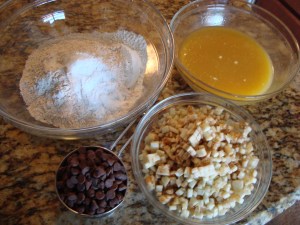
Start by making sure you have all the ingredients you will need on hand.

Ingredients for Eggplant Chocolate Chip Muffins

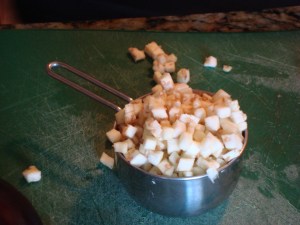
Next, figure out how to chop that eggplant! Here’s a suggestion, start by cutting into smaller sections with straight edges so the vegetable will sit flat when you start chopping.

How to Chop Eggplant

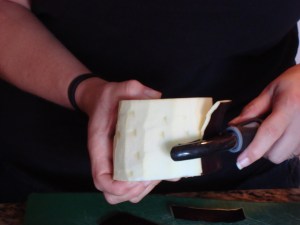
Now, peel the eggplant. Honestly, when I make my second batch of these muffins today (yes, they are that good!) I will not peel the eggplant and see how that goes… but the recipe called for peeling, so I did.

How to Chop Eggplant

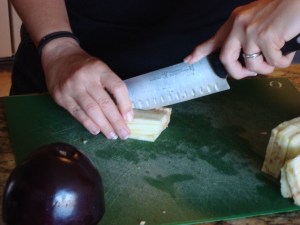
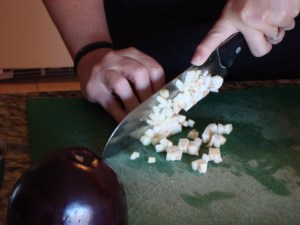
Finally, chop the section in half (again to give you a flat edge for safer chopping) and make smaller and smaller cuts. These pictures show going from the whole section, to half the section, to slices, to matchsticks, to a small chop.

How to Chop Eggplant

How to Chop Eggplant

How to Chop Eggplant

How to Chop Eggplant

How to Chop Eggplant

Finally - Chopped Eggplant!
Finally – Chopped Eggplant!

Moving on to the other ingredients, you will end up with four bowls of goodies. Top left is the flour mixture, top right is the butter mixture, bottom left is the chocolate chips, and bottom right is the chopped eggplant.

Ingredients Ready to Mix

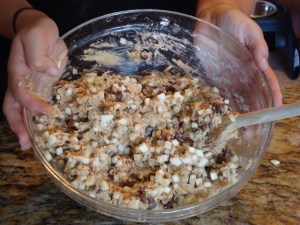
The beautiful thing about making muffins is that it is so easy! Simply make a well in your flour mixture (dry ingredients) and add your liquid ingredients. Be careful how much mixing you do! Gluten develops quickly once liquid is added to flour so you want to mix as LITTLE as possible while still combining the ingredients so there are NO DRY SPOTS of flour. Then fold in the extras (chips and eggplant) and mix just enough to distribute those extras throughout the batter. The mixture should be lumpy!

The Perfect Muffin Batter is LUMPY!

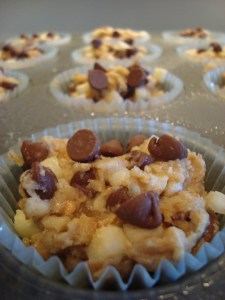
This recipe yields 24 muffins. Here they are before going in the oven

Muffins Ready for Baking

And after! YUM!

Eggplant Chocolate Chip Muffins

Compared to store-bought chocolate chip muffins, these have 50 less calories, 4 grams less fat, double the fiber, and we’ve added vitamins A and C.

Per muffin:

Calories 180
Carbohydrates (g) 26
Protein (g) 3
Fat (g) 8
Sat Fat (g) 3
Trans (g) 0
Cholesterol (mg) 30
Sodium (mg) 170
Fiber (g) 2.1
Vitamin A 3%
Vitamin C 7%
Calcium 2%
Iron 4%

Original publication date: September 30, 2012 at http://newmotivationcoaching.blogspot.com.

Cooked Cupcake - Look at that Grain!!

Veggies in Dessert – Red Velvet Beet Cupcakes

Did you know it’s “Fruits and Veggies – More Matters” month?

I’m doing a media spot this month and decided to focus on sneaking in more vegetables by using them to create desserts. My first adventure in the kitchen was red velvet cupcakes made with beets. I’m happy to report no red stains anywhere in my kitchen from the beets!

The recipe is from: http://www.dominosugar.com/recipe/beet-red-velvet-cake-7560 with no alterations. I did add store-bought cream cheese icing because making these cupcakes – which is more like making cake than muffins – was enough for one day.

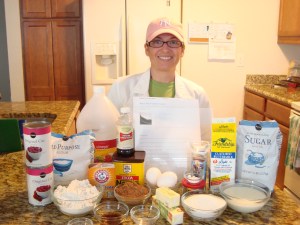
Lab coat, check. Hair back, check. Hands washed, check. All ingredients on hand and measured, check. And we are ready to go!

Ready to Bake!
Ready to Bake!


Step 1: Cream sugar and butter. Note that a husband with strong hands is helpful for this step!

Creamed Butter and Sugar
Creaming Butter and Sugar is Easiest with a Fork


Step 2: Add eggs

Egg in Creamed Butter and Sugar

Other bowls of goodness ready. Note that if you don’t have a sifter, you can use a wire mesh strainer. I did this and it sifted beautifully. Top left: flour mixture. Top right: sugar, butter, eggs mixture. Bottom left: buttermilk mixture. Bottom right: pureed beets – pretty!

Ingredients for Red Velvet Beet Cupcakes Ready for Mixing!


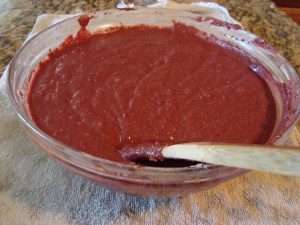
Once mixed together = big bowl of batter and a wooden spoon that will probably always be slightly reddish…

Red Velvet Beet Cupcake Batter


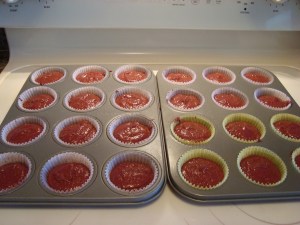
The recipe does indeed make 24 cupcakes

Ready to go in the oven

These have a nice moistness and grain but are not as red as conventional red velvet cake (even with sneaking a few drops of red food coloring in the batter…shhh!)

Cooked Cupcake - Look at that Grain!!
Cooked Cupcake – Look at that Grain!!

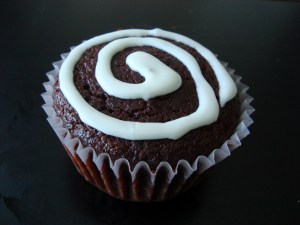
And the final product with the icing, which I will be bringing into work tomorrow to share!

Red Velvet Beet Cupcake with Icing


These are husband-approved, so you know they must be good, and they sneak in a vegetable that many people dislike in it’s pure form. Simply by making the vegetable into a puree, you can add beets to your diet! Next is the nutrition information as compared to a store-bought mix for red velvet cupcakes. The rows in pink are where the biggest nutritional changes are seen.

Red Velvet Beet Cupcake Nutrition Info

Original publication date: September 16, 2012 at http://newmotivationcoaching.blogspot.com.

How To Be a Healthy Snacker

A large snack of cookies and milk
 

I am a snacker.

I typically do not leave the house without two things: a snack and my water bottle. Snacking used to have a bad reputation. The standard American diet consisted of three square meals a day, not snacks. Snacking was linked in people’s minds with overeating and weight gain. It was a bad thing to do.

Oh how things have changed. Snacking is no longer the exception, it is now the norm and it may help people to lose or maintain their weight.

I got to thinking about this because I came across an article entitled “Frequent Snacking Linked to Healthier Diet” (1). This article reports on a five-year study of over 11,000 people aged 20 and over which found that snackers consume more healthy foods such as whole grains, fruits, and milk products and less high-sodium foods. Well, it sounds like snackers do have healthier diets! As one reads on, the study also reported that snackers also consumed more sugar, solid fats, and alcohol along with fewer vegetables. Hmmm. Finally, the article reports on another study in a younger population (teenagers) that found that teen snackers also consumed more fruit and dairy products.
Another study on snacking from the November 2011 issue of the Journal of the American Dietetic Association (2) looked at women in the 30-60 age range and grouped them by BMI. The study found that normal weight women had the highest number of snacks (2.3 snacks/day), followed by those who had lost weight and were maintaining that loss (1.9 snacks/day), followed by those who were overweight (1.5 snacks/day).

This all seems to point to the fact that snacking may actually be beneficial in terms of BMI as long as we choose healthy snacks.

But is there a downside?

Let’s say that we eat a snack that includes carbohydrate-containing foods, such as fruit, milk, or grains. For most people, it takes 1 to 2 hours for all consumed food to move through the stomach and reach the small intestine where nutrients are absorbed. Absorption of glucose (blood sugar) from the carbohydrate-containing foods triggers the hormone insulin, which is needed move glucose into our cells for use.

If we graze all day or have large snacks of carbohydrate-containing foods in between meals, we are asking our bodies to continue to release insulin and our insulin levels do not have time to go back down in between meals. On the flip side, if we eat three big meals a day, we see a big spike of glucose after that big meal and we may overload insulin’s ability to be effective. Both overloading our insulin with high levels of glucose at one time and having constantly elevated insulin levels can lead to insulin resistance and potentially to type 2 diabetes. Insulin also promotes energy storage – in other words, it makes our bodies store fat.

What’s a snacker to do?

It sounds like moderation and balance are the keys. I think we have heard that somewhere before. Here are some guidelines to help you keep your snacking healthy.

1. – Respect your body and eat when you are physically hungry. If your stomach is grumbling and you have been drinking your water, then it is time to eat something.

2. – Pick your snacks wisely. Focus on healthy foods such as fruits and vegetables, low-fat dairy, whole grains, and lean proteins. If you decide to have a “fun food” for a snack, then pay attention to the next point!

3. – Watch your portion size. A snack should not be the same as a meal in size or calories.

As always – enjoy your food!

Original publication date: December 4, 2011 at http://newmotivationcoaching.blogspot.com.

References

1. Frequent Snacking Linked to Healthier Diet. Today Health Web site. Available at: http://today.msnbc.msn.com/id/45307103/ns/today-today_health/t/frequent-snacking-linked-healthier-diet/

2. Bachman et al. Eating Frequency is Higher in Weight Loss Maintainers and Normal-Weight Individuals than in Overweight Individuals. Available at: http://www.adajournal.org/article/S0002-8223(11)01376-9/abstract

3. Image from http://office.microsoft.com/en-us/images.