You may know that I’ve had a private nutrition practice. If not, I do. Well, I did. The business is called Keeping Healthy Simple Club® and it has been partnering with people to help them live a heart-healthy lifestyle since 2021. And things are changing in 2025.
We are no longer accepting private practice or worksite wellness clients. In other words, the doors are closing after four amazing years. You can get more information here, and individuals can still work with me through Nourish.
I have loved every minute of working with my clients – individuals and businesses – to help people live healthier lives. Now, I’m ready to focus on more personal endeavors.
But wait – that still includes sending you health and wellness tips. YAY! I mean, you know I love to write, right?
So, let’s get on with it!
It’s been busy! Hubs and I moved to a new town in October and have been settling in during November. So, we have been leaning in to pre-made meals. And I’ve got tips for how to make these pre-made meals healthier so you can fit these in on your busy evenings.
Plus I’m sharing 4 holiday tips that I’ve been sharing with my coaching clients.
Yours in good health, Alexia Lewis, RD No longer Keeping Healthy Simple Club ® Now just Alexia Lewis Health and Wellness
What’s On My Table This Month
Ever wondered what a dietitian eats? Surprise! It is not only super-healthy foods. This dietitian eats for nutrition and for pleasure. You can too.
Pre-Made Meals
Did I mention we moved and I’ve been super busy? Yeah, so, I have been on a search for the best pre-made meals. You know, the ones that get delivered and are marketed for bulking up or losing weight?
I’m not super concerned with calories or macros right now, but I do want to get a dinner on the table without much work.
And to be clear, by “without much work” I mean I just want to throw something in the microwave.
And to be clear, by “best” I mean meals that don’t get mushy, taste bland or way too salty, and have meats I can recognize. I am super picky about meats and get to the gross-factor easily.
I have tried Clean Eatz, Modify Health Meals, and Super Fit Foods. I am not in any way affiliated with these companies and they don’t even know I’m writing about them.
My favorite by far is Clean Eatz. I also did like that I was near a store so could pick the weekly meal plan meals up instead of having them delivered. Check to see if there’s a store near you. I’m guessing that helped with the meal quality. These meals are the best tasting and look the most like what I would make on my own. I can’t speak to their delivery meals, but they look very similar.
No matter which meal company you choose, plan to microwave one thing to make these meals healthier.
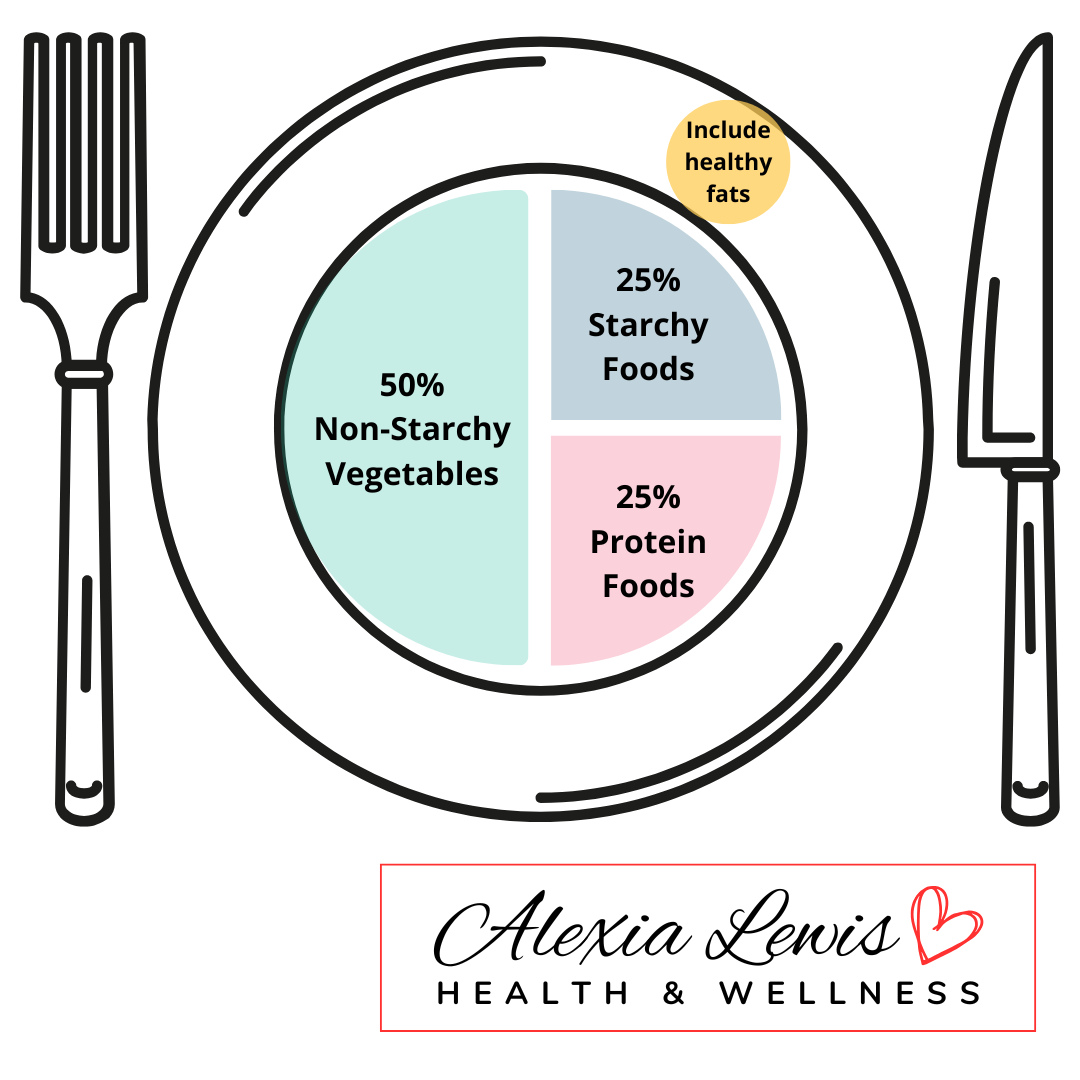
That one thing depends on what you have in front of you. I like to balance my meals with this visual method.
If it’s a low-carb meal, then it’s heavy on the meats and the veggies. To get my plate balanced, I would add a grain. A microwavable rice or quinoa cup is fast and easy.
If it’s not a low-carb meal, then you are likely looking at some meat, grains, and veggies. I like lots of veggies, like half my plate lots, so I would add some more vegetables. A microwaveable steamer bag is fast and easy.
Throw a couple things in the microwave and there ya go. Fast, healthy, and easy meal for those busy nights!
I looked at some other meal plan options but didn’t try them. If you have a meal plan company you enjoy, I would LOVE to know, so feel free to drop a comment or use the Contact form to let me know.
What I’m Coaching On Lately
You can catch a glimpse of what my coaching style is like in this section, where I share some of what I’m working with my clients on.
Holiday Meal and Party Tips
Tis the season! Let me just run down these tips.
First, enjoy your food.
If you don’t turn a few holiday meals into a holiday eating season, then eat whatever you want. For real. Eating 2-6 meals without worrying about what’s on your plate is not going to *poof* make you unhealthy and give you all sorts of chronic health conditions that make your doctor tsk-tsk you. Now, if it’s a season, meaning weeks, of meals like this, we will have a different conversation. And if you need to monitor what you eat closely due to existing health conditions, then this will not apply for you.
Second, survey the buffet.
I don’t have a lot of food rules that I promote. I prefer to help people break food rules and recover from diet/wellness culture. But, one of the few rules I have is don’t eat food you don’t enjoy. Which means that before you put anything on your plate at a meal or party, take a gander down the table to see what your options are. Save space on your plate for things you love (and some veggies, please, just a few!) so you don’t end up with a mountain of food on your plate from taking some of everything. And, if you want some of everything, surveying the buffet let’s you know this and allows you to take a small portion of all the things.
Third, hold something in both hands.
Mindless eating is real. If you are at a party and find yourself standing near the food and munching because it’s there. Then pick up a drink with one hand and your phone or clutch with the other. Now you can’t eat mindlessly. You have to pause to find somewhere to put something down, and this pause is often enough to allow you to make a conscious decision about eating.
Finally, take a walk, or do some form of activity, after eating.
Getting moving activates a secondary system in your muscles that helps take up blood sugar. It also can help you to not feel so full if you overfilled your stomach. And some fresh air does wonders for your mental health (possibly by separating you from people that you love, but totally need a break from!).
Hopefully, these tips can help you enjoy the rest of the holiday season. And that includes the pie!
If you want to work one-on-one with me on your health and wellness, keep reading below…
Medical Nutrition Therapy
Click right here to get to Alexia’s provider page, choose a date/time and and start the scheduling process.
One of the first screens when you start will let know if your health insurance is accepted by Nourish.
Before you finish the booking process, you will enter your insurance information and get an estimate of the expected costs.
And, of course, you can reply to this email if you have questions or want to be hooked up with another amazing RD at Nourish. I’m happy to help!
About Alexia Lewis RD
I believe in science, humor, and delicious food.
Heart health is my jam. I love to write and speak publicly on this topic and all aspects of living a heart-healthy lifestyle.
I believe you shouldn’t sacrifice your mental health chasing better physical health. You deserve to be both happy and healthy. You don’t have to choose just one.
I am a registered and licensed dietitian in multiple states in the USA, a certified personal trainer, and certified health coach. I also investing in becoming a culinary nutritionist and weight management specialist. In other words, I got you boo.
On the table for October is a meal-prep Breakfast Burrito Bowl and the top 5 nutrition recommendations I make for most patients.
Hello beauti-fall people!
I love fall! I love the crispness in the air, the vibrant colors on the trees, and the winter squashes on my table! (I have no idea why I live in Florida where we don’t have much of an autumn season).
Butternut is better than pumpkin.
I said it, I meant it, and I’m bringing you one of my favorite meal prep breakfasts this month. People rave about this Breakfast Burrito Bowl because it is so flavorful and filling. And it features butternut squash, which is why you butternut miss this recipe!
Lately, my work with patients has focused on revisiting the basics of nutrition. What to eat can be incredibly complex when you dive into all the little details about food. What to eat can also be incredibly simple when you focus on the big picture.
Many patients come to me with lots of questions about the details – and for good reason – there is so much nutrition and food noise out there! Those details can absolutely matter and are worth talking about. But… only after the big picture changes have been made.
In this edition, I am sharing my Nutrition 101 spiel, along with the 5 things I usually ask my patients to focus on first.
My hope is these tips can help you too – especially as you start to navigate the holiday season.
PS – If you want to get this goodness delivered right to your inbox, you can subscribe to my newsletter!
Yours in good health, Alexia Lewis, RD Keeping Healthy Simple Club ® Alexia Lewis Health and Wellness
What’s On My Table This Month
Ever wondered what a dietitian eats? Surprise! It is not only super-healthy foods. This dietitian eats for nutrition and for pleasure. You can too.
Breakfast Burrito Bowls
My morning routine is: coffee first, exercise second, breakfast third.
It’s usually around 9:00, when I am ready for breakfast. The time makes it tempting to go straight into work without eating, so I need something that is grab-and-go but also homemade, healthy, and delicious. Meal prep to the rescue!
This recipe is also a winner for those who don’t like breakfast foods.
To make, open up 3 meal-prep or other storage containers and start building your burrito bowl by adding these ingredients to each container:
1/3 cup sliced and cooked Vidalia (or other sweet) onion
1/4 cup chopped Roma (or plum) tomatoes
1/2 cup rinsed and drained low-sodium black beans
1/2 cup cubed and roasted butternut squash
1/3 of a medium ripe avocado, diced
1 teaspoon fresh lime juice
1/8 teaspoon each of garlic powder, cumin, paprika, chili powder (use less if you don’t like spicy), and a dash of salt.
Mix the ingredients within the container to distribute the seasonings.
Top with a cooked egg. Boiled and sliced works well or if you have time you can cook an egg before you eat.
TIP! Butternut is a pain to chop. Consider splurging on the pre-chopped squash!
This recipe can be adapted in so many ways. Change the protein, change the beans, change the veggies. It will all work and transform this recipe into a lunch or dinner!
The nutrition info will vary based on the brands you choose, but one serving (one bowl) comes to about 325 calories, 16g protein, 39g carbs, 13g fat, 3g saturated fat, 139mg sodium, and 13g fiber.
Post a comment with a picture if you make this!
PS – I am not perfect! I don’t always do morning routing step 2: exercise. It’s totally a new habit in the process of being built!
What I’m Coaching On Lately
You can catch a glimpse of what my coaching style is like in this section, where I share some of what I’m working with my clients on.
Going back to the basics has been the focus for many of my patients recently.
So, here are the first 5 big picture nutrition recommendations I make for many of my patients. Below it is information that covers some basics about food and nutrition to help you understand the recommendations, which are:
Meals: Include all three macronutrients and a bunch of non-starchy vegetables.
Snacks: Include a protein and a carb.
Water: Drink it.
Alcohol: Limit or avoid it.
Fiber and Fermented Foods: Eat daily.
Nutrition Basics. What and when we eat can be driven by many reasons: hunger cues to fuel our bodies, social events, cultural norms, and even to soothe emotions. You are allowed to eat any food for any reason, but you must realize that the foods you choose impacts your health and wellness.
Macronutrients are nutrients your body needs in large amounts. They provide energy (calories) and maintain your body’s structure and systems.
Proteins build your body’s muscles and other tissues, enzymes, hormones, and more.
Carbohydrates provide energy to your body and brain, protect your muscle, and more.
Fats store energy, build hormones, and are needed to absorb some vitamins, and more.
Micronutrients are nutrients your body needs in smaller amounts. These vitamins and minerals play a role in your body’s processes and promote improved health.
Nutrition to Promote Health.
Eat fiber and fermented foods. These help with gut health, regularity, and more.
Drink water. It is needed in large amounts and plays a vital role in your body.
Avoid or limit alcohol. Not only does this provide extra calories, but it often has a negative impact on health.
Hopefully, these tips can help you stay focused on the big picture as you navigate nutrition and food changes, especially over the upcoming holiday season. If this sounds good to you and you want to work with me on your health and wellness, keep reading below…
Medical Nutrition Therapy
You can work one-on-one with me through Nourish and your health insurance may even cover the cost!
Click the button below to start the scheduling process:
One of the first screens when you start will let know if your health insurance is accepted by Nourish.
Before you finish the booking process, you will enter your insurance information and get an estimate of the expected costs.
There have been a lot of opinions flying around after it became more widely known that HB1193 added an exemption to the Florida Dietetics and Nutrition Practice Law under the Occupational Freedom and Opportunity Act. See more about this exemption.
One thing I firmly believe is that the laws are designed to stop the honest people and the rule-followers. People have been providing nutrition advice without a license in Florida. This is illegal and it is not new.
RDs have been focused on “playing defense” as the nutrition license laws are systematically challenged state by state. Our associations have been working hard on this task with some success and some compromise. I do not want to downplay their efforts. They are working hard for what they believe is right. I respect that. More people should do the same.
My belief is that we should stop wasting resources, time, and money, on fighting attacks on the nutrition license laws. There are states without nutrition license laws and the sky has yet to fall. Let others onto the playing field. Competition is good for us all. It makes us be creative and grow. It fills the needs of the public – and they need help with nutrition and health.
See this idea through.
Some people will provide excellent, well-researched, and appropriate nutrition advice and people will thrive and those providers will be rewarded with referrals and reputation-building.
Others will provide crap advice, trigger or glorify disordered eating, and make people sicker and those providers will not survive for long.
Yes, people may be harmed as this sorts itself out – but people have a right to make their own choices. And no law is going to prevent them from seeking out the latest BS MLM shakes or miracle pills anyway. If you believe, as an RD, it is your job to protect everyone from harmful nutrition advice – well, that will be tiring and frustrating and I wish you luck.
In the end, those who provide the best service and solve people’s nutrition problems will be the ones who thrive.
Yes, you absolutely need to be an RD to calculate a tube feeding.
No, you absolutely do not need to be an RD to coach a generally healthy person on nutrition.
In fact, RDs who calculate tube feeds are typically lousy coaches. But that’s okay. Good coaches probably suck at calculating tube feeds.
So… I propose to you that perception is reality and RDs need to focus on MARKETING what differentiates RDs from other health providers and coaches.
I think that RDs have buried their heads in the sand about their (our) reputation. Sadly, I refer to myself as an RD very rarely offline because I have been listening to what people think in the wellness and fitness arenas.
I asked a kick-ass, supportive Facebook group that focuses on exercise with a CrossFit leaning about their perceptions of RDs. While far from being a methodologically sound study, it provides some information us RDs would be wise to pay attention to.
My post request: Would like to do an informal request for info: What is your opinion of Registered Dietitians? Do you think you need to see an RD to get valuable nutrition advice? Disclosure – I’m an RD fighting to change our organizations, so we work more with others… and am hoping to show my peers the truth about how we are perceived. I want the good, the bad, and the ugly!
In 8 hours, there were 76 comments and responses. I stopped counting at that point. Here is what those 8 hours reflect. There were 25 (33%) positive opinions, 16 (21%) neutral or no opinions, and 35 (46%) negative opinions.
There is no amount of legislation that is going to make 46% of people say, “I really need help with food and I think RDs suck but since it’s the law I’ll go to the RD who won’t help me instead of the nutrition coach who will help me.”
THIS is the problem. It is in how RDs are perceived not how nutrition advice is legislated. We need a marketing campaign, not another lobbyist.
Let’s look at some of the comments. RDs there are a lot of things we can learn from here.
PositiveComments
I think it sounds cool but also expensive. It would be great to sit down with someone and go over meal plans, goals, macros, etc. BUT there is so much info online, it’s hard to justify spending the money.
I honestly would totally use the hell out of the services of a registered dietitian, but I can’t afford it. I would love to see all insurance companies covering this service.
I’m one who would work with someone. I was looking into it before all the lockdowns started. I know all the info is online, but I have no desire to figure it out. The amount of information can be overwhelming. I also like the idea of someone checking in on me. That helps me to keep at it.
I think that RDs could make a HUGE impact within the fitness community if they marketed themselves right. I firmly believe that abs are made in the kitchen, and a lot of people fall victim to unhealthy dieting and/or eating habits. I hate seeing personal trainers with no formal nutritional training trying to play the role of an RD. Basically, I think there is a place for RDs in the fitness world, but it would take a lot of effort to get a strong foothold and get the public to truly recognize your value (because y’all are worth your weight in gold IMO).
We are working with one right now since my daughter is struggling with her IBS. We tried a low FODMAP diet on our own but struggled when trying to reintroduce foods. We needed advice about what and how to add foods back into her diet. This is a time when common sense and self-education weren’t enough and a dietician was definitely needed.
I’ve been meeting with an RD for a bit over a year. She’s free to me through my employer which is awesome. She’s helped me transition from weight loss into eating for performance and weight maintenance. She’s not pushed any specific diet plans to me, just giving me advice like how to adjust my food intake before half marathons and longer training runs and what I needed to do nutritionally to avoid muscle cramps during runs. She’s done metabolism testing on me (again, free to me) to get a baseline of how much food I really need to be eating and found I was severely under eating.
I’ve used weight watchers, nutritionists and registered dietitian. RD worked more in my mindset, which will help me more in the long run.
I have been seeing an RD for a little over a year now at the recommendation of my doctor. She has helped me. She keeps me in check and I have been successful.
Nutritional intake are the basic building blocks for these beautiful body machines. RDs are the best asset to help get the most from your efforts.
I had a great experience with a dietician in my health plan when I went in with really detailed questions and wanted recommendations about how I could increase protein as a vegetarian without going over my carb limit or eating too much fat. If I had just gone for a basic education appointment that was planned I would have felt like I already knew the information, but I took so many specific questions. The dietician gave me a lot of suggestions and some free hacks like use the information she gave to go to the local grocery store that offers a shopping trip with a dietician and some blogs that have super simple recipes that combined foods I already liked. I really wish that part of my yearly checkup included a referral back to the dietician.
I have met one twice and due to her limitations in time she could give me (a state sponsored one) I was impressed with how much she gave me personalized advice. So overall I’m positive. I’m not sure I would want to pay for the service though without someone who I trust recommending them as I feel I have a lot of knowledge myself and if someone isn’t knowledgeable enough and try to sell me a one size fit all I would not feel like it’s worth it at all.
Having an RD has definitely helped me. Even though I am now post-bariatric, even before having surgery it definitely helped change my mental mindset to help me make better choices and allow me to educate myself better with certain foods.
I think RDs are invaluable. Having said that, it is very difficult where I live to find one that understands fitness nutrition. I’ve talked to several, but they seem focused on weight loss rather than fuel for fitness. It’s frustrating.
Depends on the dietitian. Mine is amazing and covered as preventative care (zero copay) by my insurance. He specializes in working with athletes, ed folks, and special diets. He is rated as one of the best in the city to boot. Just make sure they have credentials and a good reputation.
I saw one. She seemed really strange. Had my proteins stupid low (70 g). But she helped me realize I have a body that can’t handle a lot of fat! So once I kept my fat macro under 38 g, the weight has been flying off. I did up my proteins because I was in so much pain and really hungry. I wasn’t eating enough carbs! So that was upped and man I feel a lot better. I’m glad I was open minded enough to try what she had to say.
NeutralComments
I’ve worked with 3 different dietitians: the first gave me a standard meal plan; the second gave me a macro plan; the third and current one actually started with some simple habits and exploring the deeply rooted issues I have with food. The third time was the charm.
I did WW and lost 30 pounds. But, got stuck. I am now working with a coach at EAT TO PERFORM. I love the program. That being said I don’t know if I would go to just any RD.
In this day where you can find any information online – the good, the bad, and the fake, RDs are where I turn for a way to sort through the bs. We get free access to them, sometimes you just have to wait awhile for an appointment. And I’m seriously contemplating becoming one.
I have had great nutritionists and bad nutritionists… for my goals. Some nutritionists (most of them) didn’t hear my goals and famished me trying to make me reach fat percentages in a short span of time, which was extremely frustrating. I wanted to be healthier, not stop living entirely.
When I had gestational diabetes I was referred to a RD. I already tracked everything I ate and worked out daily. Our conversation was eat more veggies, less bread, drink diet soda instead on coke… this is prior to her knowing or asking about my current diet. I asked her if I could show her my food journal, she looked at it, looked at me and said, “keep doing what you’re doing.” End of session.
I honestly can’t decide how I feel about RDs. I don’t know how or if an RD is different from a nutritionist and I don’t really understand what they do. Are they covered by insurance? Are they medical professionals? I sort of view them as being on the fringes of health and medicine with a mix of voodoo nonsense and science mixed in. I prefer science and evidence-based studies, to someone telling me what I *should* be doing. I want to know why I should be doing what you’re telling me to do and how to eat. Obviously, nutrition is important. I know I’m supposed to eat fruits, veggies and real food. So what would be the point in seeing a nutritionist/RD for them to tell me to eat more fruits, veggies and real food? I’m sorry if that sounds harsh – I really don’t mean it to be, but it’s the truth from my perspective. Maybe I just don’t know enough about them.
I think RDs are vital for those that are on tricky meditation, after surgery, cancer treatment, etc. However the vast majority of people just want to lose weight and keep it off. That is less about counting calories/macros and more about teaching habits and getting to the bottom the whys (why they do what they do with food and moving forward) to develop new strategies. This can be done with a certified nutrition coach (a good one). *Just like in any field you will find people that are good/exceptional at their job and others that give that profession a bad rap – do your research and go to someone with good referrals
I think for coaching after something like weight loss surgery, it’s important. I feel like helping someone in general, it depends on their age and where they went to school… If they still live by the food pyramid and pass that shit out, then it’s useless.
I am split down the middle as to whether or not we need them for valuable advice because I do think RD’s have the knowledge and the background/education to help, but I also think we are capable of finding most answers without them. Of course, this changes with different conditions a person might have or inherit. I’m currently in school and before starting I was really considering a local dietetics program, but decided that I’d rather go into the educational side of nutrition and health for varying reasons including having a better grasp on helping people from a different angle when it comes to healthy lifestyles.
I think you need an RD for certain medical conditions. My diet coach has a Ph.D. In sports physiology and he’s been amazing and I’ve had way more success with him then I ever had with the 3 RD’s I sought out at first. The RD’s gave me a basic AF “meal” plan, lectured me, and EVERYTHING was super restrictive. I don’t do well that way. I was honestly not excited when my son had to see a metabolic nutritionist the first time due to my experiences with an RD (he has a metabolic disease, so it’s necessary and she’s actually amazing).
Most RD I meet are locked in a cycle of standard American diet advice. The majority are stuck because of the healthcare system they work in. It’s always interesting when you meet an RD that will not follow their own advice because they know it doesn’t work for them. I’ve also met a few that actually we’re able to design a eating plan that was helpful to their client’s needs without sticking to SAD. It’s such a mixed bag and most are full of good intentions. But no one wants the liability of suggesting or prescribing food that might not work.
Honestly, I don’t think the designation is worth all much in the fitness industry. There are so many programs and certifications now. This coming from someone who went to grad school for nutrition.
I’m currently using Macrostax. Before I started that I had an appointment with a RD. I was kind of underwhelmed. I felt like I got the “my plate” handout and nothing I didn’t already know, and no idea what to change to actually start making progress where I’d been stalling. That said I’m sure RDs have different specialty areas and the one I met with probably just wasn’t the right fit for me and what I already knew (which is prob more than your average person). The other side to this coin is there are so many people out there spewing absolute BS and I would love to see RDs out there more. There’s an RD behind Macrostax and I have been very happy with that program
NegativeComments
I don’t really trust the recommendations of registered dieticians. There have been so many past cases of medical doctors and dieticians recommending specific diets based on assumptions with inadequate research that later turned out to be false. I absolutely believe that it’s not done intentionally or maliciously, and y’all are following your training, but I don’t really trust your training, and I don’t want to pay for a service I don’t trust, you know?
I had to see a registered dietitian when I was diagnosed with gestational diabetes. The sample meal plans were so bunk (like have milk or orange juice with each meal or do jello or 7 grapes – pure silliness for blood sugar control). It was super unhelpful and I found better info online (like carb to protein pairing and the awesomeness of fiber).
I’ve only seen one so I don’t have a ton of experience, but my frustration was I paid a good amount of money to get a boilerplate plan she gave everyone, nothing personalized. Even when I told her I don’t do well on carbs and wanted to balance more towards proteins and fats (I’m insulin resistant and me + carbs just don’t work well, but I also know I need a little before I work out). She gave no options and said that this was what her clients were successful on.
I have only had interactions with a registered dietitian for my high cholesterol and possible diabetes. Unfortunately, I was just told the foods to avoid.
I’ve only met with a dietician once. And the diet was so strict, I couldn’t maintain it.
I don’t want to pay a ton of money to be ordered around.
I was referred to an RD when I was Dx’d with gestational diabetes. I realize it is a specialized field BUT I absolutely couldn’t follow her dietary advice. I would have ended up on insulin. Too many net carbs. T2/GD/IR is different than T1 (unless you’re a T2 burnout) and they don’t seem to get that. I did my own thing and managed my numbers quite well through to 41wks. I’d probably use one if I could pick my own vs insurance assigned.
I have seen 3 different RDs and none of them listened. All three told me to eat things I am allergic to (yes they were told in advance what my allergies are) and I also need to follow a low oxalate diet due to my body not processing things correctly which causes all sorts of mineral deposits including kidney stones. Well all three of them told me to eat more dark leafy greens and switch to soy or nut “dairies”. All things that will put me in the hospital. As soon as they start with that shit I’m done. I can’t trust another thing that comes out of their mouths. I know I’m a difficult case that’s why I wanted to find expert help but well that’s apparently not going to work. Obviously I have to just figure it out on my own.
I was referred to an RD after I was diagnosed with celiac disease years ago. I worked with her for a while and while she helped me figure out what foods were gluten free, she also helped me make my undereating worse. After a couple of months gluten free, I started gaining weight. She had me eating 1,000 calories a day, while I continued running 3 times, 2 strength training days, 2 dance classes, 2 days running 100 flights of stairs each week plus just every day walk everywhere NYC life. I was exhausted and afraid to eat more because I didn’t want to gain weight. It was a bad experience for both my mental and physical health, and that makes me not trust RDs and not willing to pay the money to try again.
I have a very negative opinion of RDs. When I was 5 years old, I was diagnosed with hypercholesterolemia. It’s genetic (thanks Dad) and rather than immediately going on meds I was told to try diet first. So off to the RD we went. She was nice enough, but the eating plan was boiler plate. I spent the next decade on a low-fat diet, terrified of meat and fats of all kinds. I developed eating disorders I’m only now starting to get past. It was one meeting and done. No follow up, no checking in, no tailoring anything. Nutrition is such a personal thing, especially as a child, and I felt like this was just a stamp in my file to say they tried it. I know this is just one experience and not all RDs will be like this. But the issues I was left with have made me never want to try again. I would love to have somebody able to work with me and help me get past some of my food issues but this isn’t the route I would take.
I’ve only been to one, once and I’ve never been back. She printed out a plate image off the USDA website and gave generic advice. All for $225 an hour which was really 40 minutes. I had been hoping to get guidance on how to build a meal plan and was clear in that when I made the appt so waste of money for my experience. I know there are great ones out there I just don’t know how to find one
I had a couple appointments with an RD. I felt like she didn’t really listen to me. Her recommendations were basically what I was already doing and she was spoon feeding me chapters of The 10 Principles of Intuited Eating (one chapter per appt). The book from which she was directly providing the info was $14.99 on Amazon, which is significantly less than RD appointments. The book has some good points, but most of which I already had a good grasp. I expressed concern, but felt like she wasn’t really listening, so I didn’t go back.
When I went to see one after I went to my doctor asking for a hormone panel because I have PCOS I was referred to a dietitian instead. I am a vegan and I eat very clean yet I am 230 lbs and I log my food daily and I’m still not losing weight. When I met with one, she told me I was unhealthy and told me I needed to eat meat and dairy products even though I am getting all the vitamins and protein I need. She then told me she had no idea why I wasn’t losing weight after looking at over 3 months of food logs and gave up on me. After one meeting. I never went back.
Unfortunately, I think that the idea forced upon us that from a legal standpoint, only doctors and nutritionists, or registered dietitians, can give nutrition advice, breeds the idea they are infallible. I have seen them push artificial sugars, care more for calories than vegetables and also have no idea (or maybe just not interest) in working with and for people who are athletes.
I have seen one several times for myself and my child, but they never go past the basics everyone knows. They have never asked our goals or tried to tailor instruction. I had one just show the My Fitness Pal app.
For me personally, I’m in a different situation than most people. I have my PhD in biochemistry and cell biology and have studied metabolism for years. So I know what my body needs to thrive. My problem has never been what to eat, or even how much to eat, it’s to follow it. That is on me. No one can force me to do that. I do think RDs are good for people that are not knowledgeable in what to do or how to eat. And I do think it gives a level of accountability to people when they first start a healthy eating lifestyle. But the biggest thing is people need to find a good one that will not just give a cookie cutter diet plan. The plans need to be tailored to each person, their needs, and their preferences, which from what I have heard from friends, never happens.
Every RD I have spoken to has looked at my list of food allergies and given up. “Good luck” is the only response I’ve received, which felt discouraging and dismissive each of the 3 times I saw someone. I know my allergies make things challenging, that’s why I was seeing someone who was knowledgeable, or so I thought.
I’ve seen a couple RDs and they both put me on plans that were too low calorie for me that left me constantly hungry and pushed shitty processed foods at me. I’ve steered clear of them ever since.
My totally honest opinion-I am an RN and have gotten better advice from non-RDs. RD training is antiquated, many push the same ADA, AHA diets that are showing to not work (I.e. low fat). I saw an RD when I was pregnant for gestational diabetes. It was the worst thing I could have done and in hindsight, knowing what I know now, I would not do it again. I was shamed and told I wasn’t eating enough carbs and was hurting my baby. I followed their recommendations to a T-kept a daily food journal with carbs. I gained 40 lbs and my blood sugar was worse and ended up on meds. The best person I saw was trained in functional nutrition. He was going to sit for RD boards, but he customized and worked with me as individual and didn’t blame me when things didn’t work. We just changed courses and tried something until it worked.
I went to see a RD once and was told that my food is fine and balanced and that was pretty much it even though I asked about eating for fat loss I was told maybe my body likes this weight and was sent on my way. I never went back.
Rd only know what they are taught, most of it is false info bought and paid for.
I’ve been to 4 RDs. NOT ONE could tell me about PCOS, high testosterone or Metformin. Every single one said, “I don’t believe in Metformin for anything except diabetes.”
I’ve been to 2. One wanted me to eat real food, which I already did but wouldn’t give me any guidance in amounts. The second one lowered me to 1100-1200 calories a day, only green veggies, minimal carbs. I was already working out 6 days a week, she told me to add an extra 150 mins cardio a week on top of 6 hours I was already in the gym. I did see results and then stalled to which she lowered my calories again and suggested fasting. I was exhausted and starving ALL the time. I loved her don’t get me wrong but not sure 1200 calories is sustainable long term.
I have had terrible experiences with RDs. In general, it’s that even five years ago I was getting the advice to eat a bagel with no butter or cream cheese for breakfast (for example) and do like 60-70 percent carbs, 20 percent protein and as little fat as possible. My fitness coaches have me on a 40/30/30 plan which is much easier to follow and seems to work. I am thrilled with the idea that RDs are out there who are open to change but just have not personally met one who is.
Nope. I do not agree with the pyramid with cereal and grain at the bottom.
I honestly have never used a RD, but I have had several friends who had. There was nothing positive said. They said they never really learned anything. They were just told to cut calories very low and received lectures. Very restrictive type eating and told certain foods were 100% off limits. Never explained proper combinations ie protein/carb/fat, just calorie intake.
When my husband was in end stage renal failure and starting hemodialysis we had a RD stop by the hospital room and go over his diet and tell him all the things he couldn’t eat or had to restrict, hand us a bunch of papers for detail and ask us if we had any questions. That lasted 10-15 mins.
I’ve been to two RD’s. One pushed a strict vegan lifestyle. She had great ideas for whole food subs for meat, but I had/have no desire to be vegan and to fit her plan it was all or nothing. The other preached that only the quantity of calories mattered, not the quality. With both I could not get the scale to move and I felt like garbage more often than not. We worked with an RD when I was caregiving for my mother in law as well. She mostly gave us “eat this, not that” pamphlets and minimally answered questions. I was very disappointed with all of them and honestly haven’t taken most seriously since.
Hubs saw a RD for diabetic nutrition and the advice was not good. Eat whatever and take metformin.
I’ve had 5 try to help me lose weight. 3 flat-out quit on me because my body doesn’t lose weight easily/at all and they thought I was cheating on the plans we had set up. 2 I had to stop seeing because after 6 months of only losing 7 pounds and then the scale going up again, my mental stability couldn’t handle it anymore.
I saw one for a while and she did nothing for me. I am now on a program with a great “coach” who has done more for me than anything else I’ve ever tried.
I saw one that was a total waste of my time and money! I have a severe intolerance to salicylates… and week after week I was lectured that I wasn’t eating enough green vegetables and I needed to eat more fruit and to cut out sugar! It was either dump her sorry ass or get really really sick…. so her ass got dumped!
I got sick many years ago with a rare disease (Porphyria). I lost a lot of weight due to not being able to eat, spent two months in the hospital, had to relearn how to walk, etc.. After the hospital, I started gaining weight. 50 pounds one month, then another 20, then another 20; I went from 135 to 215 in a very short time. My doctor sent me to a dietitian who had me keep food diaries. Then she told me I was lying, that I couldn’t gain weight with what I was eating! Turns out that my medications had a lot to do with my weight gain. I will never forget her calling me a liar.
Florida just updated the Dietetics and Nutrition Practice Law to add another exception to the need to be a licensed nutritionist. I know some RDs who are upset about this. We have been cautioned to “share and compromise” or else we will “lose it all.”
Ummm. WTF?
Legally allowing others to be able to help people get well with nutrition is something that we should be celebrating. RDs do not own the rights to nutrition practice.
It’s not pie.
Sharing this so-very-needed work does not take anything away from the RD. There is no shortage of people who need help with nutrition.
I am one of a small contingent of RDs who welcome the inclusion of other experts into this realm. Old-school RDs cling to the idea of ONLY RDs being “the food experts” and work behind the scenes to write letters to politicians and work with lobbyists.
How’s that working out for you RDs?
I say – who cares if the law allows everyone talk and provide guidance on nutrition? RDs should welcome this friendly competition and focus on building relationships for collaboration and strengthening our marketing to showcase the things that make RDs different.
Notice the word: different. Not the word: better.
The one place that RDs level of education and internship and experience IS a necessary thing is in the hospital and medical clinics. Tube feedings, parental nutrition, kidney dialysis, healing burn victims and pressure ulcers – These things needs more than a nutrition certification. This is the medical life-and-death level of nutrition care.
I don’t think anyone is saying that a CrossFit coach should be the one calculating your parental nutrition needs. Pretty sure hospitals aren’t going to start hiring them. This will regulate itself.
So now let’s shift our focus to the new paragraph added to the Florida Statutes.
DISCLAIMER. I’m an RD, not a lawyer. This is conversational and one person’s interpretation of the law. It is NOT meant to be legal guidance and you should NOT do anything without consulting with your own lawyer or based off your own interpretation and judgment.
It says: 468.505 Exemptions; exceptions.
(1) Nothing in this part may be construed as prohibiting or restricting the practice, services, or activities of:
(n) Any person who provides information, wellness recommendations, oradvice concerning nutrition, or who markets food, food materials, or dietary supplements for remuneration, if such person does not provide such services to a person under the direct care and supervision of a medical doctor for a disease or medical condition requiring nutrition intervention, not including obesity or weight loss,and does not represent himself or herself as a dietitian, licensed dietitian, registered dietitian, nutritionist, licensed nutritionist, nutrition counselor, or licensed nutrition counselor, or use any word, letter, symbol, or insignia indicating or implying that he or she is a dietitian, nutritionist, or nutrition counselor.
Let’s break this down.
This is an exemptions paragraph. That means that people described in the paragraph are free to provide services or activities without being a licensed dietitian/nutritionist by the State of Florida.
Se let’s see who can do what under this new exemption paragraph.
The first part states that this exemption is for people who give nutrition information, advice, or wellness recommendations OR for people who sell food or dietary supplements for money.
Ah but there’s a caveat. The word “if” provides some limitations.
You can do this IF the person you are giving this info or advice to is not seeing a medical doctor for a disease or medical condition that requires nutrition intervention. Oh – but we aren’t counting obesity or weight loss as a disease or condition.
So, first, let’s define nutrition intervention. Oh. Whoops. It is not defined under the statute.
Okay so, let’s think about this. I would wager that most Floridians are seeing a medical doctor for a disease or medical condition that would benefit from nutrition intervention. We have to exclude weight management so think about the big ones: pre-diabetes, diabetes, high blood pressure, and high cholesterol. These are diseases so if someone is seeing a doctor for these – even annually – they are under a doctor’s care and supervision.
So, I would expect to see a yes/no question asked by people who want to offer services and activities under this exemption. If someone check yes, they have a disease and they see a doctor, then the person cannot practice under this exemption. If they check no, then they are a generally healthy person who would benefit from help with nutrition. Great! Let’s get them to work with whoever they feel comfortable with to improve their nutrition!
And there’s one last part to this exemption, hang on!
Finally, if you aren’t licensed, don’t act like you are or make people think you are. This statute just claimed the title of nutritionist and nutrition counselor for the licensed professionals. If you are not licensed, you may still call yourself a nutrition coach or nutrionalist (who ever came up with that crazy word? LOL).
TLDR: you can now offer services and activities to people who are generally healthy and not under a doctor’s care as long as you are careful about how you represent yourself.
This is pretty awesome. Yes, I say this as a registered dietitian and licensed dietitian/nutritionist.
People – if you don’t have medical conditions, then please…
Go see your CrossFit coach for your macros diet…
Go see your stay-at-home mom starting her business to learn about planning healthy meals for your family,…
And go see your holistic nutrition coach to learn about an organic, clean diet.
If that’s your thing, go learn about it.
And I want to end this by pointing out when it’s a good idea to see that licensed nutritionist.
It all hinges on that medical condition/disease thing. That is important. I’ve witnessed a dietary supplement seller in a gym tell a woman that his company’s shakes are totally okay and would be great for her husband who is under-going chemotherapy. That’s a problem. Even the general “eat more veggies!” mantra can be dangerous advice to someone whose kidneys are failing. And that low-carb/keto diet that we all loved (until the pandemic – anyone have yeast and flour yet?) may put a person with diabetes on insulin into the hospital.
Most of the time, nutrition advice is harmless for the majority. But there are times when it should be given by someone who understands the intricacies of medical diseases and nutritional biochemistry and health. This, my RD friends, is where you fit in.
In honor of American Heart Month, we are celebrating apples for heart health! Check out our newest recipe (Cinnamon Roasted Apples) and read on to learn why affordable, delicious apples are a great choice for your health and how to always pick the best apple from the bunch.
First, where did this “apple a day” idea come from? The expression originated in the United Kingdom, specifically, Pembrokeshire in Southern Wales. The original proverb was “To eat an apple before going to bed, will make the doctor beg his bread.” We found record of it first being published in the February 1866 edition of Notes and Queries magazine.
While there wasn’t really research done on apples way back then, they got it right about the possible health benefits of apples. Research shows many possible health benefits associated with apples due to some of the wonderful little phytochemicals (plant compounds) that are found in apples. For example, apples have:
Phenolic Compounds which may have antimicrobial properties and are associated with reduced risk of tooth decay
Flavonoids (specifically quercetin) which is associated with reduced risk of lung and colorectal cancer
Pectin, phytosterols and polyphenols which are associated lowering cholesterol levels which can reduce risk of cardiovascular disease
Flavonoids which may improve endothelial function (basically the ability of your blood vessels to expand and contract when they are supposed to) in people who are at risk for cardiovascular disease – which may reduce their risk for cardiovascular disease
So, yeah. apples, which happen to be the 2nd most eaten fruit (yay!) pack a powerhouse of nutrition-rich, health-promoting goodies!
All this being said. Please don’t rely on apples when you need to visit the doctor!
Good news – apples are available year-round and believe it or not, every single state in the USA grows apples. This could be thanks in part to Johnny Appleseed (remember him?) who planted apple trees on his trek as the United States were settled. And we are happy he did as the crabapple is the only apple native to North America.
Let’s talk real life here. You’re in the grocery store and looking at a huge selection of different types of apples. How do you know which apple to choose?
Well, we always say the best choice is the one you enjoy the most, so feel free to grab your favorite type of apple and call it a day!
After that, look to your food budget… which brings more good news: apples are affordable. If your food budget is your main concern, choose the least expensive type of apple.
If you want more details though…
In terms of picking out a good-quality apple, select ones that are firm, show no signs of bruising or decay, and don’t have broken or shriveled skin.
Great tasting apples should be ripe when picked, to maintain consistent flavor, texture, and make them last longer. You can speed up ripening by leaving them at room temperature, then store in the refrigerator when they are ripe.
There are many varieties of apples, each variety with its own distinct characteristics. For example, the Red Delicious, is excellent eaten fresh or in a salad, but does not do well in roasting. Some apples that are good for baking and/or roasting are the Fuji, Gala, Golden, Granny Smith, and the Rome Beauty. Click for more information on the different types of apple varieties and what they are best suited for.
Nutritionally:
One medium apple has just under 100 calories, 25 grams of carbohydrates, 4.5 grams fiber, and 14% of the daily value for Vitamin C. It has no fat, very little protein (1/2 gram), no cholesterol, and only 2 mg of sodium (yes, natural foods have sodium – check out our series of videos on salt!).
Don’t peel your apples! Pectin and about 2/3 of the nutritional goodness (fiber and antioxidants) are in the skin. Also, be careful when juicing. There are approximately 2 1/4 apples in an 8-ounce glass of juice so you can really get a lot of calories and natural sugars by juicing and won’t register fullness the same way you would if you ate 2 apples.
The N.E.W. Motivation Coaching criteria for heart healthy foods includes (1) has fiber, (2) low saturated/trans fat, (3) low sodium, (4) low added sugars, and (5) not too high in calories. Apples are a perfectly heart-healthy choice!
Post a comment and let us know your favorite type apple or apple recipe! We are partial to the Honeycrisp variety and love us some good apple pie… and our Recipes Page has our Cinnamon Roasted Apple recipe which mimics the flavor of apple pie! YUM!
This blog was researched and written by Millie Yeamans, UNF Nutrition Student and edited by Alexia Lewis RD. We support RD2BE students!
Kalinowska M, Bielawska A, Lewandowska-Siwkiewicz H, et al. Apples: Content of phenolic compounds vs. variety, part of apple and cultivation model, extraction of phenolic compounds, biological properties. Plant Physiol Biochem. 84 (2014) 169-188. http://dx.doi.org/10.1016/j.plaphy.2014.09.006
I have to share that I’m feeling kind of sad, angry, and disillusioned. It’s that time of year, I know. That time where every crazy idea about weight loss and getting ripped invades every media outlet in our lives.
I should be used to it; but I’m not.
It makes me sad because of all the bullshit out there.
Just this week, I’ve seen very disturbing ads. Disturbing on one hand because they are utter ridiculousness. Disturbing on the other hand because of people’s reactions to them… or should I say blind faith in them being their magic bullet for weight loss. Oh, yeah, without having to do anything except buy and use this magical new product.
Have you seen the ad for lycra pants with some magical compound woven into the fabric that is absorbed by your skin and melts fat away yet?
Really?
I mean really – think for a moment and tell me if you believe this? If this were true, everyone would know about this magical potion that melts body fat – no work required, just rub it on and abracadabra – you’re thin!
I also just saw and ad for exercises no one over 40 should do because hormones.
What the bloody hell?
I couldn’t watch it all but this charlatan has a whopping 4 studies he is using to back up his claim that women over 40 shouldn’t do cardio because it messes up their hormones (again, what the bloody hell?). Oh and I guess cardiovascular health is not as important as your weight even though heart disease remains the #1 killer in the USA?
Ummm. Okay, let’s move on ignoring this major fact.
The next part was that this guy can show you the 12-minute exercise plan that will keep you burning fat and calories for hours after you exercise (spoiler: pretty much all exercise has this impact – Learn more about EPOC.)
Damn you science.
Yes, hormones are a big part of weight loss and metabolism. But the detox metabolism tea or the 12-minutes of exercise a day aren’t going to fix them or abracadabra – we’d all be thin!
But the worst part for me is the comments. This is what makes me angry.
It’s not what I’d expect of people crying BULLSHIT! No, it’s the vulnerable and hopeless pouring out their health problems in a comment and asking if the program will work for them.
People peddling this bullshit to these people should be ashamed of themselves.
Of course, we also have had the supplements and pills around for decades now. Someone is still making money off them (off of you?) or they wouldn’t still be peddling this particular type of snake-oil.
The claim, as always, is just take these pills, no exercise or food changes required and abracadabra – you’re thin!
At least the shakes let you know you have to give up eating twice a day and instead drink their miracle shakes.
Listen, there is some evidence (as in research, not testimonials) for pills and supplements for weight loss but the fine print is usually along the lines of people losing an extra few pounds (not a lot of weight) when they also exercise and/or change their food. It’s not just the pills, people. And there’s not a big difference in weight lost with the pills.
Do you know what you are risking for that extra 5 pounds off loss with a pill or supplement?
Well, if it’s an over the counter supplement, just liver failure or death because these are not regulated.
If it’s a prescribed medication, then it’s just insomnia, damage to liver or heart valves, increased blood pressure, seizures, and diarrhea – fun!
At least with the shakes you know you are going to be starving yourself – no matter how “filling” the shakes claim to be, it’s not food and there is no chewing.
But sure, take in a mere 700-1000 calories a day and you will lose weight… and stall out your metabolism so when you stop the shakes (because come on it is not a life-time plan), all that weight you re-gain is going to be fat instead of muscle now because you have wrecked your metabolism.
They should put that in the ads too #truthinadvertising.
Actually, one of my favorite studies on an MLM shake product was provided by a seller and touted as proof that their shakes are different. The punchline? After actually reading the journal article, it turns out they gauged their weight loss shakes a success because the shake users regained less weight after one year than other dieters.
WTH? Regained less weight.
Right. Not actually losing weight… but regaining less weight back. Wow.
This all makes me disillusioned because here I am – hello – peddling health and weight loss through exercise and nutrition changes along with lifestyle management for stress and sleep.
Yawn. Boring.
And what? I expect people to do some work?
Yes. Work smarter, not harder; but work nonetheless.
At any rate, these are some random thoughts from a dietitian health coach as the money-making season begins for weight loss.
I have no real point today.
I’ll sit by and bite my tongue… and hope that someday we can see behind the abracadabra curtain and believe that common sense is sexy again.
Why do we have such a fascination with pumpkin every autumn? Could it be the childhood memories of pumpkin carving, roasting pumpkin seeds, and the fun of dressing up for Halloween to go trick-or-treating? Or could it be the bombardment of some delicious pumpkin goodies being brought back on the market – hello PSL and Pumpkin Spice Cheerios – I see you!
I am firmly in the pro-pumpkin camp and will share some tidbits from an article I wrote way back in 2012:
Choose a pumpkin that is firm and has no visible damage or soft spots. The whole vegetable can be stored for months in a cool, dark, dry place. There is no need to refrigerate your pumpkins; they keep best around 55 Fahrenheit. Once you cut the pumpkin, however, it begins to deteriorate and only lasts a couple of days.
Pumpkin is a low calorie, fiber-rich, and nutrient-rich starchy vegetable. (Sorry my low-carb friends – pumpkin does not fall into the non-starchy veg category!) Pumpkin rates as a nutrition rock-star due to its vitamin A content. This is from the pigment, beta-carotene, which is a precursor to vitamin A and gives pumpkin its orange color. Vitamin A promotes healthy eyes and vision and is involved with immune function and reproduction. It appears that vitamin A reduces risk of certain cancers in non-smokers and may slow vision loss associated with age-related macular degeneration. While there are concerns with too much vitamin A from supplements, beta-carotene has no adverse health effects except for a change in skin tone to an orange hue. This could be an advantage if you find yourself without a costume for Halloween…
Seeds are typically packed with vitamins and minerals and pumpkin seeds do not disappoint. If you have the calories to spare, you will also get a hefty amount of magnesium, phosphorus, copper, and zinc (all over 50% DV) as well as 25% DV of iron. Only 5 of the 28 grams of fat is saturated fat and there is no trans fat.
Whatever the reason, pumpkin is a delicious and versatile addition to your meals and snacks. And I’m not just talking baked pumpkin deliciousness like pumpkin pie or pumpkin breads… I’m talking some new ways to add pumpkin to your plate with a Pumpkin Vinaigrette, a Pumpkin-Nilla Chai Smoothie, and Pumpkin Power Bites!
You may have noticed that N.E.W. Motivation Coaching has an updated logo. We kept the Vitruvian man – because reasons below – but made the graphic simpler and more visually friendly.
Why Choose this Image?
You may know that the Vitruvian Man is a sketch done by Leonardo Da Vinci which represents the “perfect proportions” for man. The circle and square which surround the Vitruvian Man provide the touch-points for the length of the arms and legs as they move from one position to another.
It’s an art and a science: A multi-faceted approach. Leonardo’s new twist – to place the circle and square on top of each other – combine science and art. This is similar to our approach.
(1) We are firmly grounded in science, research, and evidence-based practice. We know the research and we keep up with new findings. We understand that the plural of anecdote is not data… yet we realize there are always outliers in research studies who may not fit the data trends. In other words, even if the research does NOT support something for a group on the whole, we are open to pursuing alternative paths to health as long as it does not bring you any harm!
(2) Making lifestyle changes that “stick” for the long-term is an art. We won’t throw information at you and tell you to make it work. Information is everywhere and if all it took was having legit info, then everyone would be exactly where they wished they were with health and weight. We do not believe our role is to tell you what you should do, what you should want for your health (or weight), or how to go about it. We instead focus on discovering your uniqueness (including your personal and environmental strengths and challenges) and then tweak, adjust, and experiment to create individualized goals to baby-step you to success. We use coaching and behavior change techniques to challenge you to think in new ways, but you will always make your own decisions.
Many body types can fit. Weight does not determine one’s overall health and yet many continue to focus on this one narrow view to judge their own health and the health of others. We like that a body with little fat and a body with lots of fat can both fit into the circle and square. The image is not body-shaming and embraces that all sizes belong.
What N.E.W. Stands For
Nutrition. The founder is a Licensed Nutritionist which means we can provide you with nutrition coaching and medical nutrition therapy. (More information on the differences here.)
Exercise. As an American Council on Exercise Certified Health Coach, we can get you started with activity and exercise safely.
Wellness. Health is more than food, exercise, and body weight. We work with you on finding health-life balance, improving sleep habits, managing stress, and figuring out all your Plan B’s for when life and situations throw you off course.
If you want more details, check out N.E.W. Motivation Coaching for upcoming workshops, group challenge classes, and individual coaching/counseling.
What do you think of the new logo and what it represents?
What we personally think about alternative sweeteners, grains, and organic foods– this does not matter. We are not the “body of evidence” or the final authority on how people “should” eat. Our opinions may be based on years of research (hopefully) or they may be based on the latest nutrition trend (unfortunately). So, our opinions: they may stink.
Our opinions, however, carry a LOT of credibility.
Our profession touts us as “THE food and nutrition expert” and holds us aside, seemingly on a pedestal when compared to other health professionals and educational tracks. We have years of schooling and internships to teach us to interpret, and sometimes perform, research studies. This training does set us apart and people seek out our opinions; but it does not make our opinion valuable to anyone other than ourselves.
There is a need for education about food and nutrition – many people are misinformed, lack an deep understanding of science and physiology, and have been led to the dark side of junk science and the business of selling health. We cannot be a part of this problem RDs! Please stop telling people what they should eat to be: good, pure, healthy, clean, and angelic. Please stop telling people about how we personally eat and which foods are bad, toxic (really??) and the devil personified.
It’s just food. And our opinions have no place in someone else’s dietary choices (except maybe our partners or children… and boy-hardy don’t they feel lucky to live with RDs #sarcasm).
Our job, our role, what we have been trained and educated to do, is to evaluate the research, separate the invalid bull from the valid conclusions, and share what we, as a field of study, currently know about food and nutrition. Yes, you may have to actually read a bunch of peer-reviewed research studies. #sorrynotsorry.
I learned a valuable lesson during my internship: the opinion of the person asking for your opinion is what really matters. People ask for an RD’s opinion to have their beliefs confirmed or to receive praise for “correct” choices. The trouble is that getting asked for our opinion gives us a launching pad to talk about our ideas – and don’t we all love doing that? Sure we do! But next time, take a beat and say, “That’s an interesting question and I can certainly give you some information; but let me first ask what you think about that?”
I’d wager that the conversation doesn’t come back around to our opinions at all.
Our actions should be in service to our clients.
Let’s try to stop focusing on being right, stop talking so much, and start listening more. Let’s focus on helping people be real with their food choices instead of making them feel “bad” for not eating “right.” Let’s use our expertise to give people evidence-based information instead of our opinions.
Let’s help people in the way that RDs really excel – by knowing and keeping up with the ever-changing body of evidence and by helping people figure out how to apply the information relevant to them to their unique lives in a way that supports a physically and emotionally healthy long-term relationship with food and nutrition.
I say when your press release gets no press, make your own! We will get to the cheese; but first:
FOR IMMEDIATE RELEASE
Dieting is Making You Bigger
Say Hello to Jacksonville’s Only Health at Every Size® Nutritionist
Jacksonville, Florida – July 2017 – There is a movement growing among health professionals called Health at Every Size® which, among other things, rejects the use of weight as an indicator of health and believes that weight is largely unchangeable by individuals. There is only one registered HAES® practitioner in the Jacksonville area. Search the listings here.
Regardless of what the celebrities and infomercials who promote a Diet Culture say, the fact is that the majority of dieters only temporarily lose weight. In the long-term, they regain the lost weight plus more. Many of them will then go back on a diet – and this weight cycling is detrimental to health. Following restrictive diets and intense work-out plans provides temporary weight loss results at the expense of mental health and self-esteem with the result often being an out-of-whack metabolism and eating binges. Social relationships can also suffer as food rules, good food/bad food beliefs, and guilt or shame about food choices become more consuming.
Many people think if someone is overweight, they are not healthy. The truth is that not everyone who has a large body is sick/unhealthy – and not everyone who has a small body is well/healthy. One cannot make judgements about someone’s health based on their body size. Many larger bodied people are healthy in terms of lab values, freedom from chronic conditions, and ability to exercise and live independently. All the diseases and conditions that obesity supposedly causes are nothing more than associations and correlations – things that happen together – not necessarily one thing causing the other.
For some fun correlations to illustrate this point, see Spurious Correlations and you can “prove” that eating cheese leads to death by strangulation by bedsheets… or that eating margarine leads to happier marriages (or at least less divorce filings)…
You see my point?
(And if you don’t, I’ve got a heckuva deal on some swampland I can sell you down here in Florida… hit me up!)
As a HAES® practitioner, registered dietitian, and certified health coach, I can offer a welcome change of pace for people who choose to reject the diet culture and prefer to work on improving health through mindful eating, enjoyable exercise, self-acceptance, and realistic, flexible lifestyle habits.










You must be logged in to post a comment.