Category Archives: Dietitian

no meats

Planning for Vegan Eating

I’ve been planning meals for my Vegan Experiment. As I mentioned in my last post, there are certain nutrients that vegetarians (and vegans) tend to eat in lower than recommended amounts.This may lead you to ask two questions. One – What exactly are nutrients? Two – Who makes these recommendations?

Nutrients are the nutritional substances we get from foods: carbohydrates, proteins, fats, vitamins and minerals, and even phytochemicals (or plant nutrients like resveratrol in wine/grapes).

The recommendations are made by the Food and Nutrition Board of the Institute of Medicine of the National Academy of Sciences. They are based on years of population studies and research. They have drafted the DRIs (dietary reference intakes), which include the RDAs (recommended daily amounts), AI (adequate intake) and TULs (tolerable upper limits) for specific nutrients.

In plain language, these all tell the general population (or health professionals who translate it!) how much of the nutrient meets the needs of the 98% of the healthy population over age 2 in order to prevent deficiencies. For certain nutrients, there is also an upper level to prevent toxicity. Personally, preventing deficiency and toxicity sound good to me. Remember though, if you are under two (and you’re reading this, I’m impressed!) or have any health condition, these recommendations may not apply to you. There’s some good information on the USDA’s Food and Nutrition Information Center. If you want to know the recommendations specifically for you, there’s an interactive tool; but I wouldn’t get too caught up in all those numbers if I were you!

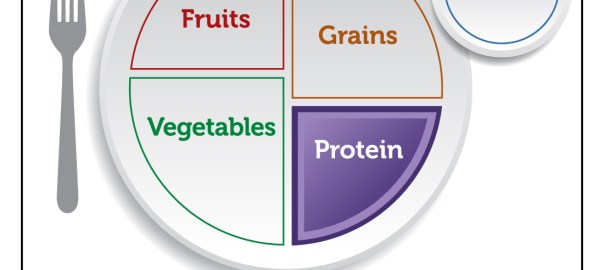
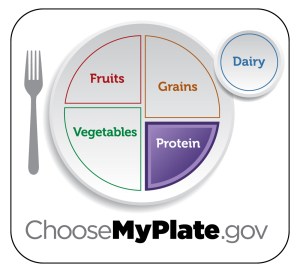
Any person who cuts out entire food groups is going to be lacking in certain nutrients. There is a reason there are food groups as the basis of the ChooseMyPlate method of eating. It’s because different food groups provide different nutrients and our bodies function best when we eat all of them. Whether it’s grains (breads and other carbohydrate foods), proteins (meats), fruits and vegetables, or dairy (milk, cheese, and yogurt), cutting out a food group cuts out specific nutrients. Those who cut out meats are taking away a large chunk of the foods in the protein group and most of the sources of complete proteins (proteins that have all the amino acids our body needs and cannot make on its own).

Image from ChooseMyPlate.gov

Finally, on to my point!

For optimal health, I recommend that over the course of the day, vegetarians include foods that, when put together, make complete proteins and plan to eat enough foods that provide iron, calcium, zinc, omega-3’s, and vitamins D and B12. Iodine may also be a concern if iodized salt is not used in cooking or flavoring foods.

How to do this?

Complete proteins: Examples of foods that make complete proteins include: tofu and rice, corn and beans, rice and beans/peas, peanut butter and whole wheat bread, granola and soy milk, or a green salad with garbanzo beans and sunflower seeds. The idea is to match grains/seeds/nuts with beans/peas or to match vegetables with  both grains/seeds/nuts and beans/peas. Simple enough! And to make it even easier, soy and quinoa are already complete proteins.

For the other nutrients listed, here are some examples of where a vegan can find these nutrients to include in their meals.

Iron: Beans (pair with vitamin C foods and avoid pairing with calcium foods to absorb more iron!) Examples might be: beans and rice with lime (vitamin C), cilantro, and salsa or a “loaded bowl” (see image below) with quinoa and black beans and vegetables including tomatoes (vitamin C).

Calcium: Fortified imitation milks (almond milk, soy milk, etc.) or dark leafy green vegetables (althought we don’t absorb as much from the vegetables!).

Zinc: Beans, peas, and nuts (I’m personally a huge almond fan and usually have a handful a day as a snack).

Omega-3’s: Walnuts and ground flaxseed. Add ground flaxseed to to smoothies, sauces, or sprinkle on salads – just watch out because it gets gummy when mixed with liquids, which is why it’s a great vegan egg replacement in baking.

Vitamin D: Sunshine! Fortified foods (milk imitators).

Vitamin B12: Fortified foods.

Iodine: Iodized table salt.

Quinoa Loaded Bowl
Quinoa Loaded Bowl

I also recommend that someone who is following a vegetarian or vegan lifestyle, ask their physician to pull a “vitamin panel” to check their levels of vitamin D and B12 (and others) every now and again just to make sure that deficiencies are being kept at bay!

I hope you found this helpful. If you have other ideas or ways to incorporate these important nutrients, please post your thoughts, meal ideas, and recipes!

Images from: ChooseMyPlate.gov, Microsoft Free Images, and personal photographs.
Woman with basket of fruits, vegetables, and bread

The Vegan Experiment

The gauntlet has been thrown down and I said, “Challenge accepted!” The Academy of Nutrition and Dietetics has issued a challenge to dietetics professionals to live a vegan lifestyle for five days.
I am not doing this for the Vitamix blender that is the prize in this contest (although I would gladly accept it). I am doing this because I believe that a vegetarian or vegan diet can be just as healthful and complete as a diet that includes animal products. In my work as a wellness dietitian at a university, I always make my cooking demonstrations vegetarian, and vegan when possible, to show the community that vegetarian/vegan meals can be yummy and satisfying. I decided I would “walk my talk” for five days.
I mean, anyone can do anything for a mere five days, right?

Let’s start with the basics: what is veganism?

There are many levels of vegetarianism. I think the definition that many people think of for a vegetarian is a person who eats no meats. However, some vegetarians still include fish (pescatarians) and some still include dairy and/or eggs (lacto/ovo-vegetarians). If carnivores (meat-eaters) on one very end of the scale, then vegans are at the other end. Vegans do not eat any animal products – meat, poultry, fish, dairy, eggs, cheese, or butter. As a friend pointed out on my Facebook page, vegans may even decide not to eat honey since animals make honey.

For more information, see the Academy’s Web site, which includes a link to a PDF document that is their position on vegetarian diets. There is a wealth of information in the position paper.

Personally, I could easily become a pescatarian. For my health, since I have heart disease, I would choose to include fish due to the nice heart-healthy omega-3 fatty acids in some fish. But cutting out cheese and milk? I think I could live on tomatoes and cheese alone… so this will present a challenge.

Finally, since I am a registered dietitian, I am concerned about the nutritional quality of my vegan choices. I will have to do some planning. There are two things that I will be thinking about when I follow a vegan diet. One is to make sure I am combining foods in a way that makes complete proteins and the other is to get all the important nutrients about which vegans must be concerned (see the link to the Academy’s Web site above). Some nutrients are found mostly in animal products so vegans must have the knowledge to plan meals that include these nutrients.

I also personally tend to eat as clean as I can, so I doubt I will be including the packaged vegan alternatives. I have to look at the food labels; but the way I remember it, these products have a long list of ingredients that are not whole foods or natural flavors or preservatives. This is a personal choice; not a part of veganism.

I am beginning my planning this week. So far, I think I will try silken tofu as a scrambled egg replacement and I just bought a few bags of dry beans to play with. I would love any ideas so please post your comments and tell me about your favorite vegan recipes.

Wish me luck!

(Note: Free images from http://office.microsoft.com/en-us/images/)

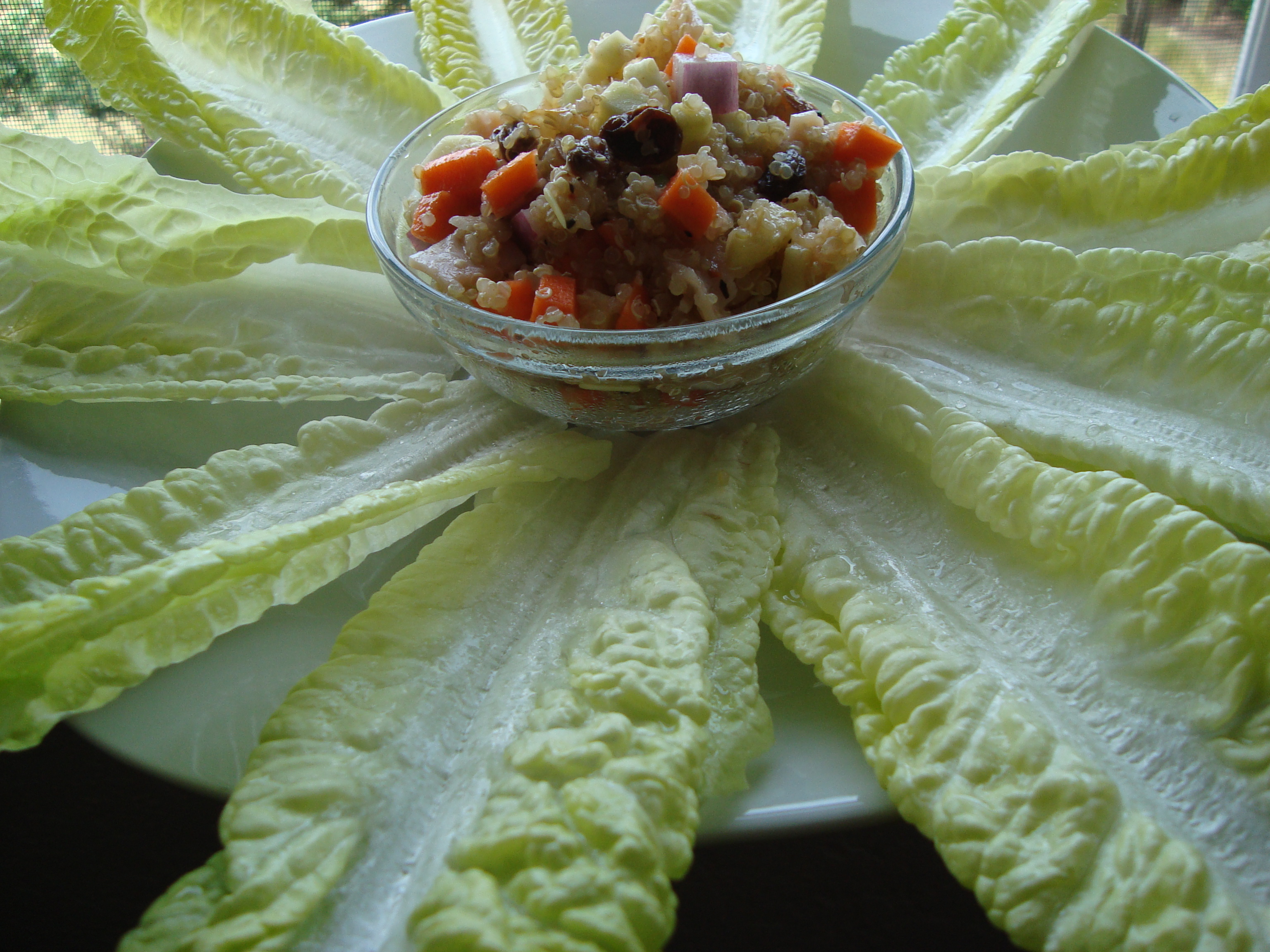
Serve in a small bowl surrounded by lettuce leaves

Quinoa Lettuce Wraps

I love quinoa. It is so versatile, it cooks quickly, and it’s a grain that is a complete protein as well! A complete protein has all of the essential amino acids that our bodies need, which is important for those who do not eat meat or other animal products (which are naturally complete proteins).

So, yesterday I was faced with a dilemma, what to do for lunch… I had quinoa and some vegetables sitting around so I threw together one of those “kitchen sink” recipes and it turned out so good that I decided to share it.

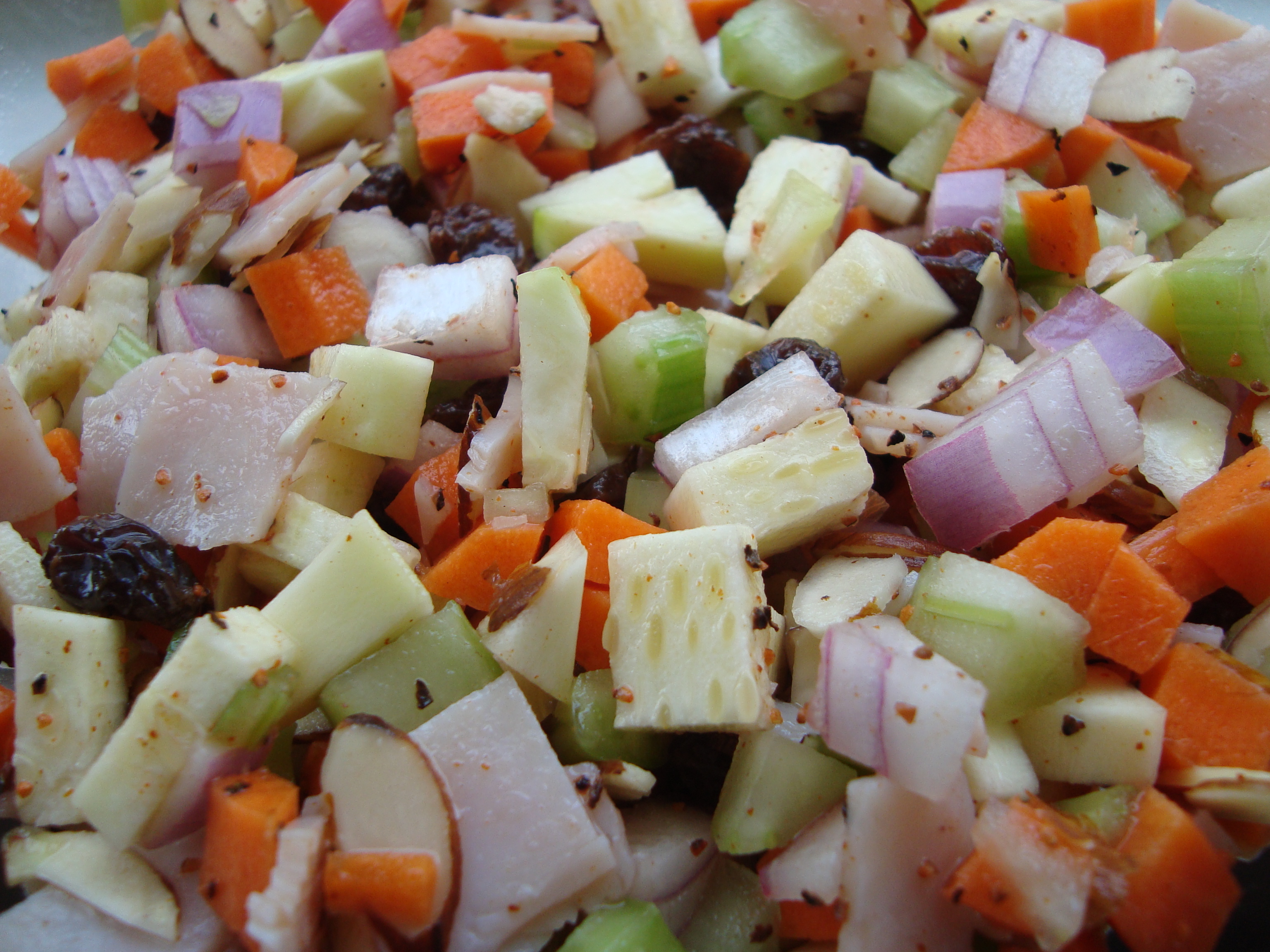
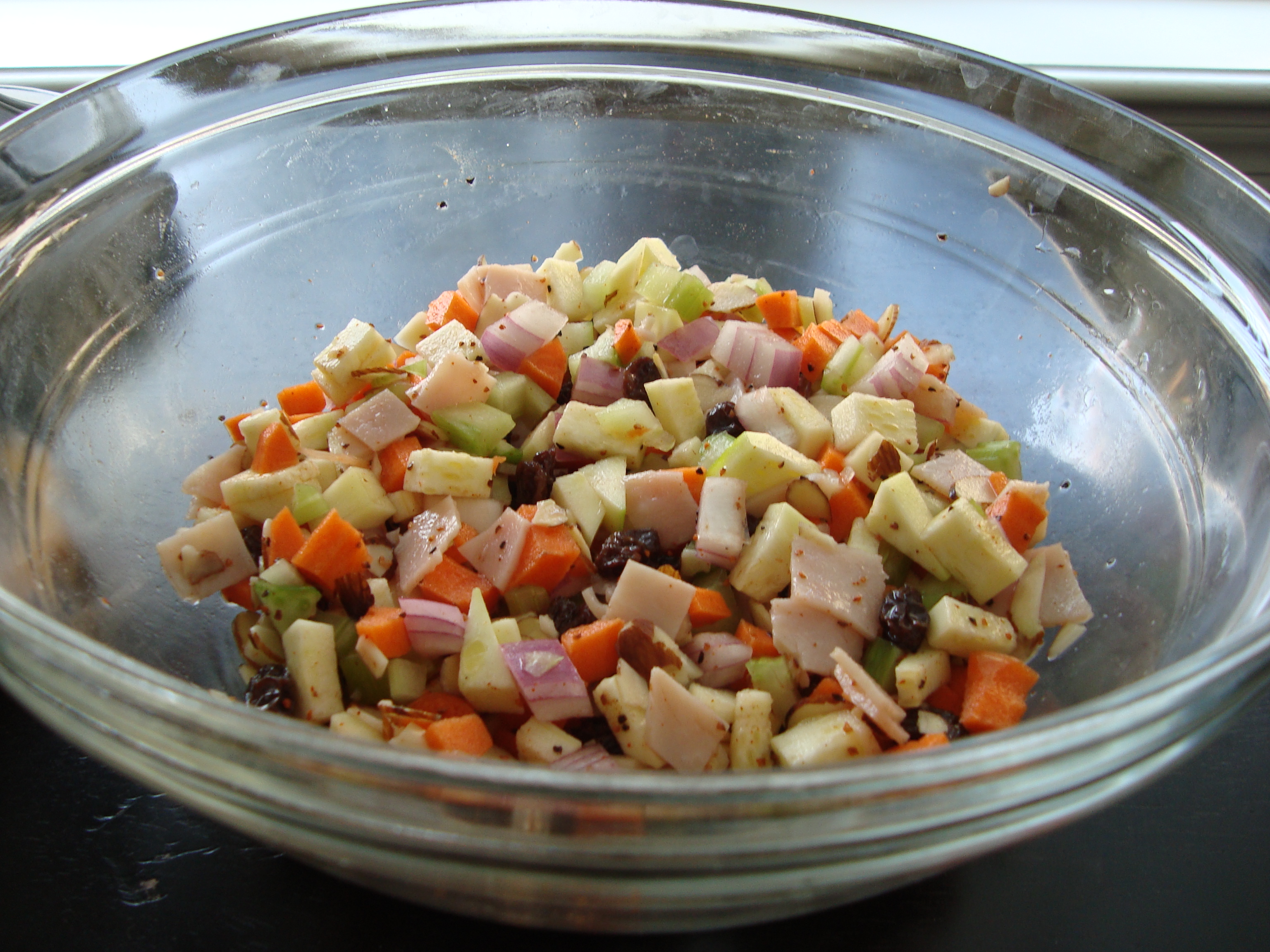
Can you guess all the goodies in here?

Quinoa Lettuce Wraps
By Alexia Lewis, MS, RD, LD/N

1 1/2 cups cooked Quinoa
1 raw zucchini, diced
1 slice red onion, diced
2 carrots, diced
1 large stalk celery, diced
2 slices nitrate-free turkey breast (optional)
Handful of sliced almonds
Handful of raisins
Red wine vinegar, to taste
Black pepper, to taste
Romaine lettuce leaves, rinsed

Simply mix together everything except the lettuce leaves, adding the red wine vinegar and black pepper in small increments until the dish has a flavor that you enjoy. Serve a spoonful on the raw romaine lettuce leaves. You can also serve with kale leaves, bok choy, or any other leafy vegetable that can act as a holder for the quinoa mixture.

I did not measure out the number of servings or do a nutrition information breakdown; but it makes a large amount (see below) and it includes the grains, protein, vegetables, and fruit so you have many food groups represented in a colorful dish – which equals nutritious!

The finished mixture of yum!

I served this up on a plate with the quinoa mixture in the middle and a ring of lettuce leaves. This dish is also husband-approved! Enjoy!

Serve in a small bowl surrounded by lettuce leaves
A day's work for an RD

Vegan Oatmeal Cookies

Today, my mission was to rework an oatmeal cookie recipe to be more heart-healthy and vegan. Oats are already a heart-healthy food so I didn’t have much work to do there; but I have not done much vegan baking. This was going to be a challenge! I ended up making two batches of oatmeal cookies. One is low-fat and the other is vegan. You decide which one fits into your healthy eating goals better.

I started with a basic oatmeal cookie recipe and focused on the ingredients that needed to be swapped out.

Ready to make oatmeal cookies!

First up, vegetable shortening. Great for flakiness and flavor in baking; but it contains trans fat which is about as far away from heart-heatlhy as you can go. For the low-fat recipe, I swapped 3/4 cup vegetable shortening with 1/4 cup butter and 1/2 cup mashed banana to retain moistness and flavor. In my experience, when I replace more than half the fat in a recipe with a fruit puree, the final product loses some “yummy.” This wouldn’t do for the vegan version however since butter is a dairy/animal product, so I chose refined coconut oil. The refining removes some of the coconut flavor and leaves you with a solid fat that is good for baking. This swap removes the trans fat; but it adds some saturated fat. I think I could find a better option; but this is at least a baby-step towards heart-healthier.

Next replacement was the egg for the vegan version. Mixing 1 tablespoon ground flaxseed with 3 tablespoons of water makes for a nice egg replacement. If you buy flaxseed from the bulk bins, it is much cheaper! I was about to spend $4 for a bag of ground flaxseed and ended up spending $0.65 on a small amount of seeds from the bulk bin. Shop smart!

Flaxseed - before and after grinding
Flaxseed – before and after grinding
Ground flaxseed mixed with water is a great egg replacer

Finally, I wanted to add more fiber. I swapped half the all-purpose flour for whole wheat flour and called it a day.

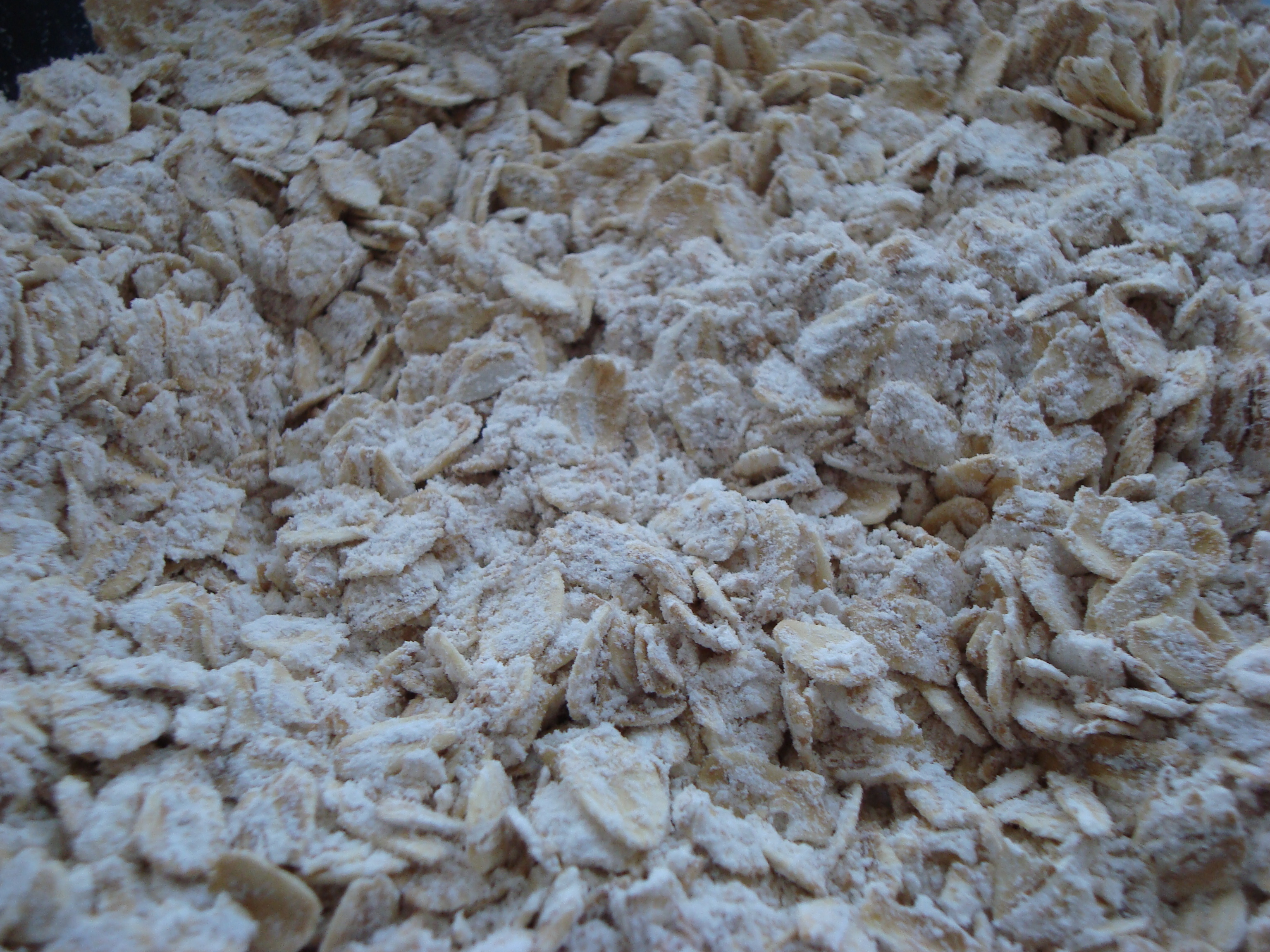
Rolled oats coated with all-purpose and whole wheat flour and baking soda

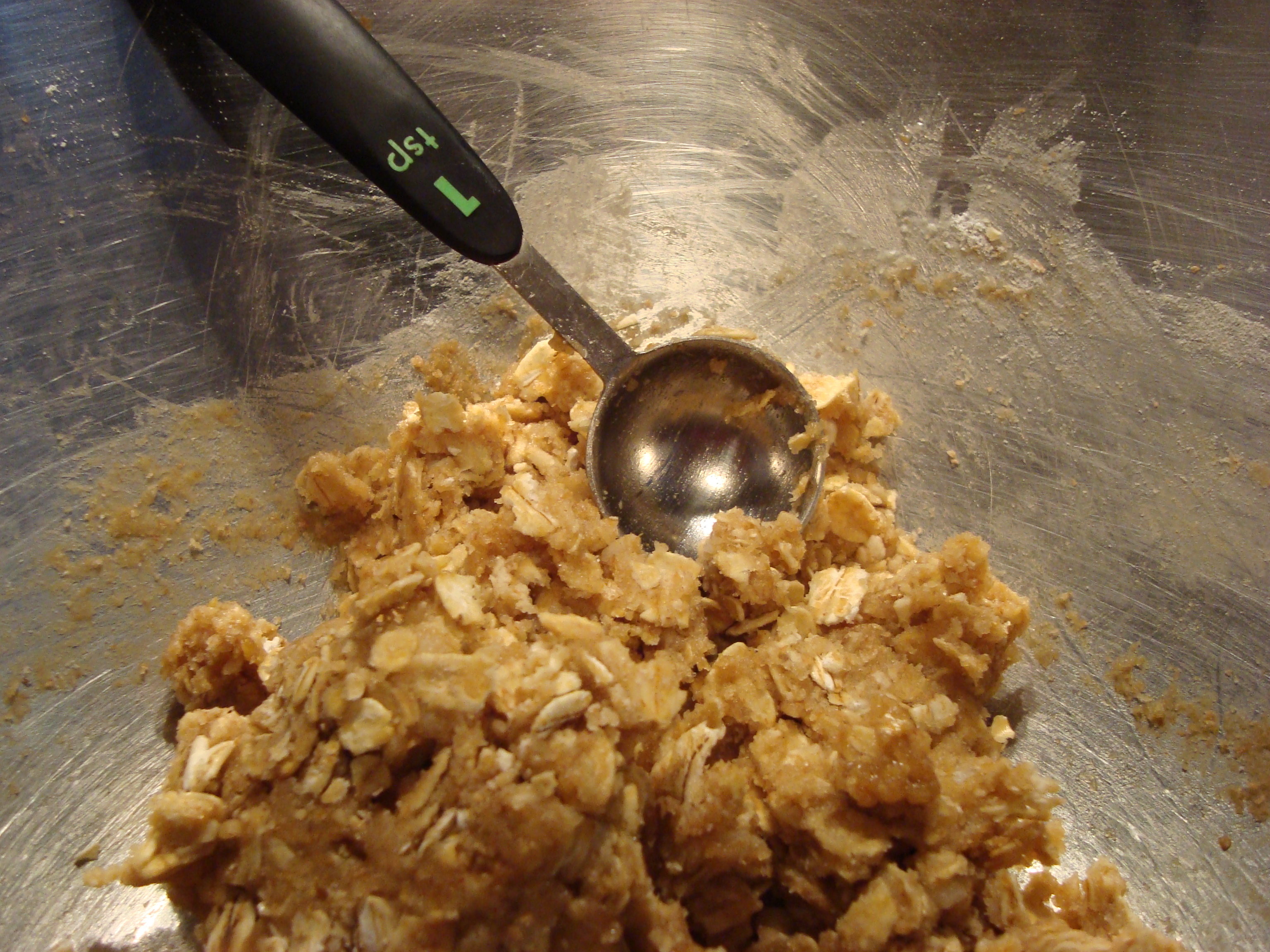
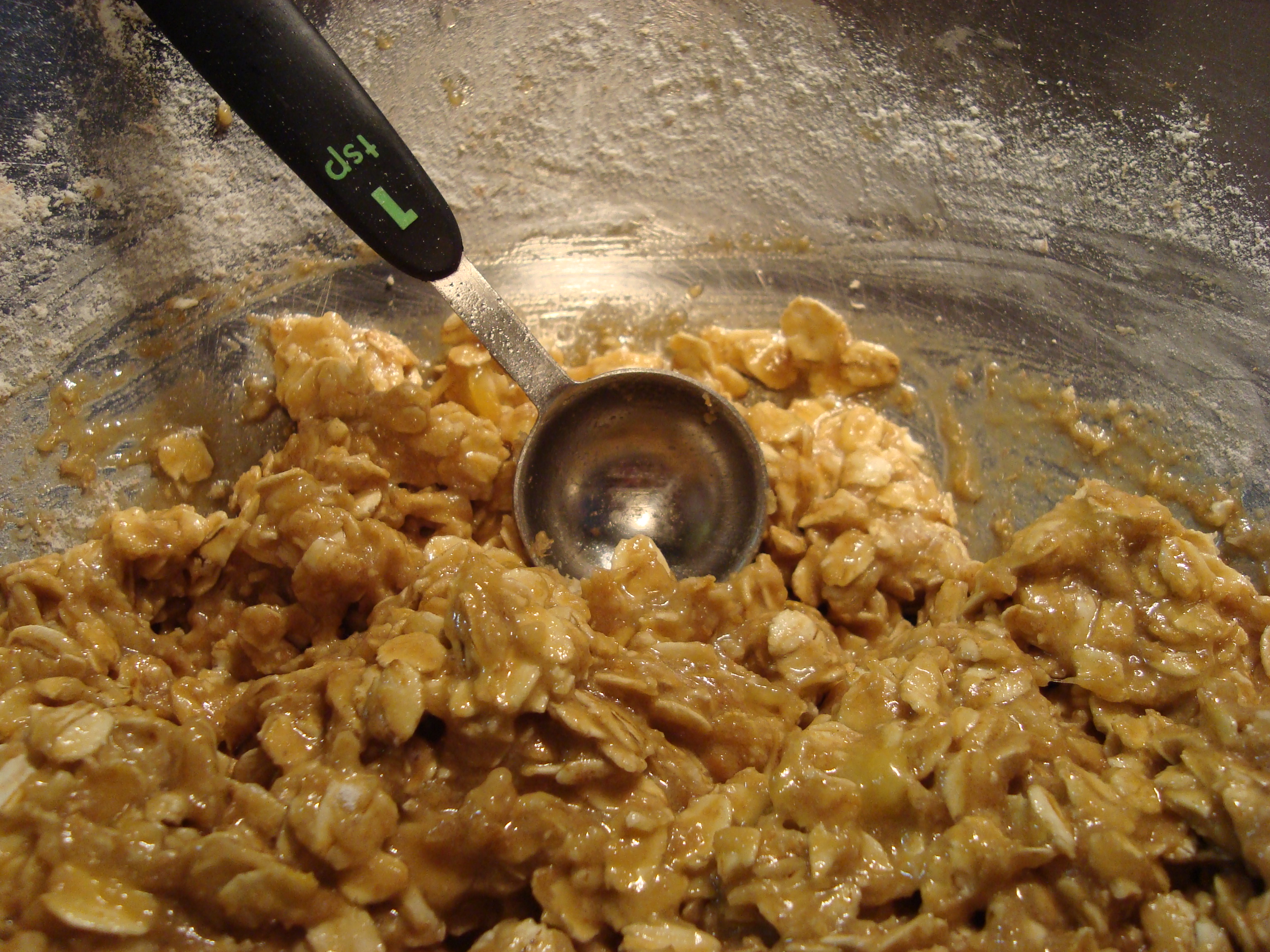
There was a difference in the batters as well as the final cookies when they came out of the oven. The vegan batter was drier than the low-fat batter. If I were to recreate the vegan recipe, I would add more water for a more moist batter and cookie.

Vegan Batter
Vegan Batter
Low-fat Batter
Low-fat Batter

Into the over for a quick 14 minutes and both cookies spread a little while baking. I didn’t adjust cooking times at all from the original recipe.

Vegan Cookie
Vegan Cookie
Low-fat Cookie
Low-fat Cookie

I was a little disappointed in the nutritional changes. The low-fat and vegan cookies both had fewer calories than the original and no trans fat. These are both heart-healthy changes. The vegan cookies had the same about of total fat and a more saturated fat that the origial due to the coconut oil. I still think that’s more heart-healthy than having a cookie with trans fat. The catch is not to eat so many cookies that the fat starts adding up! Finally, the fiber content didn’t increase as much as I’d hoped.

 Per 1 cookie Original Low-Fat Vegan
Calories 70 60 50
Fat 2.6 1.5 2.5
Saturated Fat 0.6 0.5 2
Trans Fat 0.3 0 0
Cholesterol 2.6 4.5 0
Sodium 11 11 8
Carbohydrate 11 11 8.5
Fiber 0.7 1 1
Protein 1.4 1.5 1

The important thing is how they tasted, right? I preferred the vegan cookies because they had a sweet brown sugar flavor, are more oat-ey, and have a nice crispness. The low-fat cookies are softer and moister; but they had a bit of a banana flavor. I don’t know about you; but I’m not looking for banana in my oatmeal cookies! In the future, I’d consider adding dark chocolate chips or walnuts to boost the heart-healthy properties of these cookies.

Whichever cookie you prefer, I hope you now have some strategies for adjusting recipes when baking and that you will enjoy that occasional cookie, even on your heart-healthy diet!

A day's work for an RD
A day’s work for an RD


Make your own pizza!

Skinny Pizza? Go For Homemade!

A new product, The Skinny Pizza, was announced in the latest issue of Food and Nutrition magazine. The information provided states this is a small thin crust margarita pizza with only 390 calories. Since it was listed in the “new products” section of a US-wide publication of the Academy of Nutrition and Dietetics, I assumed it was a new packaged food that would be available to most consumers.

I decided to blog about the nutrition content of this new product and to suggest alternatives for a whole food, non-packaged, homemade, low-calorie pizza because I know from experience that it’s fairly easy to make a mean homemade pizza!

It turns out this is not a packaged food. This is a menu selection from a pizza chain that has 25 locations. Only 18 of these locations are in the United States and 11 of them are in South Florida. Now, this called into question for me why this was listed as a new product in a magazine for dietitians with a demographic that covers the entire United States… But this is a topic for another day.

Let’s talk about “nutrition made easy” with a healthier homemade pizza!

Start by toasting either an English muffin, a pita, or this dietitian’s favorite, a Flat Out or other flat bread. You just want this to get a little bit crispy or the sauce will make the pizza soggy.

Once crispy, top with a little low-sodium tomato or marinara sauce, and by a little I mean a lot less than you think you need even if you like your pizza saucy like I do! If you want to keep it even more “clean,” then saute some chopped plum tomatoes in a little olive oil, garlic, and onion, mashing the tomatoes as they cook to make a bruschetta-like sauce.

Top with some shredded cheese, lean proteins, and as many vegetables or fruits as your pizza will hold and throw it back in the oven or toaster oven to warm the ingredients and melt the cheese. You may want to also saute the vegetables if you prefer a softer, cooked texture over a crunchy texture.

One of the favorite combinations in this household is chicken breast, BBQ sauce, red onions, mushrooms, a Mexican cheese blend, oregano, cumin, paprika, garlic powder, and red pepper flakes or Hot Shot! Another favorite is pineapple chunks and mushrooms.

The sky is the limit with combinations for this pizza and every person can get their own favorite combination! By limiting the portions, the amount of cheese used, and focusing on lean meats, vegetables, and fruits as toppings, you can keep this pizza low calorie, fiber- and nutrient-rich, and most importantly delicious!

I’m always looking for new flavor combinations and ideas so let me know what you put on your homemade pizza.

References:

Pizza Rustica Launches Skinny Pizza. Available at: http://www.food-business-review.com/news/pizza-rustica-launches-skinny-pizza-081112. Accessed January 27, 2013.

Pizza Rustica Locations. Available at: http://www.pizza-rustica.com/locations. Accessed January 27, 2013.

Image from: http://office.microsoft.com/en-us/images/.

Kale Rolls with brown rice

We’ve Got Greens!

It’s kale cooking demonstration time! Tis the season to harvest greens and we have a lot of them from our organic Ogier Garden where I work so I decided to do a cooking demonstration showcasing our beautiful greens. Recipes included kale quinoa rolls and autumn vegetable soup.I found both of the recipes I used online (credit given with the recipes below) and I adapted them. Give these a try and let me know what you think!

Organic Greens
Organic Greens

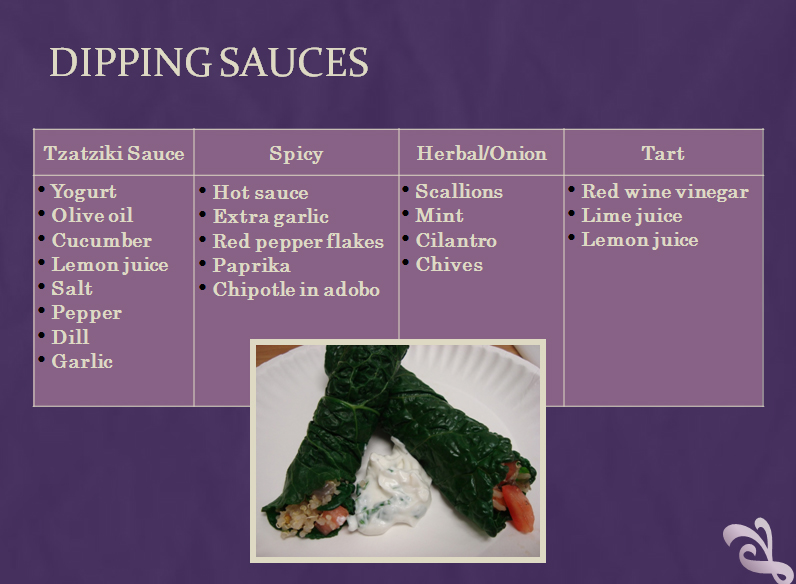
Both of these recipes are vegan. If you are a vegetarian, I do recommend a low-fat Greek yogurt dip for the rolls to increase the protein and calorie content of this meal. Here are some suggestions for flavoring the yogurt to make a yummy dipping sauce. Click to see the image larger in a new window.

Ideas for Greek yogurt dipping sauces

To begin, find some big kale leaves (dinosaur, lacinato or Tuscan varieties) or use collard greens which typically have large leaves. The curly kale will not give you enough leaf to roll with. Here in Jacksonville, Florida, I had no luck at the conventional grocery stores; but found a nice large bunch of organic lacinato kale at Fresh Market for only $2.50!

Preparing the greens is important and for the best results, you’ll want to blanche and devein the leaves. Blanching involves cooking the leaves in boiling water for a very brief time (~2 minutes) and then plunging them into an ice bath. I’ve used both a large bowl and my sink filled with ice-water with success. Blanching will make the leaves flexible enough to roll and brighten up their color. Wait until after blanching to devein the kale so you can preserve as many nutrients as possible, then take a small knife and simply cut out the thick part of the stalk, leaving the top of the leaf intact.

Kale Rolls with brown rice

I will also be packaging the complete cooking demonstration lesson plan, recipes, hand-outs, and evaluation forms into a package that will be available for purchase so you can take the work out of preparing for a cooking demonstration and just do the fun parts! Details will be posted soon.

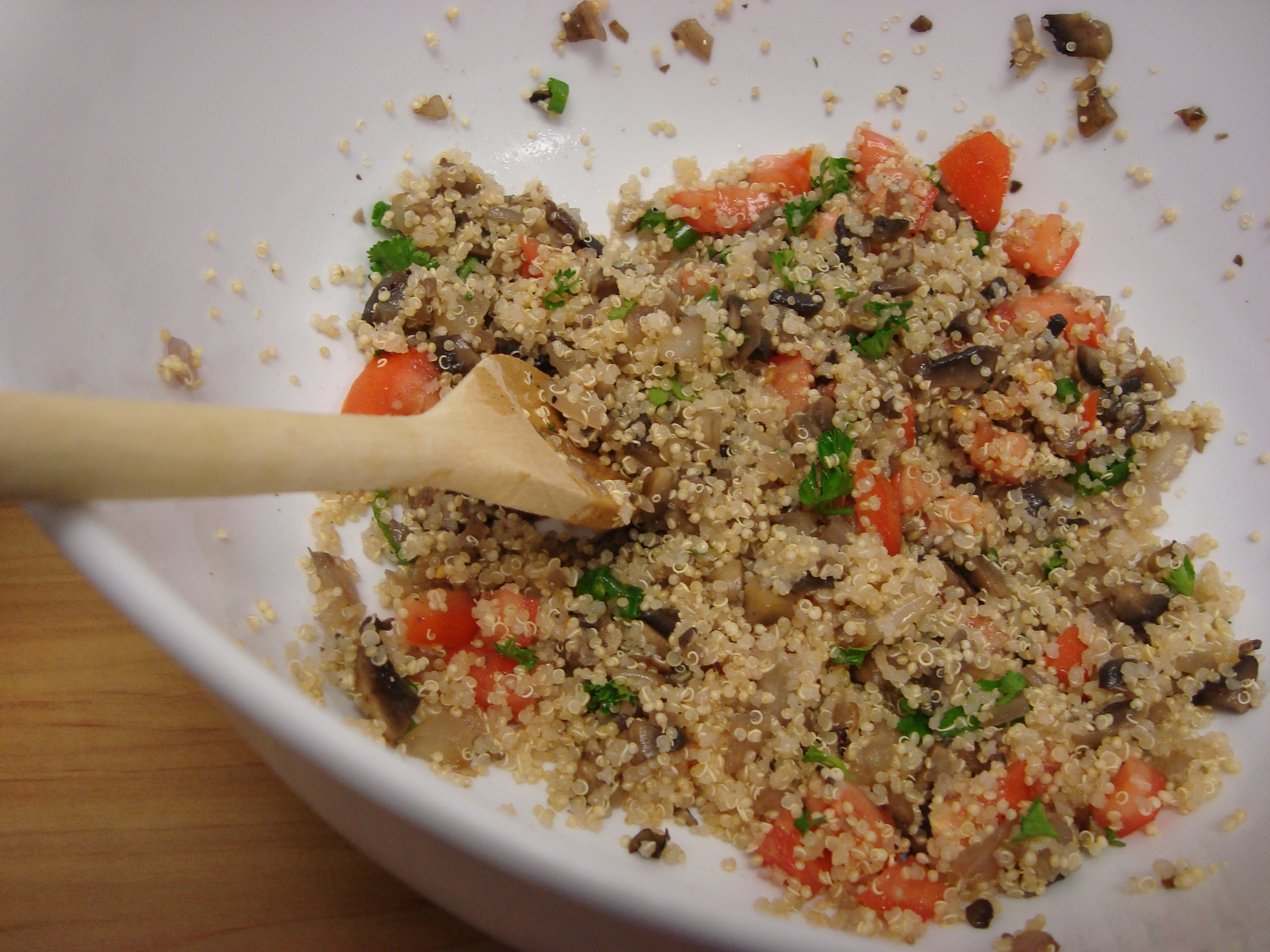
Quinoa Filling
Quinoa Filling

                      Kale Roll Ups

Recipe adapted from Gooseberry Mooseberry

http://www.gooseberrymooseberry.com/2012/07/stuffed-kale-rolls-dolma.html

By Alexia Lewis, RD, Wellness Dietitian

Ingredients

  • 25 kale leaves, preferably dinosaur kale (large leaves)
  • 1 1/2 cup cooked quinoa
  • 1/2 cup red onion, finely chopped
  • 8 oz white button mushrooms, finely chopped
  • 1 tomato, chopped
  • 2 Tbsp parsley, chopped
  • 1 Tbsp chives or scallions, chopped
  • 1 Tbsp lemon juice
  • 2 Tbsp canola oil, divided
  • salt and pepper to taste

Directions

Prepare Kale

  1. Bring a large pot of water to a boil
  2. Wash kale leaves thoroughly
  3. Add leaves to boiling water and blanch until softened and flexible, about 2 minutes
  4. Drain and rinse under cold water and pat dry
  5. Remove about 2-3 inches of the thick middle stem from each leaf

This step can be done ahead of time. If not using kale immediately, after cooking, pat leaves dry to remove excess water, wrap all leaves gently in a paper towel, and seal in a plastic bag with air squeezed out in the refrigerator for up to 3 days.

 Prepare Stuffing

  1. Heat 1 tbsp canola oil in pan over medium heat
  2. Add onion and cook, stirring frequently, 2-3 minutes
  3. Add mushrooms and cook about 8 minutes, until the water the mushrooms give off has evaporated
  4. Remove pan from heat and let cool
  5. In a large bowl, combine cooked quinoa, cooled mushroom mixture, tomato, parsley, chives, lemon juice, and the remaining 1 tbsp canola oil. Season to taste with salt and pepper.
  6. Cover and set aside

This step can also be done ahead of time. Store covered in refrigerator for up to 3 days.

Make Rolls

  1. Place one kale leaf vein-side down and put 1-2 level tablespoons of the filling in middle of leaf
  2. Fold the leaf from the bottom over the filling
  3. Tuck one side of the leaf over (the other side will remain open)
  4. Roll the leaf into a tight roll and place on plate/platter with edge of the leaf under the roll to keep roll from unrolling
  5. Repeat with remaining rolls

These can be served warm or chilled and can be kept up to 3 days in the refrigerator. If any of the previous steps were done ahead of time, subtract the number of days those ingredients were already stored from the number of storage days.

Makes approximately 20 servings (1 roll per serving): 47 calories, 1.8 g fat (0.1 g sat, 0 g trans, 0.5 g poly, 0.9 g mono), 0 g cholesterol, 15 mg sodium, 202 mg potassium, 6.5 g carbohydrate, 1 g fiber, 2 g protein.

                      Autumn Vegetable Soup

Recipe adapted from Clean Eating Magazine

http://www.cleaneatingmag.com/Recipes/Recipe/Black-Eyed-Pea-Stew-with-Collard-Greens-Potatoes.aspx

By Alexia Lewis, RD, Wellness Dietitian

 Ingredients

  • 6 cups low-sodium vegetable broth
  • 6 cups water
  • 8 cups kale or other greens, chopped
  • 3 large tomatoes, beefsteak or vine, diced
  • 1 medium butternut squash, diced
  • 1 can black-eyed peas, low sodium, rinsed
  • Salt and pepper to taste

Directions:

  1. Bring broth and water to boil in large pan over high heat
  2. Add kale, reduce heat, cover and simmer for 10-15 minutes
  3. Add tomatoes and butternut squash, cover and simmer until squash is tender, about 15 minutes
  4. Stir in black-eyed peas, cover and simmer about 2 minutes
  5. Season with salt and pepper to taste

Makes approximately 20 servings (1 cup per serving): 70 calories, 0.5 g fat, 0 g cholesterol, 220 mg sodium, 373 mg potassium, 15 g carbohydrate, 3 g fiber, 3 g protein

Cilantro!

And We’re Live!

Welcome! Today is the day I officially launch my Web site. (Wow that was a long time ago!)

To celebrate the occasion, I have just posted a cooking demonstration showing you how to make “mom’s homemade salsa” which makes a great snack or can be used in other recipes. You can find the video on my “Cooking Videos” page or on my YouTube page which is linked from the “Follow Me On…” page.

Please help me spread the word by sharing my site with others. I welcome all feedback so let me know if I help you with “nutrition made easy.”

Thanks!
-Alexia

Ready to cook!
Ready to cook!
healthy bread on table

Macronutrients – Those Confusing Carbs!

Carbohydrates

Sources:

Carbohydrates come from plant and animal sources. The food groups that contain carbohydrates include grains, fruits, dairy, and vegetables.

There are two main types of carbohydrates: simple carbohydrates (sugar) and complex carbohydrates (starch and fiber).

Sugar:

There are two types of sugars that people typically think of when talking about sugar in the diet. One type is the natural sugars that are found in foods in their natural and whole state. Examples are fructose and sucrose (in fruits) and lactose (in milk). The other type of sugar is the added sugars that are added to foods during processing or created from refining natural foods, Examples are high fructose corn syrup (in many products) or sucrose (refined into table sugar).

Starch:

Starches are long chains of sugars. Our bodies break down these long chains into simple sugars that our body can absorb to provide us with energy. Many foods that are starchy need to be cooked in order for our bodies to be able to digest them. Examples are potatoes, corn, and grain products such as bread, pasta, and rice.

Fiber:

Fiber is the indigestible part of the plant. Fibers are also long chains of sugars; but the way the chains are held together prevent our bodies from being able to digest them for energy. Fiber is important for health for many reasons. Fiber can be fermented by the bacteria in our gastrointestinal tract which promotes colon health. Insoluble fiber helps promote regularity and prevent constipation. Insoluble fiber includes whole grains (the outer bran layer) and the strings in celery. Soluble fiber can help to lower cholesterol and regular blood glucose levels. Soluble fiber includes oats, beans, and citrus fruits.

Functions:

The functions of carbohydrate include:

– Energy! Carbohydrates currently have a bad reputation; but they are the main and preferred source of energy for the body. Our bodies need carbohydrates to be at our best health.

– Help to lower cholesterol and regulate blood glucose levels (soluble fiber)

– Maintain digestive tract health (fiber)

Recommendations:

For a generally healthy adult, the range for carbohydrate intake is set between 45% and 65% of daily calories. A person consuming a 2,000 calorie diet would have a range of 900 – 1,300 calories. Since 1 gram of carbohydrate has 4 calories, this is a range of 225- 325 grams of carbohydrate per day. The minimum number of carbohydrate grams per day is 130 grams to promote good brain function.

Those trying to build muscle should be sure to consume enough carbohydrates to “spare protein” to be used for muscle growth.

Many people restrict carbohydrates due to the belief that “carbs make you fat.” In healthy individuals, carbohydrates trigger insulin and insulin lets the sugar into our body and cells. People mistakenly believe that this always means weight and fat gain. This is not true!

When we eat the appropriate amount of carbohydrates for our bodies, the sugar is used as a fuel source and burned. It is only when we overeat carbohydrates that weight gain results. Carbohydrates do not make you fat. Carbohydrates are an important part of the diet. Without carbohydrates, the body begins to break down fat storage and then body proteins. In extreme cases, metabolism slows drastically and both health and life can be jeopardized.

People with specific health conditions or concerns may need a different amount of carbohydrate in their daily diet or to time the consumption of carbohydrates throughout their day.

Other guidelines:

Whole grains: Consume whole-grain carbohydrates whenever you can. Recommendations are to make half of your grains whole. Read the food label and be sure the first ingredient is listed as a “whole” grain (example: whole wheat, not wheat flour).

Fiber: For those between 19 and 51 years old, females should consume 25 grams and men should consume 38 grams of fiber a day. Those over 51 should consume 21 grams (women) or 30 grams (men) per day. If you are increasing your fiber intake, do it slowly and drink lots of water or you may end up with a bout of constipation!

Added sugar: Limit the amount of added sugar in your diet. Many health risks are associated with added sugars and in general, Americans consume too much added sugar. The American Heart Association recommends no more than 100 calories (women) or 150 calories (men) of added sugars per day. Most natural sugars are generally not associated with health risks as these are consumed along with fiber which slows down the absorption of sugar and other vitamins, mineral, and phytochemicals which promote optimal health.

Original publication date: October 1, 2012 at http://newmotivationcoaching.blogspot.com.

Reference: Nutrition Concepts and Controveries, 12th ed. by Sizer and Whitney, 2012. ISBN-13: 978-1-1133-62818-7.

ChooseMyPlate.gov Protein Food Group

Macronutrients – The Beef on Protein

ChooseMyPlate.gov Protein Food Group

Updated 12/03/2024. One of the jobs I have held was as a wellness dietitian for a university. I loved that job. I was working on updating the nutrition info on the website and thought I’d share some of the things I’ve been updating. Enjoy!

I’m working on the macronutrients (aka macros). First up, the *beef* on protein (because I just can’t resist bad wordplay!)

Protein

Sources:

Protein comes from animal sources such as meat, dairy, and eggs and from plant sources such as beans, nuts, seeds, and even some grains.

Even your broccoli has protein, but you would have to eat nearly 3 cups to equal the protein in 1 ounce of meat. I’m stuffed just thinking about it. (And, oh, the gas!).

It is possible to consume enough protein for good health on a vegetarian or vegan diet if you plan your food choices well.

Functions:

Protein is an essential nutrient meaning that we must get it from our food. Proteins break down in our bodies to amino acids. Our bodies cannot make all the amino acids it needs to function and approximately 25% of amino acids are lost to other uses every day, which is why protein is an important part of the daily diet.

Protein has many functions including:

– Provides body structure by building and maintaining muscle, bone, and other body tissue

– Allows for movement (40% of body protein is muscle tissue)

– Regulates gene expression

– Integral part of enzymes, hormones, and neurotransmitters

– Immunity through antibodies

– Transports of vitamins, minerals, oxygen and other substances through the body

– Regulates fluid and electrolyte balance

– Maintains acid-base balance

– Necessary for blood clotting

– Used as fuel when other sources of energy are not available. (Cue the nightmare metabolism images from grad school).

– Protein is satiating – it helps us to feel full and satisfied

Recommendations:

For a generally healthy adult, the recommended daily allowance (RDA) range for protein intake is set between 10% and 35% of daily calories. A person consuming a 2,000 calorie diet would have a range of 200 – 700 calories. Since 1 gram of protein has 4 calories, this is a range of 50- 175 grams of protein per day.

Further, the recommendation for generally healthy adults is 0.8 grams per kilogram (8g/kg) of body weight. To convert pounds to kilograms, divide weight by 2.2. For example, a 150 pound person is (150 divided by 2.2) 68.18 kilograms. This person would consume around 54 grams of protein per day, which is the low end of the above range.

Now, that recommendation is based on nitrogen balance studies from way back when. It is the amount needed to prevent nitrogen deficiency. Those amino acids have a nitrogen molecule on them, which leads to a recommendation.

A recommendation that I think is too low. And I’m not the only one. For example, NASM recommendations go up to 2g/kg based on athletic training needs. And this article in the journal Nutrients questions if it’s time to update the RDA. 

People with specific health conditions or concerns may need a different amount of protein in their daily diet.

And bro, no matter how much protein you eat, you won’t build muscle without some form of resistance training.  

Updated: December 3, 2023. 

Original publication date: September 17, 2012 at http://newmotivationcoaching.blogspot.com.

Reference: Nutrition Concepts and Controveries, 12th ed. by Sizer and Whitney, 2012. ISBN-13: 978-1-1133-62818-7.

Image from: http://www.choosemyplate.gov

Muffins Ready for Baking

Veggies In Dessert – Eggplant Chocolate Chip Muffins

If you missed my segment on First Coast Living, you can watch me talk about Veggies in Desserts by choosing the tab for Food (click the right arrow to see more tabs) and then scrolling  to Wednesday September 26th UNF Nutrition.

I showcased three desserts during this segment: Red Velvet Beet Cupcakes (see previous blog post), Eggplant Chocolate Chip Muffins, and Black Bean Brownies. As I mentioned, none of these recipes were my creation and you can find them at these links:

Red Velvet Beet Cupcakes

Eggplant Chocolate Chip Muffins

Black Bean Brownies

The main points from my segment were:

1. Add vegetables to your day in any way you can!

Americans do not eat enough vegetables. The recommended amount for generally healthy adults is 2-3 cups per day and data shows we are eating 1.5-1.8 cups/day (2004 NHANES)! Sneaking vegetables into desserts can help us to baby-step our way towards the recommended daily amount – remember, it’s still dessert so it won’t get you all the way there!

2. Use vegetables to increase the nutritional content of your favorite desserts by reducing calories and fat, increasing fiber, and adding vitamins.

3. Methods (not covered in segment)

If using a puree, replace half of the fat with the puree. If it’s a liquid fat (oil) use 3/4 the amount that you are replacing and if it’s a solid fat (butter), use 1/2 the amount you are replacing. Reduce the oven temperature or check sooner than the recipe calls for or it might over-bake.

If using chopped vegetables, some have a high water content so you may need to reduce the other liquids in the recipe.

Now, on to my favorite of the three recipes – the eggplant chocolate chip muffins!

Start by making sure you have all the ingredients you will need on hand.

Ingredients for Eggplant Chocolate Chip Muffins

Next, figure out how to chop that eggplant! Here’s a suggestion, start by cutting into smaller sections with straight edges so the vegetable will sit flat when you start chopping.

How to Chop Eggplant

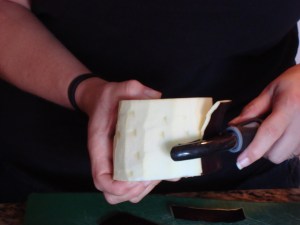
Now, peel the eggplant. Honestly, when I make my second batch of these muffins today (yes, they are that good!) I will not peel the eggplant and see how that goes… but the recipe called for peeling, so I did.

How to Chop Eggplant

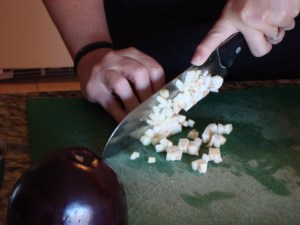
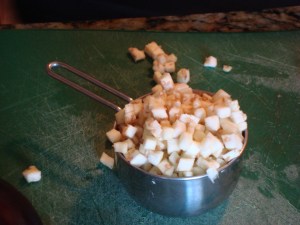
Finally, chop the section in half (again to give you a flat edge for safer chopping) and make smaller and smaller cuts. These pictures show going from the whole section, to half the section, to slices, to matchsticks, to a small chop.

How to Chop Eggplant

How to Chop Eggplant

How to Chop Eggplant

How to Chop Eggplant

How to Chop Eggplant

Finally - Chopped Eggplant!
Finally – Chopped Eggplant!

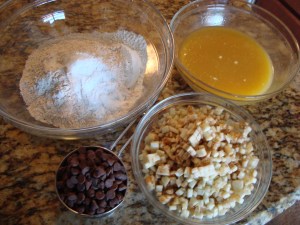
Moving on to the other ingredients, you will end up with four bowls of goodies. Top left is the flour mixture, top right is the butter mixture, bottom left is the chocolate chips, and bottom right is the chopped eggplant.

Ingredients Ready to Mix

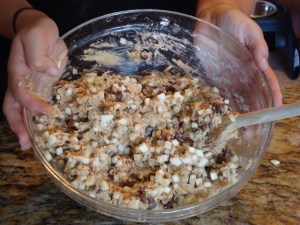
The beautiful thing about making muffins is that it is so easy! Simply make a well in your flour mixture (dry ingredients) and add your liquid ingredients. Be careful how much mixing you do! Gluten develops quickly once liquid is added to flour so you want to mix as LITTLE as possible while still combining the ingredients so there are NO DRY SPOTS of flour. Then fold in the extras (chips and eggplant) and mix just enough to distribute those extras throughout the batter. The mixture should be lumpy!

The Perfect Muffin Batter is LUMPY!

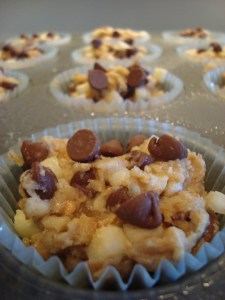
This recipe yields 24 muffins. Here they are before going in the oven

Muffins Ready for Baking

And after! YUM!

Eggplant Chocolate Chip Muffins

Compared to store-bought chocolate chip muffins, these have 50 less calories, 4 grams less fat, double the fiber, and we’ve added vitamins A and C.

Per muffin:

Calories 180
Carbohydrates (g) 26
Protein (g) 3
Fat (g) 8
Sat Fat (g) 3
Trans (g) 0
Cholesterol (mg) 30
Sodium (mg) 170
Fiber (g) 2.1
Vitamin A 3%
Vitamin C 7%
Calcium 2%
Iron 4%

Original publication date: September 30, 2012 at http://newmotivationcoaching.blogspot.com.