I recently wrote, “Change your body or don’t – we are all works in progress – but please start from a place of self-love and body-acceptance.” (Blog here). Today, I share some of my journey.
My weight fluctuates. I remember being 13 and thinking I was too fat (at 115 lbs!).
13 and playing dress-up at my aunt’s place
I also remember being my heaviest in my 20s (190 lbs!).
Remember Jane Fonda and the thong-leotard-leg-warmers aerobics phase? I jumped on that bandwagon, got my first certification (ACE Group Fitness Instructor) and got down to 125 lbs as an adult – which I maintained for about two deep breaths. I’ve also attained lifetime membership with Weight Watchers twice!
My weight goes the 140s to the 170s depending on whether I’m in a calorie-counting-exercising phase or a couch-potato-take-out-dinner phase.
I’m okay with being a “heavier” dietitian. My hope is that it gives people a place of realism from which to start, it reinforces that “knowing” and “doing” are two different things, and it lets people know that I can relate to their challenges since maintaining a socially desirable weight doesn’t come easy for me either!
This year, I’ve focused on bringing my body weight down. My reasons? I like to feel strong (I didn’t) and I have a closet full of super-cute clothes that I want to wear again. Okay, and arms. I love to see my upper arms have a little definition.
Body change will not happen until you are ready and decide what will work for you with your circumstances.
It is EASY to not think about what to eat until you’re hungry and it is HARD to meal plan, shop, and prep.
It is EASY to flop onto the coach at the end of the day and it is HARD to make time (and motivate!) to exercise.
It is EASY to make excuses and it is HARD to find small things you CAN do regardless of circumstances and place responsibility squarely on your own shoulders – where it belongs!
Next is what has worked for me to slowly lose 15 pounds this year – 3/4 pound a week adds up over time.
First was putting some money on the line. I tried DietBet. The app takes your real money from you and challenges you to lose 4% of your weight in 4 weeks. I’ve won 5 games and lost 1. Knowing that I have to make a certain goal or lose $10 – $35 has been incredibly motivating and helped with consistency.
Second was that dreaded meal planning and prepping ahead of time. I started with the New Year, a new notebook, and a heart full of hope. It worked. I have done this faithfully EVERY WEEK since January! It sucks. It’s hard. It takes soooooo long to do the prep sometimes. But it is SOOOOOOOOO worth it! (I do count calories using SparkPeople and have for years – love this site!)
Finally, (and I hate to admit this) a FitBit helped me to get moving. I didn’t realize how sedentary I was. Now I try to get 10-12k steps 4 times a week and 7k on other days. (Note that my employer has incentive money tied to steps – financial incentive helps!) In addition, I tried (and loved!) a yoga studio and promptly signed up for two Intro to Yoga series workshops.
My secrets to success are find something you love for activity, make the time for meal planning and prepping, and put some money on the line!
WHAT ARE YOUR SECRETS TO SUCCESS???
NOTE – There are NO affiliations or sponsorships from any of the linked resources mentioned.
It’s been a while since I posted a meal plan and I’m back with a delicious week of meals to share with you. I’ve been faithfully planning and prepping and have started to get a little bored with the same old meals. This week, I added a few new recipes.
Do as much prep as you can over the weekend. I chop omelet veggies, make overnight oats, boil eggs (last 5 days if they don’t crack!), make mason jar salads, and do whatever else I can to prepare ahead of time. Notice this week is heavier in cooking the first few days but then relies on leftovers to get through the week.
Not listed is a Chocolate Chia Pudding dessert I’ll be making when I sign off from here because chocolate. Yum.
Sunday:
B – Egg white omelet made with egg whites, shredded cheddar/jack, onions, mushrooms, and spinach served with a piece of toast with olive oil butter. TIP: Do your breakfast prep for the week by chopping onions and mushrooms that have been cleaned with a paper towel (no water!) and storing in mason jars – you still have to cook; but the chopping is the time-consuming part so this saves time in the morning!
L – White Bean Caprese Salad (added chopped raw videlia onions) served on spinach/romaine lettuce.
D – Baked tofu (press, cube, toss with Italian salad dressing and bake) mixed with zucchini carpaccio (pictured with this blog). Note to self: invest in a mandolin.
S – Boiled egg; cucumbers and Zesty Carrot Hummus – you seriously must try this! DELISH!
B – Overnight Oats (were prepped over weekend so easy breezy breakfast) with a sliced banana.
L – Leftover White Bean Caprese Salad on lettuce/spinach
D – Leftover Sausage Boats and Strawberry Cucumber Salad
S – Kefir and blackberries
Wednesday:
B – Overnight Oats with banana
L – Leftover Loaded Sweet Potato
D – Baked fish, steamer vegetables, quinoa
S – Egg salad (egg, mayo) with carrots
Thursday:
B – Overnight Oats with banana
L – Mason Jar Salad (prepped over weekend) with a boiled egg and blue cheese crumbles
D – Fish Bowls (leftover fish, quinoa, chipotle, jalapeno, veggies, sour cream – whatever is on hand and needs to be eaten but with a Mexican twist).
S – Apple with carrot hummus
Friday:
B – Omelet with toast
L – Leftover Loaded Sweet Potato
D – Turkey burgers (tomato, lettuce, red onion, avocado, cheese) and fries (yes – the splurge meal happens for me too!)
S – Kefir and blackberries
Saturday:
B – Overnight Oats
L – Mason Jar Salad with tuna packet (buffalo tuna is so yum).
D – Turkey Burger Bowls (chopped burger, lettuce, tomato, pickles, blue cheese and the rest of the chopped food that needs to be eaten!
S – Carrots with carrot hummus
Thanks for the inspiration as always to Clean Eating Magazine (just the recipes please people, not the articles! Food is NOT “clean” or “dirty” unless of course, it needs to be washed), SkinnyTaste (easy, low calorie, and crazy good recipes) and this week to my new find, Minimalist Baker.
Let me know if you try any recipes this week and if you like the Meal Plan posts!
“Getting what you want is simple, but not easy.” – Mel Robbins.
I believe this is true when applied to nutrition. I think many of us know WHAT to do – nutrition is really simple once you get away from the hype of the media and uneducated bloggers. We just struggle with ACTUALLY DOING IT – it isn’t easy!
To further my mission of “heart healthy nutrition made easy,” I bring you a way to fit a healthy breakfast into your meal planning. I love the ease of the week when I take the time to do meal preparation on the weekends. In fact, my husband and I have only eaten out about 8 times since the year began five months ago. That was not our goal; but is a happy unanticipated consequence of having a plan in place.
One of the best perks of meal prep is having a hot breakfast for very little work. I’ve been accomplishing this with overnight oats and with pre-chopped vegetables for omelets or “scrambles” if I’m in a hurry. Mason jars are AMAZING for keeping my chopped onion and mushrooms (cleaned with a paper towel, not water) fresh through the week!
However, in my work with my patients lately, I have been hard pressed to find an overnight oats recipe online that works for all of my patients – especially those working on blood sugar control. Once you add oats, dairy, and fruit together, you’ve got a small jar carbohydrate delight that is just an overload for the morning meal.
Note – carbohydrates are NOT bad. Carbohydrates are AWESOME! However, many people tend to eat tooooo many of them. So, please DO NOT ban or severely limit carbohydrates; but many of us could do with reigning in our portion sizes a bit.
Without further ado – my basic overnight oats recipe is below. This serving provides 215 calories and 30 grams of carbohydrates per jar. Feel free to add more fruit and nuts and other assorted yumminess to fit your needs and preferences.
Oh and by the way, Mel Robbins 20 minute video is so worth the time!
Click the recipe title for a printer-friendly version!
The chia seeds act as a thickener (in addition to be a great heart healthy food!) but they are expensive so you can try leaving them out or substituting ground flaxseed.
For those counting carbohydrates to manage blood sugar: Don’t forget to add your carb grams for any fruit or sweeteners you add!
Is overweight the new healthy? The answer might surprise you.
Let’s start with the definition of healthy. How do you define healthy?
There are many aspects of health – there is body size (BMI, body fat) or metabolic health (lab results) or cardiovascular health (resting heart rate, ability to perform daily living tasks or purposeful exercise) or even emotional and spiritual health (do the standards you hold yourself to for your physical health damage your emotional health?). Or is it based on quality of life? Or the characteristics of those who live the longest?
(Spoiler alert: We are finding that a BMI in the “overweight” range has a lower mortality rate than those in the “normal” weight range).
So, I ask: how should we define health? The good news is that you get to define it based on what is important to you and I’d recommend you do it in collaboration with a physician.
I can tell you that people choose physical appearance over their emotional health a lot. One thing most people have in common when they walk in the door to meet with an RD is that their emotional health has taken a hit regardless of their body size. It seems very few people can find peace with their bodies – even those who appear “fit” or “healthy” to others.
This concerns me.
I used to be there too and I still some days struggle with self-acceptance and self-love (stupid #fitspo memes). It’s no secret that I carry a few extra pounds. Should you consider me proof that knowing what to do to get to a socially desirable weight and actually doing it are two different things? Or should you perhaps consider that I am happy and healthy with a few extra pounds? Could this be true?!?!
In 2007, I was “overweight” by the numbers and I fought with my body and had low body-acceptance. My hips were too big, my belly isn’t flat, my thighs are so big when I sit down… all those things we let ourselves say in our heads when we don’t love ourselves as we are. I had a heart attack. I felt my body had let me down even more… and then I realized that this body that I hated – big belly, hips, thighs, and all – had actually carried me through and I survived that heart attack. Just that simple realization led to a big mind shift and changed those thoughts in my head to appreciation and gratitude for this body that I was lucky enough to still have!
Before you go screaming that being overweight is why I had a heart attack – let me stop you. I was a smoker for decades, I worked a stressful job, and I have a strong family history. Most health conditions (and the supposed “obesity epidemic”) are not as simple as people believe. These things have multiple factors that lead to these outcomes. Being thin would not have prevented my heart attack.
I share all this to lead you into considering your HEALTH over your APPEARANCE. I encourage you to think a little deeper than the eat-less-move-more movement. Check out HAES (Health at Every Size), read up on new studies that might indicate a coming shift in beliefs (just one of many studies here: BMI 27: The New Normal?), and start loving yourself first.
Change your body or don’t – we are all works in progress – but please start from a place of self-love and body-acceptance. Look forward to more information on this topic in the future.
I get it. You’re busy, you’re tired, you don’t have time for meal planning, grocery shopping, meal prepping. You think your only option is that fast food drive through or the quick convenience restaurants.
I completely disagree.
We are ALL busy, tired, and don’t have free time to do all that planning and preparation. You have no less hours in your days that anyone else. You have chosen how to prioritize your time and to what and whom you give your time and effort. I’m not trying to make you feel any certain way but I can already hear your reasons that it’s not your choice and there is nothing you can do to change it.
Perhaps that is true for some people. I’ve been a caretaker for a family member going through a multiple year crisis and I found myself not taking care of myself at first. After devoting all my energy to care-taking, I realized I needed to take care of me too and I found a way to fit it in. (Anyone else ever walked the parking garage stairs and levels at a hospital? Yep, me too).
The thing is – we pay for our choices one way or the other. We pay in dollars and health when we routinely eat most choices available for a quick lunch (and we save time and effort). We pay in time and effort spent every evening or in a block of time on the weekends to meal plan, shop, and cook dinner (and we save our health and dollars). You get to decide which is more important for you in this moment.
The good news is that YOU have the power to shift your schedule and priorities. Maybe not completely; but I challenge you to find ONE SMALL THING over which you have control and can make a change.
Trust me – you’ll feel better if you do. 🙂
So, to help you realize that you DO have some control to choose something simple – like a healthier lunch or snacks – I bring you my “I’m-starving-and-have-nothing-to-eat-for-lunch” list for the grocery store. These are grab-and-go meals and snacks that you can choose instead of a fast food meal. (Spoiler alert – that fast food salad likely has more calories and less nutrition than the bacon cheeseburger).
Lunch?
Tuna (or salmon packet or packaged grilled chicken strips) mixed into prepared green salad (from produce section) with dressing of your choice
1 whole wheat roll with sliced meat and cheese (all from the deli so you get only what you need!) plus a mustard packet and box of high-fiber crackers
Bonus – now you’ve got crackers to stash at your desk for snack-time!
Sushi roll with edamame (if store has this option)
Diced fruit and nuts on cottage cheese (major yum!)
Going back to the office?
Frozen dinner and steamer bag of vegetables (no sauces please)
Can of low-sodium soup plus green salad (from produce section) with dressing
Snacks?
Cheese stick with those crackers you stashed in your desk
Chopped fruit from produce section with a handful of nuts
Yogurt with Grape Nuts (really, don’t spend money on “granola” or “trail mix” as Grape Nuts give you the crunch without added sugar or ridiculous price!)
Apple with peanut butter (single packs are now sold! Try the natural no-sugar-added kind)
Oh, and do yourself one more favor and just grab a simple, cold, refreshing bottle of water (or fill up your bottle!) on your way out of the store.
Tell me your other ideas and tricks for eating healthy when crunched for time?
The one best thing you can do to make healthier, nutrition-rich meals, save time and money, and make life easier is to plan your meals ahead of time. You need a strategy to plan healthy meals. If you wait until you are hungry and tired at the end of the day, figuring out what to make for dinner is not easy and you’re more likely to choose something fast, easy, and unhealthy. However, this is one of the things that my clients find the hardest to do.
I’m here to help you “make nutrition easy,” so here is my strategy for you.
Grab some paper, a pen, and ASPIRE to plan your meals. Remembering this acronym will guide you through a simple way to plan meals that are healthy, yummy, and reduce your grocery expenses! I designed my free Weekly Menu Planner just for this! You can use any format as long as you have one column for each day of the week.
A = Agenda
The first thing to do is check your agenda for any commitments, meetings, and changes to your usual schedule. Also check the calendars of the others in your household. This is important so you know which nights you have time to make a meal and which nights you don’t and should plan for leftovers. It also lets you know which nights you need quick and easy meals and which nights you can spend more time on your meal creations. You can also note the days that you have to be out of the house early and may benefit from packing your a lunch the night before. Write down everyone’s commitments that have an impact on meals on the weekly menu planner.
S = Stock
What do you already have on stock, on par, or in your pantry and fridge? Flip your weekly menu planner over and make a list of all the foods in your fridge and pantry (your “stock foods”) on the left side of the back of the paper.
P = Promotions
Check the store promotions. What is on sale this week? What do you have coupons for? We all want to stretch our food dollars and this is one way to do it. If you don’t clip coupons, go to the grocery store’s web site as many are now allowing their customers to electronically collect coupons on reward cards or by their phone number. You can also check one of my favorite coupon sites, Southern Savers, for printable coupons. On the right side of the back of your weekly menu planner, write down the “promotions foods” you plan to buy based on sales, coupons, and promotions.
I = Invent
Put on your creative chef’s hat, and invent meals you can put together using only foods on your list of “stock foods.” If you can’t make anything with what you have in stock, then figure out what you can add from the list of “promotion foods” to make a meal with your “stock foods”. The idea is to use as few foods from the “promotion foods” list so you make as many meals as you can without spending money on new foods! Once you have invented a few meal ideas, flip your weekly meal planner over and put the meals where they fit best based on your schedule.
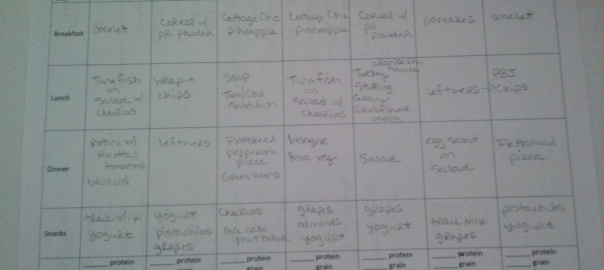
A Weekly Meal Planner
Tips
Google is your friend. I made this delicious Puff Pastry Tart just by putting “puff pastry,” “spinach,” “sweet potato,” and “healthy easy recipe” into Google!
Cook more than you need so you have leftovers from every time you cook! A few tweaks and one night’s baked chicken, sauteed mushrooms and zucchini, and brown rice transform into the second night’s chicken quesadillas.
Make the first meal on your weekly planner one that you have all the ingredients for… just in case you don’t make it to the store right away.
This is the hard part and it takes time – so save every weekly meal planner you create to re-use for those weeks you don’t want to spend the time and effort doing all this work.
Use the food group tallies on the bottom of my weekly meal planner to make sure you are including food from all food groups in your meal plans. Don’t know how many of each food group to include? Here’s a guideline based on a 2,000 calorie diet.
R = Run
Get out and run those errands! Use your list of “promotions foods” to make a shopping list. Clip your coupons. Go to the grocery store and do your shopping.
E = Execute
You spent all that time and effort making a plan, now execute your plan.
Post the weekly meal planner in the kitchen where you can see it. If you have helpers at home, let them know they can start prepping foods for dinners before you get home.
Most importantly, be flexible. This plan is an outline and life happens. You may have forgotten you need fish for one dinner… just push that meal back to another day. You may decide that you are way too tired to cook one night… just pick up your plan the next night.
Always have a Plan B Meal in mind. In my home, it is either flatbread pizza or turkey burgers and sweet potato fries. We always have the ingredients in stock and, on those nights we aren’t feeling our meal plan, we have a yummy 20-minute, low-effort dinner.
Let me know if you like my strategy. I hope you ASPIRE to give meal planning a try this week!
Updated 01/30/2025 to included reducing added sugars and ultra-processed foods to “the basics of heart-healthy eating.”
The Basics of Heart-Healthy Eating.
You may hear about magical foods or failproof techniques that are touted as the way to improve heart health. Yah… no. If they existed, then heart disease would not have remained the number one killer of Americans for over 100 years. WHAT? Yes, heart disease first topped the charts back in 1921 (1).
If you know me (Hi, I’m Alexia, a dietitian and heart attack survivor!), then you know I like to simplify nutrition. While nutrition can become incredibly complex and nuanced, most people benefit from big-picture, easier-to-implement steps. To that end, here is my take on the basics of heart-healthy eating.
Of note: I do mention weight in this article. I am a strong believer that people can be healthy at many body sizes – and confident and beautiful (2). I promote and respect every individual’s choice regarding their weight. I believe we should continue to work towards doing better with providing non-biased health care. More on the weight and heart disease below.
Increase Fiber.
Dietary fiber plays many roles to help with heart disease. It helps with managing cholesterol, blood sugar, and with satisfying appetite, which can lead to reducing weight, which can lead to reducing blood pressure.
Many people would benefit from increasing dietary fiber intake. Unless, of course, you have health conditions or other concerns that limit your fiber intake. If you need to limit fiber, talk to a qualified nutritionist and skip on down to the next basic of heart-healthy eating.
Since we eat foods, not fiber: dietary fiber is found in fruits, vegetables, whole grains, and legumes (beans and peas).
Okay, true. There is also fiber in nuts, however, you would need to eat a lot of them to significantly contribute to your fiber intake, and they are the most calorie dense of the choices. In other words, one measured cup of dry roasted mixed nuts comes in at 9 grams of fiber and a whopping 595 calories (4). Absolutely include nuts in your diet for heart health… just not because of the fiber content!
Bottom line:
Eat at least one of type of food with fiber with every meal and snack.
Choose non-starchy vegetables for most of those food choices to load up on fiber without loading up on calories.
Which type of foods you choose depends on your preferences, health, and goals.
You have lots of choices for foods to include, so… no excuses! And I say this because according to the 2020-2025 Dietary Guidelines for Americans, a distressingly low 10% of women and 3% of men are eating enough the recommended amount of fiber (5).
You don’t eat grains, fine! Eat a starchy veggie.
You don’t eat vegetables, fine! Eat some beans. (Well, kinda “fine” on the veggies, I mean, eat some, yeah?).
You don’t eat beans, fine! Eat some fruit.
Need help including more foods with fiber or navigating all the confusing information on food packaging?
Change Up Your Fats.
The type of dietary fat you eat can have an impact on heart health. This happens because the type of fats you eat helps to reduce LDL (bad) and increase HDL (good) cholesterol. This has a positive impact on heart health.
Notice I didn’t say reduce your fat intake? (Unless, of course, you have a condition that requires eating a low-fat diet, then reducing dietary fat intake is also important.)
That’s because fats are delicious (#noshame), needed for some types of cooking, and needed for your body to absorb fat-soluble nutrients. Eating a fat-free salad? You are missing out on absorbing some of that salad’s nutrition!
Reducing saturated fat, on its own, has been shown to reduce LDL cholesterol.
Increasing unsaturated fat, on its own, has been shown to decrease LDL and increase HDL cholesterol.In incredibly simplified terms, HDL’s job is to help get rid of LDL (6). Boom.
Doubling down by replacing saturated fats with unsaturated fats can reduce LDL and increase HDL all with one dietary swap. It’s as easy as replacing butter with avocado oil for sautéing.
In addition, specific unsaturated fats, omega-3’s can reduce triglycerides and blood pressure. Your body cannot put together omega-3 fats (or omega-6s), so getting foods with these types of fats in your diet is important.
Eat more meatless/plant-based meals and use lower fat dairy foods to reduce saturated fats.
Enjoy nuts, seeds, olives, and avocados often including cooking with oils made from these foods to boost unsaturated fats. Just be mindful of portion sizes due to being high in calories and/or sodium – I’m looking at you delicious salty olives.
Add a meal with a food high in omega-3′ fats once or twice a week.
I didn’t mention trans fats because they were banned from our food supply in 2018 and food manufacturers were given until 2021 to get them out of their foods (9). So, you likely won’t see trans fats in most foods you buy now.
But it’s worth checking the back of your pantry to make sure older foods you may have do not have trans fats on the label (or partially hydrogenated oils listed in the ingredients). And, um, it’s 2025 as I write this, so yeah, check those use by and expiration dates too.
Need help with a virtual pantry and kitchen cleanout?
Do you remember from your early biology classes that water follows salt. I remember really struggling with osmosis. Who knew it would actually be relevant when I grew up?
So, water follows salt. If your salt intake is high, your body holds water to keep all things in balance. More water in your blood vessels makes your blood pressure go up, and that is a risk factor for heart disease.
Most of the salt in the Standard American Diet (yes, the acronym is SAD, which fits) comes from packaged foods, including canned foods. We know salt enhances flavors. It is also a preservative and a binder in foods, and it keeps the foods holding water too, which keeps them *insert the m-word here* so this tracks.
Check food labels to choose brands with less sodium.
Rinse canned foods when you can.
Choose more whole/unpackaged foods.
And salt really does wonders to improve foods flavor, so use it. Just stop shaking the shaker after a few shakes, whether used at the table or while cooking.
One very interesting piece of info is that not everyone is salt-sensitive. That means reducing salt in the diet will not impact blood pressure for those who are salt-resistant. Even so, reducing sodium is a positive food choice for many (10).
Of note, there are instances and conditions that may require limiting or consuming a specific amount of salt. In those cases, this info does not appy.
Need help making sure your meals are still delicious without salt?
Decrease Added Sugars.
Just like salt, most of the added sugar in our food isn’t added by us. It’s added by food manufacturers. And just like salt, sugar makes foods delicious. That’s likely why we are also eating too much added sugar in our foods.
Well, that and its “hiding” in many foods that aren’t especially sweet.
The recommendation from the American Heart Association recommends 6% of intake of added sugars, or 6 teaspoons a day for women and 9 teaspoons a day for men (13). The Dietary Guidelines allow for 12 teaspoons (if you eat 2,000 calories a day) (5). One study based on 100,000 people over 9 years found the highest risk of heart disease hits around 24 teaspoons of added sugar (14).
And, of course, as always, people managing specific health conditions or others may need to have different recommendations.
So, drumroll please… We eat 17 teaspoons of added sugars on average (15).
Sugar contributes to heart disease as it can increase blood pressure, inflammation, weight gain, and make it more difficult to manage diabetes/prediabetes.
Bottom line:
Do your best to reduce added sugars down to the recommendations.
Continue to enjoy foods with natural sugars.
Yes, you can eat fruit (and unsweetened dairy foods). Foods with natural sugars have other nutrients (fiber, protein, fat) which slows digestion, and the research doesn’t show that these increase heart disease risk.
Need help on finding the added sugars in your foods?
Reduce Ultra-Processed Foods.
In the hurry up, stay busy, no time to relax kind of culture that many of Americans live in, processed foods make it easier to get food on the table. #noshame. They are also generally less expensive. With a store-brand dozen of eggs now costing over $4.00, we all could use a little help with our food budgets.
While processed foods have been around for 1.5 million years. After all, cooking with fire is a form of processing. The 1800s saw the inventions of the tin can for foods and pasteurization (17). Then the 1900s saw a big boost in demand for processed foods, with Swanson’s frozen meals hitting the market in the 1920s and fast food starting to hit its stride in the 1950s (18).
Fast forward and we have gone from minimally processing foods (cooking, canning, salting, smoking, freezing, etc.) to the ultra-processed powdered meal replacement drinks of today.
Did I mention there is no food shaming allowed here?
So, yes. Ultra-processed foods can have a place in an otherwise generally healthy dietary approach. And yes, it’s going to be in moderation. Nutrition is not so unforgiving (for most of us!) that eating a small amount of these foods will wreck health. What matters is what we do most of the time.
That being said food exists on a spectrum of processing, and while processing can improve nutrition with fortification, they have been starting to get linked to many negative health outcomes. For example, increasing inflammation and reducing gut health. In terms of heart health, these foods can raise triglycerides, blood pressure, and body weight (20).
Bottom line:
Work to reduce ultra-processed foods that are of low nutrition quality as your time and budget allow. For heart health, assessing foods for the nutrients mentioned in this article may be a good start.
Look for processed foods that positively impact nutrition. For example, adding vitamins or fiber.
Eat whole and minimally processed foods when you can.
On the flip side, it’s also entirely possible to eat a diet of whole/minimally processed foods that have a negative impact on heart health. Food choices matter. And a healthy diet can include ultra-processed foods. After all, store-bought bread and flavored yogurt are both ultra-processed food under the NOVA classification system (21).
PS – Research is ongoing to learn more about if it is the quality of ultra-processed foods (high sugar, salt, fat, etc.) or the actual processing of the foods that matter most for health.
Need help with meal planning and/or prepping to reduce ultra-processed foods?
Bonus Basics of Heart-Healthy Eating.
For some extra steps to add to your basics of heart-healthy eating, you may also add more berries, nuts, avocado, and plant sterols and stanols (22) to your food choices.
Credible information is important. And putting that information into action is where the magic happens.
Small changes done consistently over time add up to big results. So just pick one or two changes to make right now. When you’ve got that down, add another 1-2 changes.
Work with Alexia on your heart health.
She can work with people in multiple states in the USA and accepts some health insurance plans through her partnership with Nourish. Learn more and start the scheduling process to see if your insurance is accepted and get an estimate of your out-of-pocket costs. (Note that Nourish handles the health insurance stuff, not Alexia!)
If she can’t work with you, you can choose another dietitian who can, or reach out for help getting connected with the right RD for you.
Today, I had my standards challenged and this was a good thing.
Fish is on the menu for this week – filets tonight and homemade fish sticks later in the week. I only buy fish or meats at one of the nicer grocery stores, so it was the last thing I needed to pick up to be completely food-ready for the week ahead. I decided to do something different. I decided to check out the little hole-in-the-wall, local-only seafood market.
As a registered dietitian, I consider myself fairly food savvy in terms of how food is grown, raised, processed, and packaged. Fish, however, is one item that always remains fuzzy in my mind. I know to do my part for fish happiness and to reduce disease, wild is preferable to farm raised. I know which fish are more healthful because they are a good source of omega-3 fatty acids, such as salmon or mackerel. I know which fish are better in limited amounts because of potential higher mercury levels, such as swordfish or shark. This, however, is all that my brain chooses to remember. Here’s a great link from the Food and Drug Administration about selecting, storing, preparing fish and some health concerns.
Today, I walked into a local fish market and asked for tilapia. I was happy to learn some more about fish from a friendly fish monger.
This may or may not be my local fishmonger
According to my local fishmonger, tilapia is not a fish that is local to my area (Florida) and since he only carries fish caught up the road in Mayport, he doesn’t have any. He added that most of the tilapia comes from out of the country (which equals a lot of food miles) and is farm raised, not wild caught. He definitely was not a fan of tilapia; but I had a meal plan to stick to so I asked for his recommendation and engaged in an educational conversation about fish.
According to the Monterey Bay Aquarium Seafood Watch 2012 report on tilapia, 95% of the tilapia eaten by Americans is imported from other countries. The fish that is raised in the US is mostly farmed in the West and Northeast regions of the country. Tilapia is the fourth most consumed fish in the USA after shrimp, tuna, and salmon. Most of the US-raised tilapia (75%) is farmed using closed recirculating systems. On the negative side, these fish are separated from other wildlife, ponds are typically overly full, it requires more to be put into the system than comes out (1.4 pounds of feed to produce 1 pound of fish) and many farms use drugs to treat/prevent disease or to change the fish’s gender to male to produce a larger fish. One the positive side, this method does have an overall low environmental cost (food miles excepted).
If you are curious, I happily purchased a more expensive, local, drug-free triggerfish, which is supposed to be similar to grouper. I will be baking this beautiful fish in the oven at 350 degrees for 15-20 minutes (until it flakes easily with a fork) after dredging the filets in egg whites and coating with a combination of breadcrumbs, crushed pecans, and oregano. On the side, will be homemade tartar sauce (mayonnaise and relish), fresh boiled corn on the cob, and oven-fried red potatoes sprinkled with salt, pepper, and garlic powder.
Today, my mission was to rework an oatmeal cookie recipe to be more heart-healthy and vegan. Oats are already a heart-healthy food so I didn’t have much work to do there; but I have not done much vegan baking. This was going to be a challenge! I ended up making two batches of oatmeal cookies. One is low-fat and the other is vegan. You decide which one fits into your healthy eating goals better.
I started with a basic oatmeal cookie recipe and focused on the ingredients that needed to be swapped out.
Ready to make oatmeal cookies!
First up, vegetable shortening. Great for flakiness and flavor in baking; but it contains trans fat which is about as far away from heart-heatlhy as you can go. For the low-fat recipe, I swapped 3/4 cup vegetable shortening with 1/4 cup butter and 1/2 cup mashed banana to retain moistness and flavor. In my experience, when I replace more than half the fat in a recipe with a fruit puree, the final product loses some “yummy.” This wouldn’t do for the vegan version however since butter is a dairy/animal product, so I chose refined coconut oil. The refining removes some of the coconut flavor and leaves you with a solid fat that is good for baking. This swap removes the trans fat; but it adds some saturated fat. I think I could find a better option; but this is at least a baby-step towards heart-healthier.
Next replacement was the egg for the vegan version. Mixing 1 tablespoon ground flaxseed with 3 tablespoons of water makes for a nice egg replacement. If you buy flaxseed from the bulk bins, it is much cheaper! I was about to spend $4 for a bag of ground flaxseed and ended up spending $0.65 on a small amount of seeds from the bulk bin. Shop smart!
Flaxseed – before and after grinding
Ground flaxseed mixed with water is a great egg replacer
Finally, I wanted to add more fiber. I swapped half the all-purpose flour for whole wheat flour and called it a day.
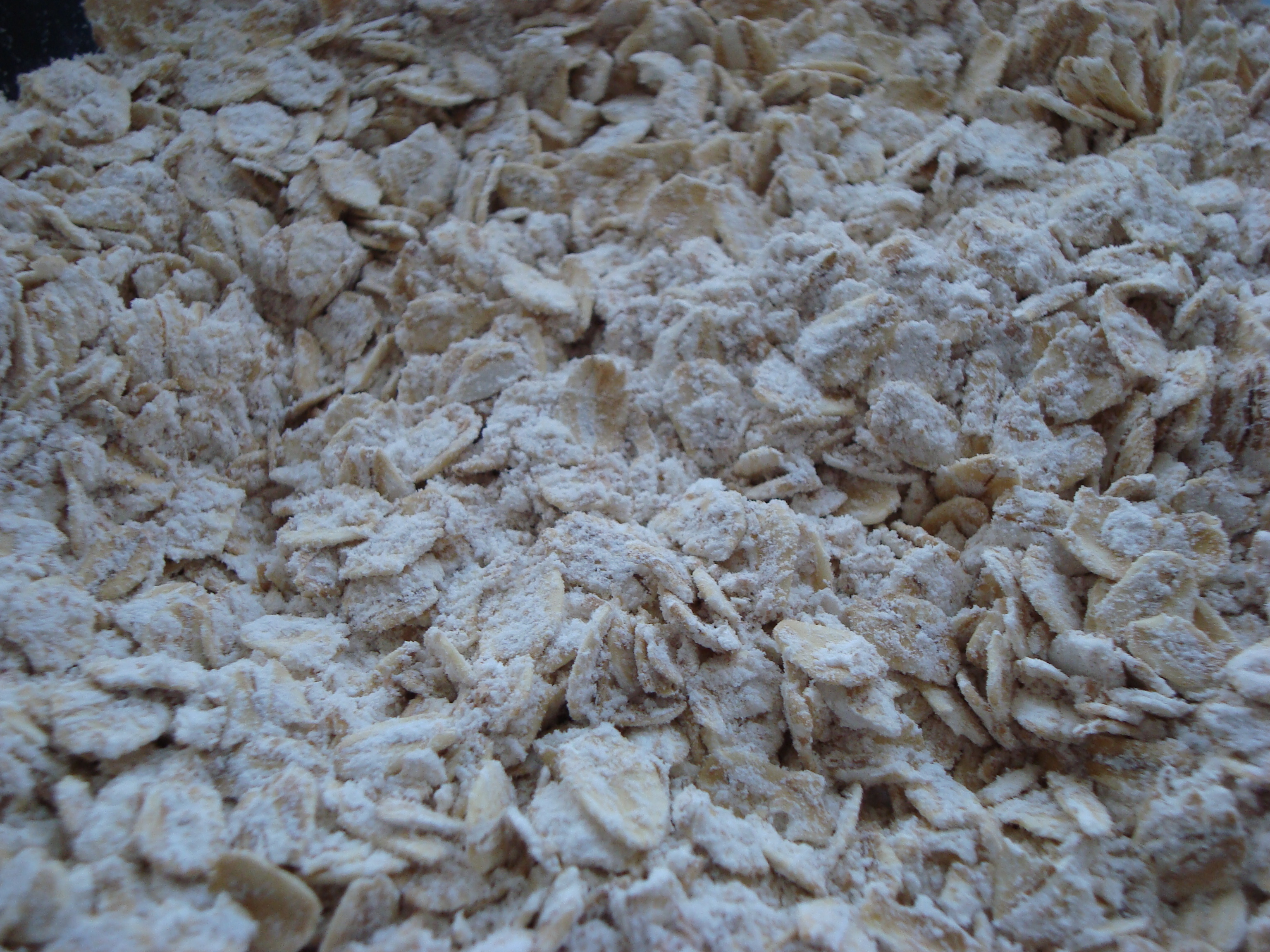
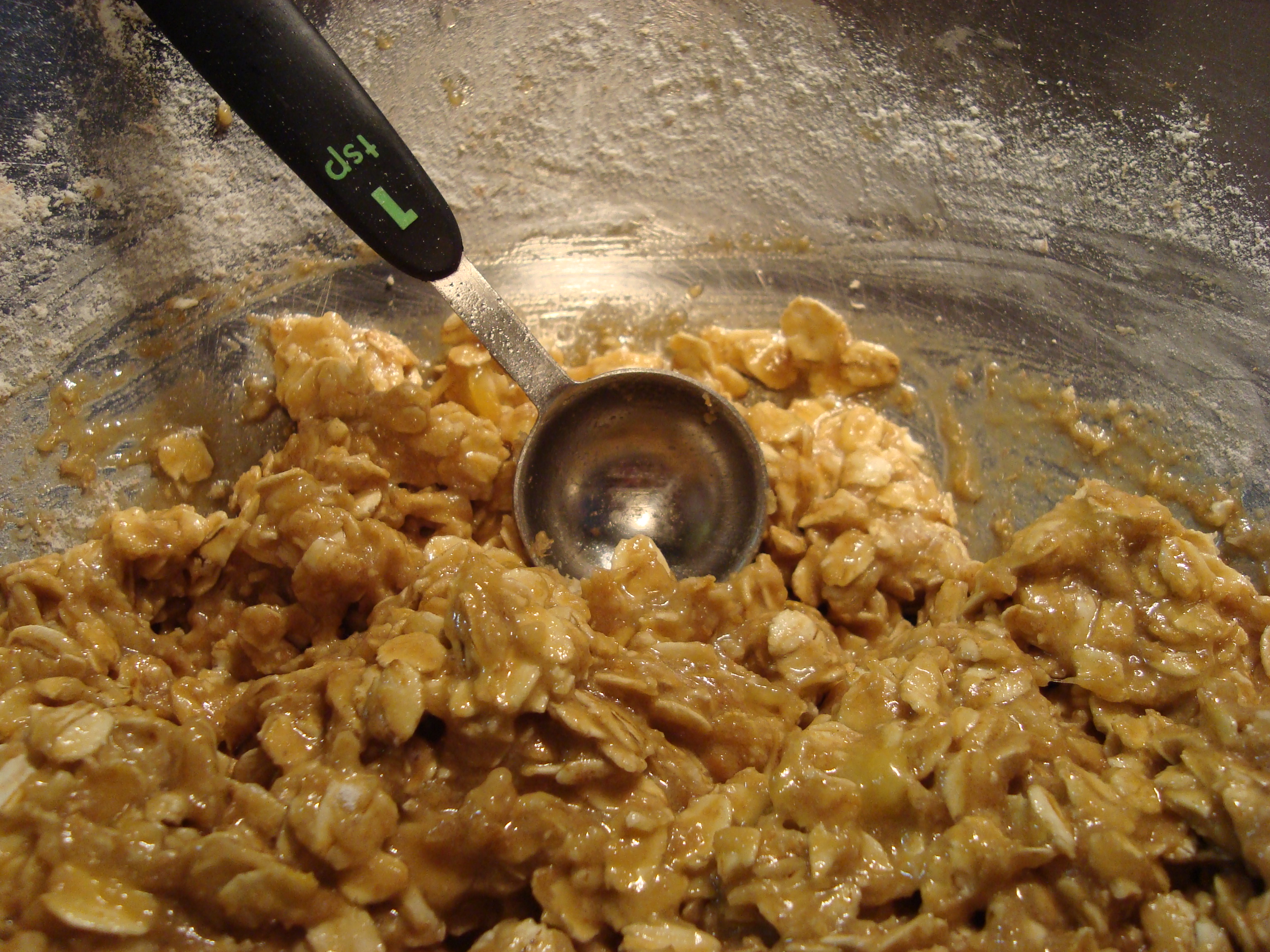
Rolled oats coated with all-purpose and whole wheat flour and baking soda
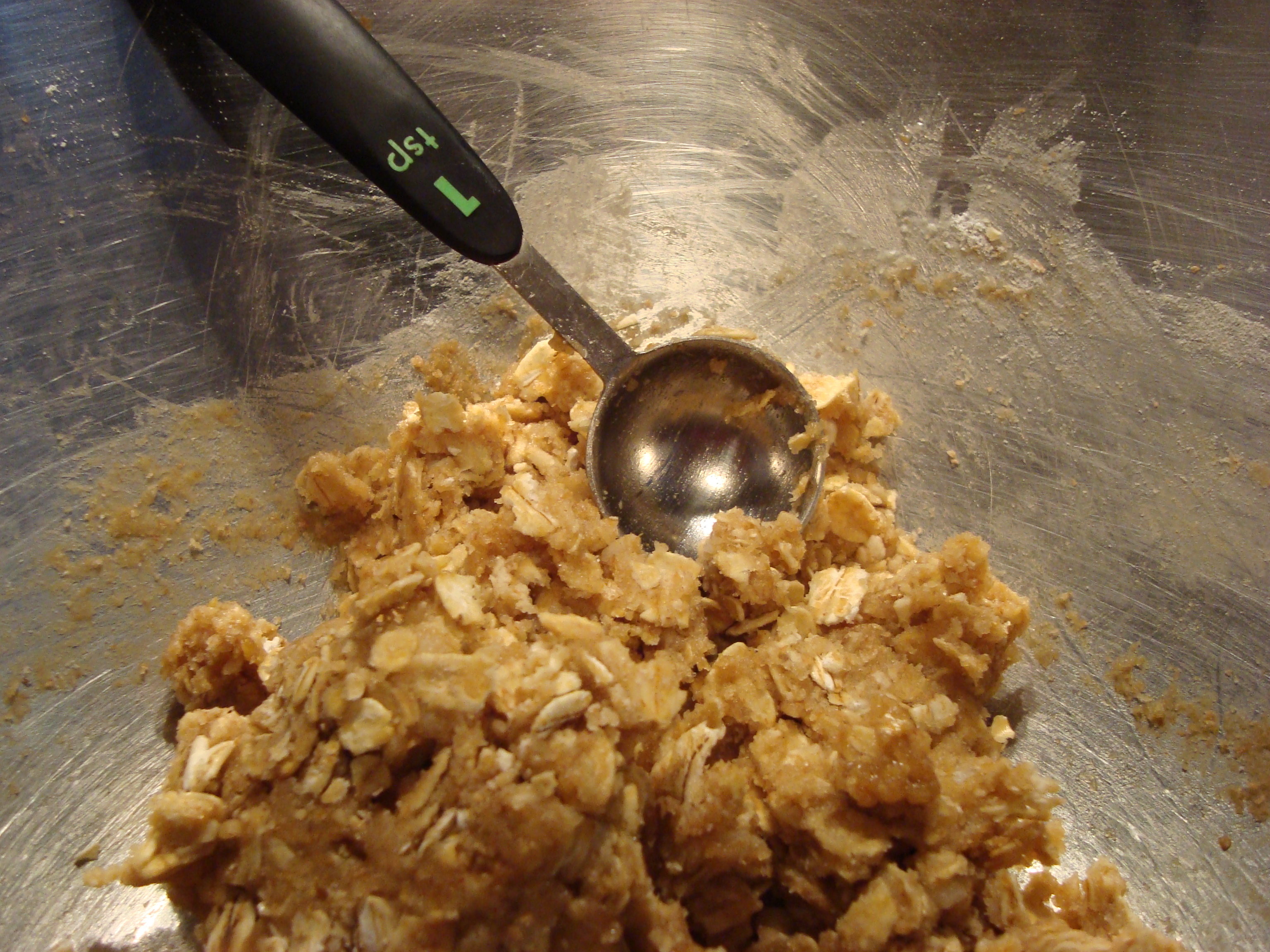
There was a difference in the batters as well as the final cookies when they came out of the oven. The vegan batter was drier than the low-fat batter. If I were to recreate the vegan recipe, I would add more water for a more moist batter and cookie.
Vegan Batter
Low-fat Batter
Into the over for a quick 14 minutes and both cookies spread a little while baking. I didn’t adjust cooking times at all from the original recipe.
Vegan Cookie
Low-fat Cookie
I was a little disappointed in the nutritional changes. The low-fat and vegan cookies both had fewer calories than the original and no trans fat. These are both heart-healthy changes. The vegan cookies had the same about of total fat and a more saturated fat that the origial due to the coconut oil. I still think that’s more heart-healthy than having a cookie with trans fat. The catch is not to eat so many cookies that the fat starts adding up! Finally, the fiber content didn’t increase as much as I’d hoped.
Per 1 cookie
Original
Low-Fat
Vegan
Calories
70
60
50
Fat
2.6
1.5
2.5
Saturated Fat
0.6
0.5
2
Trans Fat
0.3
0
0
Cholesterol
2.6
4.5
0
Sodium
11
11
8
Carbohydrate
11
11
8.5
Fiber
0.7
1
1
Protein
1.4
1.5
1
The important thing is how they tasted, right? I preferred the vegan cookies because they had a sweet brown sugar flavor, are more oat-ey, and have a nice crispness. The low-fat cookies are softer and moister; but they had a bit of a banana flavor. I don’t know about you; but I’m not looking for banana in my oatmeal cookies! In the future, I’d consider adding dark chocolate chips or walnuts to boost the heart-healthy properties of these cookies.
Whichever cookie you prefer, I hope you now have some strategies for adjusting recipes when baking and that you will enjoy that occasional cookie, even on your heart-healthy diet!
It’s kale cooking demonstration time! Tis the season to harvest greens and we have a lot of them from our organic Ogier Garden where I work so I decided to do a cooking demonstration showcasing our beautiful greens. Recipes included kale quinoa rolls and autumn vegetable soup.I found both of the recipes I used online (credit given with the recipes below) and I adapted them. Give these a try and let me know what you think!
Organic Greens
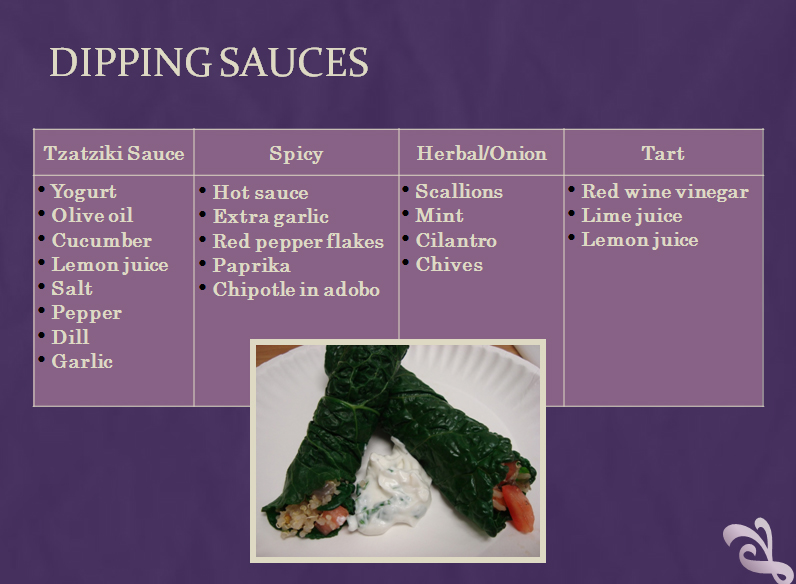
Both of these recipes are vegan. If you are a vegetarian, I do recommend a low-fat Greek yogurt dip for the rolls to increase the protein and calorie content of this meal. Here are some suggestions for flavoring the yogurt to make a yummy dipping sauce. Click to see the image larger in a new window.
Ideas for Greek yogurt dipping sauces
To begin, find some big kale leaves (dinosaur, lacinato or Tuscan varieties) or use collard greens which typically have large leaves. The curly kale will not give you enough leaf to roll with. Here in Jacksonville, Florida, I had no luck at the conventional grocery stores; but found a nice large bunch of organic lacinato kale at Fresh Market for only $2.50!
Preparing the greens is important and for the best results, you’ll want to blanche and devein the leaves. Blanching involves cooking the leaves in boiling water for a very brief time (~2 minutes) and then plunging them into an ice bath. I’ve used both a large bowl and my sink filled with ice-water with success. Blanching will make the leaves flexible enough to roll and brighten up their color. Wait until after blanching to devein the kale so you can preserve as many nutrients as possible, then take a small knife and simply cut out the thick part of the stalk, leaving the top of the leaf intact.
Kale Rolls with brown rice
I will also be packaging the complete cooking demonstration lesson plan, recipes, hand-outs, and evaluation forms into a package that will be available for purchase so you can take the work out of preparing for a cooking demonstration and just do the fun parts! Details will be posted soon.
25 kale leaves, preferably dinosaur kale (large leaves)
1 1/2 cup cooked quinoa
1/2 cup red onion, finely chopped
8 oz white button mushrooms, finely chopped
1 tomato, chopped
2 Tbsp parsley, chopped
1 Tbsp chives or scallions, chopped
1 Tbsp lemon juice
2 Tbsp canola oil, divided
salt and pepper to taste
Directions
Prepare Kale
Bring a large pot of water to a boil
Wash kale leaves thoroughly
Add leaves to boiling water and blanch until softened and flexible, about 2 minutes
Drain and rinse under cold water and pat dry
Remove about 2-3 inches of the thick middle stem from each leaf
This step can be done ahead of time. If not using kale immediately, after cooking, pat leaves dry to remove excess water, wrap all leaves gently in a paper towel, and seal in a plastic bag with air squeezed out in the refrigerator for up to 3 days.
Prepare Stuffing
Heat 1 tbsp canola oil in pan over medium heat
Add onion and cook, stirring frequently, 2-3 minutes
Add mushrooms and cook about 8 minutes, until the water the mushrooms give off has evaporated
Remove pan from heat and let cool
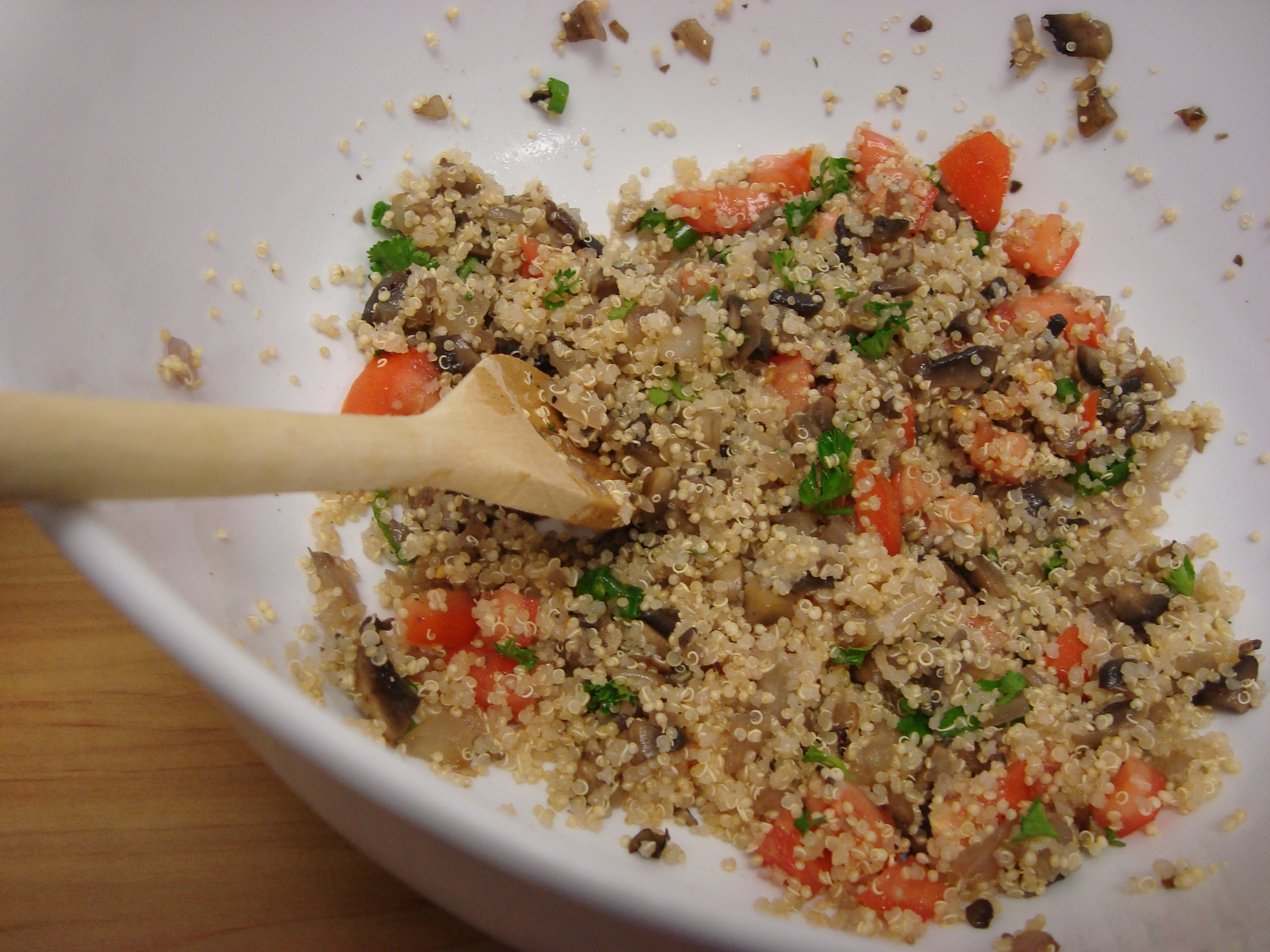
In a large bowl, combine cooked quinoa, cooled mushroom mixture, tomato, parsley, chives, lemon juice, and the remaining 1 tbsp canola oil. Season to taste with salt and pepper.
Cover and set aside
This step can also be done ahead of time. Store covered in refrigerator for up to 3 days.
Make Rolls
Place one kale leaf vein-side down and put 1-2 level tablespoons of the filling in middle of leaf
Fold the leaf from the bottom over the filling
Tuck one side of the leaf over (the other side will remain open)
Roll the leaf into a tight roll and place on plate/platter with edge of the leaf under the roll to keep roll from unrolling
Repeat with remaining rolls
These can be served warm or chilled and can be kept up to 3 days in the refrigerator. If any of the previous steps were done ahead of time, subtract the number of days those ingredients were already stored from the number of storage days.
Makes approximately 20 servings (1 roll per serving): 47 calories, 1.8 g fat (0.1 g sat, 0 g trans, 0.5 g poly, 0.9 g mono), 0 g cholesterol, 15 mg sodium, 202 mg potassium, 6.5 g carbohydrate, 1 g fiber, 2 g protein.
Bring broth and water to boil in large pan over high heat
Add kale, reduce heat, cover and simmer for 10-15 minutes
Add tomatoes and butternut squash, cover and simmer until squash is tender, about 15 minutes
Stir in black-eyed peas, cover and simmer about 2 minutes
Season with salt and pepper to taste
Makes approximately 20 servings (1 cup per serving): 70 calories, 0.5 g fat, 0 g cholesterol, 220 mg sodium, 373 mg potassium, 15 g carbohydrate, 3 g fiber, 3 g protein


















You must be logged in to post a comment.