Tag Archives: nutrition

Who Is the Best Health Professional to Help with Creating New Lifestyle Habits?

With so many options for a finding a health professional to help you move towards your health goals, how do you know how to choose? Let me be clear that your medical doctor is your first partner but you only get so much in-person time there! Let your doctor help guide your decisions about what to work on; then find a health professional to find the best strategies to get it done!

First, figure out how you want to approach your goals – do you want to focus on nutrition, on activity, or on a combination of many things: sleep, stress, time management, consistency, overcoming your typical challenges? This will guide you to the best person to help you. Second – and so important – is to find someone who makes you feel comfortable. Finally, make sure they have relevant education and hands-on experience. You want to make sure it is safe before you put your trust and health in someone’s hands!
smileyfaces

Before jumping in to the many types of health professionals you can choose from, let me start with some key differences.

Nutrition Education / Nutrition Recommendations / Medical Nutrition Therapy.

Anyone, even you, can provide nutrition education as long as you are not paid. You can look up credible guidelines (American Heart Association USDA’s Choose My Plate,  etc.) and share the information one-on-one or in a group as “nutrition education” in general terms. Now, if you decide to charge people for the education, you should probably check out the laws in your state because that changes things. In the 46 states in the U.S.A. that have license laws for nutrition , only certain professionals can (legally) make nutrition recommendations or practice Medical Nutrition Therapy. A nutrition recommendation would be giving you a meal plan or recommending a specific food change/supplement. To illustrate the difference, giving education is saying, “What we know about X is Y;” making a recommendation is saying, “If you are concerned about X, you should do Y.”  Medical Nutrition Therapy / MNT is giving recommendations about a dietary/nutrition approach for any health condition from a gluten sensitivity to heart disease or cancer. This does not involve diagnosing health conditions but it does include dietary “treatment” for health conditions.

Exercise Education / Exercise Foundation / Exercise Training.

Exercise education is like nutrition education. Anyone can speak in general terms about credible information regarding exercise and activity if not paid. An exercise foundation is getting someone started with exercise. It may be assessing you for exercise readiness, screening you to find out you should talk to your doctor first, or helping you start a beginner’s program designed by an exercise agency/trainer, such as an easy walking program. It should not make you breathless, involve lifting anything, or be hands-on exercise guidance one-on-one or in a group setting. Exercise training (personal training) is making recommendations by giving you a workout routine they designed or doing hands-on instruction and guidance (leading you through a work out).

As an aside for both of these definitions of terms: many people are more successful when given education and having a discussion with their health professional about how to apply it. Getting a recommendation is what many people think they want, only to find out those recommendations don’t stick for long. We all know that someone else telling you what to do rarely works for long… we tend to start tweaking things or just straight-up stop, right? A health professional skilled in having the conversation with people about behavior and lifestyle changes can be just as – if not more – helpful in the long-term than someone who can make recommendations.

education plus discussion

Types of Health Professionals

Certified Health Coach. If you want to focus in many areas, this is your go-to professional! Just know that there are many different types of coaching certifications with some being intensive and some being laughable – so ask questions. The more intensive certifications can require a NCCA-accredited certification/license or an associate’s degree in a health-related field as a prerequisite, followed by additional education (classes, readings, practical videos, critiqued practice of coaching skills) and a proctored exam. They can coach you in many areas of health and wellness including nutrition education, exercise education (and possibly building your exercise foundation), sleep, stress, time management, consistency, overcoming challenges, etc. They should also be skilled in motivating you to change and dispelling health myths.

Certified Personal Trainer. For exercise, this is your go-to professional! The same agencies that certify Health Coaches may also certify Personal Trainers so the requirements for this certification are similar except that only a high school diploma and current CPR certification are required. Personal Trainers can do exercise education, foundation, and training. They will know how to work around any injuries you have; but they cannot diagnose or treat injuries (that’s medicine) or help with injury recovery (that’s physical therapy). They can lead you through workouts or design an exercise program for you to follow on your own. For nutrition, dig a little deeper into their training. Legitimately credentialed personal trainers will have some education in nutrition and they can obtain extra certifications in nutrition (quality of programs vary); however, they are limited to nutrition education.  They should also be skilled in motivating you to change and dispelling exercise myths.

Registered Dietitian / State-Licensed Nutritionist. For nutrition, this person is your go-to professional! They will have an undergraduate (or master’s) degree in health / nutrition science and have completed 1,200 hours of hands-on practical internships. They can do nutrition education, make recommendations, and provide MNT. “Registered Dietitian” and “Dietitian” are legally protected titles in most U.S. States. “Licensed Dietitian/Nutritionist” is a title for those who have a license from their state’s Department of Health (same as a medical or trades license). In terms of exercise, they can provide exercise education and let you know if your “calories burned” part of the energy equation is low; but they cannot do any exercise foundation or training work with you. They should be skilled in motivating you to change and dispelling nutrition myths.

Nutritionist / Nutritionalist / Nutrition Counselor / Etc. Go make yourself a web page and business card – I’ll wait – congrats you are now a nutritionist! Would you put your health in the hands of someone simply because they have a good eye for design and a compelling way with words? Or because some new and interesting eating or exercise thing they did worked for them? Please be smarter than this. Some “schools” will give people a nutritionist title and it may mean nothing (very little training) or it may be more intensive; either way, unless they are a “licensed nutritionist” they can still only legally do nutrition education in many states. Ask questions before working with someone with this kind of title.

Mental Health Counselor. At times (lots of times), food and exercise issues are rooted in emotional and mental health. The previously listed health professionals help you with the “outside work” (doing things) and can help you work through some of the smaller internal mental challenges with creating new lifestyle habits. They can also help you identify if some more involved “inside work” (thinking things) might be helpful and refer you to a therapist. This is a great person to have on your team; just be sure to find someone state-licensed.

Where do I fit in? I’m so glad you asked!

I am a Certified Health Coach (American Council on Exercise), Registered Dietitian, and State-Licensed Dietitian/Nutritionist (Florida); but my approach is different from many other RDs.

I have had clients tell me they were not interested in working with me because I am an RD; but they gave an RD one last try. After a while, they confessed this to me that all they got before were handouts and food rules and it was not helpful. There was no flexibility; just “here, do this.” Thankfully, I do not speak about all RDs here – as practitioners, we are as different as the people you will find in any other helping field.  You will not get a handout, some food rules, and a plan from me and I will not tell you how you should go about reaching your goals. Someone else’s plan (even mine!) will not work for you for long – and it certainly does not get you near the goal of making changes stick for a lifetime.

My job as I see it is to help you examine your goals and how they fit into your lifestyle, break your food rules, and explore the many options you have to reach your goals. Then we set about finding a few small, flexible, realistic ways for you to move towards those goals. I will not tell you what you should or should not do.

Don’t enough people already try to tell you what to do?

Yours in Good Health,

-Alexia Lewis RD

This article is Part 2 of 4 in “Health versus Weight as a Focus for Wellness.”

Part 1: The Continuum of Approaches to Health: Thoughts from a Curvy and Healthy Dietitian Health Coach

Part 3: If Diets Don’t Work, How Can a Health Coach Help Me?

Part 4: What Is This No-Diet / Anti-Diet Thing Anyway?

References & Resources:

Health Coach Certification, American Council on Exercise: https://www.acefitness.org/fitness-certifications/health-coach-certification/default.aspx

ACSM Certified Personal Trainer, American College of Sports Medicine: https://certification.acsm.org/acsm-certified-personal-trainer

5 Steps to Become a Registered Dietitian Nutritionist, Academy of Nutrition & Dietetics: http://www.eatrightpro.org/resource/career/become-an-rdn-or-dtr/high-school-students/5-steps-to-become-a-registered-dietitian-nutritionist

Essential Oils – raffle and coupon!

Simply Earth provided an “Essential Oil Recipe Box” to me free of charge in exchange for a blog review. Yes, this is #sponsored quid pro quo – all opinions in my reviews are mine and I if love it or hate it, I’ll let you know.

I don’t know a lot about essential oils (EO). I think they smell good. I like the cool lavender towel I get at the end of yoga class. I think rose essential oil smells delicious. Some of my colleagues have switched from being hospital dietitians to selling EO. My neighbor also sells them and the bug spray she gave me seemed to keep the mosquitoes away for a short time until the scent wore off.

If you know me, you know I’m a firm believer in science and evidence-based practice and I do my best to educate people on what is and is not upheld by research because there is way too much crap out there and way too many people who are making a buck off people who haven’t had the education or experience – or the time! – to sort it all out. #WooFighter #StandforScience Yep that’s me.

My concern with EO is ingesting the oils. EO are highly concentrated and there is zero regulation as they are non-food products. Some will come with trademarked business phrases designed to make consumers think they are certified and regulated for eating or drinking– but they are not. Just as I don’t recommend unverified supplements (pills), I do not recommend ingesting EO. After learning Simply Earth tests their EO with gas chromatography and mass spectrometry to verify that what is on the label is actually in the bottle and that their “recipes” were for yummy-smelling things and not for drinks or foods, I was more than happy to review a recipe box. They also donate 13% of their profits to end human trafficking and the source materials are GMO-free if that’s a concern for you.

When the box arrived, I was excited to see that it is a holiday recipe box and the smell immediately stirred up memories. I was brought back to when my family had a live Christmas tree and my mom would use the fallen pine needles to make pillows. Yes, they could be prickly but with some adjusting they made a deliciously comforting place to lay my head as a little girl. I was reminded of cold walks through parking lots re-purposed as tree sales lots and the fun of being the one to pick out the tree for the family. Did I mention we lived in a loft in NYC with ridiculously high ceilings? We got monster trees back then. These scents brought all these memories back – and this was still while they were in the box!

eo-box

The box contains:

Essential Oils: frankincense, rosemary, pine, a “happy joy” blend, and a roller called “curb hunger”

Recipes: 5 different recipes for a “Christmas Air Freshener” to be placed in a jar with baking soda to absorb odors and provide a holiday scent, a “Christmas Tree Blend” and a “Christmas Diffuser Blend” to be used with a diffuser, a “Holiday Home Scent Spray,” and a recipe to make “DIY Scented Ornaments.”

Supplies included! The box also holds the mason jar and a permeable paper jar cover for the air freshener, the spray bottle for the spray, and two small bottles for mixing up the recipes along with labels for the bottles and ribbons/twine to use for the ornaments you can make.

As a newbie to EO, this box gives me all the supplies and instruction I need to get started. Simply Earth offers a monthly recipe box program for $39.95 a month which will have the EO, the recipes, and containers. I do recommend this box for those who want to start benefiting from EO. Each box will contain 6-7 different recipes with a new theme each month, 5 full size bottles of essential oils, labels and containers to make your recipes – and they have videos to help you with the recipes!

Raffle!

I wish I could keep this box but I’m raffling off all the supplies for the holiday recipes in the box. One lucky person will win this box at the Surviving the Holidays Workshop on November 14 (Monday) at 6pm! (Must pre-pay to enter the raffle).

logo-orange

Coupon

If you read this far, you deserve a reward! How about a coupon for a free diffuser when you sign up for a subscription box?

Add BOTH Simply Earth’s essential oil recipe box AND the diffuser in your cart AND USE coupon code: YOGAFREEDIF.
Click here to check out the diffuser https://simplyearth.com/products/essential-oil-diffuser
AlexiaLewisRD gets no kick-back or any type of payment or compensation from any orders. 

Willpower – Psssshaw.

On average, I talk to about 30-40 people every week who are working on reaching their health goals using food and nutrition. Sure, we talk about food and calories and all that fun dietitian-stuff; but more often than not, the issue is not what or how to eat. Google yourself a nutrition question and you’ll get everything from solid evidence-based advice to some crazy woo-promoting ideas. Information on what or how to eat is everywhere.

The issue is putting that knowledge into practice. The issue is in the decision at 3:00 pm when your tummy rumbles and you frown at the bag of cucumbers and hummus you have packed for your snack and start thinking about that vending machine down the hall. The issue is in that coffee meeting when you really want that mocha frap with extra whip instead of a plain iced coffee. The issue is in having to work late and now it is 7pm and you feel like you’ve earned those drive-through fries even though you’ve got an already prepped dinner waiting on you at home.

How do you make the more healthful choice when you don’t want to?

You tell yourself – and you tell me – that you just have to make yourself do it.

Oh no. Do not rely on being able to MAKE yourself do something if you really want to success. It is ridiculous to use willpower for food choices.

Think about it. You see an amazing new whatever in the store and you want it. You rely on will power to walk by and then you’re done, you leave the store and it’s no longer easy to get that whatever. Now imagine that whatever is yummy food in your pantry and that store is your living room. You don’t get the benefit of leaving and having the decision be behind you. You have to make the decision to ignore that yummy food about, oh, every 60 seconds. I don’t think that many people could do that – okay, maybe for one night – but for every minute of every night? No way!

We know some things about willpower that can help us. Here is what the evidence reflects:

  1. Willpower is limited. You only get so much and then it’s gone.
  1. Willpower is used up over the day. We chip away at willpower with stress, emotions, and all those little decisions we make until there is none left to keep you away from that yummy food in the pantry by the end of the day.
  1. Willpower resets every night – great news! This is why you can wake up every morning and tell yourself: Self, today is THE day that I make it happen!

My advice is don’t set yourself up to have to rely on willpower. Instead do whatever you have to do to make the healthy choice the easier choice.

  • Modify your environment so you see the healthy choices more regularly
  • Plan and prepare for meals/snacks
  • Carry snacks with you when away from home
  • Have a plan for the gas station stop or a drive through or that day-long meeting
  • Plan any tempting situations for morning when you have the most willpower. Need to catch up with a friend? How about a breakfast date instead of happy hour?
  • Use mornings to plan, shop, exercise – do whatever it is that is the hardest thing for you in the mornings!

Just to be sure though, practice saying no to temptations and people just in case you have to draw on some of that limited willpower. My hope for you is that you don’t resort to “I just have to do it” and rely on willpower because then it’s a crap-shoot.

How will you change your environment or social situations so you can be successful without relying on will power?

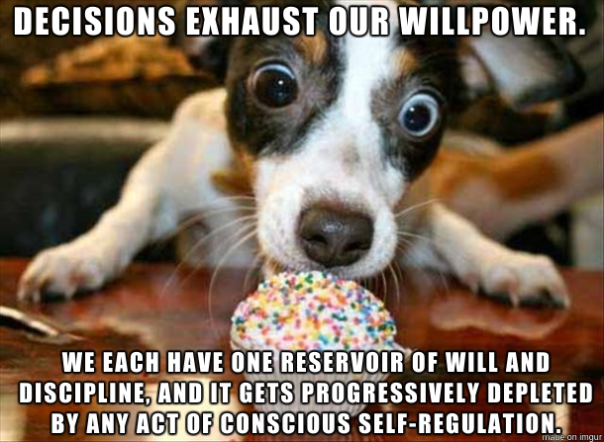
willpowerdog

Image from: http://pandawhale.com/post/44157/decisions-exhaust-our-willpower-we-each-have-one-reservoir-of-will-and-discipline-and-it-gets-progressively-depleted-by-active-choices

Another Study on Splenda: Mice, Cancer, and Ridiculous Advice

I just came across a blog titled Splenda Possibly Linked to Cancer, New Study Finds. I use Splenda. Daily. So I checked this out. Turns out the study was released in January, six months ago; but it was worth investigating since if it popped up in my Facebook feed, it was probably popping up in others.

In short – mouse study, blood cancers (leukemia), high doses equivalent to 10 cans of soda a day in people, and the CSPI, which has a lovely tool to rate foods, has changed its status to “avoid.

There is a link to the journal article in the blog which give a little more detail for consideration.

  1. The mice started being exposed prenatally. Chances are many little ones probably are also exposed during this stage if their moms use Splenda so let’s move on.
  1. Cancers only manifest in male mice. This is a place to pause. Why only in males? Assuming we can we extrapolate these results out to humans (possibly but not a definite), then do they apply to females? Are only males at risk? This is something that needs more investigation!
  1. The mice were given multiple doses measured in parts per million (ppm). The male mice developed cancer at doses of 2,000 and 16,000 ppm but NOT at 0, 500, or 8,000 ppm. Okay, let’s pause again. If Splenda is the reason for the cancers, we would expect that the higher the dose, the more cancers. So why yes-cancer at 2,000 ppm, but no-cancer at 8,000 ppm, and then yes-cancer again at 16,000 ppm. This is an unexpected result which needs more investigation!

So, file this study away under the developing story of Splenda but this is not the type of study that will lead to a blanket-statement and declare that all people must avoid Splenda! Well, except for the CSPI I guess.

Oh, and I can’t forget my favorite part – the ridiculous part – where the CSPI president is quoted as pointing out “that consuming too much regular sugar carries a higher risk of diabetes, heart disease and obesity than the cancer risk posed by artificial sweeteners.” Yet his organization now says to AVOID Splenda and CUT BACK on sugar.

So… let me see if I understand. Yes there is a high risk of big-bads from regular sugar versus low risk of big-bads from alternative sweeteners; soooo avoid the thing with the lower risk? What??? Makes sense to me (NOT!).

I routinely talk to my patients with type 2 diabetes and explain this exact thing. The chances that you will have negative health outcomes (high blood sugar) by using real sugars is pretty much a given unless the dose (amount) and meal composition (what do you eat it with) are pretty well designed. Having high blood sugar over the long-term can have some pretty devastating results (kidney disease, losing toes and vision). Compare that to the chances that you will get cancer from using alternative sweeteners, which is pretty low (unless you are downing a LOT of the stuff!).

What surprises me is that many people choose sugar over the alternatives. Thanks documentary-makers and media celebrities for ruining sugar’s reputation. To be clear, I don’t promote using a LOT of the natural OR the fake stuff – I promote letting your taste buds adjust to LESS sweet flavor in food and using very LITTLE of whichever one you choose.

Good news – it is YOUR decision what to choose.

Me? I’m sticking with my Splenda for now. What about you?

Meal Plan Yumminess

It’s been a while since I posted a meal plan and I’m back with a delicious week of meals to share with you. I’ve been faithfully planning and prepping and have started to get a little bored with the same old meals. This week, I added a few new recipes.

Do as much prep as you can over the weekend. I chop omelet veggies, make overnight oats, boil eggs (last 5 days if they don’t crack!), make mason jar salads, and do whatever else I can to prepare ahead of time. Notice this week is heavier in cooking the first few days but then relies on leftovers to get through the week.

Not listed is a Chocolate Chia Pudding dessert I’ll be making when I sign off from here because chocolate. Yum.

Sunday: 

B – Egg white omelet made with egg whites, shredded cheddar/jack, onions, mushrooms, and spinach served with a piece of toast with olive oil butter. TIP: Do your breakfast prep for the week by chopping onions and mushrooms that have been cleaned with a paper towel (no water!) and storing in mason jars – you still have to cook; but the chopping is the time-consuming part so this saves time in the morning!

L – White Bean Caprese Salad (added chopped raw videlia onions) served on spinach/romaine lettuce.

D – Baked tofu (press, cube, toss with Italian salad dressing and bake) mixed with zucchini carpaccio (pictured with this blog). Note to self: invest in a mandolin.

S – Boiled egg; cucumbers and Zesty Carrot Hummus – you seriously must try this! DELISH!

Monday:

B – omelet with toast

L – Loaded Sweet Potato

D – Strawberry Cucumber Salad (with balsamic glaze – yes please!) and (Chicken) Sausage Stuffed Zucchini Boats. 

S – Apple with Laughing Cow Cheese

Tuesday:

B – Overnight Oats (were prepped over weekend so easy breezy breakfast) with a sliced banana.

L – Leftover White Bean Caprese Salad on lettuce/spinach

D – Leftover Sausage Boats and Strawberry Cucumber Salad

S – Kefir and blackberries

Wednesday:

B – Overnight Oats with banana

L – Leftover Loaded Sweet Potato

D – Baked fish, steamer vegetables, quinoa

S – Egg salad (egg, mayo) with carrots

Thursday:

B – Overnight Oats with banana

L – Mason Jar Salad (prepped over weekend) with a boiled egg and blue cheese crumbles

D – Fish Bowls (leftover fish, quinoa, chipotle, jalapeno, veggies, sour cream – whatever is on hand and needs to be eaten but with a Mexican twist).

S – Apple with carrot hummus

Friday:

B – Omelet with toast

L – Leftover Loaded Sweet Potato

D – Turkey burgers (tomato, lettuce, red onion, avocado, cheese) and fries (yes – the splurge meal happens for me too!)

S – Kefir and blackberries

Saturday: 

B – Overnight Oats

L – Mason Jar Salad with tuna packet (buffalo tuna is so yum).

D – Turkey Burger Bowls (chopped burger, lettuce, tomato, pickles, blue cheese and the rest of the chopped food that needs to be eaten!

S – Carrots with carrot hummus

Thanks for the inspiration as always to Clean Eating Magazine (just the recipes please people, not the articles! Food is NOT “clean” or “dirty” unless of course, it needs to be washed), SkinnyTaste (easy, low calorie, and crazy good recipes) and this week to my new find, Minimalist Baker.

Let me know if you try any recipes this week and if you like the Meal Plan posts!

Spiralized Sweet Potato

Happy New Meal Planning!

I returned to work today and the majority of people are focusing on meal planning as their current focus with their renewed enthusiasm of a new year. Meal planning and preparing foods ahead of time is a wonderful way to have a successful week in terms of meeting your nutrition goals. Two quotes come to mind:

  1. Ben Franklin is purported to have said: He who fails to plan, plans to fail.
  2. Mel Robbins kind of said (forgive me Mel, I paraphrase your Ted talk): You can have anything you want – it’s simple; but it’s not easy.

By the way, I really encourage you to invest 20 minutes in watching Mel’s Ted talk. I watch it every time I need a  motivation boost.

In the interest of helping others who struggle with meal planning, I decided to share my meal plan for this week and links to recipes where possible. I warn you though, this takes time and effort. Expect to spend a good 4 hours in the kitchen… but then relax because your food for the week is DONE!

Sunday:

B = egg white omelet with mushrooms, onions, spinach, shredded cheddar cheese(veggies chopped on Sunday for the week), L = green salad (veggies chopped on Sunday for the week) with Asian Sesame dressing with chicken salad (canned chicken, olive oil mayonnaise, red onion, celery, red grapes, black pepper); Zesty Lime Shrimp and Avocado over brown rice, vegetable soup (garlic, onion, tomato, zucchini, low sodium chicken broth, black pepper, red pepper flakes, basil).

Monday:

B = overnight oats (made for week) with oatmeal, unsweetened almond milk, chia seeds, peanut butter powder, cinnamon, cocoa powder, and vanilla extract with banana sliced into it in the morning, L = Zesty Lime Shrimp on romaine, D = Mexican Sweet Potato Casserole, broccoli, Snacks = yogurt, crackers.

Tuesday:

B = omelet, L = tofu sandwich (chipotle baked tofu, lettuce tomato, whole wheat bread), vegetable soup, D = Mexican Sweet Potato Casserole, brussels sprouts.

Wednesday:

B = omelet, L = green salad with chicken salad, vegetable soup, D = pork chop, edamame pesto pasta (copied from a recipe book so can’t link sorry!) with grape tomatoes, sauteed squash and mushrooms.

Thursday:

B = oatmeal, L = tofu sandwich, vegetable soup, D = pork chop, leftover pasta, green salad.

Friday:

B = omelet, L = green salad with chicken salad, D = Mexican Sweet Potato Casserole (from frozen), broccoli.

Saturday:

B = omelet, L = sandwich, crackers, D = a leftovers meal with whatever remains!

My snacks aren’t planned day by day but they include celery/carrots with hummus or peanut butter; yogurt with grape nuts; or crackers with cheese.

I hope this helps!


D-vine Orange Chipotle Cod

“D”-vine Orange Chipotle Cod: A Dish High in Vitamin D

Vitamin D is one of those vitamins that keeps popping up in the media as beneficial for our health and it’s a vitamin that many of us are lacking. I created a recipe high in vitamin D using Atlantic cod, orange juice, bran cereal flakes, and chipotle. The result was a divine vitamin-D rich Orange Chipotle Cod recipe.

904 Fitness Magazine gave me this challenge to go along with a vitamin D article that is in the May edition. As a dietitian, I love turning to food before supplements so I accepted the challenge!

Facts about Vitamin D

  • According to the CDC, 31% of non-Hispanic blacks, 12% of Mexican Americans, and 3% of non-Hispanic whites have vitamin D deficiency.
  • Vitamin D is called the “sunshine vitamin” because substances in our skin are activated by the UV rays to produce vitamin D. This partially explains why vitamin D deficiency is higher in those with darker skin (which protects against UV rays) as well as those who live in climates with less sunshine or who spend more time indoors.
  • The recommended amount of Vitamin D for adults between 19-70 is 600 IU (international units) per day. A deficiency may cause bone issues such as bone pain, muscle pain or spasms, osteomalacia (soft bones), and rickets in children.
  • Since many people supplement, I’ll also give you the tolerable upper limit, which is 4,000 IU per day. Research is ongoing that is looking at the effects of large amounts of Vitamin D so these recommendations may change in the future. A toxicity may cause bone loss and kidney stones – you cannot overload on vitamin D from sunlight.
  • Vitamin D is important for calcium absorption and bone health. It’s being researched for its impact on heart disease, cancer, immune function, type 2 diabetes, blood pressure, and many other things.

I’m a light-skinned white dietitian who lives at the beach in Florida and even I had low enough levels of vitamin D that my physician put me on supplements! So, it is difficult to get your D when you rely on sunshine and foods.

Here’s why it is difficult to get enough vitamin D (600 IU) from foods… unless you are willing to swallow cod liver oil or can afford to eat salmon every day!

Food Amount IU (average) Source
Cod liver oil 1 tablespoon 1,360 Natural
Swordfish 3 ounces 560 Natural
Portabella mushrooms (with UV exposure) 1 cup 450 Natural
Salmon/mackerel (fatty fish) 3 ounces 425 Natural
Tuna (light, canned) 3 ounces 200 Natural
Fortified orange juice 1 cup 115 Fortified
Fortified milk 1 cup 115 Fortified
Fortified yogurt 6 ounces 80 Fortified
Fortified cereal 1 cup 70 Fortified
Sardines (canned in oil, drained) 2 pieces 50 Natural
Egg yolk 1 large 30 Natural
Portabella mushrooms (no UV exposure) 1 cup 10 Natural

Note that the fortified foods give an average for the IU of vitamin D and the actual amount can vary quite widely based on the level of fortification. When I was looking for cereals for my recipe, I found cereals with 0% to 25% of the daily value of vitamin D! It’s important to look at the labels for the fortified foods you choose. Also, notice that mushrooms contain much more vitamin D if they have been exposed to UV light. Since the packaged mushrooms in my store didn’t mention UV light on their labels, I asked my grocer about the mushrooms in the store and he had no idea if they were UV-exposed.

I turned to fish and fortified foods to make a “D”-vine Orange Chipotle Cod dish that has 32% of the daily value (~ 200 IU) of vitamin D and packs a nice little spicy kick. This recipe is also heart-healthy with low calories, low saturated fat, no trans fat, and low sodium. It is a little higher in cholesterol than I’d like; but still within heart healthy recommendations.

D-vine Orange Chipotle Cod (click link for a printer-friendly version)

Makes: 4 servings

Ingredients

Orange Chipotle Sauce

  • Chipotle in Adobo: 1 chipotle pepper, de-seeded and chopped plus 1 Tablespoon sauce
  • 1 cup vitamin D fortified orange juice
  • 1/4 cup vitamin D fortified plain non-fat yogurt

Fish

  • 2 large eggs
  • 2 cups vitamin D rich (25% DV) bran flakes cereal
  • 4 6-ounce Atlantic Cod filets
  • Non-stick cooking spray

Directions

Preheat oven to 450° F. Line baking sheet with tin foil and spray with non-stick cooking spray and set aside.

When preparing chipotle peppers, or any hot pepper for that matter, remember that the heat is mostly in the seeds. Chipotles pack a spicy punch so remove these little seeds before chopping to reduce the kick in the sauce.

Deseeding Chipotle Peppers

Begin sauce. Pour 1 cup orange juice, chipotle pepper, and chipotle sauce into small saucepan and heat until mixture just begins to boil. Reduce heat to low and simmer, stirring frequently to prevent sticking until mixture thickens, approximately 35 minutes. Set aside when done.

The thicker drops show that the sauce has begun to thicken - it will continue to thicken after removed from the heat.
The thicker drops show that the sauce has begun to thicken – it will continue to thicken after removed from the heat.

In a shallow bowl, crack eggs and stir to combine yolk and white. Pour bran cereal into another shallow bowl and use measuring cup or the back of a spoon to crush the cereal into small pieces.

Use the back of your measuring cup as a crushing tool for the cereal
The smaller the flakes, the better the coating!

Rinse fish filets, draw through the egg and then press gently into the cereal to coat the fish with cereal. Place fish on foil-lined baking sheet. Repeat with each filet. Sprinkle any remaining cereal on top of fish.

Having everything prepared and close together makes coating the fish much easier

Bake fish in oven for 20 minutes or until done and flesh flakes easily with a fork.

When orange-chipotle sauce has cooled, combine the sauce with the yogurt and stir to combine.

To serve, top each fish filet with approximately 1/4 cup of sauce.

Nutrition Information per serving (1 fish filet topped with 1/4 cup sauce): 315 calories, 5 grams fat (1 gram saturated fat, 0 trans fat), 174 milligrams cholesterol, 375 milligrams sodium, 26 grams carbohydrate (3 grams fiber), 37 grams protein, and 32% DV of vitamin D.

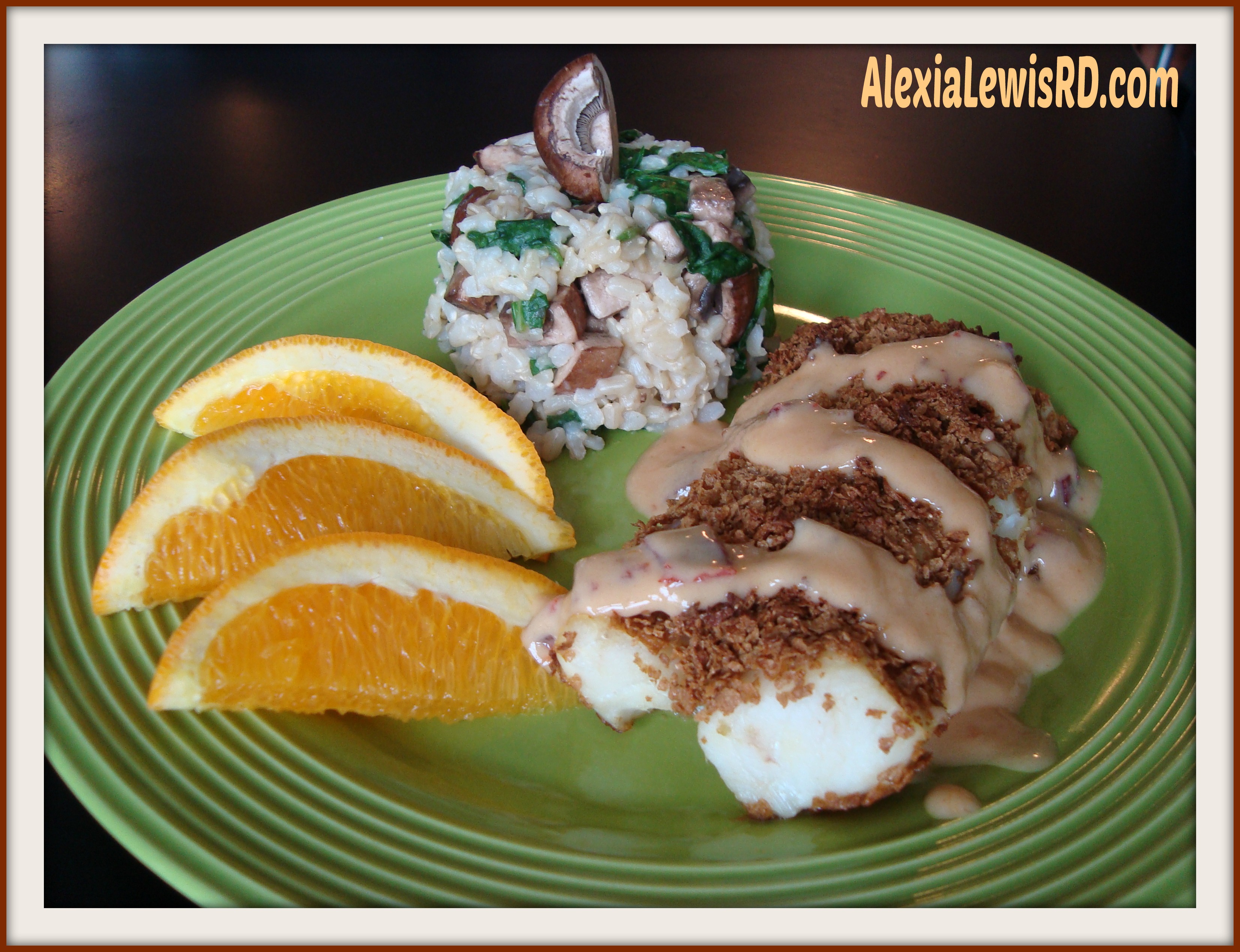
Served with brown rice mixed with chopped mushrooms and spinach – enjoy!

D-vine Orange Chipotle Cod

References as linked above, Nutrition: Concepts and Controversies, and the Linus Pauling Institute.

A Weekly Meal Planner

“ASPIRE” – Six Steps to Healthy Meal Planning

The one best thing you can do to make healthier, nutrition-rich meals, save time and money, and make life easier is to plan your meals ahead of time. You need a strategy to plan healthy meals. If you wait until you are hungry and tired at the end of the day, figuring out what to make for dinner is not easy and you’re more likely to choose something fast, easy, and unhealthy. However, this is one of the things that my clients find the hardest to do.

I’m here to help you “make nutrition easy,” so here is my strategy for you.

Grab some paper, a pen, and ASPIRE to plan your meals. Remembering this acronym will guide you through a simple way to plan meals that are healthy, yummy, and reduce your grocery expenses! I designed my free Weekly Menu Planner just for this! You can use any format as long as you have one column for each day of the week.

A = Agenda

The first thing to do is check your agenda for any commitments, meetings, and changes to your usual schedule. Also check the calendars of the others in your household. This is important so you know which nights you have time to make a meal and which nights you don’t and should plan for leftovers. It also lets you know which nights you need quick and easy meals and which nights you can spend more time on your meal creations. You can also note the days that you have to be out of the house early and may benefit from packing your a lunch the night before. Write down everyone’s commitments that have an impact on meals on the weekly menu planner.

S = Stock

What do you already have on stock, on par, or in your pantry and fridge? Flip your weekly menu planner over and make a list of all the foods in your fridge and pantry (your “stock foods”) on the left side of the back of the paper.

P = Promotions

Check the store promotions. What is on sale this week? What do you have coupons for? We all want to stretch our food dollars and this is one way to do it. If you don’t clip coupons, go to the grocery store’s web site as many are now allowing their customers to electronically collect coupons on reward cards or by their phone number. You can also check one of my favorite coupon sites, Southern Savers, for printable coupons. On the right side of the back of your weekly menu planner, write down the “promotions foods” you plan to buy based on sales, coupons, and promotions.

I = Invent

Put on your creative chef’s hat, and invent meals you can put together using only foods on your list of “stock foods.” If you can’t make anything with what you have in stock, then figure out what you can add from the list of “promotion foods” to make a meal with your  “stock foods”. The idea is to use as few foods from the “promotion foods” list so you make as many meals as you can without spending money on new foods! Once you have invented a few meal ideas, flip your weekly meal planner over and put the meals where they fit best based on your schedule.

A Weekly Meal Planner

Tips

  • Google is your friend. I made this delicious Puff Pastry Tart just by putting “puff pastry,” “spinach,” “sweet potato,” and “healthy easy recipe” into Google!
  • Cook more than you need so you have leftovers from every time you cook! A few tweaks and one night’s baked chicken, sauteed mushrooms and zucchini, and brown rice transform into the second night’s chicken quesadillas.
  • Make the first meal on your weekly planner one that you have all the ingredients for… just in case you don’t make it to the store right away.
  • This is the hard part and it takes time – so save every weekly meal planner you create to re-use for those weeks you don’t want to spend the time and effort doing all this work.
  • Use the food group tallies on the bottom of my weekly meal planner to make sure you are including food from all food groups in your meal plans. Don’t know how many of each food group to include? Here’s a guideline based on a 2,000 calorie diet.

R = Run

Get out and run those errands! Use your list of “promotions foods” to make a shopping list. Clip your coupons. Go to the grocery store and do your shopping.

E = Execute

You spent all that time and effort making a plan, now execute your plan.

Post the weekly meal planner in the kitchen where you can see it. If you have helpers at home, let them know they can start prepping foods for dinners before you get home.

Most importantly, be flexible. This plan is an outline and life happens. You may have forgotten you need fish for one dinner… just push that meal back to another day. You may decide that you are way too tired to cook one night… just pick up your plan the next night.

Always have a Plan B Meal in mind. In my home, it is either flatbread pizza or turkey burgers and sweet potato fries. We always have the ingredients in stock  and, on those nights we aren’t feeling our meal plan, we have a yummy 20-minute, low-effort dinner.

Let me know if you like my strategy. I hope you ASPIRE to give meal planning a try this week!

Delicious, Easy, and Healthy Vegan CrockPot Quinoa Chili

Eat More Beans! Crockpot Quinoa Chili Recipe (Vegan)

Imagine this. You are in the grocery store and you need to buy some beans. In one hand, you hold a can of beans. In the other hand, you hold a bag of dried beans. Which one do you buy?

You probably consider a few things before you decide.

The first consideration may be convenience. The canned beans are ready to go. You can throw those in the microwave and have hot, cooked beans in just a couple of minutes. The dried beans will take much more time because you have to soak them for many hours and then cook them for another couple of hours. Do you have time for this? Do you know how to cook dried beans? Will you forget and then have to come up with a Plan B dinner?

The second consideration may be nutrition. Beans are a nutrition-packed food! If you cook dried beans, then in 1/2 cup of black beans you get 7 grams of protein, 20 grams of carbohydrates, 14 grams of fiber, and 10% daily value of iron with only 115 calories, 1/2 gram of fat, and no cholesterol or sodium! If you choose the canned beans, much of this stays the same; but you get more sodium. If you choose regular black beans, that 1/2 cup can have 500 milligrams of sodium and reduced sodium black beans can have 240 milligrams of sodium. Some canned products are also packaged in cans that have BPA.

Many people don’t consider cost because those other two things are more important. A 15 ounce can of beans gives you approximately 1 3/4 cups of beans for $1.00 to $3.00. A 16 ounce bag of dried beans contains 3 1/4 cups of dried beans which gives you about 9 cups of cooked beans for about  $1.00 to $2.00. If you do the work of cooking dried beans, you get about five times a much for your money!

I used dried beans most of the time and save canned beans for when I don’t want to rely on myself to remember to cook dried beans the day before I need them or I decided on having beans for dinner on the day I grocery shop. I went in search of dried bean recipes that eliminated the need to cook the beans the day before. After reviewing a few recipes for cooking times and methods and a few trial runs, here is what I ended up with.

Crockpot Quinoa Chili

Makes 9 cups cooked chili

Prep time: 15 minutes, Cook time: 6 hours 15 minutes

Skill level: low

Ingredients

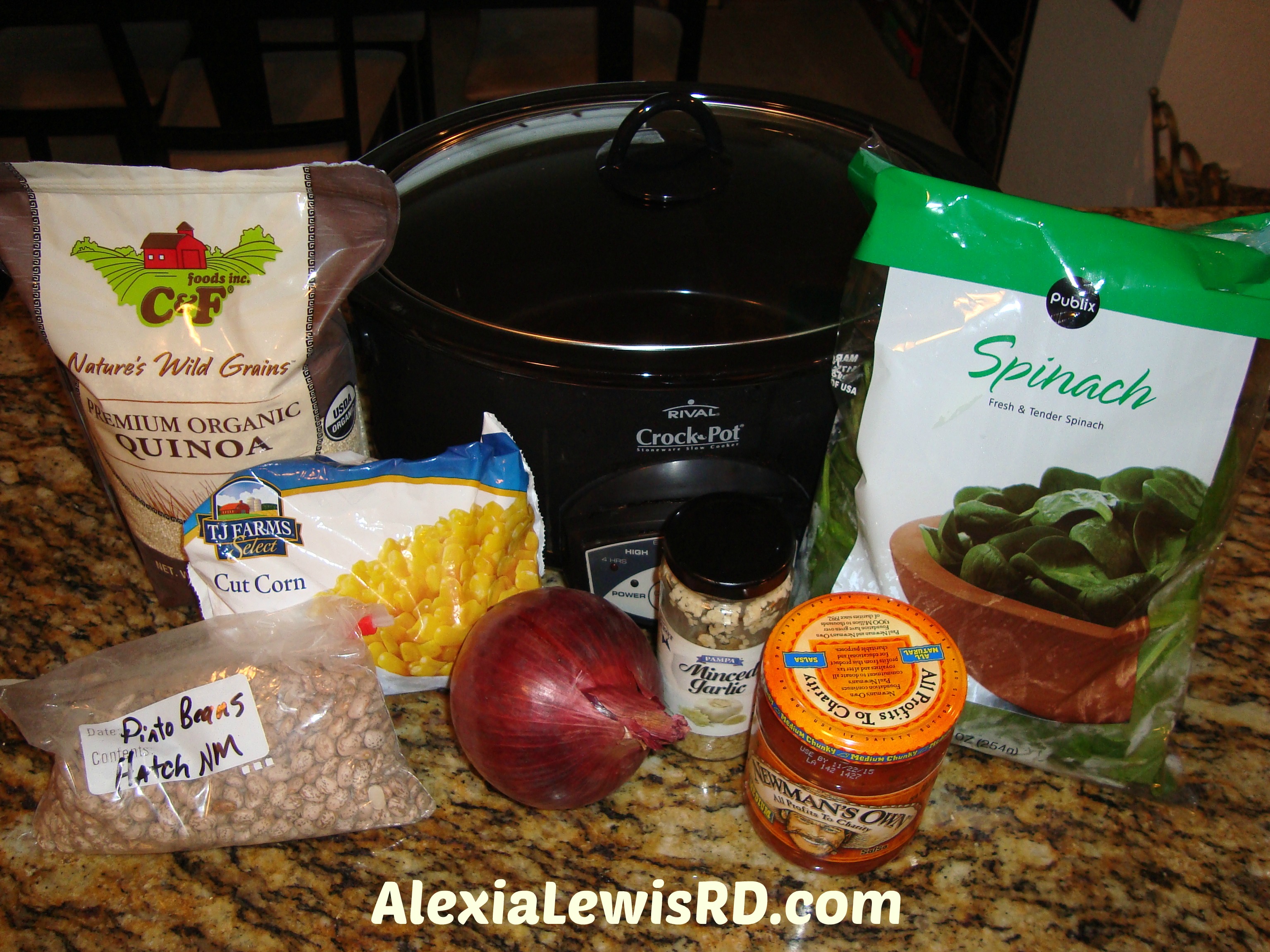
1 1/2 cups dried pinto beans

1/2 cup uncooked quinoa, rinsed

1 teaspoon or 2 cloves minced garlic

2 cups frozen corn

1 package (10 ounces) spinach

2 cups low-sodium salsa

1/2 large red onion, chopped

5 cups water

1/2 teaspoon each: Hot Shot (red/black pepper blend) and red pepper flakes

1/4 teaspoon of each ground spice: turmeric, paprika, cayenne pepper, cumin, and chipotle chile pepper

Quinoa Chili Ingredients
Ingredients – Yes, those are pinto beans from Hatch, New Mexico courtesy of a great neighbor!

Directions

1. Layer all ingredients except spices in crockpot in order listed above.

2. Cook on high heat for one hour and then reduce to low heat for five hours. If home, stir occasionally making sure beans and quinoa stay covered by liquid.

3. Add spices and stir before serving.

Quinoa Chili Start
How it starts…

Nutrition Information per 1-cup serving: 138 calories, 1 gram fat (0 saturated, 0 trans), 0 milligrams cholesterol,  225 milligrams sodium, 34 grams carbohydrate, 13 grams fiber, 8 grams protein.

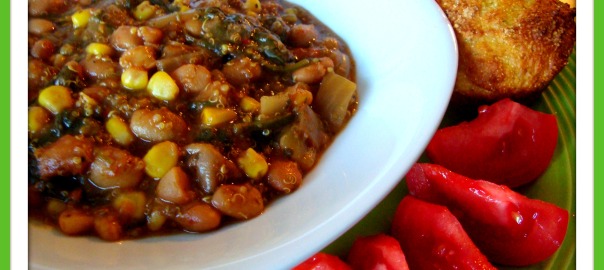
Serving suggestion: Stir in plain Greek yogurt (not vegan!) to cool it down or top with chopped chipotle peppers and hot sauce to kick it up a notch! I added homemade cornbread muffins on the side (also not vegan) following this recipe and sliced tomatoes.

Delicious, Easy, and Healthy Vegan CrockPot Quinoa Chili


Dinner is served!

Weekly Meal Plan: Baked Panko Shrimp and Pineapple Fried Rice

One thing you didn’t know about me until now is that my second job was in a Japanese Steak House where I worked as a hostess. I was young and what I remember most about that job is how difficult it is to dress in a kimono. Below is an old polaroid and the only picture I have from that time… long ago…

Alexia in Kimono 1986

The other things I came away from that job with were a love of sushi and the knowledge that cooked rice should be refrigerated before it is turned into fried rice. With this knowledge, I scoffed at the feedback on the Pineapple Fried Rice recipe, knowing that my fried rice would not be mushy since I knew this trick!

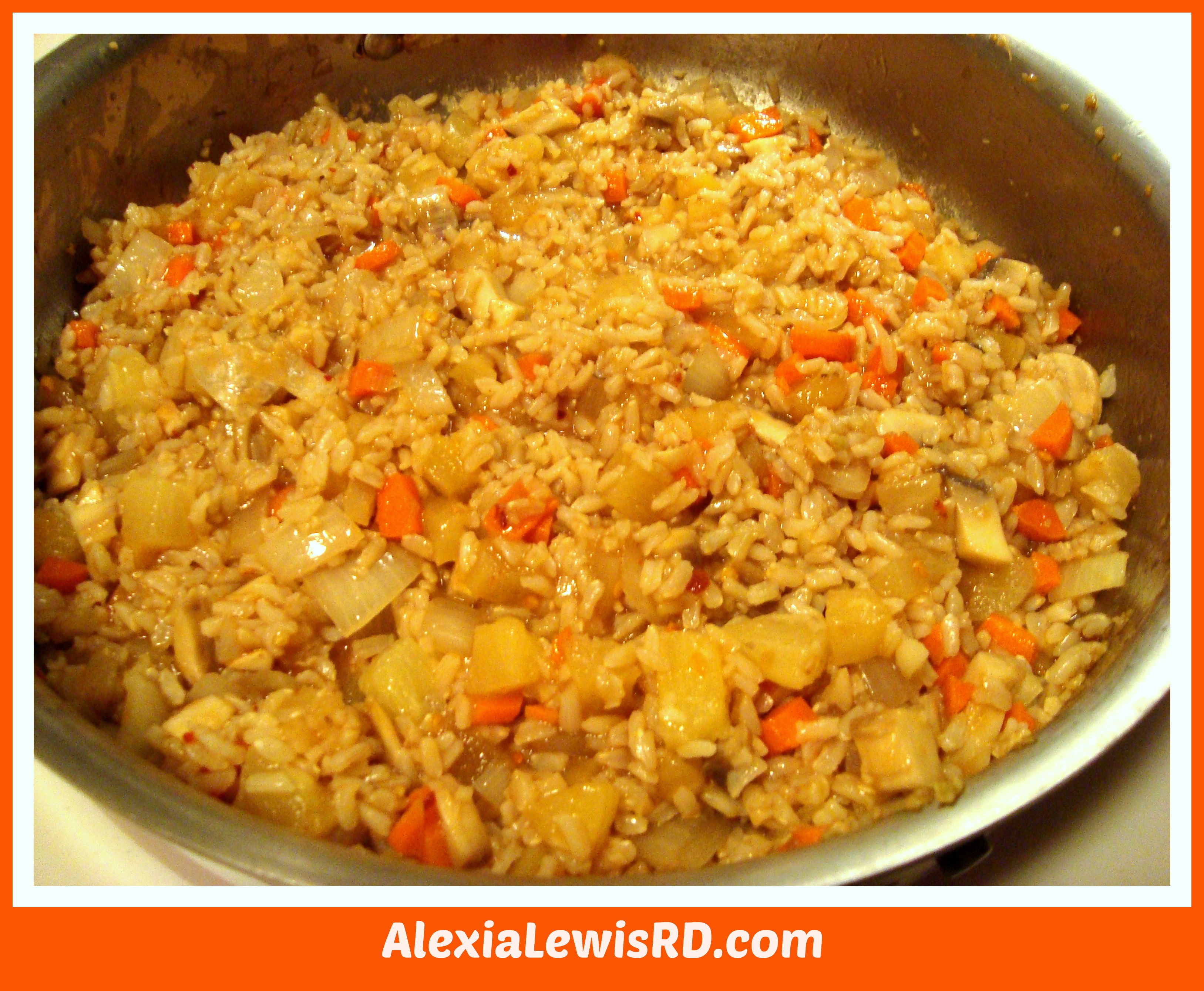
I didn’t measure for this recipe and I used mushrooms instead of the red pepper. The sauce (pineapple, soy sauce, red pepper flakes) is absolutely delicious and I will use this for other recipes. The rice was also really tasty; but unfortunately, it was mushy!

Pineapple Fried Rice

I figured next time, I would also rinse off the rice before putting it in the fridge to wash some of the sticky starch off the rice… however, next time (yes, I already made it again and added diced chicken and broccoli), I used steamed white rice picked up from the local Chinese restaurant. I find that a worthwhile expense because it made a much less sticky rice dish.

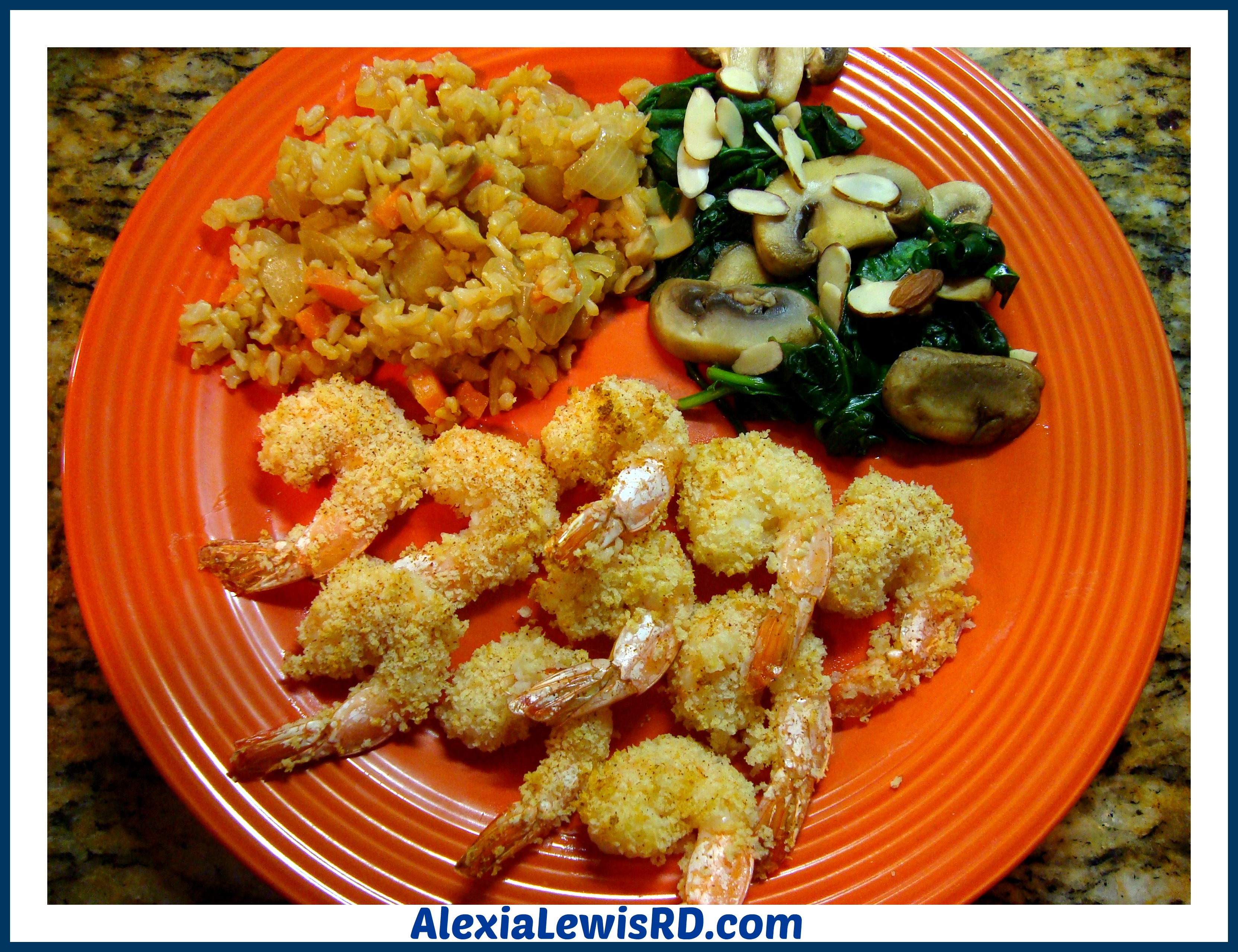
For the Baked Panko Shrimp, I simply combined panko and cayenne pepper, then dipped raw shrimp into egg whites and then the panko mixture. I laid them out on a baking sheet covered with tin foil. I suggest spraying this with cooking spray, a step I did not do and I lost half the panko breading on the foil! These were baked at 475 for about 20 minutes.

Baked Panko Shrimp
Baked Panko Shrimp

I served these with sauteed spinach and mushrooms with sliced almonds. YUM!

Dinner is served!
Dinner is served!