Tag Archives: heart health

Picture of hands holding out a red heart-shaped object with a blurred person in a lab coat in the background, with the words: Risk Factors for Heart Disease.

Risk Factors for Heart Disease

Chances are you or someone you know has heart disease. After all, it has been the #1 cause of death for Americans since 1921 (1). Yikes! For many of us, it’s important to know the risk factors for heart disease – and to take whatever steps we can to reduce our risk.

Before we jump in, let’s take a breath. First, if you are here because you think you may be having a heart attack, call 911 or your emergency services line right now. Trust me, they would rather see you 10 times and have it be a false alarm, then to have you not seek care the 1 time it’s happening. Call. Now.

Also, this article and its content are not a substitute for medical advice. It may not be appropriate for you, you certainly shouldn’t use it as a way to gauge your heart disease risk, and it is not comprehensive. If you follow the information on this website without consulting your personal medical provider, you do so at your own risk.

Let’s start with the shorter list. The risk factors for heart disease that cannot be changed.

  • Age: Getting older increases risk. Over age 65, more women than men die from heart disease, at a rate of about one woman every minute (2).
  • Sex: Men have greater risk than women and generally have heart attacks earlier. Women’s risk increases post-menopause.
  • Family history: Risk increases for children whose parents have heart disease.
  • Race and ethnicity: People who are Black, Asian, Mexican, Hawaiian, and/or Native American have higher risks.
  • Social determinants of health: People with less access to health care or to healthy foods, for example, have higher risks.
  • Medical conditions such as chronic kidney disease, rheumatoid arthritis, and preeclampsia increase risk(3).

Can’t be changed. Cool, cool. Okay, so… now what? Go see a medical provider to discuss heart health and follow their advice consistently. Then, shrug it off. No need to stress about things that can’t be changed.

Focus on the next list of risk factors for heart disease that can be controlled. Which, thankfully, is much longer.

Doing your best on these risk factors for heart disease can help to reduce risk.

  • Manage blood sugar levels and/or diabetes.
  • Improve cholesterol by increasing HDL and decreasing LDL and triglycerides.
  • Bring blood pressure down or manage hypertension.
  • Quit smoking/vaping and reduce exposure to secondhand smoke.
  • Drink alcohol in moderation. Don’t drink alcohol excessively.
  • Address excess body fat, especially around the stomach area.
  • Get more active. Reduce sedentary and sitting time.
  • Improve diet quality. Eat more of the food with fiber and unsaturated fats. Eat less of the foods that are high in saturated or trans fats, refined carbohydrates, added sugars, and sodium.
  • Get the right amount of good quality sleep.
  • Reduce stressors and practice strategies to reduce chronic stress.
  • Manage mental health issues such as depression, and anxiety (3).
  • Get more connected with social support and community (4).
Graphic with a heart-shape with the words "heart health" on it held in the palm of a hand with multiple arrows pointing towards it and the words: stress, weight, blood sugar, activity, nutrition, blood pressure, cholesterol, and sleep.

DYK that food can help with many of these things. True story.

Check out my article that includes the Basics of Heart Healthy Eating and learn about working with me on nutrition to reduce heart disease risk.

You may be thinking… uhhhhhh, that’s so much, where do I start? Or… uhhhhh I can’t do all that, I think I’ll grab some donuts and hit the couch.

No food shaming for donuts here. They are delicious and even donuts can fit into a heart-healthy diet with planning.

Start small by picking one thing to work on first.

I encourage my patients to choose either the thing they think will be easiest to do, or the thing they think will have the biggest impact. Focusing on one thing will likely have an impact on the other things anyway. And with a lot less overwhelm.
Picture of a winding pavement highway with trees on both sides and the words, "Fresh Start"  overlaid on the road.

I am a weight neutral provider, and I see healthy people in many different body shapes and sizes. I dislike Diet Culture and do my best to pull people out of it. Here’s why and a bit of a rant. I also believe in body autonomy; therefore, I support my patients if they want to lose weight or don’t give a flip about weight.

So yes, excess body weight is on the list of risk factors that can be changed. Please know that I put it on the list begrudgingly. I recognize how difficult weight loss can be for so many reasons that have nothing to do with people’s motivation or efforts.

Lots of thin people have heart disease and lots of people with excess body weight are super heart healthy. So, what gives? Amirite? See Weight Does Not Equal Health and Are You Healthy? for personal stories about my weight and health.

Most research states that weight is a risk factor because it is associated with other risk factors, like diabetes and high blood pressure. But some research is also indicating that excess weight is associated with heart disease on its own (5). Where a person carries weight also comes into play with excess weight in the mid-section increasing risk (3).

And remember, associations don’t prove causation. These things are just linked together in some way.

For some fun correlations to illustrate this point, see Spurious Correlations and you can prove that “it’s Wednesday my dudes” searches are responsible for Boeing’s stock prices… or that eating margarine leads to happier marriages (or at least less divorce filings) (6)… In which case, post those memes and bring me the margarine! #justsayin

Here’s a fun twist you may not have heard… When people improve dietary choices, become more active, manage stress, get good sleep, and address mental health and isolation, heart disease risk may be reduced… wait for it… even if labs or weight don’t change.

What? Yes!

In other words, don’t get caught up in the outcomes. Be consistent with changing the daily habits – the things that can be controlled – and let the outcomes be whatever they will be.

The behaviors themselves make a difference.

Now, likely, some labs will change from implementing these habits and maybe the scale will too. I don’t know. But I don’t want anyone to get discouraged if they don’t change, or they change slowly. It is still having a positive impact on reducing heart disease risk.

And if labs and weight change, then great! Risk is reduced even more.

Are you ready to work on reducing your risk factors for heart disease while enjoying delicious food? Let’s do it!

Picture of woman in white shirt holding a red heart-shaped object in heart hands with the words: you can live a heart-healthy lifestyle with confidence, love the body you live in, and still enjoy delicious food.

Working with people on reducing risk for heart disease and managing existing heart disease is one of my most favorite things to do! That includes working on any (or all!) of those risk factors that can be changed with food and nutrition. (Which is a lot, yo).

Click right here to get to Alexia’s provider page with Nourish, choose a date/time and start the scheduling process.

  • One of the first screens when you start will let know if your health insurance is accepted by Nourish.
  • Before you finish the booking process, you will enter your insurance information and get an estimate of the expected costs.

And, of course, you can reach out l if you have questions or want to be hooked up with another amazing RD at Nourish. I’m happy to help! 

Alexia in suit outside.

Hi there! I’m Alexia and I believe in science, humor, and delicious food.

Heart health is my jam. I love to write and speak publicly on this topic and all aspects of living a heart-healthy lifestyle.

I believe you shouldn’t sacrifice your mental health in pursuit of better physical health. You deserve to be both happy and healthy. You don’t have to choose just one.

I am a master’s level nutritionist who is also a registered and licensed dietitian in multiple states in the USA, a certified personal trainer, and certified health coach. I also invested in becoming a culinary nutritionist and weight management specialist. In other words, I got you.

  1. American Heart Association Newsroom: More Than Half of US Adults Don’t Know Heart Disease Is Leading Cause of Death Despite 100 Year Reign, posted 01/24/2024.
  2. Go Red for Women: Common Myths About Heart Disease: https://www.goredforwomen.org/en/about-heart-disease-in-women/facts/common-myths-about-heart-disease, reviewed 02/16/2024
  3. American Heart Association: Understand Your Risks to Prevent a Heart Attack: https://www.heart.org/en/health-topics/heart-attack/understand-your-risks-to-prevent-a-heart-attack. Reviewed 12/19/2024.
  4. Methodist Debakey Cardiovasc J. 2021 Sep 24;17(4):15–27.  doi: 10.14797/mdcvj.846.
  5. Johns Hopkins Medicine: Weight A Silent Heart Risk: https://www.hopkinsmedicine.org/health/wellness-and-prevention/weight-a-silent-heart-risk, no date.
  6. Tyler Vigen: Spurious Correlations: https://www.tylervigen.com/spurious-correlations, no date.
Salt: Where Does the Salt in Your Diet Come From?

This is Video/Blog # 2 in our Series: All About Salt.

Myth or Fact? I don’t have to worry about my sodium because I don’t use the salt shaker at meals or when cooking?

When my clients want to reduce sodium in their diets, they typically focus on the salt shaker. They believe if they don’t add salt to their food at the table or when they are cooking, it is enough to keep their salt intake low.

Is it enough?

This is a MYTH!

Wait. What? Why???

Most of the salt in the average American diet – a whopping 71% according to the Centers for Disease Control and Prevention – comes from processed foods and restaurant foods – not from the salt we add during cooking or sprinkle on to our cooked steaks or vegetables!

In fact, the foods with hidden sources of salt are the biggest offenders since many do not realize they are so high in salt. The American Heart Association has dubbed these foods the “Salty Six.”

The Salty Six includes:

  • Breads
  • Deli lunch meats
  • Sandwiches
  • Pizza
  • Soups
  • Processed chicken products.

And, if they asked me, I would make it the Salty Seven and added

  • Sauces and condiments

Can you Trust the Food Packaging Claims?

You can always look at the nutrition information label to find the milligrams (mg) per serving – just be sure to notice how much is considered one serving of the food per the label.

Those nutrition claims on food packages are a little trickier. Let’s quickly go over what those nutrition claims really mean.

First, realize that some of the claims are based off comparing the lower sodium version to the regular version.

If you see “reduced sodium” on the label, that means there is at least 25% less salt than the regular version. So, if your food is a salty one – like soup that can have 2000 mg in one can, then reduced sodium may still have 1500 mg which is not what I would consider low in sodium at all.

Claims that mean low sodium include “low sodium” with 140 mg or less per serving, “very low sodium” with 35 mg or less per serving, and “salt / sodium free” which means less than 5 mg per serving.

Finally, “no salt added” means just that – salt was not added during the food processing. The food may or may not be high in salt naturally.

Check out the video where I review some food packages and talk about the salt in some common foods – including what you just might be eating for lunch today!

So getting rid of the salt shaker may not be enough to get you to your salt intake goals.

Which may make you wonder… just how much salt should I actually eating? I will answer that question with our next video!

To get these when they are released – subscribe to my YouTube Channel

Slide7

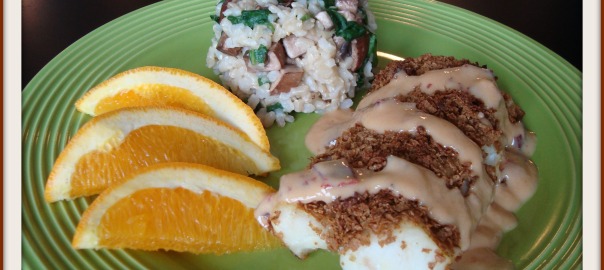
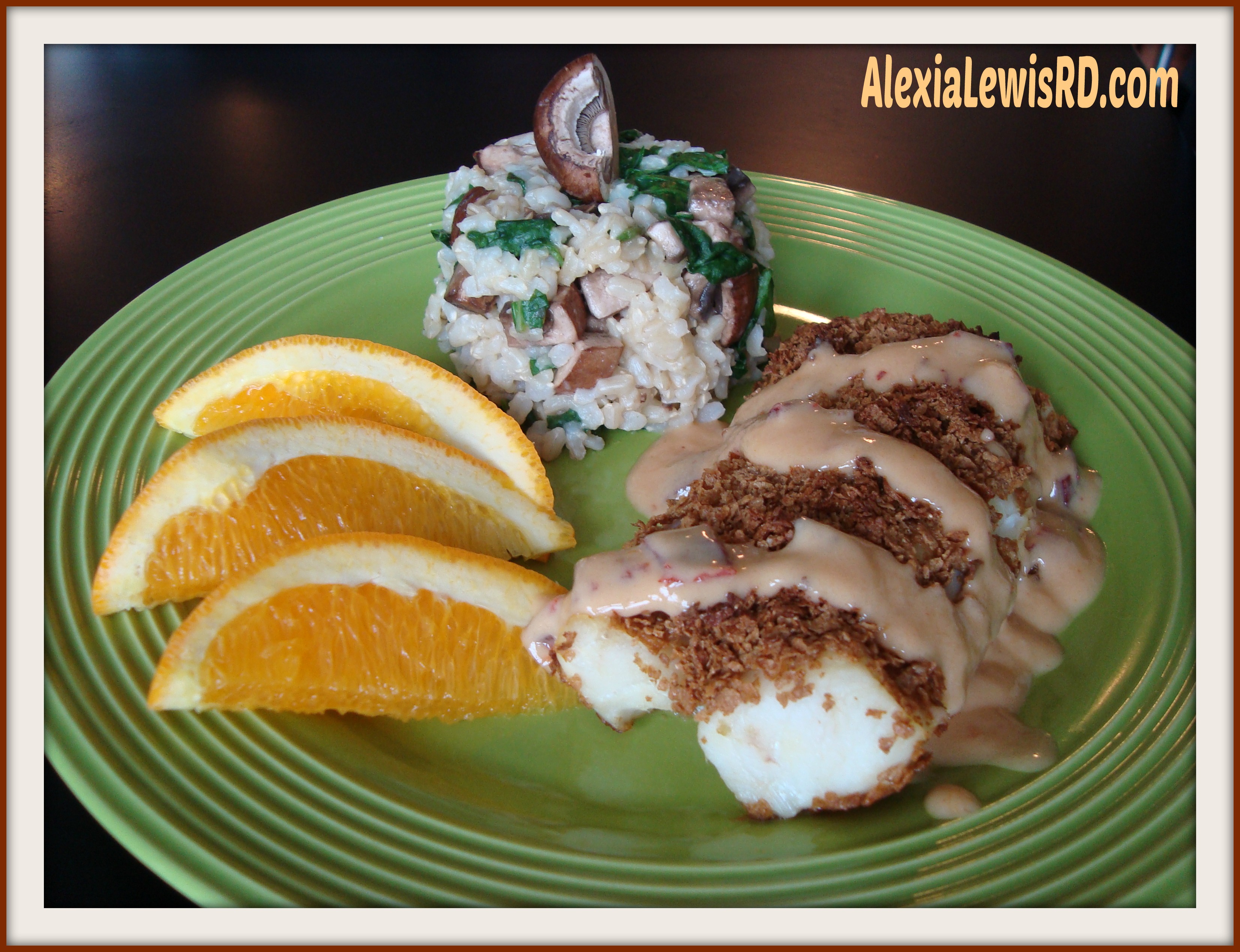
D-vine Orange Chipotle Cod

“D”-vine Orange Chipotle Cod: A Dish High in Vitamin D

Vitamin D is one of those vitamins that keeps popping up in the media as beneficial for our health and it’s a vitamin that many of us are lacking. I created a recipe high in vitamin D using Atlantic cod, orange juice, bran cereal flakes, and chipotle. The result was a divine vitamin-D rich Orange Chipotle Cod recipe.

904 Fitness Magazine gave me this challenge to go along with a vitamin D article that is in the May edition. As a dietitian, I love turning to food before supplements so I accepted the challenge!

Facts about Vitamin D

  • According to the CDC, 31% of non-Hispanic blacks, 12% of Mexican Americans, and 3% of non-Hispanic whites have vitamin D deficiency.
  • Vitamin D is called the “sunshine vitamin” because substances in our skin are activated by the UV rays to produce vitamin D. This partially explains why vitamin D deficiency is higher in those with darker skin (which protects against UV rays) as well as those who live in climates with less sunshine or who spend more time indoors.
  • The recommended amount of Vitamin D for adults between 19-70 is 600 IU (international units) per day. A deficiency may cause bone issues such as bone pain, muscle pain or spasms, osteomalacia (soft bones), and rickets in children.
  • Since many people supplement, I’ll also give you the tolerable upper limit, which is 4,000 IU per day. Research is ongoing that is looking at the effects of large amounts of Vitamin D so these recommendations may change in the future. A toxicity may cause bone loss and kidney stones – you cannot overload on vitamin D from sunlight.
  • Vitamin D is important for calcium absorption and bone health. It’s being researched for its impact on heart disease, cancer, immune function, type 2 diabetes, blood pressure, and many other things.

I’m a light-skinned white dietitian who lives at the beach in Florida and even I had low enough levels of vitamin D that my physician put me on supplements! So, it is difficult to get your D when you rely on sunshine and foods.

Here’s why it is difficult to get enough vitamin D (600 IU) from foods… unless you are willing to swallow cod liver oil or can afford to eat salmon every day!

Food Amount IU (average) Source
Cod liver oil 1 tablespoon 1,360 Natural
Swordfish 3 ounces 560 Natural
Portabella mushrooms (with UV exposure) 1 cup 450 Natural
Salmon/mackerel (fatty fish) 3 ounces 425 Natural
Tuna (light, canned) 3 ounces 200 Natural
Fortified orange juice 1 cup 115 Fortified
Fortified milk 1 cup 115 Fortified
Fortified yogurt 6 ounces 80 Fortified
Fortified cereal 1 cup 70 Fortified
Sardines (canned in oil, drained) 2 pieces 50 Natural
Egg yolk 1 large 30 Natural
Portabella mushrooms (no UV exposure) 1 cup 10 Natural

Note that the fortified foods give an average for the IU of vitamin D and the actual amount can vary quite widely based on the level of fortification. When I was looking for cereals for my recipe, I found cereals with 0% to 25% of the daily value of vitamin D! It’s important to look at the labels for the fortified foods you choose. Also, notice that mushrooms contain much more vitamin D if they have been exposed to UV light. Since the packaged mushrooms in my store didn’t mention UV light on their labels, I asked my grocer about the mushrooms in the store and he had no idea if they were UV-exposed.

I turned to fish and fortified foods to make a “D”-vine Orange Chipotle Cod dish that has 32% of the daily value (~ 200 IU) of vitamin D and packs a nice little spicy kick. This recipe is also heart-healthy with low calories, low saturated fat, no trans fat, and low sodium. It is a little higher in cholesterol than I’d like; but still within heart healthy recommendations.

D-vine Orange Chipotle Cod (click link for a printer-friendly version)

Makes: 4 servings

Ingredients

Orange Chipotle Sauce

  • Chipotle in Adobo: 1 chipotle pepper, de-seeded and chopped plus 1 Tablespoon sauce
  • 1 cup vitamin D fortified orange juice
  • 1/4 cup vitamin D fortified plain non-fat yogurt

Fish

  • 2 large eggs
  • 2 cups vitamin D rich (25% DV) bran flakes cereal
  • 4 6-ounce Atlantic Cod filets
  • Non-stick cooking spray

Directions

Preheat oven to 450° F. Line baking sheet with tin foil and spray with non-stick cooking spray and set aside.

When preparing chipotle peppers, or any hot pepper for that matter, remember that the heat is mostly in the seeds. Chipotles pack a spicy punch so remove these little seeds before chopping to reduce the kick in the sauce.

Deseeding Chipotle Peppers

Begin sauce. Pour 1 cup orange juice, chipotle pepper, and chipotle sauce into small saucepan and heat until mixture just begins to boil. Reduce heat to low and simmer, stirring frequently to prevent sticking until mixture thickens, approximately 35 minutes. Set aside when done.

The thicker drops show that the sauce has begun to thicken - it will continue to thicken after removed from the heat.
The thicker drops show that the sauce has begun to thicken – it will continue to thicken after removed from the heat.

In a shallow bowl, crack eggs and stir to combine yolk and white. Pour bran cereal into another shallow bowl and use measuring cup or the back of a spoon to crush the cereal into small pieces.

Use the back of your measuring cup as a crushing tool for the cereal
The smaller the flakes, the better the coating!

Rinse fish filets, draw through the egg and then press gently into the cereal to coat the fish with cereal. Place fish on foil-lined baking sheet. Repeat with each filet. Sprinkle any remaining cereal on top of fish.

Having everything prepared and close together makes coating the fish much easier

Bake fish in oven for 20 minutes or until done and flesh flakes easily with a fork.

When orange-chipotle sauce has cooled, combine the sauce with the yogurt and stir to combine.

To serve, top each fish filet with approximately 1/4 cup of sauce.

Nutrition Information per serving (1 fish filet topped with 1/4 cup sauce): 315 calories, 5 grams fat (1 gram saturated fat, 0 trans fat), 174 milligrams cholesterol, 375 milligrams sodium, 26 grams carbohydrate (3 grams fiber), 37 grams protein, and 32% DV of vitamin D.

Served with brown rice mixed with chopped mushrooms and spinach – enjoy!

D-vine Orange Chipotle Cod

References as linked above, Nutrition: Concepts and Controversies, and the Linus Pauling Institute.

Yummy Southern Shrimp Scampi

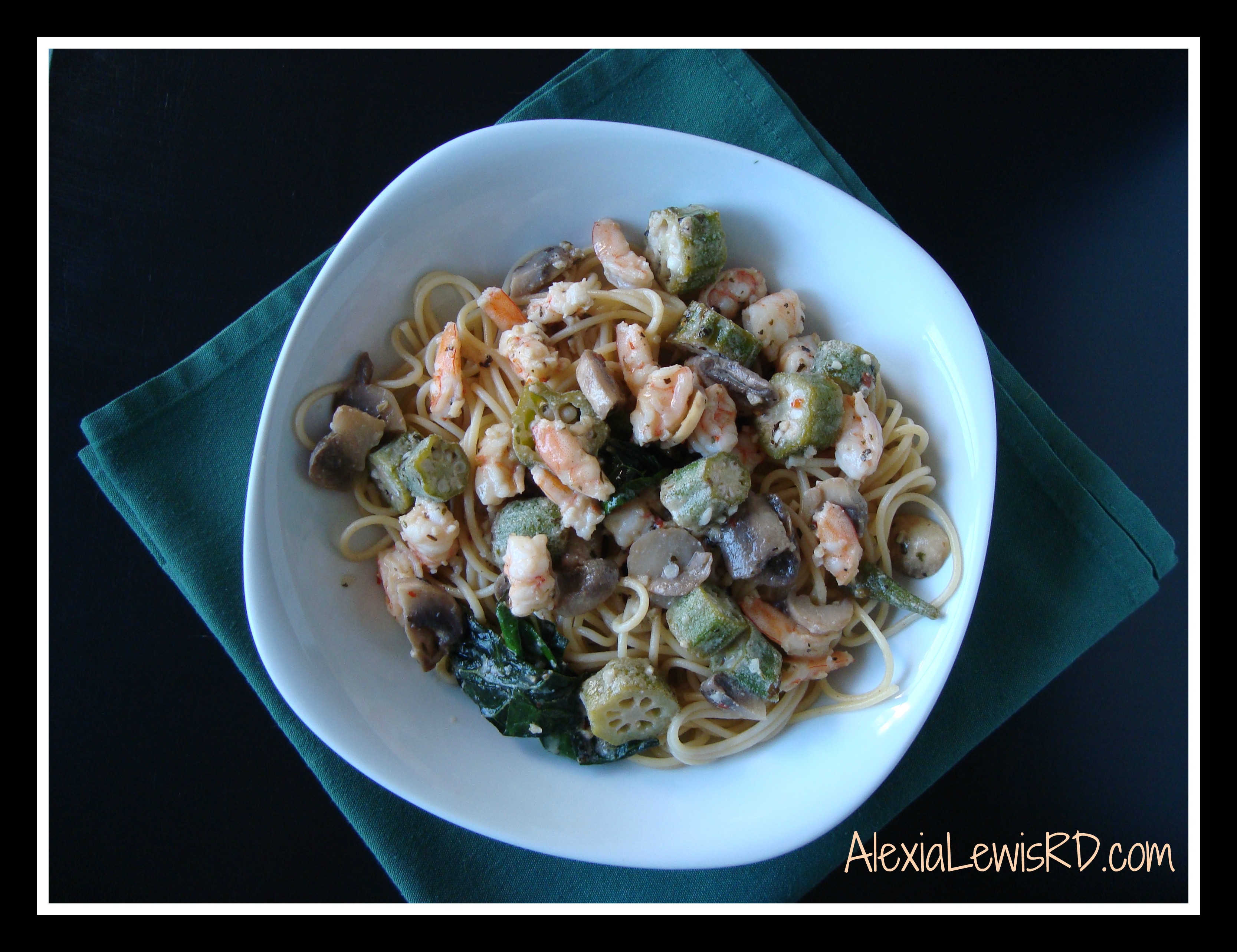
Southern Shrimp Scampi

Yes, shrimp scampi can be heart healthy! With a few adjustments, this dish becomes low in saturated fat, cholesterol, and sodium and yet is still chock full of flavor.

I believe a traditional scampi would include lemon and butter; but I used what I had on hand from the wonderful UNF Ogier Gardens. I ended up with a scampi that has okra and kale. Since these are traditional southern ingredients, I named this southern scampi.

This recipe is one the came together as I cooked it and so the ingredients are estimations. I did not measure ahead of time and I ended up with 3 servings (an odd number for a recipe, I  know!) and leftover spaghetti. If you want more or less of an ingredient or don’t think the consistency is right (too watery or too dry), please make adjustments to the amounts listed.

Yummy Southern Shrimp Scampi

Southern Shrimp Scampi

(Makes 3 servings)

Ingredients

  •  1/2 package of spaghetti (I used Dreamfields but recommend whole wheat)
  • 1 Tablespoon olive oil
  • 1 1/2 Tablespoons minced garlic
  • 6 okra pods, chopped into 1-inch pieces
  • 1 cup low-sodium vegetable broth, divided
  • 1/2 cup white wine, divided
  • 3 large Dino (lacinato) kale leaves, stems removed, cut into 1-inch square pieces
  • 3 button mushrooms, sliced
  • 15 medium raw shrimp, peeled, deveined, each one cut into 3 pieces
  • Garlic powder, to taste
  • Italian seasoning, to taste
  • Pecorino-Romano cheese, grated, to taste

Directions:

  1. Begin spaghetti by boiling water. Add spaghetti and cook to desired tenderness. Drain and set aside until sauce is prepared.
  2. While pasta water is coming to a boil, begin sauce by heating oil in saucepan. When heated, add garlic and sauté 1 minute – do not let it brown.
  3. Add okra and cook, stirring frequently for about 2 minutes. Add half of vegetable broth and white wine and simmer, stirring frequently until okra begins to soften, about 5 minutes.
  4. Add kale and mushrooms and cook until kale begins to wilt.
  5. Add shrimp and the remaining vegetable broth and white wine. Simmer and stir frequently until shrimp is pink and cooked through.
  6. Sprinkle liberally with garlic powder, Italian seasoning and stir to combine.

To serve: top 3/4 cup of spaghetti with 1/3 of southern shrimp scampi sauce, sprinkle with a small amount of  pecorino-romano cheese. Serve hot.

Per Serving: 310 calories, 7 grams fat, 2 grams saturated fat, 0 grams trans fat, 4 milligrams cholesterol, 290 milligrams sodium, 38 grams carbohydrates, 3 grams fiber, 14 grams protein

Let me know what you think. I’d love to hear about any adjustments you make!

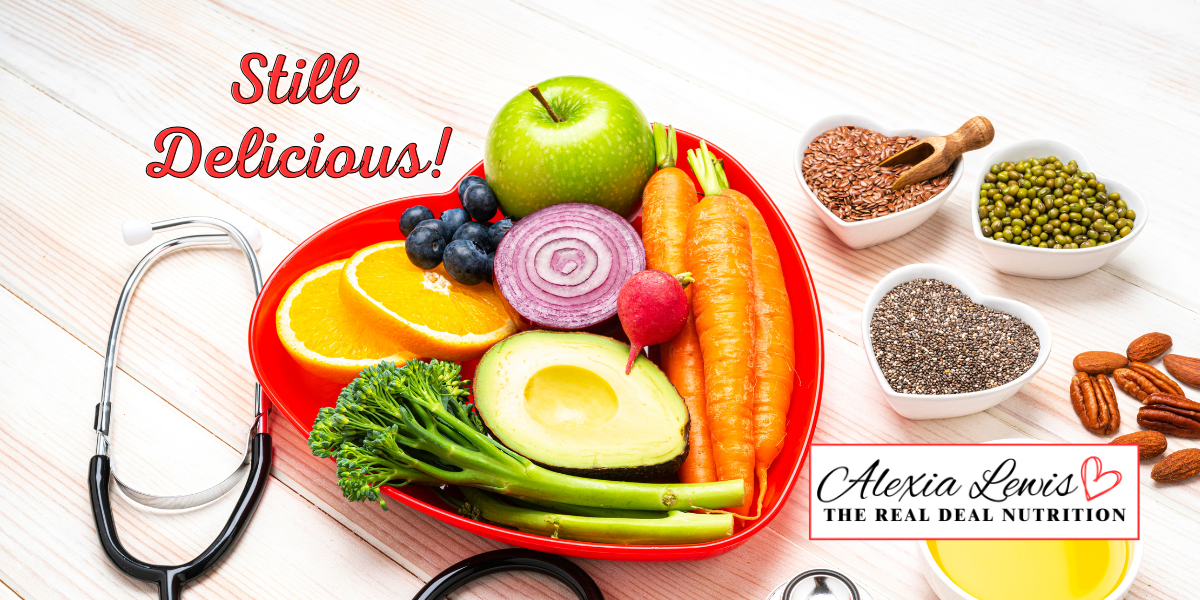
Image of a salad in a heart shaped bowl with a stethoscope near it and the words: The Basics of Heart Healthy Eating, Alexia Lewis, Real Deal Nutrition

The Basics of Heart-Healthy Eating

Updated 01/30/2025 to included reducing added sugars and ultra-processed foods to “the basics of heart-healthy eating.”

Picture of colorful heart-healthy foods on a heart-shaped plate with the words: Still Delicious!

The Basics of Heart-Healthy Eating.

You may hear about magical foods or failproof techniques that are touted as the way to improve heart health.  Yah… no. If they existed, then heart disease would not have remained the number one killer of Americans for over 100 years. WHAT? Yes, heart disease first topped the charts back in 1921 (1).

If you know me (Hi, I’m Alexia, a dietitian and heart attack survivor!), then you know I like to simplify nutrition. While nutrition can become incredibly complex and nuanced, most people benefit from big-picture, easier-to-implement steps. To that end, here is my take on the basics of heart-healthy eating. 

TL:DR:

  1. Increase fiber.
  2. Change up your dietary fats.
  3. Decrease sodium.
  4. Decrease added sugars.
  5. Reduce ultra-processed foods.
  6. Bonus basics of heart-healthy eating.

Of note: I do mention weight in this article. I am a strong believer that people can be healthy at many body sizes – and confident and beautiful (2). I promote and respect every individual’s choice regarding their weight. I believe we should continue to work towards doing better with providing non-biased health care. More on the weight and heart disease below.

Increase Fiber.

Dietary fiber plays many roles to help with heart disease. It helps with managing cholesterol, blood sugar, and with satisfying appetite, which can lead to reducing weight, which can lead to reducing blood pressure.

Many people would benefit from increasing dietary fiber intake. Unless, of course, you have health conditions or other concerns that limit your fiber intake. If you need to limit fiber, talk to a qualified nutritionist and skip on down to the next basic of heart-healthy eating.

This excellent article from Mayo Clinic shares more about fiber, why to eat it, and when to avoid it (3).

Since we eat foods, not fiber: dietary fiber is found in fruits, vegetables, whole grains, and legumes (beans and peas).

Okay, true. There is also fiber in nuts, however, you would need to eat a lot of them to significantly contribute to your fiber intake, and they are the most calorie dense of the choices. In other words, one measured cup of dry roasted mixed nuts comes in at 9 grams of fiber and a whopping 595 calories (4). Absolutely include nuts in your diet for heart health… just not because of the fiber content!

Bottom line:

  1. Eat at least one of type of food with fiber with every meal and snack.
  2. Choose non-starchy vegetables for most of those food choices to load up on fiber without loading up on calories.
  3. Which type of foods you choose depends on your preferences, health, and goals.

You have lots of choices for foods to include, so… no excuses! And I say this because according to the 2020-2025 Dietary Guidelines for Americans, a distressingly low 10% of women and 3% of men are eating enough the recommended amount of fiber (5).

You don’t eat grains, fine! Eat a starchy veggie.

You don’t eat vegetables, fine! Eat some beans. (Well, kinda “fine” on the veggies, I mean, eat some, yeah?).

You don’t eat beans, fine! Eat some fruit.

Need help including more foods with fiber or navigating all the confusing information on food packaging?

Change Up Your Fats.

The type of dietary fat you eat can have an impact on heart health. This happens because the type of fats you eat helps to reduce LDL (bad) and increase HDL (good) cholesterol. This has a positive impact on heart health.

Notice I didn’t say reduce your fat intake? (Unless, of course, you have a condition that requires eating a low-fat diet, then reducing dietary fat intake is also important.)

That’s because fats are delicious (#noshame), needed for some types of cooking, and needed for your body to absorb fat-soluble nutrients. Eating a fat-free salad? You are missing out on absorbing some of that salad’s nutrition!

Reducing saturated fat, on its own, has been shown to reduce LDL cholesterol.

Increasing unsaturated fat, on its own, has been shown to decrease LDL and increase HDL cholesterol. In incredibly simplified terms, HDL’s job is to help get rid of LDL (6). Boom.

Doubling down by replacing saturated fats with unsaturated fats can reduce LDL and increase HDL all with one dietary swap. It’s as easy as replacing butter with avocado oil for sautéing.

In addition, specific unsaturated fats, omega-3’s can reduce triglycerides and blood pressure. Your body cannot put together omega-3 fats (or omega-6s), so getting foods with these types of fats in your diet is important.

The Australian Heart Foundation has a great overview with more details and food examples (7).

Bottom line:

  1. Eat more meatless/plant-based meals and use lower fat dairy foods to reduce saturated fats.
  2. Enjoy nuts, seeds, olives, and avocados often including cooking with oils made from these foods to boost unsaturated fats. Just be mindful of portion sizes due to being high in calories and/or sodium – I’m looking at you delicious salty olives.
  3. Add a meal with a food high in omega-3′ fats once or twice a week.

I struggle to cook salmon, but it always comes out well when I make this amazing salmon recipe (8).

Image of a piece of salmon on a plate topped with dill sauce, fresh dill, sliced almonds, and pomegranate arils.

I didn’t mention trans fats because they were banned from our food supply in 2018 and food manufacturers were given until 2021 to get them out of their foods (9). So, you likely won’t see trans fats in most foods you buy now.

But it’s worth checking the back of your pantry to make sure older foods you may have do not have trans fats on the label (or partially hydrogenated oils listed in the ingredients). And, um, it’s 2025 as I write this, so yeah, check those use by and expiration dates too.

Need help with a virtual pantry and kitchen cleanout?

Decrease Sodium.

While most of us aren’t eating enough fiber, we are eating too much salt. On average, Americans eat 1,100 milligrams more than the recommended amount, which is 2,300 milligrams a day (10).

Do you remember from your early biology classes that water follows salt. I remember really struggling with osmosis. Who knew it would actually be relevant when I grew up?

So, water follows salt. If your salt intake is high, your body holds water to keep all things in balance. More water in your blood vessels makes your blood pressure go up, and that is a risk factor for heart disease.

Most of the salt in the Standard American Diet (yes, the acronym is SAD, which fits) comes from packaged foods, including canned foods. We know salt enhances flavors. It is also a preservative and a binder in foods, and it keeps the foods holding water too, which keeps them *insert the m-word here* so this tracks.

For more info, check out this list of 16 high sodium foods (11) and tips for lowering sodium (12).

Bottom Line:

  1. Check food labels to choose brands with less sodium.
  2. Rinse canned foods when you can.
  3. Choose more whole/unpackaged foods.
  4. And salt really does wonders to improve foods flavor, so use it. Just stop shaking the shaker after a few shakes, whether used at the table or while cooking.

One very interesting piece of info is that not everyone is salt-sensitive. That means reducing salt in the diet will not impact blood pressure for those who are salt-resistant. Even so, reducing sodium is a positive food choice for many (10).

Of note, there are instances and conditions that may require limiting or consuming a specific amount of salt. In those cases, this info does not appy.

Need help making sure your meals are still delicious without salt?

Decrease Added Sugars.

Just like salt, most of the added sugar in our food isn’t added by us. It’s added by food manufacturers. And just like salt, sugar makes foods delicious. That’s likely why we are also eating too much added sugar in our foods.

Well, that and its “hiding” in many foods that aren’t especially sweet.

The recommendation from the American Heart Association recommends 6% of intake of added sugars, or 6 teaspoons a day for women and 9 teaspoons a day for men (13). The Dietary Guidelines allow for 12 teaspoons (if you eat 2,000 calories a day) (5). One study based on 100,000 people over 9 years found the highest risk of heart disease hits around 24 teaspoons of added sugar (14).

And, of course, as always, people managing specific health conditions or others may need to have different recommendations.

So, drumroll please… We eat 17 teaspoons of added sugars on average (15).

Sugar contributes to heart disease as it can increase blood pressure, inflammation, weight gain, and make it more difficult to manage diabetes/prediabetes.

Bottom line:

  1. Do your best to reduce added sugars down to the recommendations.
  2. Continue to enjoy foods with natural sugars.

Yes, you can eat fruit (and unsweetened dairy foods). Foods with natural sugars have other nutrients (fiber, protein, fat) which slows digestion, and the research doesn’t show that these increase heart disease risk.

This Harvard Health article on The Sweet Danger of Sugar is a nice resource for more info (16).

Need help on finding the added sugars in your foods?

Reduce Ultra-Processed Foods.

In the hurry up, stay busy, no time to relax kind of culture that many of Americans live in, processed foods make it easier to get food on the table. #noshame. They are also generally less expensive. With a store-brand dozen of eggs now costing over $4.00, we all could use a little help with our food budgets.

While processed foods have been around for 1.5 million years. After all, cooking with fire is a form of processing. The 1800s saw the inventions of the tin can for foods and pasteurization (17). Then the 1900s saw a big boost in demand for processed foods, with Swanson’s frozen meals hitting the market in the 1920s and fast food starting to hit its stride in the 1950s (18).

Fast forward and we have gone from minimally processing foods (cooking, canning, salting, smoking, freezing, etc.) to the ultra-processed powdered meal replacement drinks of today.

Did I mention there is no food shaming allowed here?

So, yes. Ultra-processed foods can have a place in an otherwise generally healthy dietary approach. And yes, it’s going to be in moderation. Nutrition is not so unforgiving (for most of us!) that eating a small amount of these foods will wreck health. What matters is what we do most of the time.

Speaking of most of the time, ultra-processed foods now make up 60% of the foods we eat (19). So, yeah, that’s more than “in moderation” and that makes for a different conversation.

That being said food exists on a spectrum of processing, and while processing can improve nutrition with fortification, they have been starting to get linked to many negative health outcomes. For example, increasing inflammation and reducing gut health. In terms of heart health, these foods can raise triglycerides, blood pressure, and body weight (20).

Bottom line:

  1. Work to reduce ultra-processed foods that are of low nutrition quality as your time and budget allow. For heart health, assessing foods for the nutrients mentioned in this article may be a good start.
  2. Look for processed foods that positively impact nutrition. For example, adding vitamins or fiber.
  3. Eat whole and minimally processed foods when you can.

On the flip side, it’s also entirely possible to eat a diet of whole/minimally processed foods that have a negative impact on heart health. Food choices matter. And a healthy diet can include ultra-processed foods. After all, store-bought bread and flavored yogurt are both ultra-processed food under the NOVA classification system (21).

PS – Research is ongoing to learn more about if it is the quality of ultra-processed foods (high sugar, salt, fat, etc.) or the actual processing of the foods that matter most for health.

Need help with meal planning and/or prepping to reduce ultra-processed foods?

Bonus Basics of Heart-Healthy Eating.

For some extra steps to add to your basics of heart-healthy eating, you may also add more berries, nuts, avocado, and plant sterols and stanols (22) to your food choices.

And, while weight on its own does not cause heart disease, losing 2% to 5% of excess weight (if overweight) or gaining weight (if underweight), can also help to reduce risk of cardiac disease and its management for those with existing heart disease (23).

Next Steps.

Credible information is important. And putting that information into action is where the magic happens.

Small changes done consistently over time add up to big results. So just pick one or two changes to make right now. When you’ve got that down, add another 1-2 changes.

Work with Alexia on your heart health.

She can work with people in multiple states in the USA and accepts some health insurance plans through her partnership with Nourish. Learn more and start the scheduling process to see if your insurance is accepted and get an estimate of your out-of-pocket costs. (Note that Nourish handles the health insurance stuff, not Alexia!)

If she can’t work with you, you can choose another dietitian who can, or reach out for help getting connected with the right RD for you.

References & Links.

  1. American Heart Association Newsroom: More Than Half of US Adults Don’t Know Heart Disease Is Leading Cause of Death Despite 100 Year Reign, posted 01/24/2024.
  2. Alexia Lewis RD article: Weight Does Not Equal Health, posted 06/05/2017.
  3. Mayo Clinic: Nutrition and Healthy Eating: Dietary Fiber: Essential for Healthy Diet, posted 12/11/2024.
  4. USDA: Food Data Central: Food Details: Mixed Nuts, posted 04/01/2019.
  5. USDA & DHHS: Dietary Guidelines for Americans: 2020-2025, posted 12/2020.
  6. Harvard Health Publishing: How It’s Made: Cholesterol Production In Your Body, posted 02/06/2017.
  7. Heart Foundation (Australia): Fats, Oils, and Heart Health, updated 03/19/2024.
  8. Keeping Healthy Simple Club: KHSC Festive Salmon recipe, posted 01/2025.
  9. US FDA: Trans fat, current as of 04/30/2024.
  10. Harvard T.H. Chan School of Public Health: The Nutrition Source: Salt and Sodium, reviewed 03/2023.
  11. Fresenius Kidney Care: 16 High Sodium Foods, n.d.
  12. US FDA: Sodium in Your Diet, current as of 03/05/2024.
  13. American Heart Association: Added Sugars, reviewed 08/02/2024.
  14. Hartford Health Care, St. Vincent’s Medical Center: Not-So-Sweet Link Between Sugar and Heart Disease, posted 02/22/2023.
  15. Harvard T.H. Chan School of Public Health: The Nutrition Source: Added Sugar, reviewed 04/2022.
  16. Harvard Health Publishing: Heart Health: The Sweet Danger of Sugar, posted 01/06/2022.
  17. Automated Process Equipment Corporation: The History of Food Processing: How We Got to What We Eat, posted 10/05/2023.
  18. Institute of Food Technologists: Food Processing, n.d.
  19. Diabetes: Volume 72, Issue Supplement 1: 1374-P: Ultra-Processed Food Consumption and Cardiometabolic Risk in Individuals With and Without Type 1 Diabetes Mellitus, published 06/20/2023.
  20. British Heart Foundation: Ultra-Processed Foods: How Bad Are They For Your Health? updated 04/12/2024.
  21. News-Medical Net: The NOVA Method of Food Classification, updated 10/17/2024.
  22. Cleveland Clinic: Phytosterols, reviewed 07/30/2022.
  23. Clevelend Clinic: Health Essentials: How Weight Affects Your Heart, posted 02/19/2024.

Huevos Delicioso

Five Food Group Friday: Huevos Delicioso

Planning a heart-healthy balanced meal can be a challenge. To help with the concept of balance, I bring you a Five Food Group (FFG) Friday meal.

I’ve based these FFG meals on the Choose My Plate model, which is the US Government’s initiative to promote healthy eating habits. MyPlate is an easy-to-understand visual of a healthy plate of food incorporating the five food groups: protein, grains, fruit, vegetables, and dairy.

Choose My Plate
Add balance to your meals with Choose My Plate

The rationale behind including all five food groups on the plate is that each food group provides different nutrients, all of which our body needs in order for us to be at our best. This is a very heart-healthy way of eating since it includes a nice amount of fiber by incorporating three food groups with fiber (fruits, vegetables, and grains). Making heart-smart choices for protein and dairy by choosing lean or reduced fat foods and including heart-healthy unsaturated fats kick the heart-healthiness of MyPlate up a notch.

It is not, however, always easy to get all five of those food groups on every plate. I counsel my clients to eat the food groups they miss at their main meals as their snacks. For example, if they have cereal with a banana for breakfast (grains, dairy, fruit), then to include a protein and vegetable snack (celery with peanut butter). That way, over the course of the day, all food groups end up in balance.

I am bringing you FFG Fridays to help with the difficult challenge of building a plate with all the food groups.

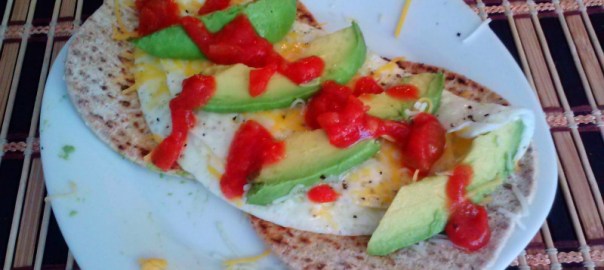
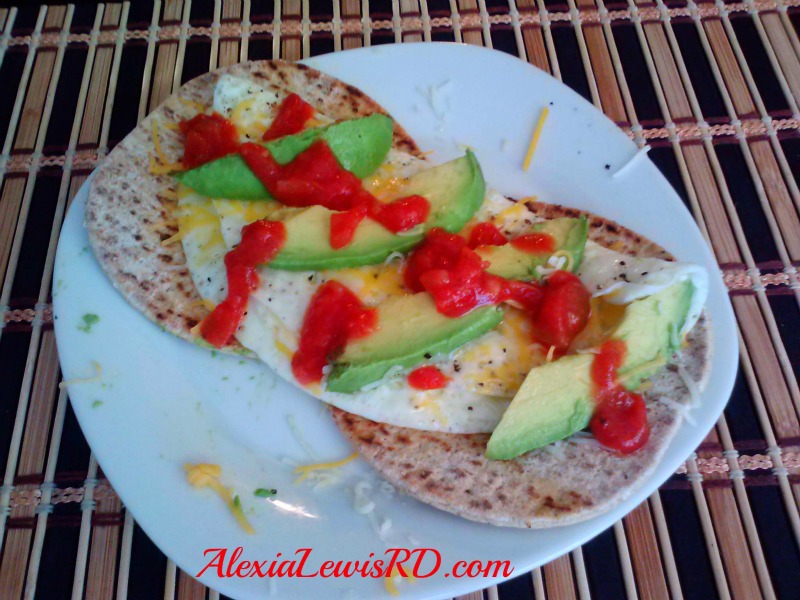
Introducing the FFG Omelet Sandwich – Huevos Delicioso!

Huevos Delicioso
Huevos Delicioso – A Five Food Group Friday Meal

This hearty breakfast is made from egg whites (protein), mushrooms, onions, salsa (vegetables), reduced fat cheddar cheese (dairy), a Flat Out fold-it (grain), and avocado (fruit).

Using egg whites and reduced fat cheddar make the dish more heart healthy by reducing the amount of saturated fat and cholesterol, while the avocado adds a nice amount of heart-healthy monounsaturated fats.

To make this yummy dish, use a non-stick pan to sauté 2-3 medium mushrooms and a thin slice of onion (both chopped) in a spritz of canola oil until soft then remove from pan. Add another spritz of canola oil and slowly pour in 1/2 cup of egg whites – if you pour down the side of the pan, you will reduce the places were the egg sticks. Once the egg starts to cook and set, add the cooked mushrooms and onions and sprinkle 1/8 cup shredded cheddar on one half of the egg only. I also add some ground pepper and garlic powder at this point. Use a spatula to loosen one edge and flip one half of the egg on top of the other to make the omelet. Slide out of the pan onto your Flat Out and top with 2 Tbsp salsa and 1/4 sliced avocado.

Per serving: 320 calories, 12 g fat, 3 g saturated fat, 0 g trans fat, 10 mg cholesterol, 835 mg sodium, 35 g carbohydrate, 10 g fiber, 26 g protein.

Suggestion: This dish may be a little high in sodium for some people due to the salsa. To reduce the sodium, use sliced tomatoes instead of salsa.

Heart

Vegan Challenge – The Final Day

I did it! I ate completely vegan for five days! Well, except for that one bite of celery with ranch dressing that snuck into my mouth before my brain thought about it…

There are no pictures or foods listed for this day because it was an exact repeat of yesterday. There is a joy that comes with the easiness of using leftovers and I took full advantage! The only minor change was to my smoothie, in which I simply used pineapple and strawberries.

This final day was the first day that I was a little bit hungry between meals. The first four days, I was eating so often that I didn’t really move into full-on hunger; but on this afternoon, I did. I think I am learning to better meet my body’s needs for protein and calories and I have finally (yay!) adjusted to the increased amount of fiber in my diet.

Overall, I feel really good. I feel a little slimmer because of how my clothes are fitting, which may or may not be due to the vegan diet. It could be that this challenge has motivated me to keep up with my food journal and workouts. I also have slept through the night the last two nights, which is not at all typical for me.

Now that this challenge is ending, I am actually considering continuing a no-meat diet. I very much miss cheese, eggs, and milk so I will definitely add dairy back into my meals. I also, as an RD, am not comfortable with cutting out an entire food group. However, I’m not sure I want to go back to my old eating habits because I have found that I get to eat so much food and the nutrition quality of my diet has been stellar while eating like a vegan.

Initially, my vegan diet was low in protein, calories, and B12. By the end of the challenge, I was eating adequate amounts of these nutrients without using specialty foods. This has also reaffirmed my belief that vegans/vegetarians should consider a multi-vitamin since it can be difficult to obtain all the nutrients in the recommended amounts.

My vegan diet was also very low in cholesterol (obviously since it’s found in animal products), saturated fat, and sodium. These are the three main things to limit to eat heart healthy and reduce risk of some chronic diseases. Another heart- and cancer-healthy guideline is to focus on fiber and, as I’ve shared, this diet was definitely high in fiber.

I’m very happy that I decided to take part in this challenge. My goal was to better understand the challenges faced by vegans in planning for an optimally nutritious diet. I wanted to do this to help me when I counsel my vegan and vegetarian clients. I feel I have reached this goal. I think I will be a better nutrition counselor to my clients because of this challenge.

My final day was on May 24th and since then I have not yet eaten meat. I have been following a lacto/ovo vegetarian diet for the past week. I am one very happy camper to once again have cheese! I love cheese. 🙂 I’m still uncertain if I want to return to my previous omnivorous ways. Right now, my plan is to continue lacto/ovo and add seafood back in when I feel ready (there was an advertisement for a local restaurant’s deal on oysters that definitely peaked my interest!). But once I transistion into pescatarian, I may just stay there.

Don’t tell my husband! But he’ll probably read this blog…

Featured image from: http://office.microsoft.com/en-us/images/