Category Archives: goals

Header with words, "Hello 2025" and background picture of a clock about to strike midnight.

Hi There 2025!

Hello Bubbly Buddies!

The new year is the time when people are ready to stop buffering and hit Ctrl-Alt-Delete on their habits. Clicking over into a fresh start, and hopefully, one that gets you to what you want. 
 
If you have been around a minute (Hi, I appreciate you!), then you have heard me talk about NOT setting New Year’s resolutions in the past.

I have been a firm believer that you should not wait to start a new healthy habit. I often start new habits on Thursdays or Fridays. If that’s when the commitment happens in my mind, I get right to it instead of waiting for a Monday.
 
After all, Jan 1 and Mondays aren’t magic days. Or… are they?
 
Let’s talk about motivation. Oh, motivation. It comes and it goes.

Many believe they should be able to maintain a motivated mindset all. the. time. But it doesn’t work that way. Sorry about that.
 
But… new beginnings = increased motivation.
And… increased motivation = more action.
And… more action = better results.
And… better results = more motivation!
 
If you rinse and repeat, this can put you in the middle of a big ole upward spiral. And that is why I changed my mind and now encourage you to set some resolutions!
 
Check out The Monday Campaigns if you want more info on this “fresh start” approach.
 
And remember, I don’t recommend setting up resolutions that are focused on NOT doing something or deprivation. Instead, add in new things and you may find the old things get crowded out on their own.
 
In other words, don’t set a resolution to never eat another cookie… you may just crumble under the pressure! #badpun.

January 1 “is the first blank page of a 365-page book. Write a good one.” – Brad Paisly.

Yours in good health,
Alexia Lewis, RD
Master’s Level Nutritionist
Registered Dietitian
Certified Health Coach
Header with words, "Hello 2025" and background picture of a clock about to strike midnight.

I have been getting back into Meal Prep Sundays lately and have been enjoying salads for lunch. One that has been in my rotation a lot lately is a Fall Harvest Salad. It’s not incredibly budget-friendly due to some of the ingredients, but man, is it ever delicious!

Fall Harvest Salad

Picture of the Fall Harvest Salad in a bowl.

Not a lot of measuring in this one. So, if not noted, just divide ingredients evenly among 5 containers.

  • Pomegranate arils, 8-ounce container
  • Crumbled feta cheese (light or regular), 2 Tbsp per salad
  • 2 cans of black beans, low sodium, rinsed
  • Quinoa, cooked, 1/2 cup per salad
  • 2 16-ounce bags of pre-cut Butternut squash, fresh (not frozen) and roasted in oven until soft
  • Pepitas (pumpkin seeds), 1 Tbsp per salad
  • 16-ounces (1 lb) raw Brussels sprouts, rinsed and shredded (use a food processor if you can!)

Prep by cooking the squash and quinoa. Factor in some time for this to cool down before you assemble the salads.

Layer the ingredients into your container in the order listed.

I’ve been using a Creamy Ceasar dressing (so yum) but use whatever you like – or nothing, this is full of flavor already.

Depending on your storage containers, these can last anywhere from 3-5 days. But I must tell you, to be on the safe side, the food safety rule is to toss things out after 3 days. You do you.

One of the recommendations I make for many of my patients is to add some probiotics to their diet. I’ve been talking a lot about gut health, and specifically bloating and distention.
 
Probiotics are the trillions of little guys (bacteria) that live in your gut – and this is a good thing! You may have heard of them as your gut microbiome, microbiota, or microflora. They account for 3-4 pounds of your body weight and there are over 400 strains in our guts.
 
Probiotics live in food, specifically fermented foods. Think yogurt, kefir, miso, tempeh, kimchi, sauerkraut and kombucha. Not all probiotics survive their trip through our guts, and processing (like cooking sourdough bread) kills them off. Yogurt is your best bet to get these guys where you need them.
 
There are also many supplements on the market. Supplements are the Wild West of Big Wellness (yep, I said that) and what is in that supplement bottle is a crapshoot.

If you choose this path, look for supplements that are independently verified for quality by USP, NSF, or other organizations. In other words, someone besides the seller should test it to make sure it actually has what it says it has in it… and it doesn’t have things in it that aren’t on the label (hello heavy metals). Also, check out What You Need to Know about supplements.
 
Speaking of Big Wellness, the probiotics market in the USA was over $1.2 million in 2024.
 
You will see CFUs (colony forming units) which is how the “dose” is measured. And you will likely see different types of lactobacillus and bifidobacterium on the labels. Many companies have copyrighted a unique combination of strains, which can make their supplements seem extra special. (They’re not).  
 
While probiotics can have many benefits, they do specifically impact heart health (which is my jam). They may lower total and LDL cholesterol, but it does appear this benefit is from multiple strains. Studies are providing inconsistent results for reducing body weight, so stay tuned on this one.

Antibiotics and the standard American diet (high in saturated fat, added sugar, and processed foods) can suck the life out of these little guys.
 
Finally, you should  know that there are no official dietary recommendations for probiotics. Adults and littles with specific conditions should not include these in their diets.
 
For many, grabbing a yogurt, or lactose-free yogurt, is a delicious way to support these little guys who are always hard at work supporting you. 
 
For more information:
https://ods.od.nih.gov/factsheets/Probiotics-consumer/
https://media.market.us/probiotic-statistics/

Wanna talk about probiotics or gut health with me? More ideas for meal prep salads?

Let’s do it!

Click right here to get to Alexia’s provider page, choose a date/time and start the scheduling process.

  • One of the first screens when you start will let know if your health insurance is accepted by Nourish.
  • Before you finish the booking process, you will enter your insurance information and get an estimate of the expected costs.

And, of course, you can reply to this email if you have questions or want to be hooked up with another amazing RD at Nourish. I’m happy to help! 

I believe in science, humor, and delicious food.

Heart health is my jam. I love to write and speak publicly on this topic and all aspects of living a heart-healthy lifestyle.

I believe you shouldn’t sacrifice your mental health chasing better physical health. You deserve to be both happy and healthy. You don’t have to choose just one.

I am a master’s level nutritionist who is also a registered and licensed dietitian in multiple states in the USA, a certified personal trainer, and certified health coach. I also invested in becoming a culinary nutritionist and weight management specialist. In other words, I got you boo.

Picture of Alexia
Banner with the words "Alexia Lewis. The Real Deal Nutrition" with a red heart next to it.

What I Learned from the 10 Holiday Survival Tips Workshop

Do you wish there was a way to have all of your favorite foods of the holiday season. Well, sit down and brace yourself – it IS possible!

Welcome Vanessa, NMC’s nutrition student and mentee, who  shares below what she learned from attending the live event showcasing the 10 Holiday Survival Tips from the “Love Yourself Healthy through the Holidays” Plan.

The holidays are fast approaching and I’ve already been daydreaming about the rich, indulgent foods that only are made at this time of year. They are calling my name! How do I choose what to eat? Do I go all in with my favorites, like green bean casserole or pumpkin pie, at every party… or do I not indulge in my favorite foods because I know how many more parties I will have to go to?

After seeing Coach Alexia talk about her 10 holiday tips to enjoy a guilt-free holiday, I walked away with three new ideas for how to enjoy everything about the holidays this year.

First, it is important to take the time to catch up with my family and friends. This is the only time of year that I get to see my aunt and uncle that live out west. I always say that I will plan a trip and I never do. If I take this time to catch up with them then I take the focus off the food and can reconnect with my family. As a bonus, while I’m chatting away, my mouth is too busy to chew!

Second, keeping my hands full will help keep me from eating too much. This year at the holiday party, I’m going to keep a drink in one hand and my phone in the other hand to have ready for taking pictures. With both hands full there is no space for me to hold a plate of snacks and mindlessly eat during the party.

Third, and most importantly, I gained new confidence for going into the holidays. With these 10 new strategies, I know can get through the season worry free (maybe even a little lighter!). The holidays are a time of family, friends, laughter and tons of food and this year I can now make my plan so I can eat, drink and be merry!

Happy Holidays from Vanessa!

Check out the entire Love Yourself Healthy through the Holidays Plan so you can make a plan and not be so uncomfortable after your holiday meals that you have to reach under the table and try to unbutton your pants while hoping no one notices!


A Gift: Enjoy the Holidays without Sabotaging Your Health

I am beyond excited to announce a gift to you from me and N.E.W. Motivation Coaching. Because I am so unhappy with the Diet Culture / Weight Loss wheels turning as we come to the end of another year, I am giving away – yes free – both a video course and a booklet this year. 

Survival-Guide-Image

Unfortunately, December is a month when many feel overwhelmed with stress and give up on their health goals believing they will return to healthy habits in January when they make their resolutions.

There is some good in this actually.

If you look at the research on willpower, it indicates that people are not as successful at white-knuckling it / sucking it up / using their willpower to [insert goal here: stick to their meal plan, exercise daily, go to sleep on time, etc] when they are either stressed or depressed.

The trick is to manage the stress or depression first and then re-focus on health goals. If you are stressed in December, then relaxing on your health goals may be 100% appropriate. 

Giving up entirely to eat like a jerk and couch surf for 4-6 weeks, however, can result in a pretty big back-slide on health complete with weight gain and loss of cardiovascular endurance and muscle mass/strength! Oh, and an increase in blood pressure, cholesterol, blood sugars, and those other health concerns that are totally impacted by your daily food and activity choices.

So, what do we do?

I’ve got an idea: Find a way to both enjoy the holidays and keep some focus on your health goals. It is so very possible to do with a few tricks & tips up your sleeve!

Planning

The free course gives you 5 realistic tips to coast through the holidays while staying true to your health – and weight – goals as well as 3 worksheets and a health coach walks you through making your personal strategy in the videos so you can enjoy the holidays without sabotaging your health!

You also get tips for making traditional holiday foods healthier AND a list of which herbs and spices pair best with which foods so you can reduce fat and sodium without sacrificing flavor.

This course is designed for:

Dieters who are tired of the repeated cycles of weight loss and regain who want to find peace with food, activity, and themselves so they can improve health and weight

Adults with – or at risk for – chronic lifestyle diseases who want to find realistic and enjoyable ways to approach lifestyle changes so they can reduce their risk for chronic diseases and live a healthier life.

People who are confused or overwhelmed with all the conflicting rules and information about nutrition and exercise who want to sort it out so they can find a lasting, realistic plan that works in their unique lives.

True-Health-Requires-Balance

I offered this information last year as an in-person class and just didn’t get to share it with enough people! So this year we are giving it away in order to get this good info into the hands of more people who need this type of support and guidance during the season.

Check it out – try some tips before the next big holiday meal in just a few short weeks – and share this with anyone you think may benefit from it! There is no limit on how many freebies we give away so share it as much as you would like to!

Here is the link text: https://new-motivation-coaching.teachable.com/p/our-favorite-5-tips-to-enjoy-the-holidays-without-sabotaging-your-health

So you know, this is only 50% of the tips we share in our Love Yourself Healthy Plan. We will be sharing more on that soon!

Yes, you can eat the pecan pie AND be healthy.

Vitruvian Man Logo

You may have noticed that N.E.W. Motivation Coaching has an updated logo. We kept the Vitruvian man – because reasons below –  but made the graphic simpler and more visually friendly.

Logo-Medium_FINAL

Why Choose this Image?

You may know that the Vitruvian Man is a sketch done by Leonardo Da Vinci which represents the “perfect proportions” for man. The circle and square which surround the Vitruvian Man provide the touch-points for the length of the arms and legs as they move from one position to another.

It’s an art and a science: A multi-faceted approach. Leonardo’s new twist – to place the circle and square on top of each other – combine science and art. This is similar to our approach.

(1) We are firmly grounded in science, research, and evidence-based practice. We know the research and we keep up with new findings. We understand that the plural of anecdote is not data… yet we realize there are always outliers in research studies who may not fit the data trends. In other words, even if the research does NOT support something for a group on the whole, we are open to pursuing alternative paths to health as long as it does not bring you any harm!

(2) Making lifestyle changes that “stick” for the long-term is an art. We won’t throw information at you and tell you to make it work. Information is everywhere and if all it took was having legit info, then everyone would be exactly where they wished they were with health and weight. We do not believe our role is to tell you what you should do, what you should want for your health (or weight), or how to go about it. We instead focus on discovering your uniqueness (including your personal and environmental strengths and challenges) and then tweak, adjust, and experiment to create individualized goals to baby-step you to success. We use coaching and behavior change techniques to challenge you to think in new ways, but you will always make your own decisions.

Many body types can fit. Weight does not determine one’s overall health and yet many continue to focus on this one narrow view to judge their own health and the health of others. We like that a body with little fat and a body with lots of fat can both fit into the circle and square. The image is not body-shaming and embraces that all sizes belong.

What N.E.W. Stands For

Nutrition. The founder is a Licensed Nutritionist which means we can provide you with nutrition coaching and medical nutrition therapy. (More information on the differences here.)

Exercise. As an American Council on Exercise Certified Health Coach, we can get you started with activity and exercise safely.

Wellness. Health is more than food, exercise, and body weight. We work with you on finding health-life balance, improving sleep habits, managing stress, and figuring out all your Plan B’s for when life and situations throw you off course.

If you want more details, check out N.E.W. Motivation Coaching for upcoming workshops, group challenge classes, and individual coaching/counseling.

What do you think of the new logo and what it represents?

Who Is the Best Health Professional to Help with Creating New Lifestyle Habits?

With so many options for a finding a health professional to help you move towards your health goals, how do you know how to choose? Let me be clear that your medical doctor is your first partner but you only get so much in-person time there! Let your doctor help guide your decisions about what to work on; then find a health professional to find the best strategies to get it done!

First, figure out how you want to approach your goals – do you want to focus on nutrition, on activity, or on a combination of many things: sleep, stress, time management, consistency, overcoming your typical challenges? This will guide you to the best person to help you. Second – and so important – is to find someone who makes you feel comfortable. Finally, make sure they have relevant education and hands-on experience. You want to make sure it is safe before you put your trust and health in someone’s hands!

smileyfaces

Before jumping in to the many types of health professionals you can choose from, let me start with some key differences.

Nutrition Education / Nutrition Recommendations / Medical Nutrition Therapy.

Anyone, even you, can provide nutrition education as long as you are not paid. You can look up credible guidelines (American Heart Association USDA’s Choose My Plate,  etc.) and share the information one-on-one or in a group as “nutrition education” in general terms. Now, if you decide to charge people for the education, you should probably check out the laws in your state because that changes things. In the 46 states in the U.S.A. that have license laws for nutrition , only certain professionals can (legally) make nutrition recommendations or practice Medical Nutrition Therapy. A nutrition recommendation would be giving you a meal plan or recommending a specific food change/supplement. To illustrate the difference, giving education is saying, “What we know about X is Y;” making a recommendation is saying, “If you are concerned about X, you should do Y.”  Medical Nutrition Therapy / MNT is giving recommendations about a dietary/nutrition approach for any health condition from a gluten sensitivity to heart disease or cancer. This does not involve diagnosing health conditions but it does include dietary “treatment” for health conditions.

Exercise Education / Exercise Foundation / Exercise Training.

Exercise education is like nutrition education. Anyone can speak in general terms about credible information regarding exercise and activity if not paid. An exercise foundation is getting someone started with exercise. It may be assessing you for exercise readiness, screening you to find out you should talk to your doctor first, or helping you start a beginner’s program designed by an exercise agency/trainer, such as an easy walking program. It should not make you breathless, involve lifting anything, or be hands-on exercise guidance one-on-one or in a group setting. Exercise training (personal training) is making recommendations by giving you a workout routine they designed or doing hands-on instruction and guidance (leading you through a work out).

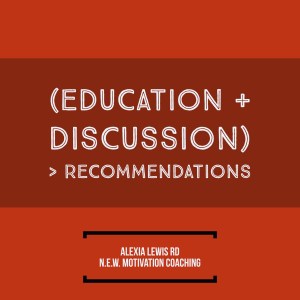
As an aside for both of these definitions of terms: many people are more successful when given education and having a discussion with their health professional about how to apply it. Getting a recommendation is what many people think they want, only to find out those recommendations don’t stick for long. We all know that someone else telling you what to do rarely works for long… we tend to start tweaking things or just straight-up stop, right? A health professional skilled in having the conversation with people about behavior and lifestyle changes can be just as – if not more – helpful in the long-term than someone who can make recommendations.

education plus discussion

Types of Health Professionals

Certified Health Coach. If you want to focus in many areas, this is your go-to professional! Just know that there are many different types of coaching certifications with some being intensive and some being laughable – so ask questions. The more intensive certifications can require a NCCA-accredited certification/license or an associate’s degree in a health-related field as a prerequisite, followed by additional education (classes, readings, practical videos, critiqued practice of coaching skills) and a proctored exam. They can coach you in many areas of health and wellness including nutrition education, exercise education (and possibly building your exercise foundation), sleep, stress, time management, consistency, overcoming challenges, etc. They should also be skilled in motivating you to change and dispelling health myths.

Certified Personal Trainer. For exercise, this is your go-to professional! The same agencies that certify Health Coaches may also certify Personal Trainers so the requirements for this certification are similar except that only a high school diploma and current CPR certification are required. Personal Trainers can do exercise education, foundation, and training. They will know how to work around any injuries you have; but they cannot diagnose or treat injuries (that’s medicine) or help with injury recovery (that’s physical therapy). They can lead you through workouts or design an exercise program for you to follow on your own. For nutrition, dig a little deeper into their training. Legitimately credentialed personal trainers will have some education in nutrition and they can obtain extra certifications in nutrition (quality of programs vary); however, they are limited to nutrition education.  They should also be skilled in motivating you to change and dispelling exercise myths.

Registered Dietitian / State-Licensed Nutritionist. For nutrition, this person is your go-to professional! They will have an undergraduate (or master’s) degree in health / nutrition science and have completed 1,200 hours of hands-on practical internships. They can do nutrition education, make recommendations, and provide MNT. “Registered Dietitian” and “Dietitian” are legally protected titles in most U.S. States. “Licensed Dietitian/Nutritionist” is a title for those who have a license from their state’s Department of Health (same as a medical or trades license). In terms of exercise, they can provide exercise education and let you know if your “calories burned” part of the energy equation is low; but they cannot do any exercise foundation or training work with you. They should be skilled in motivating you to change and dispelling nutrition myths.

Nutritionist / Nutritionalist / Nutrition Counselor / Etc. Go make yourself a web page and business card – I’ll wait – congrats you are now a nutritionist! Would you put your health in the hands of someone simply because they have a good eye for design and a compelling way with words? Or because some new and interesting eating or exercise thing they did worked for them? Please be smarter than this. Some “schools” will give people a nutritionist title and it may mean nothing (very little training) or it may be more intensive; either way, unless they are a “licensed nutritionist” they can still only legally do nutrition education in many states. Ask questions before working with someone with this kind of title.

Mental Health Counselor. At times (lots of times), food and exercise issues are rooted in emotional and mental health. The previously listed health professionals help you with the “outside work” (doing things) and can help you work through some of the smaller internal mental challenges with creating new lifestyle habits. They can also help you identify if some more involved “inside work” (thinking things) might be helpful and refer you to a therapist. This is a great person to have on your team; just be sure to find someone state-licensed.

Where do I fit in? I’m so glad you asked!

I am a Certified Health Coach (American Council on Exercise), Registered Dietitian, and State-Licensed Dietitian/Nutritionist (Florida); but my approach is different from many other RDs.

I have had clients tell me they were not interested in working with me because I am an RD; but they gave an RD one last try. After a while, they confessed this to me that all they got before were handouts and food rules and it was not helpful. There was no flexibility; just “here, do this.” Thankfully, I do not speak about all RDs here – as practitioners, we are as different as the people you will find in any other helping field.  You will not get a handout, some food rules, and a plan from me and I will not tell you how you should go about reaching your goals. Someone else’s plan (even mine!) will not work for you for long – and it certainly does not get you near the goal of making changes stick for a lifetime.

My job as I see it is to help you examine your goals and how they fit into your lifestyle, break your food rules, and explore the many options you have to reach your goals. Then we set about finding a few small, flexible, realistic ways for you to move towards those goals. I will not tell you what you should or should not do.

Don’t enough people already try to tell you what to do?

Yours in Good Health,

-Alexia Lewis RD

This article is Part 2 of 4 in “Health versus Weight as a Focus for Wellness.”

Part 1: The Continuum of Approaches to Health: Thoughts from a Curvy and Healthy Dietitian Health Coach

Part 3: If Diets Don’t Work, How Can a Health Coach Help Me?

Part 4: What Is This No-Diet / Anti-Diet Thing Anyway?

References & Resources:

Health Coach Certification, American Council on Exercise: https://www.acefitness.org/fitness-certifications/health-coach-certification/default.aspx

ACSM Certified Personal Trainer, American College of Sports Medicine: https://certification.acsm.org/acsm-certified-personal-trainer

5 Steps to Become a Registered Dietitian Nutritionist, Academy of Nutrition & Dietetics: http://www.eatrightpro.org/resource/career/become-an-rdn-or-dtr/high-school-students/5-steps-to-become-a-registered-dietitian-nutritionist