Tag Archives: healthy habits

Picture of woman throwing glitter into the air with the words, "reach your health goals with environmental design.

Reach Your Health Goals with Environmental Design

April 2025. Life certainly has its rough patches, no? I’m in the middle of one right now.

It’s tempting to throw in the proverbial towel and just take a break from all the health goals when life laughs at your plans. And that certainly is a valid option. Sometimes taking a break is exactly what is needed to come back stronger.

But other times, continuing forward progress is what will help the most. Especially if you need a distraction from highly emotional times. (Hi, that’s me!). Keeping busy and staying focused on my goals is helping me to navigate this rough patch.

Enter environmental design. This is a strategy based on setting up your environment in a way that makes it easier to make the choice you decided to make when life wasn’t quite so rough. And if this resonates with you, be sure to check out my blog on how to never fail at your goals again.

I’m also sharing a simple, healthy, and delicious recipe for the hummus wraps I have been loving for quite a minute now. It’s best for those who can put together a wrap when it’s time to eat. That way the wrap doesn’t get soggy from the ingredients. It’s also vegan, but don’t let that scare you away. You can always add some meat!

Start where you are. Use what you have. Do what you can.” – The great Arthur Ashe 

Yours in good health,
Alexia Lewis, RD
Master’s Level Nutritionist
Registered Dietitian
Certified Health Coach

Graphic of review with words: DYK I currently have a 5-star rating (out of 5) based on 136 reviews?! Here’s one of my recent reviews. 

“I really enjoyed working with Alexia. Our sessions well exceeded my expectations, Alexia jumped right in and met me where I was at with tailored sessions. We strategized about my concerns, I always felt listened to, the sessions were prepared with responsive information, I learned so much and [now I] feel more empowered and confident in my journey. I appreciate you so much! Thank you!

Ever wondered what a dietitian eats? Surprise! It is not only super-healthy foods. This dietitian eats for nutrition and for pleasure. You can too. 


I’m having a food jag with my hummus wrap for lunch. #noshame. With just a little meal-prepping, I’m enjoying quick-to-make lunches that are nutrition-rich and delicious!

Colorful picture of hummus wrap on a kitchen counter.

The meal-prepping part:

  • Peel away the tunic (that’s the papery coating!) and slice one Vidala or another sweet onion.
  • Wash, remove seeds, and slice one or two bell peppers into strips.
  • Wash and cut one zucchini or yellow squash in half, then cut into large matchsticks.
  • Sauté these vegetables until they are cooked to your preference.
  • Store in the refrigerator for 3-4 days and grab them when it’s time to make lunch.

You can use any vegetables you like that will cook down to soft so they will roll up into a wrap. Cutting into slices or large matchsticks works best. 

The make-a-lunch part:

  • Get a burrito-sized flour tortilla. Heat using stovetop if not bendy. Do not get too close to the stove element or flame!
  • Spread your favorite hummus on one half of the wrap. May I recommend Lantana’s Sriracha Carrot Hummus – *chef’s kiss* (no affiliation).
  • Sprinkle nutritional yeast on the hummus for a little more protein and a little bit of a cheesy flavor. I use about a teaspoon, but there are no rules here.
  • Get those prepped veggies out of the fridge and place them on top of the hummus and nutritional yeast. It takes a little practice to get the right amount of veggies so the wrap isn’t sad, but not so much that it won’t wrap up or stay together.
  • Add a side of fruit. I love blackberries and fresh pineapple these days.

You can add meat or legumes like chickpeas, or tofu to boost the protein.

Give this recipe a try and let me know what you think! I would also love your suggestions for ways to jazz it up! Sometimes we all need a little #foodspiration.

You can catch a glimpse of what my coaching style is like in this section, where I share some of what I’m working with my clients on. 

This is based on my experience with my patients and is provided solely for educational purposes. It may NOT be appropriate for you. Please check with your healthcare provider before making changes based on the information provided here.


Here we are just over 3 months into the new year. So… how’s it going with your health goals?

The motivation that you felt in January is waning and things you could do easily in January are likely getting more difficult to do. #truestory. Life starts life-ing and we tell ourselves that we must grit our teeth, power through, suck it up, and get it done.

Yah. No. Willpower is not always the answer.

There is some cool research on willpower. It used to be thought that your willpower runs out over the day and with every decision you make. Now, they are finding that this is the case for some people, but not for others. Read up on this along with tips to increase your willpower.

I still stand by needing to use willpower a lot means you will not be able to maintain what you are trying to do for the long-term. It’s a great way to get started or a goal for that event in a few weeks. But if it’s your lifetime plan… oh, how exhausting to always be pushing that hard and likely having that negative internal voice beat you down.

Picture of a stack of big rocks alternating with small rocks that is perfectly balanced.

So, let’s talk about something that can help boost your willpower: environmental design. This is the idea that you build the environment around you (the triggers) to make the choice you want to make (the goal) easier.

Want some examples?

  • If your goal is to eat more veggies, it will be easier if they are washed and cut and stored front and center when you open the fridge. If that slice of cake is there instead, it is so much harder to eat the veggies.
  • If your goal is to take a walk after dinner, it will be easier if you put your walking shoes on before you sit down to eat and hang your jacket over your chair. If those things are back in the closet, well, out of sight, out of mind.
  • If your goal is to eat more regularly throughout the day, it will be easier if you have pre-planned what to eat and set a reminder when the time comes to eat.

Make sense?

At a minimum, assess your environment using the topics below. And if you want to do a deeper dive, this article on building an environment that supports you is filled with tips. Or, you know, reply to this email to see if I am licensed in your state then schedule an appointment with me through Nourish. Most people have no out-of-pocket costs.

People.  

Who supports you? Stick with them as much as you can.

Who doesn’t support you or takes you into situations with lots of temptations? Even if it’s a happy hour friend, alcohol lowers your food inhibitions so that seemingly harmless situation can drastically change your food choices.

For these people, what conversation do you need to have with them? Plan for it: what will you say, practice saying it, decide what they can do to best support you? Offer to support them with something too!

Hopefully, this will not apply BUT if these conversations could be potentially dangerous for you emotionally or physically, please seek appropriate guidance, support, and assistance. Do not endanger yourself – better safe than sorry. And getting help from a mental health therapist on boundary setting can make all the difference.

Start by asking your medical provider or insurance company representative for their recommended therapist. There are also some resources for the USA include Psychology Today’s directory, and there are many app-based services too like TalkSpace or BetterHelp. (No affiliations with any of these).

Places & Situations.

Think though where you go and the situations you typically encounter.

Ask yourself:

  • Which ones support your goals, and which ones derail you?
  • At home or in other places, what do you need to change?
  • Is your schedule making it more difficult, how could you change your schedule?
  • Are you going to social events that are full of temptation, how can you change your actions and choices at these events?

Things.

What things around you could you get rid of or put away somewhere to better support you?

What things that do support you can you put within view and make easy to reach? This is where moving the vegetables to the front of the fridge comes into play.

Try this out as an affirmation this week: When I set myself up for success, anything is possible!

Now, get going! Take a break from those gut-it-out goals and build your environment to support you.

Yes, RDs can help with designing your environment to support your nutrition goals, and lots of other behavior change strategies! You may be surprised at how much this can help.

My main jams are heart health, breaking food rules to improve people’s relationship with food, and weight loss including supporting those on weight loss medication and stopping binge eating (but not accepting diagnosed binge eating disorder).

If you are ready, let’s do it!

  • Reply to this email to ask if I am licensed in your state.
  • Go to my provider page, choose a date/time and start the scheduling process. NOTE: Even if I’m not licensed in your state, click to my page, then click Find Your Dietitian and filter using the drop downs at the top of the page.
  • One of the first screens will let know if your health insurance is accepted by Nourish.
  • Before you finish the booking process, you will enter your insurance information and get an estimate of the expected costs.
  • And 95% of people have no out-of-pocket costs!!

And, of course, you can reply to this email if you have questions or want to be hooked up with another amazing RD at Nourish. I’m happy to help! 

Hi there! I’m Alexia and I believe in science, humor, and delicious food.

I believe you shouldn’t sacrifice your mental health in pursuit of better physical health. You deserve to be both happy and healthy. You don’t have to choose just one. I’ve been working with people to improve this balance while still meeting their food and lifestyle goals since 2012.

I am a master’s level nutritionist who is also a registered and licensed dietitian in multiple states in the USA, a certified personal trainer, and certified health coach. I also invested in becoming a culinary nutritionist and weight management specialist. In other words, I got you.
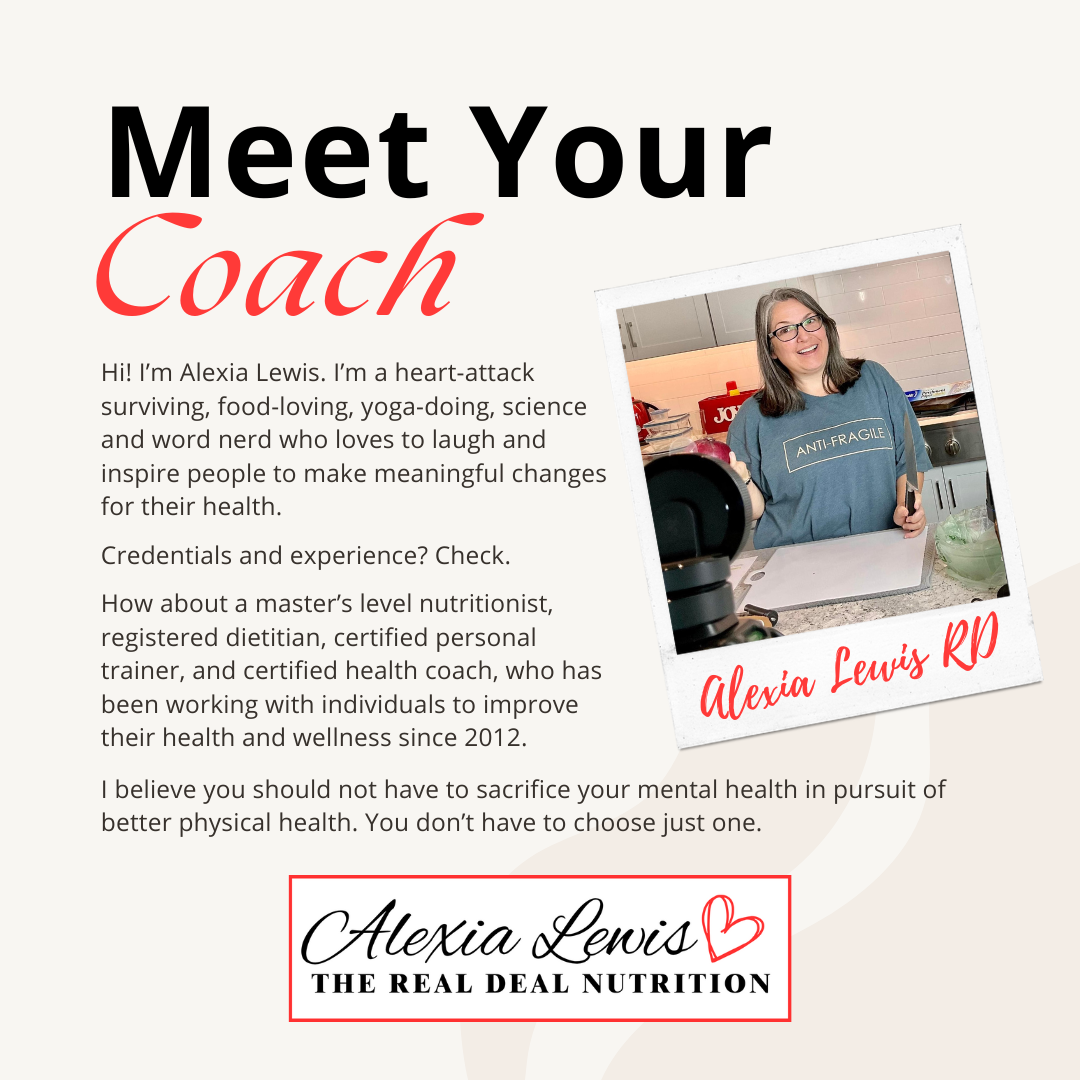
Graphic with image of Alexia.

References:

BBC. The Mindset That Brings Unlimited Willpower, published January 3, 2023.

Vitality Nutrition. How To Build An Environment That Supports Your Goals + Helps You Get “In Control” Of Your Cravings, published June 7, 2022.

What I Learned from the 10 Holiday Survival Tips Workshop

Do you wish there was a way to have all of your favorite foods of the holiday season. Well, sit down and brace yourself – it IS possible!

Welcome Vanessa, NMC’s nutrition student and mentee, who  shares below what she learned from attending the live event showcasing the 10 Holiday Survival Tips from the “Love Yourself Healthy through the Holidays” Plan.

The holidays are fast approaching and I’ve already been daydreaming about the rich, indulgent foods that only are made at this time of year. They are calling my name! How do I choose what to eat? Do I go all in with my favorites, like green bean casserole or pumpkin pie, at every party… or do I not indulge in my favorite foods because I know how many more parties I will have to go to?

After seeing Coach Alexia talk about her 10 holiday tips to enjoy a guilt-free holiday, I walked away with three new ideas for how to enjoy everything about the holidays this year.

First, it is important to take the time to catch up with my family and friends. This is the only time of year that I get to see my aunt and uncle that live out west. I always say that I will plan a trip and I never do. If I take this time to catch up with them then I take the focus off the food and can reconnect with my family. As a bonus, while I’m chatting away, my mouth is too busy to chew!

Second, keeping my hands full will help keep me from eating too much. This year at the holiday party, I’m going to keep a drink in one hand and my phone in the other hand to have ready for taking pictures. With both hands full there is no space for me to hold a plate of snacks and mindlessly eat during the party.

Third, and most importantly, I gained new confidence for going into the holidays. With these 10 new strategies, I know can get through the season worry free (maybe even a little lighter!). The holidays are a time of family, friends, laughter and tons of food and this year I can now make my plan so I can eat, drink and be merry!

Happy Holidays from Vanessa!

Check out the entire Love Yourself Healthy through the Holidays Plan so you can make a plan and not be so uncomfortable after your holiday meals that you have to reach under the table and try to unbutton your pants while hoping no one notices!


Willpower – Psssshaw.

On average, I talk to about 30-40 people every week who are working on reaching their health goals using food and nutrition. Sure, we talk about food and calories and all that fun dietitian-stuff; but more often than not, the issue is not what or how to eat. Google yourself a nutrition question and you’ll get everything from solid evidence-based advice to some crazy woo-promoting ideas. Information on what or how to eat is everywhere.

The issue is putting that knowledge into practice. The issue is in the decision at 3:00 pm when your tummy rumbles and you frown at the bag of cucumbers and hummus you have packed for your snack and start thinking about that vending machine down the hall. The issue is in that coffee meeting when you really want that mocha frap with extra whip instead of a plain iced coffee. The issue is in having to work late and now it is 7pm and you feel like you’ve earned those drive-through fries even though you’ve got an already prepped dinner waiting on you at home.

How do you make the more healthful choice when you don’t want to?

You tell yourself – and you tell me – that you just have to make yourself do it.

Oh no. Do not rely on being able to MAKE yourself do something if you really want to success. It is ridiculous to use willpower for food choices.

Think about it. You see an amazing new whatever in the store and you want it. You rely on will power to walk by and then you’re done, you leave the store and it’s no longer easy to get that whatever. Now imagine that whatever is yummy food in your pantry and that store is your living room. You don’t get the benefit of leaving and having the decision be behind you. You have to make the decision to ignore that yummy food about, oh, every 60 seconds. I don’t think that many people could do that – okay, maybe for one night – but for every minute of every night? No way!

We know some things about willpower that can help us. Here is what the evidence reflects:

  1. Willpower is limited. You only get so much and then it’s gone.
  1. Willpower is used up over the day. We chip away at willpower with stress, emotions, and all those little decisions we make until there is none left to keep you away from that yummy food in the pantry by the end of the day.
  1. Willpower resets every night – great news! This is why you can wake up every morning and tell yourself: Self, today is THE day that I make it happen!

My advice is don’t set yourself up to have to rely on willpower. Instead do whatever you have to do to make the healthy choice the easier choice.

  • Modify your environment so you see the healthy choices more regularly
  • Plan and prepare for meals/snacks
  • Carry snacks with you when away from home
  • Have a plan for the gas station stop or a drive through or that day-long meeting
  • Plan any tempting situations for morning when you have the most willpower. Need to catch up with a friend? How about a breakfast date instead of happy hour?
  • Use mornings to plan, shop, exercise – do whatever it is that is the hardest thing for you in the mornings!

Just to be sure though, practice saying no to temptations and people just in case you have to draw on some of that limited willpower. My hope for you is that you don’t resort to “I just have to do it” and rely on willpower because then it’s a crap-shoot.

How will you change your environment or social situations so you can be successful without relying on will power?

willpowerdog

Image from: http://pandawhale.com/post/44157/decisions-exhaust-our-willpower-we-each-have-one-reservoir-of-will-and-discipline-and-it-gets-progressively-depleted-by-active-choices

Are You Healthy?

Is overweight the new healthy? The answer might surprise you.

Let’s start with the definition of healthy. How do you define healthy?

There are many aspects of health – there is body size (BMI, body fat) or metabolic health (lab results) or cardiovascular health (resting heart rate, ability to perform daily living tasks or purposeful exercise) or even emotional and spiritual health (do the standards you hold yourself to for your physical health damage your emotional health?). Or is it based on quality of life? Or the characteristics of those who live the longest?

(Spoiler alert: We are finding that a BMI in the “overweight” range has a lower mortality rate than those in the “normal” weight range).

So, I ask: how should we define health? The good news is that you get to define it based on what is important to you and I’d recommend you do it in collaboration with a physician.

I can tell you that people choose physical appearance over their emotional health a lot. One thing most people have in common when they walk in the door to meet with an RD is that their emotional health has taken a hit regardless of their body size. It seems very few people can find peace with their bodies – even those who appear “fit” or “healthy” to others.

This concerns me.

I used to be there too and I still some days struggle with self-acceptance and self-love (stupid #fitspo memes). It’s no secret that I carry a few extra pounds. Should you consider me proof that knowing what to do to get to a socially desirable weight and actually doing it are two different things? Or should you perhaps consider that I am happy and healthy with a few extra pounds? Could this be true?!?!

In 2007, I was “overweight” by the numbers and I fought with my body and had low body-acceptance. My hips were too big, my belly isn’t flat, my thighs are so big when I sit down… all those things we let ourselves say in our heads when we don’t love ourselves as we are. I had a heart attack. I felt my body had let me down even more… and then I realized that this body that I hated – big belly, hips, thighs, and all – had actually carried me through and I survived that heart attack. Just that simple realization led to a big mind shift and changed those thoughts in my head to appreciation and gratitude for this body that I was lucky enough to still have!

Before you go screaming that being overweight is why I had a heart attack – let me stop you. I was a smoker for decades, I worked a stressful job, and I have a strong family history. Most health conditions (and the supposed “obesity epidemic”) are not as simple as people believe. These things have multiple factors that lead to these outcomes. Being thin would not have prevented my heart attack.

I share all this to lead you into considering your HEALTH over your APPEARANCE. I encourage you to think a little deeper than the eat-less-move-more movement. Check out HAES (Health at Every Size), read up on new studies that might indicate a coming shift in beliefs (just one of many studies here: BMI 27: The New Normal?), and start loving yourself first.

Change your body or don’t – we are all works in progress – but please start from a place of self-love and body-acceptance. Look forward to more information on this topic in the future.

Image from: https://fridayforgood.com/2015/11/20/be-rebellious/

A Weekly Meal Planner

“ASPIRE” – Six Steps to Healthy Meal Planning

The one best thing you can do to make healthier, nutrition-rich meals, save time and money, and make life easier is to plan your meals ahead of time. You need a strategy to plan healthy meals. If you wait until you are hungry and tired at the end of the day, figuring out what to make for dinner is not easy and you’re more likely to choose something fast, easy, and unhealthy. However, this is one of the things that my clients find the hardest to do.

I’m here to help you “make nutrition easy,” so here is my strategy for you.

Grab some paper, a pen, and ASPIRE to plan your meals. Remembering this acronym will guide you through a simple way to plan meals that are healthy, yummy, and reduce your grocery expenses! I designed my free Weekly Menu Planner just for this! You can use any format as long as you have one column for each day of the week.

A = Agenda

The first thing to do is check your agenda for any commitments, meetings, and changes to your usual schedule. Also check the calendars of the others in your household. This is important so you know which nights you have time to make a meal and which nights you don’t and should plan for leftovers. It also lets you know which nights you need quick and easy meals and which nights you can spend more time on your meal creations. You can also note the days that you have to be out of the house early and may benefit from packing your a lunch the night before. Write down everyone’s commitments that have an impact on meals on the weekly menu planner.

S = Stock

What do you already have on stock, on par, or in your pantry and fridge? Flip your weekly menu planner over and make a list of all the foods in your fridge and pantry (your “stock foods”) on the left side of the back of the paper.

P = Promotions

Check the store promotions. What is on sale this week? What do you have coupons for? We all want to stretch our food dollars and this is one way to do it. If you don’t clip coupons, go to the grocery store’s web site as many are now allowing their customers to electronically collect coupons on reward cards or by their phone number. You can also check one of my favorite coupon sites, Southern Savers, for printable coupons. On the right side of the back of your weekly menu planner, write down the “promotions foods” you plan to buy based on sales, coupons, and promotions.

I = Invent

Put on your creative chef’s hat, and invent meals you can put together using only foods on your list of “stock foods.” If you can’t make anything with what you have in stock, then figure out what you can add from the list of “promotion foods” to make a meal with your  “stock foods”. The idea is to use as few foods from the “promotion foods” list so you make as many meals as you can without spending money on new foods! Once you have invented a few meal ideas, flip your weekly meal planner over and put the meals where they fit best based on your schedule.

A Weekly Meal Planner

Tips

  • Google is your friend. I made this delicious Puff Pastry Tart just by putting “puff pastry,” “spinach,” “sweet potato,” and “healthy easy recipe” into Google!
  • Cook more than you need so you have leftovers from every time you cook! A few tweaks and one night’s baked chicken, sauteed mushrooms and zucchini, and brown rice transform into the second night’s chicken quesadillas.
  • Make the first meal on your weekly planner one that you have all the ingredients for… just in case you don’t make it to the store right away.
  • This is the hard part and it takes time – so save every weekly meal planner you create to re-use for those weeks you don’t want to spend the time and effort doing all this work.
  • Use the food group tallies on the bottom of my weekly meal planner to make sure you are including food from all food groups in your meal plans. Don’t know how many of each food group to include? Here’s a guideline based on a 2,000 calorie diet.

R = Run

Get out and run those errands! Use your list of “promotions foods” to make a shopping list. Clip your coupons. Go to the grocery store and do your shopping.

E = Execute

You spent all that time and effort making a plan, now execute your plan.

Post the weekly meal planner in the kitchen where you can see it. If you have helpers at home, let them know they can start prepping foods for dinners before you get home.

Most importantly, be flexible. This plan is an outline and life happens. You may have forgotten you need fish for one dinner… just push that meal back to another day. You may decide that you are way too tired to cook one night… just pick up your plan the next night.

Always have a Plan B Meal in mind. In my home, it is either flatbread pizza or turkey burgers and sweet potato fries. We always have the ingredients in stock  and, on those nights we aren’t feeling our meal plan, we have a yummy 20-minute, low-effort dinner.

Let me know if you like my strategy. I hope you ASPIRE to give meal planning a try this week!

Image of a salad in a heart shaped bowl with a stethoscope near it and the words: The Basics of Heart Healthy Eating, Alexia Lewis, Real Deal Nutrition

The Basics of Heart-Healthy Eating

Updated 01/30/2025 to included reducing added sugars and ultra-processed foods to “the basics of heart-healthy eating.”

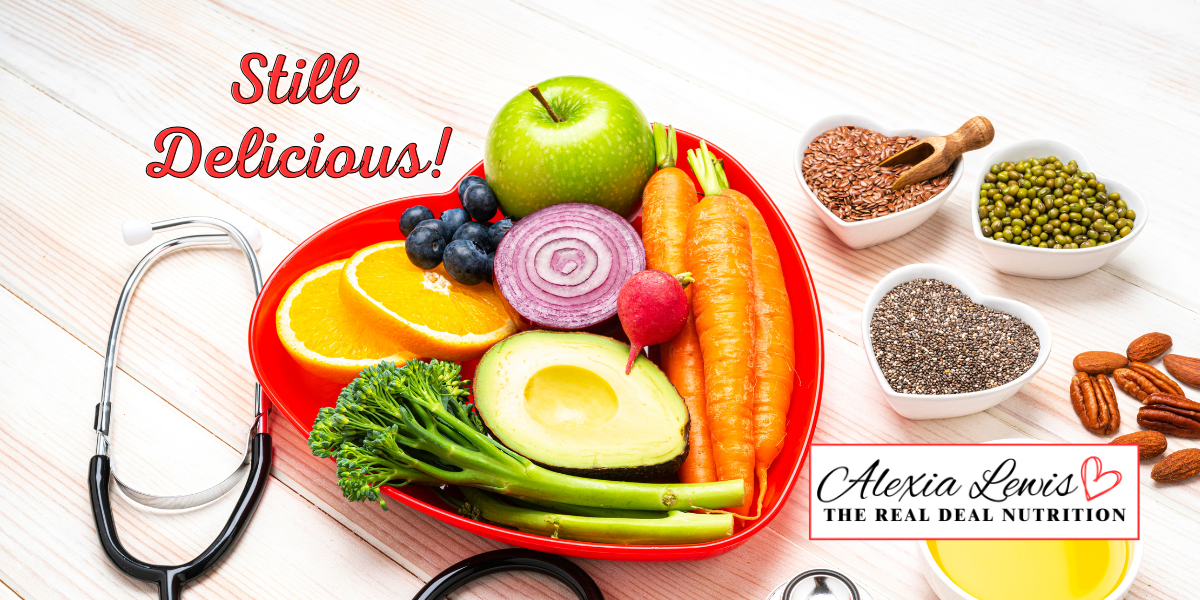
Picture of colorful heart-healthy foods on a heart-shaped plate with the words: Still Delicious!

The Basics of Heart-Healthy Eating.

You may hear about magical foods or failproof techniques that are touted as the way to improve heart health.  Yah… no. If they existed, then heart disease would not have remained the number one killer of Americans for over 100 years. WHAT? Yes, heart disease first topped the charts back in 1921 (1).

If you know me (Hi, I’m Alexia, a dietitian and heart attack survivor!), then you know I like to simplify nutrition. While nutrition can become incredibly complex and nuanced, most people benefit from big-picture, easier-to-implement steps. To that end, here is my take on the basics of heart-healthy eating. 

TL:DR:

  1. Increase fiber.
  2. Change up your dietary fats.
  3. Decrease sodium.
  4. Decrease added sugars.
  5. Reduce ultra-processed foods.
  6. Bonus basics of heart-healthy eating.

Of note: I do mention weight in this article. I am a strong believer that people can be healthy at many body sizes – and confident and beautiful (2). I promote and respect every individual’s choice regarding their weight. I believe we should continue to work towards doing better with providing non-biased health care. More on the weight and heart disease below.

Increase Fiber.

Dietary fiber plays many roles to help with heart disease. It helps with managing cholesterol, blood sugar, and with satisfying appetite, which can lead to reducing weight, which can lead to reducing blood pressure.

Many people would benefit from increasing dietary fiber intake. Unless, of course, you have health conditions or other concerns that limit your fiber intake. If you need to limit fiber, talk to a qualified nutritionist and skip on down to the next basic of heart-healthy eating.

This excellent article from Mayo Clinic shares more about fiber, why to eat it, and when to avoid it (3).

Since we eat foods, not fiber: dietary fiber is found in fruits, vegetables, whole grains, and legumes (beans and peas).

Okay, true. There is also fiber in nuts, however, you would need to eat a lot of them to significantly contribute to your fiber intake, and they are the most calorie dense of the choices. In other words, one measured cup of dry roasted mixed nuts comes in at 9 grams of fiber and a whopping 595 calories (4). Absolutely include nuts in your diet for heart health… just not because of the fiber content!

Bottom line:

  1. Eat at least one of type of food with fiber with every meal and snack.
  2. Choose non-starchy vegetables for most of those food choices to load up on fiber without loading up on calories.
  3. Which type of foods you choose depends on your preferences, health, and goals.

You have lots of choices for foods to include, so… no excuses! And I say this because according to the 2020-2025 Dietary Guidelines for Americans, a distressingly low 10% of women and 3% of men are eating enough the recommended amount of fiber (5).

You don’t eat grains, fine! Eat a starchy veggie.

You don’t eat vegetables, fine! Eat some beans. (Well, kinda “fine” on the veggies, I mean, eat some, yeah?).

You don’t eat beans, fine! Eat some fruit.

Need help including more foods with fiber or navigating all the confusing information on food packaging?

Change Up Your Fats.

The type of dietary fat you eat can have an impact on heart health. This happens because the type of fats you eat helps to reduce LDL (bad) and increase HDL (good) cholesterol. This has a positive impact on heart health.

Notice I didn’t say reduce your fat intake? (Unless, of course, you have a condition that requires eating a low-fat diet, then reducing dietary fat intake is also important.)

That’s because fats are delicious (#noshame), needed for some types of cooking, and needed for your body to absorb fat-soluble nutrients. Eating a fat-free salad? You are missing out on absorbing some of that salad’s nutrition!

Reducing saturated fat, on its own, has been shown to reduce LDL cholesterol.

Increasing unsaturated fat, on its own, has been shown to decrease LDL and increase HDL cholesterol. In incredibly simplified terms, HDL’s job is to help get rid of LDL (6). Boom.

Doubling down by replacing saturated fats with unsaturated fats can reduce LDL and increase HDL all with one dietary swap. It’s as easy as replacing butter with avocado oil for sautéing.

In addition, specific unsaturated fats, omega-3’s can reduce triglycerides and blood pressure. Your body cannot put together omega-3 fats (or omega-6s), so getting foods with these types of fats in your diet is important.

The Australian Heart Foundation has a great overview with more details and food examples (7).

Bottom line:

  1. Eat more meatless/plant-based meals and use lower fat dairy foods to reduce saturated fats.
  2. Enjoy nuts, seeds, olives, and avocados often including cooking with oils made from these foods to boost unsaturated fats. Just be mindful of portion sizes due to being high in calories and/or sodium – I’m looking at you delicious salty olives.
  3. Add a meal with a food high in omega-3′ fats once or twice a week.

I struggle to cook salmon, but it always comes out well when I make this amazing salmon recipe (8).

Image of a piece of salmon on a plate topped with dill sauce, fresh dill, sliced almonds, and pomegranate arils.

I didn’t mention trans fats because they were banned from our food supply in 2018 and food manufacturers were given until 2021 to get them out of their foods (9). So, you likely won’t see trans fats in most foods you buy now.

But it’s worth checking the back of your pantry to make sure older foods you may have do not have trans fats on the label (or partially hydrogenated oils listed in the ingredients). And, um, it’s 2025 as I write this, so yeah, check those use by and expiration dates too.

Need help with a virtual pantry and kitchen cleanout?

Decrease Sodium.

While most of us aren’t eating enough fiber, we are eating too much salt. On average, Americans eat 1,100 milligrams more than the recommended amount, which is 2,300 milligrams a day (10).

Do you remember from your early biology classes that water follows salt. I remember really struggling with osmosis. Who knew it would actually be relevant when I grew up?

So, water follows salt. If your salt intake is high, your body holds water to keep all things in balance. More water in your blood vessels makes your blood pressure go up, and that is a risk factor for heart disease.

Most of the salt in the Standard American Diet (yes, the acronym is SAD, which fits) comes from packaged foods, including canned foods. We know salt enhances flavors. It is also a preservative and a binder in foods, and it keeps the foods holding water too, which keeps them *insert the m-word here* so this tracks.

For more info, check out this list of 16 high sodium foods (11) and tips for lowering sodium (12).

Bottom Line:

  1. Check food labels to choose brands with less sodium.
  2. Rinse canned foods when you can.
  3. Choose more whole/unpackaged foods.
  4. And salt really does wonders to improve foods flavor, so use it. Just stop shaking the shaker after a few shakes, whether used at the table or while cooking.

One very interesting piece of info is that not everyone is salt-sensitive. That means reducing salt in the diet will not impact blood pressure for those who are salt-resistant. Even so, reducing sodium is a positive food choice for many (10).

Of note, there are instances and conditions that may require limiting or consuming a specific amount of salt. In those cases, this info does not appy.

Need help making sure your meals are still delicious without salt?

Decrease Added Sugars.

Just like salt, most of the added sugar in our food isn’t added by us. It’s added by food manufacturers. And just like salt, sugar makes foods delicious. That’s likely why we are also eating too much added sugar in our foods.

Well, that and its “hiding” in many foods that aren’t especially sweet.

The recommendation from the American Heart Association recommends 6% of intake of added sugars, or 6 teaspoons a day for women and 9 teaspoons a day for men (13). The Dietary Guidelines allow for 12 teaspoons (if you eat 2,000 calories a day) (5). One study based on 100,000 people over 9 years found the highest risk of heart disease hits around 24 teaspoons of added sugar (14).

And, of course, as always, people managing specific health conditions or others may need to have different recommendations.

So, drumroll please… We eat 17 teaspoons of added sugars on average (15).

Sugar contributes to heart disease as it can increase blood pressure, inflammation, weight gain, and make it more difficult to manage diabetes/prediabetes.

Bottom line:

  1. Do your best to reduce added sugars down to the recommendations.
  2. Continue to enjoy foods with natural sugars.

Yes, you can eat fruit (and unsweetened dairy foods). Foods with natural sugars have other nutrients (fiber, protein, fat) which slows digestion, and the research doesn’t show that these increase heart disease risk.

This Harvard Health article on The Sweet Danger of Sugar is a nice resource for more info (16).

Need help on finding the added sugars in your foods?

Reduce Ultra-Processed Foods.

In the hurry up, stay busy, no time to relax kind of culture that many of Americans live in, processed foods make it easier to get food on the table. #noshame. They are also generally less expensive. With a store-brand dozen of eggs now costing over $4.00, we all could use a little help with our food budgets.

While processed foods have been around for 1.5 million years. After all, cooking with fire is a form of processing. The 1800s saw the inventions of the tin can for foods and pasteurization (17). Then the 1900s saw a big boost in demand for processed foods, with Swanson’s frozen meals hitting the market in the 1920s and fast food starting to hit its stride in the 1950s (18).

Fast forward and we have gone from minimally processing foods (cooking, canning, salting, smoking, freezing, etc.) to the ultra-processed powdered meal replacement drinks of today.

Did I mention there is no food shaming allowed here?

So, yes. Ultra-processed foods can have a place in an otherwise generally healthy dietary approach. And yes, it’s going to be in moderation. Nutrition is not so unforgiving (for most of us!) that eating a small amount of these foods will wreck health. What matters is what we do most of the time.

Speaking of most of the time, ultra-processed foods now make up 60% of the foods we eat (19). So, yeah, that’s more than “in moderation” and that makes for a different conversation.

That being said food exists on a spectrum of processing, and while processing can improve nutrition with fortification, they have been starting to get linked to many negative health outcomes. For example, increasing inflammation and reducing gut health. In terms of heart health, these foods can raise triglycerides, blood pressure, and body weight (20).

Bottom line:

  1. Work to reduce ultra-processed foods that are of low nutrition quality as your time and budget allow. For heart health, assessing foods for the nutrients mentioned in this article may be a good start.
  2. Look for processed foods that positively impact nutrition. For example, adding vitamins or fiber.
  3. Eat whole and minimally processed foods when you can.

On the flip side, it’s also entirely possible to eat a diet of whole/minimally processed foods that have a negative impact on heart health. Food choices matter. And a healthy diet can include ultra-processed foods. After all, store-bought bread and flavored yogurt are both ultra-processed food under the NOVA classification system (21).

PS – Research is ongoing to learn more about if it is the quality of ultra-processed foods (high sugar, salt, fat, etc.) or the actual processing of the foods that matter most for health.

Need help with meal planning and/or prepping to reduce ultra-processed foods?

Bonus Basics of Heart-Healthy Eating.

For some extra steps to add to your basics of heart-healthy eating, you may also add more berries, nuts, avocado, and plant sterols and stanols (22) to your food choices.

And, while weight on its own does not cause heart disease, losing 2% to 5% of excess weight (if overweight) or gaining weight (if underweight), can also help to reduce risk of cardiac disease and its management for those with existing heart disease (23).

Next Steps.

Credible information is important. And putting that information into action is where the magic happens.

Small changes done consistently over time add up to big results. So just pick one or two changes to make right now. When you’ve got that down, add another 1-2 changes.

Work with Alexia on your heart health.

She can work with people in multiple states in the USA and accepts some health insurance plans through her partnership with Nourish. Learn more and start the scheduling process to see if your insurance is accepted and get an estimate of your out-of-pocket costs. (Note that Nourish handles the health insurance stuff, not Alexia!)

If she can’t work with you, you can choose another dietitian who can, or reach out for help getting connected with the right RD for you.

References & Links.

  1. American Heart Association Newsroom: More Than Half of US Adults Don’t Know Heart Disease Is Leading Cause of Death Despite 100 Year Reign, posted 01/24/2024.
  2. Alexia Lewis RD article: Weight Does Not Equal Health, posted 06/05/2017.
  3. Mayo Clinic: Nutrition and Healthy Eating: Dietary Fiber: Essential for Healthy Diet, posted 12/11/2024.
  4. USDA: Food Data Central: Food Details: Mixed Nuts, posted 04/01/2019.
  5. USDA & DHHS: Dietary Guidelines for Americans: 2020-2025, posted 12/2020.
  6. Harvard Health Publishing: How It’s Made: Cholesterol Production In Your Body, posted 02/06/2017.
  7. Heart Foundation (Australia): Fats, Oils, and Heart Health, updated 03/19/2024.
  8. Keeping Healthy Simple Club: KHSC Festive Salmon recipe, posted 01/2025.
  9. US FDA: Trans fat, current as of 04/30/2024.
  10. Harvard T.H. Chan School of Public Health: The Nutrition Source: Salt and Sodium, reviewed 03/2023.
  11. Fresenius Kidney Care: 16 High Sodium Foods, n.d.
  12. US FDA: Sodium in Your Diet, current as of 03/05/2024.
  13. American Heart Association: Added Sugars, reviewed 08/02/2024.
  14. Hartford Health Care, St. Vincent’s Medical Center: Not-So-Sweet Link Between Sugar and Heart Disease, posted 02/22/2023.
  15. Harvard T.H. Chan School of Public Health: The Nutrition Source: Added Sugar, reviewed 04/2022.
  16. Harvard Health Publishing: Heart Health: The Sweet Danger of Sugar, posted 01/06/2022.
  17. Automated Process Equipment Corporation: The History of Food Processing: How We Got to What We Eat, posted 10/05/2023.
  18. Institute of Food Technologists: Food Processing, n.d.
  19. Diabetes: Volume 72, Issue Supplement 1: 1374-P: Ultra-Processed Food Consumption and Cardiometabolic Risk in Individuals With and Without Type 1 Diabetes Mellitus, published 06/20/2023.
  20. British Heart Foundation: Ultra-Processed Foods: How Bad Are They For Your Health? updated 04/12/2024.
  21. News-Medical Net: The NOVA Method of Food Classification, updated 10/17/2024.
  22. Cleveland Clinic: Phytosterols, reviewed 07/30/2022.
  23. Clevelend Clinic: Health Essentials: How Weight Affects Your Heart, posted 02/19/2024.

no meats

Planning for Vegan Eating

I’ve been planning meals for my Vegan Experiment. As I mentioned in my last post, there are certain nutrients that vegetarians (and vegans) tend to eat in lower than recommended amounts.This may lead you to ask two questions. One – What exactly are nutrients? Two – Who makes these recommendations?

Nutrients are the nutritional substances we get from foods: carbohydrates, proteins, fats, vitamins and minerals, and even phytochemicals (or plant nutrients like resveratrol in wine/grapes).

The recommendations are made by the Food and Nutrition Board of the Institute of Medicine of the National Academy of Sciences. They are based on years of population studies and research. They have drafted the DRIs (dietary reference intakes), which include the RDAs (recommended daily amounts), AI (adequate intake) and TULs (tolerable upper limits) for specific nutrients.

In plain language, these all tell the general population (or health professionals who translate it!) how much of the nutrient meets the needs of the 98% of the healthy population over age 2 in order to prevent deficiencies. For certain nutrients, there is also an upper level to prevent toxicity. Personally, preventing deficiency and toxicity sound good to me. Remember though, if you are under two (and you’re reading this, I’m impressed!) or have any health condition, these recommendations may not apply to you. There’s some good information on the USDA’s Food and Nutrition Information Center. If you want to know the recommendations specifically for you, there’s an interactive tool; but I wouldn’t get too caught up in all those numbers if I were you!

Any person who cuts out entire food groups is going to be lacking in certain nutrients. There is a reason there are food groups as the basis of the ChooseMyPlate method of eating. It’s because different food groups provide different nutrients and our bodies function best when we eat all of them. Whether it’s grains (breads and other carbohydrate foods), proteins (meats), fruits and vegetables, or dairy (milk, cheese, and yogurt), cutting out a food group cuts out specific nutrients. Those who cut out meats are taking away a large chunk of the foods in the protein group and most of the sources of complete proteins (proteins that have all the amino acids our body needs and cannot make on its own).

Image from ChooseMyPlate.gov

Finally, on to my point!

For optimal health, I recommend that over the course of the day, vegetarians include foods that, when put together, make complete proteins and plan to eat enough foods that provide iron, calcium, zinc, omega-3’s, and vitamins D and B12. Iodine may also be a concern if iodized salt is not used in cooking or flavoring foods.

How to do this?

Complete proteins: Examples of foods that make complete proteins include: tofu and rice, corn and beans, rice and beans/peas, peanut butter and whole wheat bread, granola and soy milk, or a green salad with garbanzo beans and sunflower seeds. The idea is to match grains/seeds/nuts with beans/peas or to match vegetables with  both grains/seeds/nuts and beans/peas. Simple enough! And to make it even easier, soy and quinoa are already complete proteins.

For the other nutrients listed, here are some examples of where a vegan can find these nutrients to include in their meals.

Iron: Beans (pair with vitamin C foods and avoid pairing with calcium foods to absorb more iron!) Examples might be: beans and rice with lime (vitamin C), cilantro, and salsa or a “loaded bowl” (see image below) with quinoa and black beans and vegetables including tomatoes (vitamin C).

Calcium: Fortified imitation milks (almond milk, soy milk, etc.) or dark leafy green vegetables (althought we don’t absorb as much from the vegetables!).

Zinc: Beans, peas, and nuts (I’m personally a huge almond fan and usually have a handful a day as a snack).

Omega-3’s: Walnuts and ground flaxseed. Add ground flaxseed to to smoothies, sauces, or sprinkle on salads – just watch out because it gets gummy when mixed with liquids, which is why it’s a great vegan egg replacement in baking.

Vitamin D: Sunshine! Fortified foods (milk imitators).

Vitamin B12: Fortified foods.

Iodine: Iodized table salt.

Quinoa Loaded Bowl
Quinoa Loaded Bowl

I also recommend that someone who is following a vegetarian or vegan lifestyle, ask their physician to pull a “vitamin panel” to check their levels of vitamin D and B12 (and others) every now and again just to make sure that deficiencies are being kept at bay!

I hope you found this helpful. If you have other ideas or ways to incorporate these important nutrients, please post your thoughts, meal ideas, and recipes!

Images from: ChooseMyPlate.gov, Microsoft Free Images, and personal photographs.

Can we change our genes?

Genetics: An Old Excuse on its Way Out

Can we change our genes?

Research is now showing that how people choose to live (lifestyle habits) can, in effect, turn on or turn off genes.

That’s right. If you consistently put down the donut during snack-time and reach instead for a cup of yogurt with blueberries, you could literally change the course of your life!

There is no denying that your genes play a pretty big part in who you become. They lay down the code for how you look and for what medical conditions you are predisposed to developing. The key word here is predisposed. The Free Dictionary online defines predisposed as “to make (someone) inclined to something in advance” (1).

Predisposition does not determine your future health path; it just tells you which of the possible paths you are more likely to walk down.

A simple example of this is found in the transcription of genes that produce lactase, an enzyme needed to digest lactose which is found primarily in milk. If a person stops drinking milk, the body doesn’t take the steps needed to produce lactase because it is wasted energy and eventually the person loses the ability to digest milk resulting in a lactose intolerance. However, if that same person doesn’t stop drinking milk, or even begins to drink very small amounts of milk again, the body will spend the extra energy needed to keep making lactase and be able to digest milk (2). Same person. If they drink milk regularly, they can digest it. If they don’t drink milk regularly, they develop a lactose intolerance.

Pretty neat stuff.

The point of this discussion is an article (3) discussing lifestyle habits and cardiovascular disease (CVD). This article covers two studies. One of these studies suggests that developing healthy lifestyle habits can have more of an impact on a person’s predisposition to develop CVD than their genetics. The authors list five habits:

· Do not smoke

· Drink little, if any, alcohol

· Maintain a healthy body weight

· Be physically active

· Consume a healthy diet

Sounds familiar, doesn’t it?

One of the studies this is based on had nearly 2,400 participants and spanned 20 years. It found that 60% of the participants who had all five lifestyle habits had a low-risk for CVD. The picture is not nearly as pretty for those who had one or none of those lifestyle habits – only 6% had a low-risk profile. 60% or 6%. That’s a pretty big difference when it comes to your heart health.

The other study reviewed data from the famous Framingham Heart Study and included nearly 16,500 people who were either 40 or 50 years old. This study found that genetics plays a small role in CVD when compared to lifestyle habits. Even scarier, it found that only 8% of Americans have “ideal levels of all the risk factors for cardiovascular health at middle age.” 8%! That’s a pretty low number!

So, what does this tell us?

It tells me a couple of things. One is that our population is falling short when it comes to practicing these healthy lifestyle habits and this concerns me. The other is that genetics does not absolutely determine our fate. We have some control over our fate.

Our future health is literally in our hands. It is determined by whether we reach for the donut or the yogurt. It is determined by whether we reach for our sneakers or the remote control.

Me? I’m going for the yogurt and my sneakers.

How about you?

Original publication date: January 13, 2011 at http://newmotivationcoaching.blogspot.com.

References

1. http://www.thefreedictionary.com/predisposed

2. Nutrition and Metabolism I class taught by Dr. Nancy Correa-Matos at University of North Florida

3. Northwestern University (2010, November 15). Healthy lifestyle has bigger impact on cardiovascular health than genetics, studies. http://www.sciencedaily.com/releases/2010/11/101115151954.htm

4. Image from: http://office.microsoft.com/en-us/images