Tag Archives: health

The Secrets of My Success

I recently wrote, “Change your body or don’t – we are all works in progress – but please start from a place of self-love and body-acceptance.” (Blog here). Today, I share some of my journey.

My weight fluctuates. I remember being 13 and thinking I was too fat (at 115 lbs!).

OLYMPUS DIGITAL CAMERA
13 and playing dress-up at my aunt’s place

I also remember being my heaviest in my 20s (190 lbs!).

alexia and chris

Remember Jane Fonda and the thong-leotard-leg-warmers aerobics phase? I jumped on that bandwagon, got my first certification (ACE Group Fitness Instructor) and got down to 125 lbs as an adult – which I maintained for about two deep breaths. I’ve also attained lifetime membership with Weight Watchers twice!

100_3423

My weight goes the 140s to the 170s depending on whether I’m in a calorie-counting-exercising phase or a couch-potato-take-out-dinner phase.

I’m okay with being a “heavier” dietitian. My hope is that it gives people a place of realism from which to start, it reinforces that “knowing” and “doing” are two different things, and it lets people know that I can relate to their challenges since maintaining a socially desirable weight doesn’t come easy for me either!

This year, I’ve focused on bringing my body weight down. My reasons? I like to feel strong (I didn’t) and I have a closet full of super-cute clothes that I want to wear again. Okay, and arms. I love to see my upper arms have a little definition.

Body change will not happen until you are ready and decide what will work for you with your circumstances.

It is EASY to not think about what to eat until you’re hungry and it is HARD to meal plan, shop, and prep.

It is EASY to flop onto the coach at the end of the day and it is HARD to make time (and motivate!) to exercise.

It is EASY to make excuses and it is HARD to find small things you CAN do regardless of circumstances and place responsibility squarely on your own shoulders – where it belongs!

Next is what has worked for me to slowly lose 15 pounds this year – 3/4 pound a week adds up over time.

First was putting some money on the line. I tried DietBet. The app takes your real money from you and challenges you to lose 4% of your weight in 4 weeks. I’ve won 5 games and lost 1. Knowing that I have to make a certain goal or lose $10 – $35 has been incredibly motivating and helped with consistency.

Second was that dreaded meal planning and prepping ahead of time. I started with the New Year, a new notebook, and a heart full of hope. It worked. I have done this faithfully EVERY WEEK since January! It sucks. It’s hard. It takes soooooo long to do the prep sometimes. But it is SOOOOOOOOO worth it! (I do count calories using SparkPeople and have for years – love this site!)

Finally, (and I hate to admit this) a FitBit helped me to get moving. I didn’t realize how sedentary I was. Now I try to get 10-12k steps 4 times a week and 7k on other days. (Note that my employer has incentive money tied to steps – financial incentive helps!) In addition, I tried (and loved!) a yoga studio and promptly signed up for two Intro to Yoga series workshops.

My secrets to success are find something you love for activity, make the time for meal planning and prepping, and put some money on the line!

WHAT ARE YOUR SECRETS TO SUCCESS???

NOTE – There are NO affiliations or sponsorships from any of the linked resources mentioned.

Featured picture from:http://www.niashanks.com/stop-weighing-on-the-scale-for-weight-loss/. The other pictures are obviously mine. Please don’t use them without my permission.

Are You Healthy?

Is overweight the new healthy? The answer might surprise you.

Let’s start with the definition of healthy. How do you define healthy?

There are many aspects of health – there is body size (BMI, body fat) or metabolic health (lab results) or cardiovascular health (resting heart rate, ability to perform daily living tasks or purposeful exercise) or even emotional and spiritual health (do the standards you hold yourself to for your physical health damage your emotional health?). Or is it based on quality of life? Or the characteristics of those who live the longest?

(Spoiler alert: We are finding that a BMI in the “overweight” range has a lower mortality rate than those in the “normal” weight range).

So, I ask: how should we define health? The good news is that you get to define it based on what is important to you and I’d recommend you do it in collaboration with a physician.

I can tell you that people choose physical appearance over their emotional health a lot. One thing most people have in common when they walk in the door to meet with an RD is that their emotional health has taken a hit regardless of their body size. It seems very few people can find peace with their bodies – even those who appear “fit” or “healthy” to others.

This concerns me.

I used to be there too and I still some days struggle with self-acceptance and self-love (stupid #fitspo memes). It’s no secret that I carry a few extra pounds. Should you consider me proof that knowing what to do to get to a socially desirable weight and actually doing it are two different things? Or should you perhaps consider that I am happy and healthy with a few extra pounds? Could this be true?!?!

In 2007, I was “overweight” by the numbers and I fought with my body and had low body-acceptance. My hips were too big, my belly isn’t flat, my thighs are so big when I sit down… all those things we let ourselves say in our heads when we don’t love ourselves as we are. I had a heart attack. I felt my body had let me down even more… and then I realized that this body that I hated – big belly, hips, thighs, and all – had actually carried me through and I survived that heart attack. Just that simple realization led to a big mind shift and changed those thoughts in my head to appreciation and gratitude for this body that I was lucky enough to still have!

Before you go screaming that being overweight is why I had a heart attack – let me stop you. I was a smoker for decades, I worked a stressful job, and I have a strong family history. Most health conditions (and the supposed “obesity epidemic”) are not as simple as people believe. These things have multiple factors that lead to these outcomes. Being thin would not have prevented my heart attack.

I share all this to lead you into considering your HEALTH over your APPEARANCE. I encourage you to think a little deeper than the eat-less-move-more movement. Check out HAES (Health at Every Size), read up on new studies that might indicate a coming shift in beliefs (just one of many studies here: BMI 27: The New Normal?), and start loving yourself first.

Change your body or don’t – we are all works in progress – but please start from a place of self-love and body-acceptance. Look forward to more information on this topic in the future.

Image from: https://fridayforgood.com/2015/11/20/be-rebellious/

Heart

Vegan Challenge – The Final Day

I did it! I ate completely vegan for five days! Well, except for that one bite of celery with ranch dressing that snuck into my mouth before my brain thought about it…

There are no pictures or foods listed for this day because it was an exact repeat of yesterday. There is a joy that comes with the easiness of using leftovers and I took full advantage! The only minor change was to my smoothie, in which I simply used pineapple and strawberries.

This final day was the first day that I was a little bit hungry between meals. The first four days, I was eating so often that I didn’t really move into full-on hunger; but on this afternoon, I did. I think I am learning to better meet my body’s needs for protein and calories and I have finally (yay!) adjusted to the increased amount of fiber in my diet.

Overall, I feel really good. I feel a little slimmer because of how my clothes are fitting, which may or may not be due to the vegan diet. It could be that this challenge has motivated me to keep up with my food journal and workouts. I also have slept through the night the last two nights, which is not at all typical for me.

Now that this challenge is ending, I am actually considering continuing a no-meat diet. I very much miss cheese, eggs, and milk so I will definitely add dairy back into my meals. I also, as an RD, am not comfortable with cutting out an entire food group. However, I’m not sure I want to go back to my old eating habits because I have found that I get to eat so much food and the nutrition quality of my diet has been stellar while eating like a vegan.

Initially, my vegan diet was low in protein, calories, and B12. By the end of the challenge, I was eating adequate amounts of these nutrients without using specialty foods. This has also reaffirmed my belief that vegans/vegetarians should consider a multi-vitamin since it can be difficult to obtain all the nutrients in the recommended amounts.

My vegan diet was also very low in cholesterol (obviously since it’s found in animal products), saturated fat, and sodium. These are the three main things to limit to eat heart healthy and reduce risk of some chronic diseases. Another heart- and cancer-healthy guideline is to focus on fiber and, as I’ve shared, this diet was definitely high in fiber.

I’m very happy that I decided to take part in this challenge. My goal was to better understand the challenges faced by vegans in planning for an optimally nutritious diet. I wanted to do this to help me when I counsel my vegan and vegetarian clients. I feel I have reached this goal. I think I will be a better nutrition counselor to my clients because of this challenge.

My final day was on May 24th and since then I have not yet eaten meat. I have been following a lacto/ovo vegetarian diet for the past week. I am one very happy camper to once again have cheese! I love cheese. 🙂 I’m still uncertain if I want to return to my previous omnivorous ways. Right now, my plan is to continue lacto/ovo and add seafood back in when I feel ready (there was an advertisement for a local restaurant’s deal on oysters that definitely peaked my interest!). But once I transistion into pescatarian, I may just stay there.

Don’t tell my husband! But he’ll probably read this blog…

Featured image from: http://office.microsoft.com/en-us/images/

A beautiful vegan salad

Vegan Experiment – Day Three: Taking It to the Office

This was the first day that I was following my vegan diet at work. This added just a little more of a challenge since I had to prepare my lunch and snacks in the morning. I also forgot to photograph my meals while at work, even though I did remember to bring my camera.

Breakfast: Same as previous two days and I’m getting bored with it – Kashi Cinnamon Harvest cereal with almond milk, coffee with almond milk and splenda.

Post-workout Snack: Smoothie with banana, pineapple, and ice/water.

Lunch: Peanut butter and banana sandwich on a sandwich thin.

Snack: Snack: Roasted spicy chickpeas.

Snack: Vegetables from veggie tray (grape tomatoes, baby carrots, snap peas, broccoli).

Dinner: Huge salad with romaine lettuce, broccoli, celery, carrots, mushrooms, snap peas, grape tomatoes, avocado, raisins, roasted chickpeas, sliced almonds, and balsamic vinegar served with triscuits.

A beautiful vegan salad

Overall, I have been feeling fine; but I was a little low on energy on this afternoon. I came home and found myself wishing I didn’t have a meal to prepare for dinner, especially a salad – so much chopping! I also am still ridiculously gassy! I ran this morning and was happy to find that I am still properly fueled to enjoy my morning workouts.

My biggest struggle so far has been my ability to meet what I’ve deemed my nutrient goals for some nutrients.

Nutrition information: 1430 calories, 249 grams carbohydrates, 48 grams fiber, 37 grams fat, 4 grams saturated fat, 0 trans fat, 0 cholesterol, 51 grams protein, and 670 milligrams sodium. For the daily values, my numbers were 67% calcium, 65 iron, 33% vitamin D, 12% zinc, and 0 vitamin B12.

Overall, the quality of my diet is good in many ways following a vegan diet; but there are some concerns. I am concerned with my low protein intake (I am for about 55 grams/day minimum) and I haven’t been able to find soy protein in the conventional grocery stores. I went to a supplement store and purchased a plant protein powder. It was expensive and I’m realizing that it may not be possible to easily stick with non-specialty foods and get enough protein as a vegan. Today I was closest to my minimum protein goal (4 grams under). While it sounds weird to say, I think I may not be getting enough sodium either (ranging from 670-890 mg/day); but from what I can find there is no set minimum requirement. The previous two days, it has been difficult to get enough calories; but today I was right where I like to be on workout days!

I’m learning how to better work with this type of diet and my goals.

This has gotten me thinking… My goal was to do this without any specialty products; but perhaps vegans do need to use the specialty products (protein powder, aminos, TVP, etc.) to meet their body’s needs. At least, it would make it much easier to meet the body’s needs. While my food costs for this week were low (before the protein powder purchase); I think if I followed this as a permanent lifestyle, my food budget might increase to account for these products.

As a final thought, I want to hit on one of the miconceptions about veganism. I’m a talker; I talk to anyone and everyone. I stopped by the dollar store to pick up more spices and pretzels and was chatting with the cashier and mentioned that I was doing this vegan challenge. People have such misguided notions about food and nutrition… he asked me how my immunity was, since I wasn’t eating meat, wasn’t I more likely to get sick? Ummm, no. I have learned not to go to deep into nutrition unless people ask, so I just told him I was feeling fine. 🙂 And in case you are wondering, no, a vegan diet does not make anyone who is generally healthy already more likely to get sick.

no meats

Planning for Vegan Eating

I’ve been planning meals for my Vegan Experiment. As I mentioned in my last post, there are certain nutrients that vegetarians (and vegans) tend to eat in lower than recommended amounts.This may lead you to ask two questions. One – What exactly are nutrients? Two – Who makes these recommendations?

Nutrients are the nutritional substances we get from foods: carbohydrates, proteins, fats, vitamins and minerals, and even phytochemicals (or plant nutrients like resveratrol in wine/grapes).

The recommendations are made by the Food and Nutrition Board of the Institute of Medicine of the National Academy of Sciences. They are based on years of population studies and research. They have drafted the DRIs (dietary reference intakes), which include the RDAs (recommended daily amounts), AI (adequate intake) and TULs (tolerable upper limits) for specific nutrients.

In plain language, these all tell the general population (or health professionals who translate it!) how much of the nutrient meets the needs of the 98% of the healthy population over age 2 in order to prevent deficiencies. For certain nutrients, there is also an upper level to prevent toxicity. Personally, preventing deficiency and toxicity sound good to me. Remember though, if you are under two (and you’re reading this, I’m impressed!) or have any health condition, these recommendations may not apply to you. There’s some good information on the USDA’s Food and Nutrition Information Center. If you want to know the recommendations specifically for you, there’s an interactive tool; but I wouldn’t get too caught up in all those numbers if I were you!

Any person who cuts out entire food groups is going to be lacking in certain nutrients. There is a reason there are food groups as the basis of the ChooseMyPlate method of eating. It’s because different food groups provide different nutrients and our bodies function best when we eat all of them. Whether it’s grains (breads and other carbohydrate foods), proteins (meats), fruits and vegetables, or dairy (milk, cheese, and yogurt), cutting out a food group cuts out specific nutrients. Those who cut out meats are taking away a large chunk of the foods in the protein group and most of the sources of complete proteins (proteins that have all the amino acids our body needs and cannot make on its own).

Image from ChooseMyPlate.gov

Finally, on to my point!

For optimal health, I recommend that over the course of the day, vegetarians include foods that, when put together, make complete proteins and plan to eat enough foods that provide iron, calcium, zinc, omega-3’s, and vitamins D and B12. Iodine may also be a concern if iodized salt is not used in cooking or flavoring foods.

How to do this?

Complete proteins: Examples of foods that make complete proteins include: tofu and rice, corn and beans, rice and beans/peas, peanut butter and whole wheat bread, granola and soy milk, or a green salad with garbanzo beans and sunflower seeds. The idea is to match grains/seeds/nuts with beans/peas or to match vegetables with  both grains/seeds/nuts and beans/peas. Simple enough! And to make it even easier, soy and quinoa are already complete proteins.

For the other nutrients listed, here are some examples of where a vegan can find these nutrients to include in their meals.

Iron: Beans (pair with vitamin C foods and avoid pairing with calcium foods to absorb more iron!) Examples might be: beans and rice with lime (vitamin C), cilantro, and salsa or a “loaded bowl” (see image below) with quinoa and black beans and vegetables including tomatoes (vitamin C).

Calcium: Fortified imitation milks (almond milk, soy milk, etc.) or dark leafy green vegetables (althought we don’t absorb as much from the vegetables!).

Zinc: Beans, peas, and nuts (I’m personally a huge almond fan and usually have a handful a day as a snack).

Omega-3’s: Walnuts and ground flaxseed. Add ground flaxseed to to smoothies, sauces, or sprinkle on salads – just watch out because it gets gummy when mixed with liquids, which is why it’s a great vegan egg replacement in baking.

Vitamin D: Sunshine! Fortified foods (milk imitators).

Vitamin B12: Fortified foods.

Iodine: Iodized table salt.

Quinoa Loaded Bowl
Quinoa Loaded Bowl

I also recommend that someone who is following a vegetarian or vegan lifestyle, ask their physician to pull a “vitamin panel” to check their levels of vitamin D and B12 (and others) every now and again just to make sure that deficiencies are being kept at bay!

I hope you found this helpful. If you have other ideas or ways to incorporate these important nutrients, please post your thoughts, meal ideas, and recipes!

Images from: ChooseMyPlate.gov, Microsoft Free Images, and personal photographs.

healthy bread on table

Macronutrients – Those Confusing Carbs!

Carbohydrates

Sources:

Carbohydrates come from plant and animal sources. The food groups that contain carbohydrates include grains, fruits, dairy, and vegetables.

There are two main types of carbohydrates: simple carbohydrates (sugar) and complex carbohydrates (starch and fiber).

Sugar:

There are two types of sugars that people typically think of when talking about sugar in the diet. One type is the natural sugars that are found in foods in their natural and whole state. Examples are fructose and sucrose (in fruits) and lactose (in milk). The other type of sugar is the added sugars that are added to foods during processing or created from refining natural foods, Examples are high fructose corn syrup (in many products) or sucrose (refined into table sugar).

Starch:

Starches are long chains of sugars. Our bodies break down these long chains into simple sugars that our body can absorb to provide us with energy. Many foods that are starchy need to be cooked in order for our bodies to be able to digest them. Examples are potatoes, corn, and grain products such as bread, pasta, and rice.

Fiber:

Fiber is the indigestible part of the plant. Fibers are also long chains of sugars; but the way the chains are held together prevent our bodies from being able to digest them for energy. Fiber is important for health for many reasons. Fiber can be fermented by the bacteria in our gastrointestinal tract which promotes colon health. Insoluble fiber helps promote regularity and prevent constipation. Insoluble fiber includes whole grains (the outer bran layer) and the strings in celery. Soluble fiber can help to lower cholesterol and regular blood glucose levels. Soluble fiber includes oats, beans, and citrus fruits.

Functions:

The functions of carbohydrate include:

– Energy! Carbohydrates currently have a bad reputation; but they are the main and preferred source of energy for the body. Our bodies need carbohydrates to be at our best health.

– Help to lower cholesterol and regulate blood glucose levels (soluble fiber)

– Maintain digestive tract health (fiber)

Recommendations:

For a generally healthy adult, the range for carbohydrate intake is set between 45% and 65% of daily calories. A person consuming a 2,000 calorie diet would have a range of 900 – 1,300 calories. Since 1 gram of carbohydrate has 4 calories, this is a range of 225- 325 grams of carbohydrate per day. The minimum number of carbohydrate grams per day is 130 grams to promote good brain function.

Those trying to build muscle should be sure to consume enough carbohydrates to “spare protein” to be used for muscle growth.

Many people restrict carbohydrates due to the belief that “carbs make you fat.” In healthy individuals, carbohydrates trigger insulin and insulin lets the sugar into our body and cells. People mistakenly believe that this always means weight and fat gain. This is not true!

When we eat the appropriate amount of carbohydrates for our bodies, the sugar is used as a fuel source and burned. It is only when we overeat carbohydrates that weight gain results. Carbohydrates do not make you fat. Carbohydrates are an important part of the diet. Without carbohydrates, the body begins to break down fat storage and then body proteins. In extreme cases, metabolism slows drastically and both health and life can be jeopardized.

People with specific health conditions or concerns may need a different amount of carbohydrate in their daily diet or to time the consumption of carbohydrates throughout their day.

Other guidelines:

Whole grains: Consume whole-grain carbohydrates whenever you can. Recommendations are to make half of your grains whole. Read the food label and be sure the first ingredient is listed as a “whole” grain (example: whole wheat, not wheat flour).

Fiber: For those between 19 and 51 years old, females should consume 25 grams and men should consume 38 grams of fiber a day. Those over 51 should consume 21 grams (women) or 30 grams (men) per day. If you are increasing your fiber intake, do it slowly and drink lots of water or you may end up with a bout of constipation!

Added sugar: Limit the amount of added sugar in your diet. Many health risks are associated with added sugars and in general, Americans consume too much added sugar. The American Heart Association recommends no more than 100 calories (women) or 150 calories (men) of added sugars per day. Most natural sugars are generally not associated with health risks as these are consumed along with fiber which slows down the absorption of sugar and other vitamins, mineral, and phytochemicals which promote optimal health.

Original publication date: October 1, 2012 at http://newmotivationcoaching.blogspot.com.

Reference: Nutrition Concepts and Controveries, 12th ed. by Sizer and Whitney, 2012. ISBN-13: 978-1-1133-62818-7.

A Healthy Plate from ChooseMyPlate.gov

Fill Your Plate with Color for National Nutrition Month

A Healthy Plate from ChooseMyPlate.gov

March is National Nutrition Month and what better way to celebrate than with a plateful of colors?

The Academy of Nurtition and Dietetics’s (formerly theAmerican Dietetic Association) theme for the 2011 National Nutrition Month is “eat right with color” to emphasize the importance of choosing a variety of foods to promote optimal health. Since different colors of food contain different types of nutrients, incorporating a variety colors provides a wide range of nutrients that our bodies need to function at their best.

Other guidelines for healthy eating include:

Enjoy 2-3 servings of fruit every day. These provide many vitamins and minerals in the form of phytochemicals along with fiber. Eat the skins when you can! Fresh fruits make a great snack food, frozen fruits add thickness to homemade smoothies, and fruits can be pureed to use in place of fats in baking.

Sneak in 5-7 servings of vegetables every day. It’s important to eat vegetables from all five categories – dark green, orange/deep yellow, starchy, legumes (peas and beans), and others such as onions, mushrooms, tomatoes, okra, green beans, and cucumbers. Vegetables provide many nutrients and fiber. Pile vegetables on sandwiches, add to sauces and frozen entrees, and puree to add to soups. Just be sure to not add on calorie-laden sauces!

Aim for making half of your grain selections whole. Whole grains provide fiber and carbohydrates necessary for energy and brain power. Replace processed, refined, white products with whole grain products when choosing rice, pasta, and bread. Not all brands taste the same, so don’t give up if you don’t like the first one you try.

Lean meats and dairy are good choices for protein. Proteins are the building blocks of our bodies; they are the basis for our enzymes and hormones and build muscle that enables us to move. Proteins are typically high in fat. The healthiest options are to choose lean cuts of meat, to remove visible fat and grease when cooking, and to look for low-fat or non-fat dairy products.

Last but not least are the fats. Fats are a major component of our cell membranes, they provide padding for our internal organs, and they help with absorption of the fat-soluble vitamins. Just be sure to choose the healthier mono- and poly-unsaturated fats found in avocado, almonds, walnuts, fatty fish, and canola, safflower, or olive oils.

Fill your plate with a variety of colors while following the above guidelines and you are taking a big step towards good health.

By the way… March 9th is Registered Dietitian Day. Have you hugged your RD lately?

Original publication date: March 2, 2011 at http://newmotivationcoaching.blogspot.com.

Image from: Choosemyplate.gov.

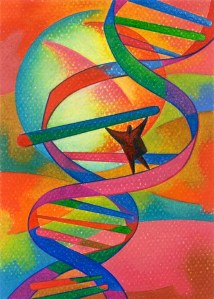
Can we change our genes?

Genetics: An Old Excuse on its Way Out

Can we change our genes?

Research is now showing that how people choose to live (lifestyle habits) can, in effect, turn on or turn off genes.

That’s right. If you consistently put down the donut during snack-time and reach instead for a cup of yogurt with blueberries, you could literally change the course of your life!

There is no denying that your genes play a pretty big part in who you become. They lay down the code for how you look and for what medical conditions you are predisposed to developing. The key word here is predisposed. The Free Dictionary online defines predisposed as “to make (someone) inclined to something in advance” (1).

Predisposition does not determine your future health path; it just tells you which of the possible paths you are more likely to walk down.

A simple example of this is found in the transcription of genes that produce lactase, an enzyme needed to digest lactose which is found primarily in milk. If a person stops drinking milk, the body doesn’t take the steps needed to produce lactase because it is wasted energy and eventually the person loses the ability to digest milk resulting in a lactose intolerance. However, if that same person doesn’t stop drinking milk, or even begins to drink very small amounts of milk again, the body will spend the extra energy needed to keep making lactase and be able to digest milk (2). Same person. If they drink milk regularly, they can digest it. If they don’t drink milk regularly, they develop a lactose intolerance.

Pretty neat stuff.

The point of this discussion is an article (3) discussing lifestyle habits and cardiovascular disease (CVD). This article covers two studies. One of these studies suggests that developing healthy lifestyle habits can have more of an impact on a person’s predisposition to develop CVD than their genetics. The authors list five habits:

· Do not smoke

· Drink little, if any, alcohol

· Maintain a healthy body weight

· Be physically active

· Consume a healthy diet

Sounds familiar, doesn’t it?

One of the studies this is based on had nearly 2,400 participants and spanned 20 years. It found that 60% of the participants who had all five lifestyle habits had a low-risk for CVD. The picture is not nearly as pretty for those who had one or none of those lifestyle habits – only 6% had a low-risk profile. 60% or 6%. That’s a pretty big difference when it comes to your heart health.

The other study reviewed data from the famous Framingham Heart Study and included nearly 16,500 people who were either 40 or 50 years old. This study found that genetics plays a small role in CVD when compared to lifestyle habits. Even scarier, it found that only 8% of Americans have “ideal levels of all the risk factors for cardiovascular health at middle age.” 8%! That’s a pretty low number!

So, what does this tell us?

It tells me a couple of things. One is that our population is falling short when it comes to practicing these healthy lifestyle habits and this concerns me. The other is that genetics does not absolutely determine our fate. We have some control over our fate.

Our future health is literally in our hands. It is determined by whether we reach for the donut or the yogurt. It is determined by whether we reach for our sneakers or the remote control.

Me? I’m going for the yogurt and my sneakers.

How about you?

Original publication date: January 13, 2011 at http://newmotivationcoaching.blogspot.com.

References

1. http://www.thefreedictionary.com/predisposed

2. Nutrition and Metabolism I class taught by Dr. Nancy Correa-Matos at University of North Florida

3. Northwestern University (2010, November 15). Healthy lifestyle has bigger impact on cardiovascular health than genetics, studies. http://www.sciencedaily.com/releases/2010/11/101115151954.htm

4. Image from: http://office.microsoft.com/en-us/images