One thing you didn’t know about me until now is that my second job was in a Japanese Steak House where I worked as a hostess. I was young and what I remember most about that job is how difficult it is to dress in a kimono. Below is an old polaroid and the only picture I have from that time… long ago… Alexia in Kimono 1986
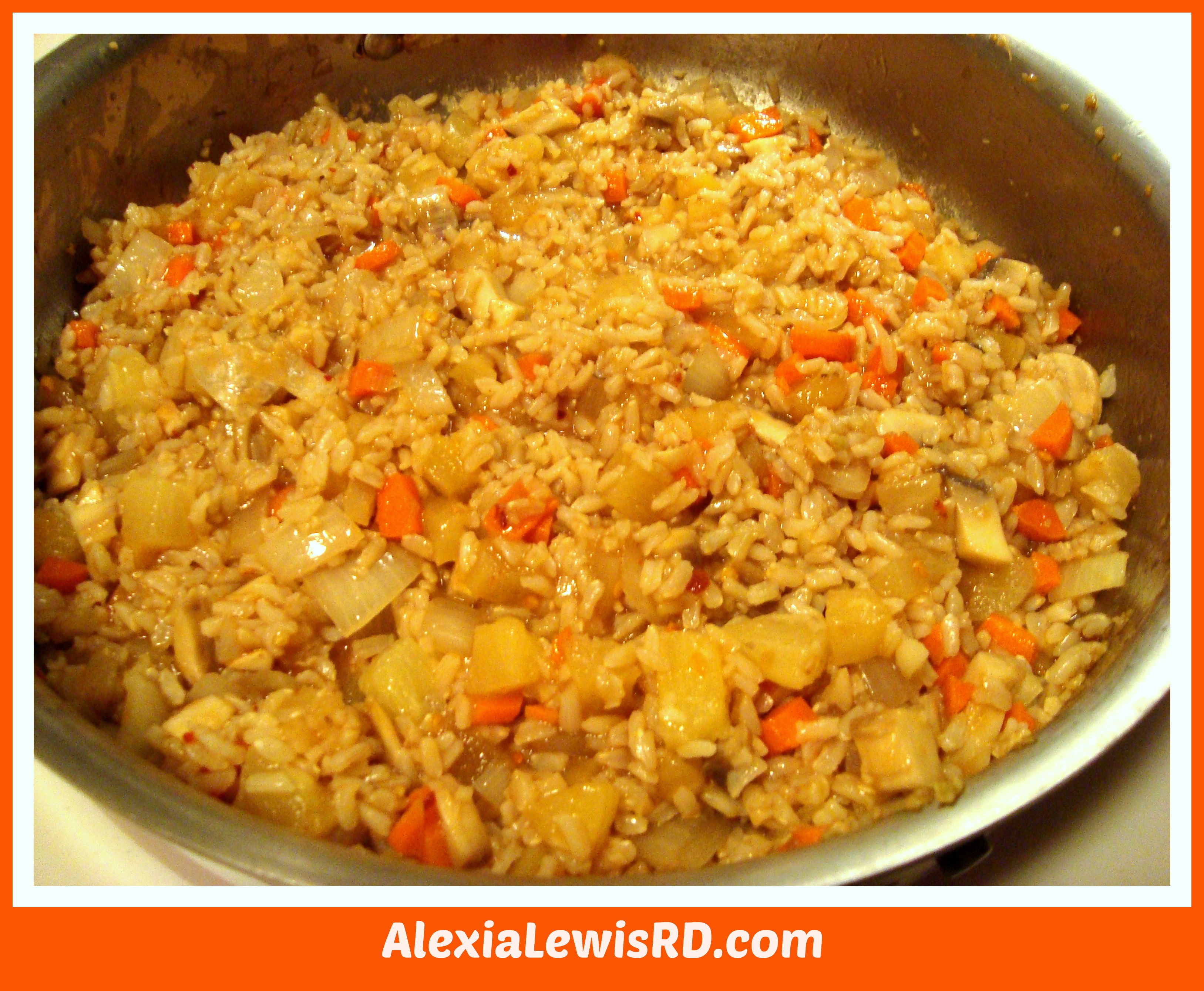
The other things I came away from that job with were a love of sushi and the knowledge that cooked rice should be refrigerated before it is turned into fried rice. With this knowledge, I scoffed at the feedback on the Pineapple Fried Rice recipe, knowing that my fried rice would not be mushy since I knew this trick!
I didn’t measure for this recipe and I used mushrooms instead of the red pepper. The sauce (pineapple, soy sauce, red pepper flakes) is absolutely delicious and I will use this for other recipes. The rice was also really tasty; but unfortunately, it was mushy! Pineapple Fried Rice
I figured next time, I would also rinse off the rice before putting it in the fridge to wash some of the sticky starch off the rice… however, next time (yes, I already made it again and added diced chicken and broccoli), I used steamed white rice picked up from the local Chinese restaurant. I find that a worthwhile expense because it made a much less sticky rice dish.
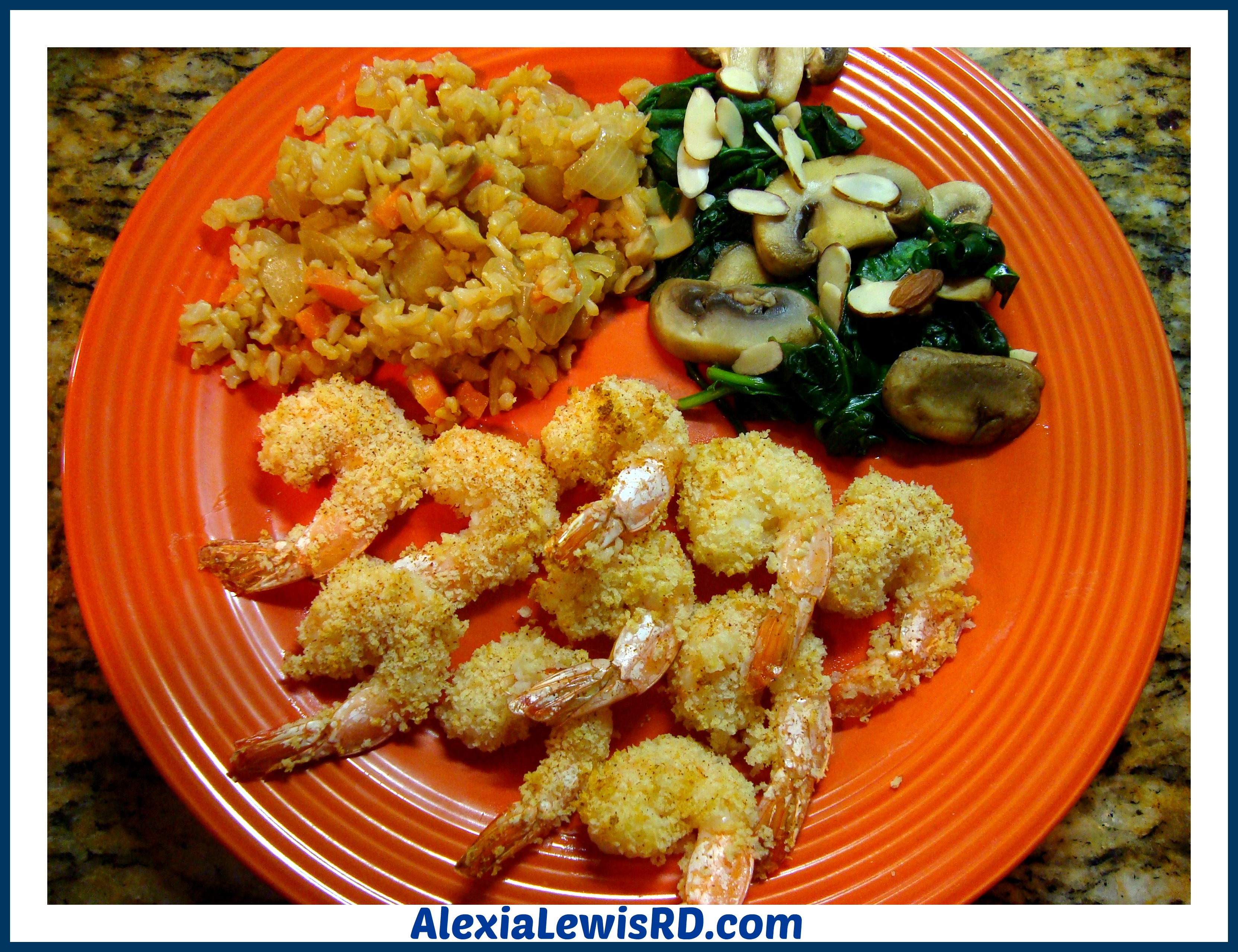
For the Baked Panko Shrimp, I simply combined panko and cayenne pepper, then dipped raw shrimp into egg whites and then the panko mixture. I laid them out on a baking sheet covered with tin foil. I suggest spraying this with cooking spray, a step I did not do and I lost half the panko breading on the foil! These were baked at 475 for about 20 minutes. Baked Panko Shrimp
I served these with sauteed spinach and mushrooms with sliced almonds. YUM! Dinner is served!
This is the first in a new recurring post. My plan is to do my personal meal planning for the week and then share the recipes and tips from the week with you. My hope is that you will try something new and be inspired with your own weekly meal planning.
One of my recipes this week was based on the foods I had that needed to be used, specifically a big bag of spinach and thawed puff pastry. I found a recipe for a Sweet Potato, Spinach, and Caramelized Onion Tart with Balsamic Reduction that sounded delicious and I had every single ingredient on hand. I reduced the amount of oil from 3 Tbsp to 1/2 Tbsp only used when caramelizing the onions; but that can even be swapped out for starting the onions with cooking spray. If you are trying to improve your cholesterol numbers, use the olive oil and if you are trying to reduce calories, use the cooking spray. I also replaced the honey with agave syrup (what I had) and used about 1/2 Tbsp for the balsamic reduction, which thickened up beautifully!
Prepping for the Tart
I found this to be scrumptious… but… the toppings were too thick. If you make this, I’d recommend using half the spinach and onions (or make two tarts). I piled it up anyway and I think this contributed to the pastry being a bit doughy in the middle (or it could have been that I should have cooked it a little bit longer). I also recommend you serve this on a day that you’ve had enough protein (meat, dairy foods, eggs, beans, nuts, etc.) since it is low in protein. I served this with grape tomatoes that I halved and roasted with mozzarella cheese on top. One tart serves 2-4 people depending on their appetites and what else you serve it with.
Tart Ready for the Oven
My other new recipe this week was enchiladas. I’ve been playing with using cottage cheese in cooking. While I love cottage cheese on its own; I’m kind of enthralled with cooking with it right now. Last week, I made lasagna rolls and they were delicious. I’ll be tweaking that recipe and posting it here in the future. I found myself with 1-cup of cottage cheese and I found a Cottage Cheese Enchiladas recipe. I’m not a huge fan of corn tortillas so I had to purchase those and I need your advice on these (see below).
Of course, I modified this recipe as well. We were out of cheddar cheese so I used shredded mozzarella as the only cheese, I omitted the chives and lime wedge, and I made the enchilada sauce. The sauce was simple, I used diced tomatoes (what I had) and pureed those in the food processor, then added chipotle powder, cumin, garlic powder, red pepper flakes, cayenne pepper and a touch of Splenda. Perfection! To the filling, I added some boiled chicken I had since my dog is currently not feeling well and is on a chicken and rice diet. Omit the chicken to keep this vegetarian.
Enchilada Filling
These were INCREDIBLE in terms of flavor; but they completely fell apart. So, readers, if you know how to handle corn tortillas so they don’t fall apart, please comment on this post – I need your help since I will be making this dish again. I served this with chips and salsa and a side salad of halved grape tomatoes, diced avocado, and lime juice. As you can see, it makes a hefty portion!
A Whole Lotta Enchilada
I do apologize for the quality of the photographs. My wonderful husband got me a Galaxy Tablet for the holiday and I am still learning how to best use the camera… and to be honest, hunger was a factor in not having the patience to get that perfect picture!
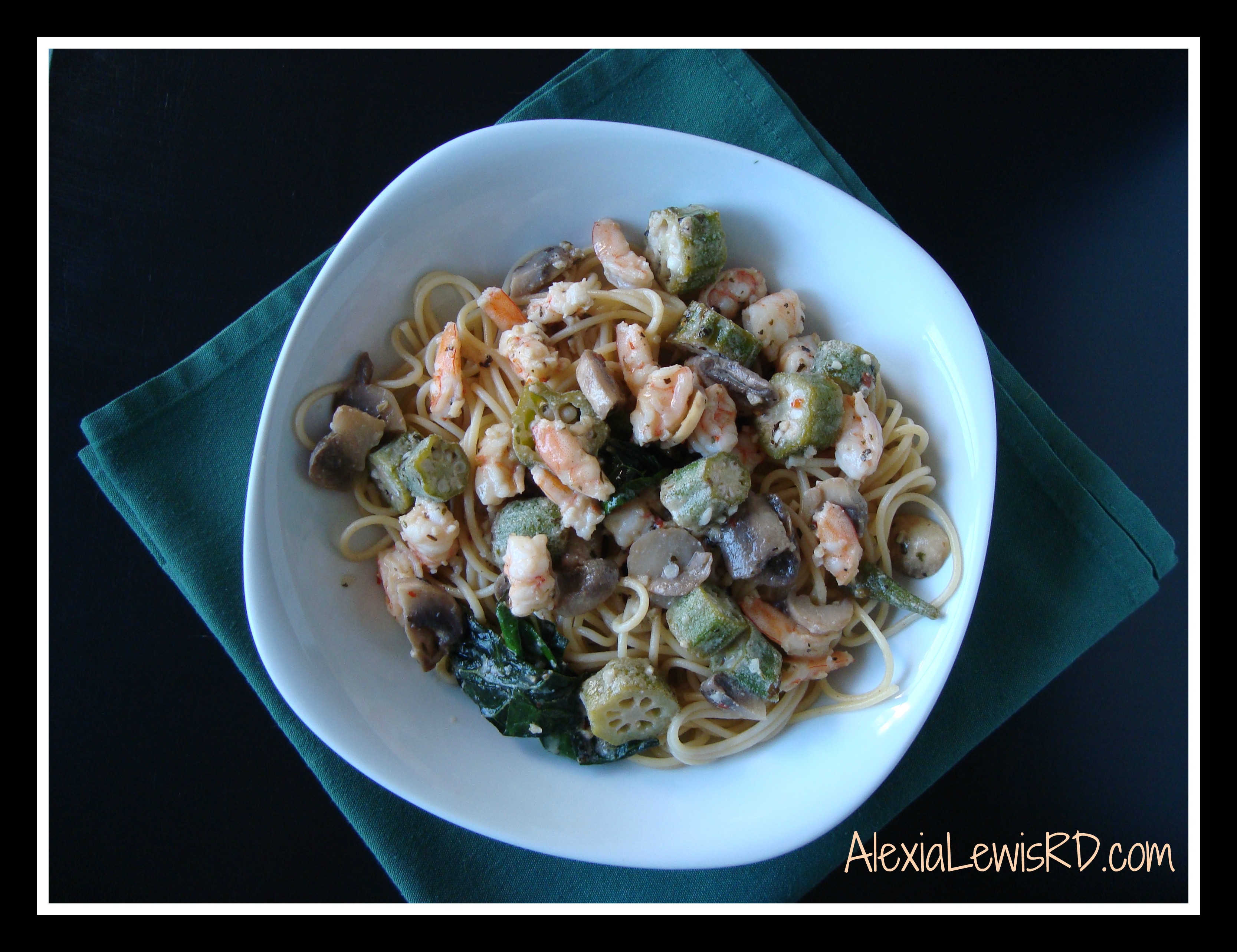
Yes, shrimp scampi can be heart healthy! With a few adjustments, this dish becomes low in saturated fat, cholesterol, and sodium and yet is still chock full of flavor.
I believe a traditional scampi would include lemon and butter; but I used what I had on hand from the wonderful UNF Ogier Gardens. I ended up with a scampi that has okra and kale. Since these are traditional southern ingredients, I named this southern scampi.
This recipe is one the came together as I cooked it and so the ingredients are estimations. I did not measure ahead of time and I ended up with 3 servings (an odd number for a recipe, I know!) and leftover spaghetti. If you want more or less of an ingredient or don’t think the consistency is right (too watery or too dry), please make adjustments to the amounts listed.
Yummy Southern Shrimp Scampi
Southern Shrimp Scampi
(Makes 3 servings)
Ingredients
1/2 package of spaghetti (I used Dreamfields but recommend whole wheat)
1 Tablespoon olive oil
1 1/2 Tablespoons minced garlic
6 okra pods, chopped into 1-inch pieces
1 cup low-sodium vegetable broth, divided
1/2 cup white wine, divided
3 large Dino (lacinato) kale leaves, stems removed, cut into 1-inch square pieces
3 button mushrooms, sliced
15 medium raw shrimp, peeled, deveined, each one cut into 3 pieces
Garlic powder, to taste
Italian seasoning, to taste
Pecorino-Romano cheese, grated, to taste
Directions:
Begin spaghetti by boiling water. Add spaghetti and cook to desired tenderness. Drain and set aside until sauce is prepared.
While pasta water is coming to a boil, begin sauce by heating oil in saucepan. When heated, add garlic and sauté 1 minute – do not let it brown.
Add okra and cook, stirring frequently for about 2 minutes. Add half of vegetable broth and white wine and simmer, stirring frequently until okra begins to soften, about 5 minutes.
Add kale and mushrooms and cook until kale begins to wilt.
Add shrimp and the remaining vegetable broth and white wine. Simmer and stir frequently until shrimp is pink and cooked through.
Sprinkle liberally with garlic powder, Italian seasoning and stir to combine.
To serve: top 3/4 cup of spaghetti with 1/3 of southern shrimp scampi sauce, sprinkle with a small amount of pecorino-romano cheese. Serve hot.
Per Serving: 310 calories, 7 grams fat, 2 grams saturated fat, 0 grams trans fat, 4 milligrams cholesterol, 290 milligrams sodium, 38 grams carbohydrates, 3 grams fiber, 14 grams protein
Let me know what you think. I’d love to hear about any adjustments you make!
Planning a heart-healthy balanced meal can be a challenge. To help with the concept of balance, I bring you a Five Food Group (FFG) Friday meal.
I’ve based these FFG meals on the Choose My Plate model, which is the US Government’s initiative to promote healthy eating habits. MyPlate is an easy-to-understand visual of a healthy plate of food incorporating the five food groups: protein, grains, fruit, vegetables, and dairy.
Add balance to your meals with Choose My Plate
The rationale behind including all five food groups on the plate is that each food group provides different nutrients, all of which our body needs in order for us to be at our best. This is a very heart-healthy way of eating since it includes a nice amount of fiber by incorporating three food groups with fiber (fruits, vegetables, and grains). Making heart-smart choices for protein and dairy by choosing lean or reduced fat foods and including heart-healthy unsaturated fats kick the heart-healthiness of MyPlate up a notch.
It is not, however, always easy to get all five of those food groups on every plate. I counsel my clients to eat the food groups they miss at their main meals as their snacks. For example, if they have cereal with a banana for breakfast (grains, dairy, fruit), then to include a protein and vegetable snack (celery with peanut butter). That way, over the course of the day, all food groups end up in balance.
I am bringing you FFG Fridays to help with the difficult challenge of building a plate with all the food groups.
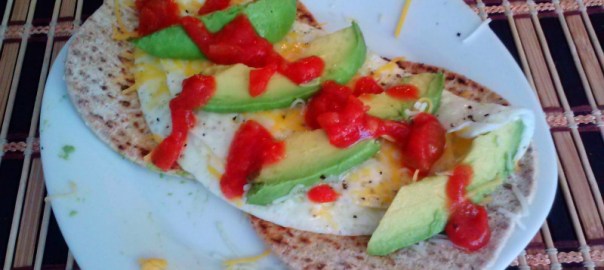
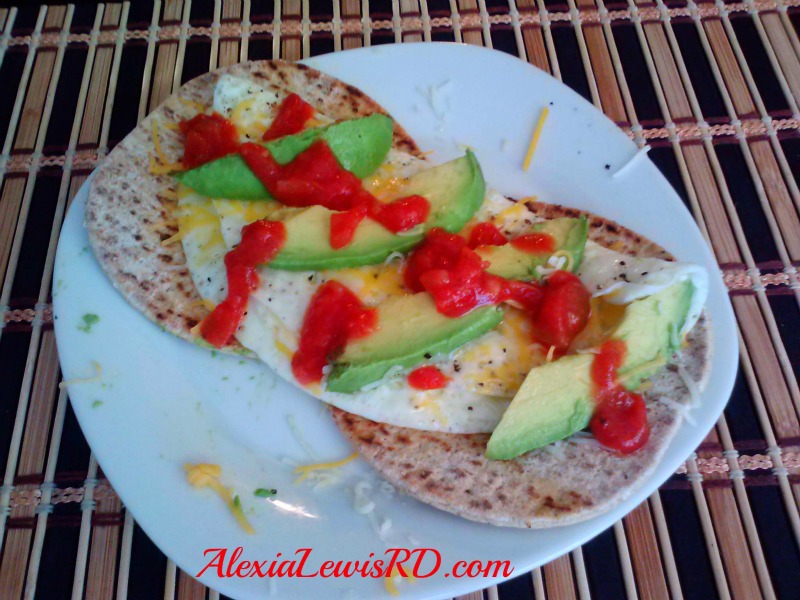
Introducing the FFG Omelet Sandwich – Huevos Delicioso!
Huevos Delicioso – A Five Food Group Friday Meal
This hearty breakfast is made from egg whites (protein), mushrooms, onions, salsa (vegetables), reduced fat cheddar cheese (dairy), a Flat Out fold-it (grain), and avocado (fruit).
Using egg whites and reduced fat cheddar make the dish more heart healthy by reducing the amount of saturated fat and cholesterol, while the avocado adds a nice amount of heart-healthy monounsaturated fats.
To make this yummy dish, use a non-stick pan to sauté 2-3 medium mushrooms and a thin slice of onion (both chopped) in a spritz of canola oil until soft then remove from pan. Add another spritz of canola oil and slowly pour in 1/2 cup of egg whites – if you pour down the side of the pan, you will reduce the places were the egg sticks. Once the egg starts to cook and set, add the cooked mushrooms and onions and sprinkle 1/8 cup shredded cheddar on one half of the egg only. I also add some ground pepper and garlic powder at this point. Use a spatula to loosen one edge and flip one half of the egg on top of the other to make the omelet. Slide out of the pan onto your Flat Out and top with 2 Tbsp salsa and 1/4 sliced avocado.
Per serving: 320 calories, 12 g fat, 3 g saturated fat, 0 g trans fat, 10 mg cholesterol, 835 mg sodium, 35 g carbohydrate, 10 g fiber, 26 g protein.
Suggestion: This dish may be a little high in sodium for some people due to the salsa. To reduce the sodium, use sliced tomatoes instead of salsa.
I made two breakfasts on Day Four. It is rare that I make something that is inedible. Even my most crazy flavor combinations result in edible, even if unusual, dishes. This was not the case on this day. I had to toss my first breakfast. It was truly that bad. Most protein powders that I’ve used have anywhere from 16-22 grams of protein in a scoop. Since plants do not contain as much protein as the other foods used to make protein powders (whey, soy, etc.), the amount of powder that has to be used to get to 21 grams of protein is huge. It completely overpowered my usually-delicious pumpkin pie oatmeal. I couldn’t eat it. I almost forced myself since I dread throwing away food; but I just couldn’t make myself eat it.
So, here we go – food pictures!
Breakfast #1: Pumpkin Pie Oatmeal – adapted from Clean Eating Magazine. I’m sharing the recipe because if you make this with vanilla whey protein powder, it is very yummy!
First, start your oatmeal on the stove by boiling 2 parts water, adding 1 part whole oats (example: 2/3 cup water and 1/3 cup oats), and then simmering until the desired consitency. While simmering, mix one scoop protein powder with a tiny bit of water and stir into a paste. You can see the plant protein powder took up half the bowl!
Nearly half a bowl-full of plant protein powder to get 21 grams of protein
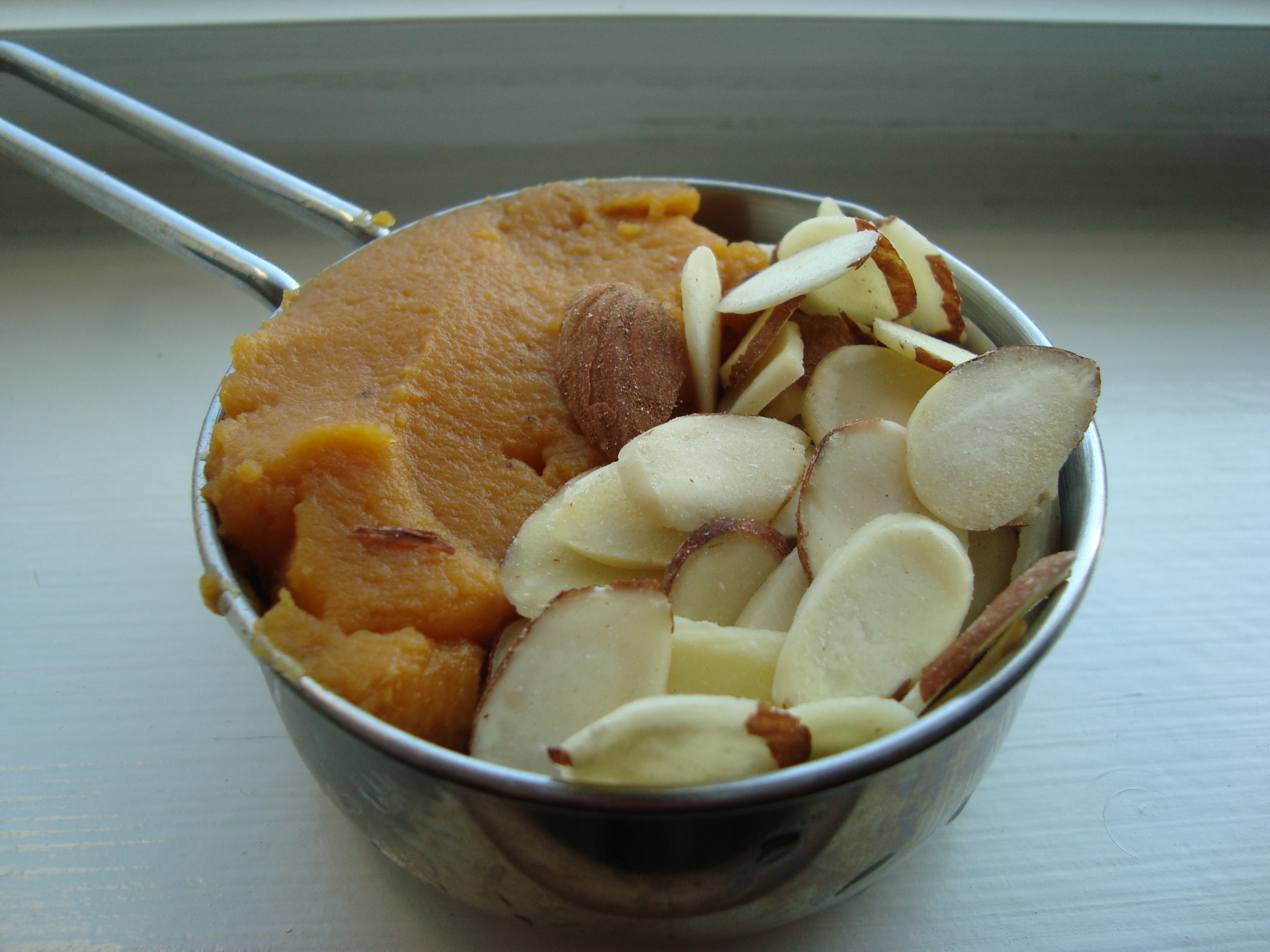
Next take the same measuring cup you just used for measuring your oatmeal and water, and fill it half with pumpkin puree (no salt) and half with sliced almonds. If you use the same measuring cup, then you can easily adjust this recipe for any amount of oatmeal without having to do any food math!
Pumpkin puree and sliced almonds
Once the oats are cooked, simply add them to the bowl with the protein powder and stir in the pumpkin and almonds. Top this with a dash of cinnamon, nutmeg, and ginger.
Pumpkin Pie Oatmeal
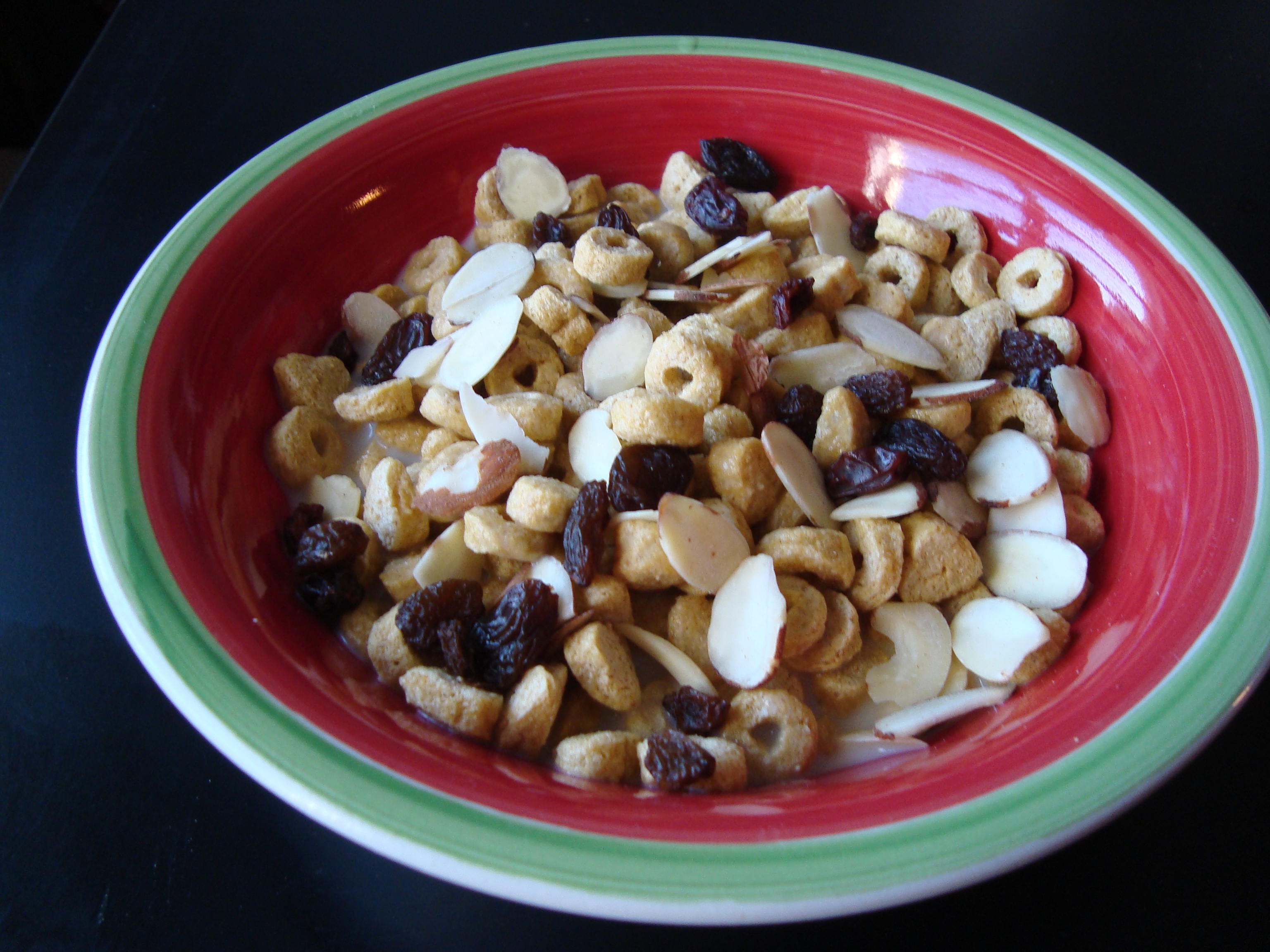
Breakfast #2: Kashi Heart to Heart Honey Toasted Oats cereal with almond milk, sliced almonds, and raisins. Coffee with almond milk and splenda. Thank you to Jason McDonald for commenting on my blog post to add nuts to cereal because it made me realize I can add some protein and fun to a basic cereal!
Pumped up cereal
Post-workout Snack: Smoothie made with banana, pineapple, peanut butter, and flaxseed. Blend with as much ice and water as it takes to get the volume and consistency that you like.
Smoothie in progressSmoothie completed!
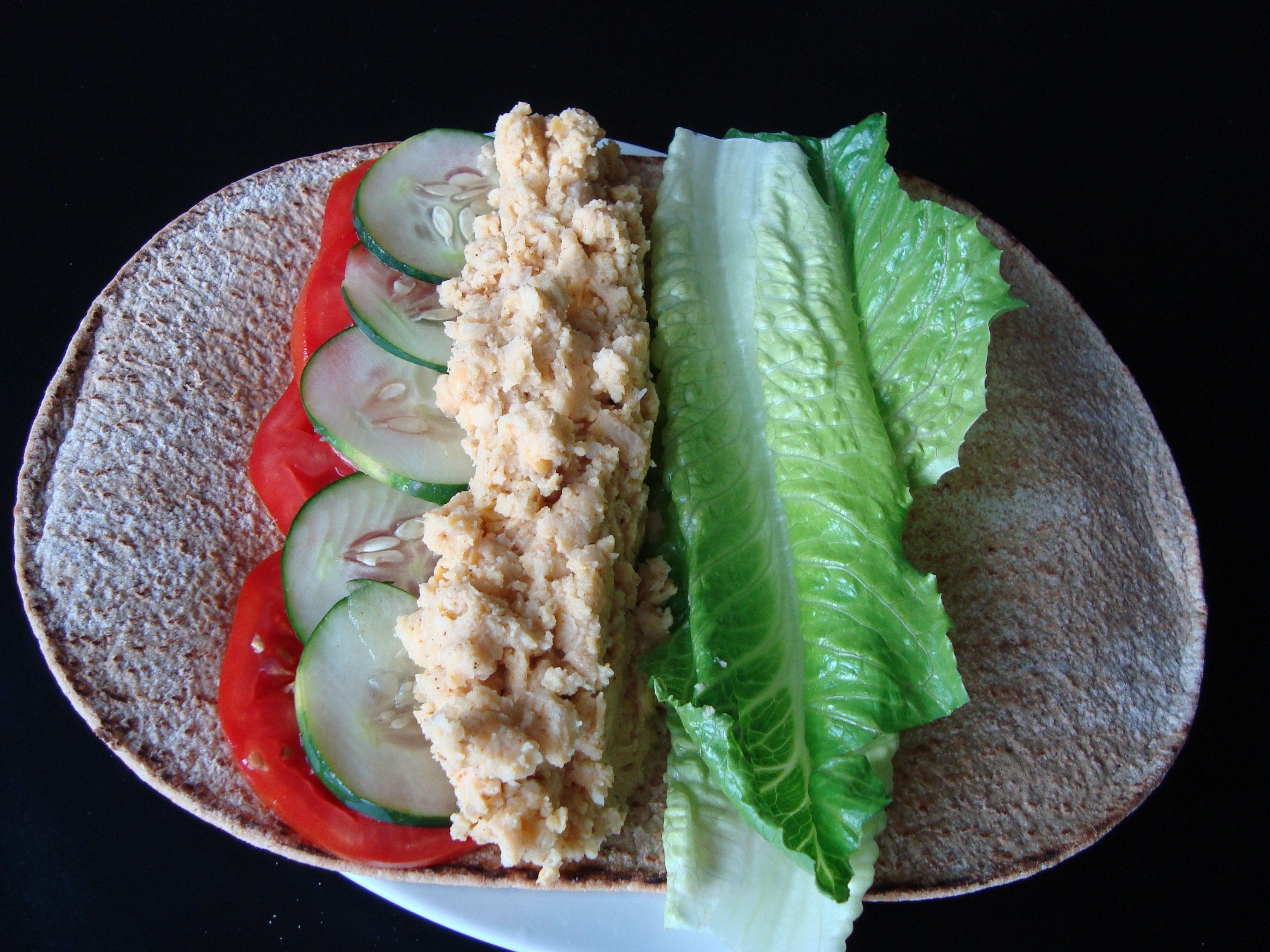
Lunch: Hummus wrap (homemade with chickpeas, olive oil, garlic, curry powder, and salt) with lettuce, tomato, and cucumber served with pretzel sticks.
The insides of the hummus wrap
Snack #2: almonds
Dinner: Whole wheat spaghetti with homemade sauce of onions, tomatoes, garlic, silken tofu, marinara sauce, garlic powder, Italian seasoning, red pepper flakes, and fresh basil served with sandwich thin garlic toast (olive oil, garlic powder, and Italian seasoning). For this, I first sauted the onions then added the chopped garlic and chopped tomatoes and let those cook just a little. Then I added the marinara sauce and tofu and cooked to heat through. Last step was seasoning with the spices. It looks a little weird as a sauce due to how the tofu stirred in to the sauce in a chunky way. If I make this again, I’ll blend the sauce as a last step to make it smooth. Regardless of what it looked like, it was good! I think this was extra yummy due to the organic onions and basil from the university’s garden!
Pretty tomatoes, onions, and garlicVegan spaghettiMangia!
One victory for today is the realization that my usual urge to (over)-snack on the days that I work from home is greatly diminished following this plan. That’s usually a huge struggle for me and I give in to the temptation to graze all day even thought I’m not hungry. Today, I had that urge for a minute and I was able to overcome it. Overall, I’m feeling good and strong; still gassy but my body is (finally!) adjusting to the extra fiber it’s starting to get a little better! My energy levels are normal for me and I can still think clearly and have strength for
yoga class.
In case you are wondering, I did live the vegan lifestyle for five days in a row. I’m just not the fastest blogger. It’s something I’m working on.
Nutrition information: 1415 calories, 235 grams carbohydrates, 46 grams fiber, 395 grams fat, 2 grams saturated fat, 0 trans fat, 0 cholesterol, 55 grams protein, and 1360 milligrams sodium. For the daily values, my numbers were 54% calcium, 77% iron, 30% vitamin D, 36% zinc, and 250% vitamin B12.
Once again, all images are my personal pictures. You may use them as long as you credit me (my name and a link back to my Web site).
Today, I realized that there is more to think about when following a vegan lifestyle than just meat and dairy foods. I have to admit to an unintentional slip today – ranch dressing! But I’ll get to that as I go through my meals in pictures.
Breakfast: Kashi Cinnamon Harvest cereal with almond milk, coffee with almond milk and splenda.
An easy vegan breakfast
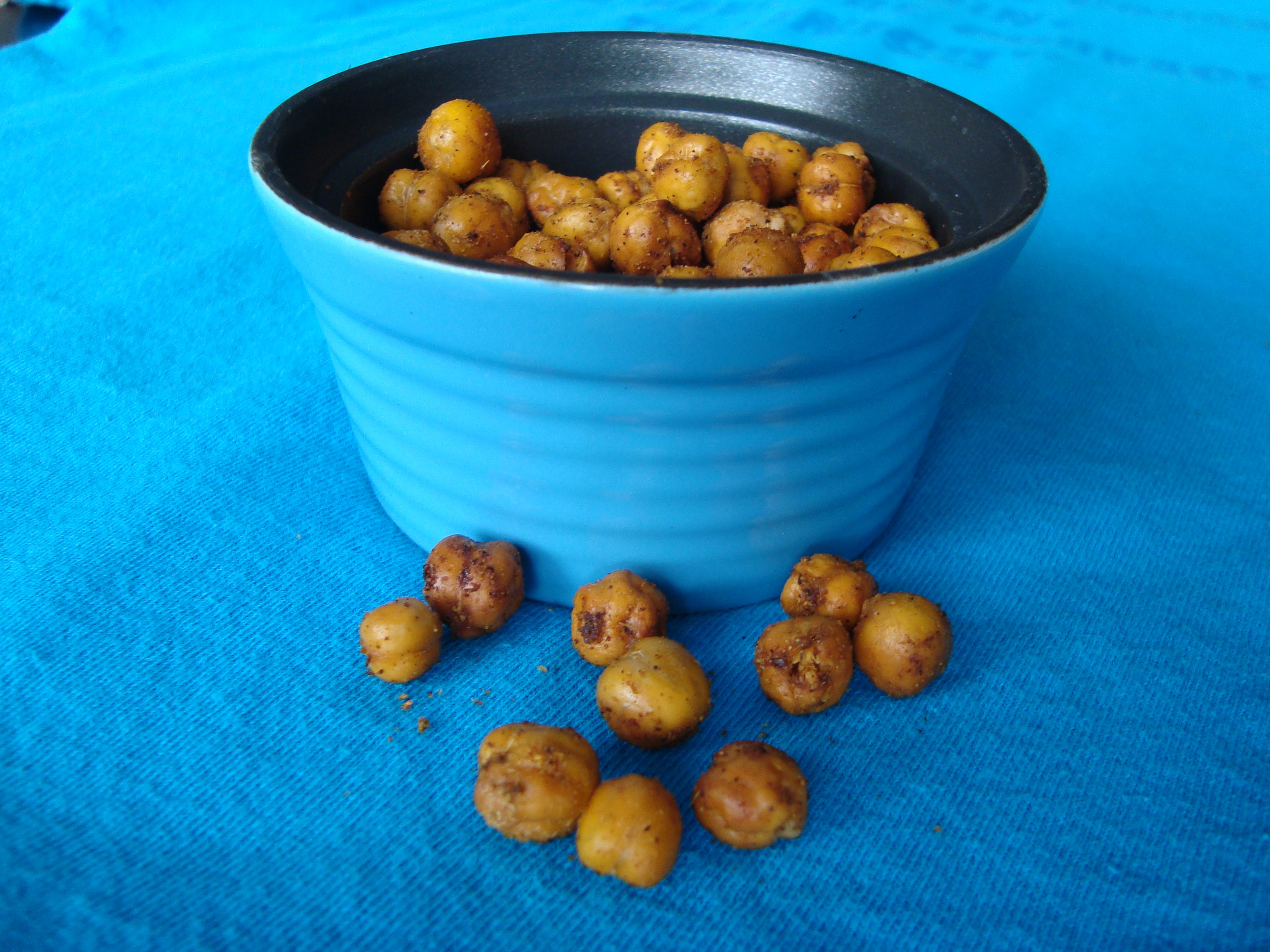
Snack: Roasted spicy chickpeas.
Roasted Spicy Chickpeas
This was a time-consuming recipe; but I’m working on stretching my food dollars so it was worth the effort. I started with a bag of dried garbanzo beans (chickpeas) and soaked and cooked them one day. The next day, I tossed the half of the cooked beans with a tablespoon of canola oil, a pinch of salt, and a fair amount of paprika, cumin, and a touch of cayenne pepper. Then I cooked them in the oven at 400 degrees for about an hour on a baking sheet lined with tin foil and sprayed with canola oil cooking spray. Cook the beans in one layer because the goal is to dry them out until they are a crispy crunchy treat. If you don’t cook them long enough, they will be mealy. I know this from my first attempt at this recipe! Per 1/2-cup serving: 135 calories and 7 grams of protein.
Post-workout snack: granny smith apple courtesy of my gym’s member appreciation day offerings.
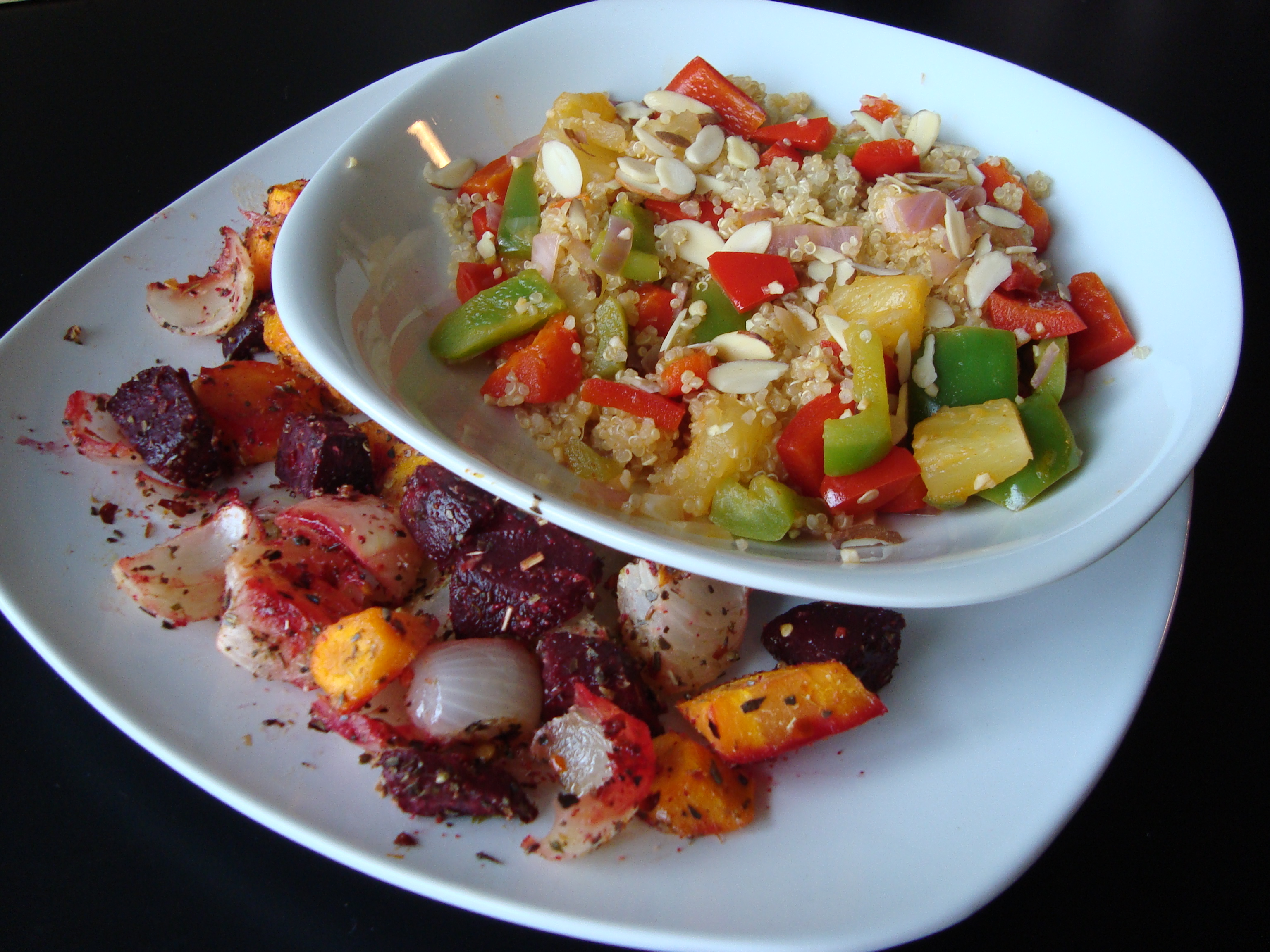
Lunch: Last night’s dinner leftovers: Quinoa with red/green bell peppers, red onions, garlic, pineapple, sliced almonds, and a dash of sriracha sauce served with a side of roasted vegetables (beets, carrots, onions) seasoned with canola oil, garlic powder, oregano, and red pepper flakes.
Quinoa bowl and roasted garden vegetables
Snack: Sweet Peanut Butter Smoothie!
I typically make my smoothies with either milk, yogurt, or almond milk depending on what I have on hand and how much protein and calories I would like to have. This time, I used water and ice instead of a milk or yogurt. I blended banana, pineapple chunks, and peanut butter with water and ice (adjusting to fill my cup and be the consistency and I wanted).
Snack: Celery and snap peas.
This is where I inadvertenly fell off the vegan wagon. I had an evening meeting to attend. The good news is that I brought the snacks and so could bring vegan alternatives. One thing I brought was a veggie tray with ranch dressing. I grabbed a celery stick and dipped it in the ranch dressing and as I was chewing, it hit me that the dressing was probably not vegan! I checked and I was correct – buttermilk is the second ingredient. This made me realize that there are more foods to limit that I realized. I wanted the convenience of the pre-made veggie tray… If only the grocery stores packaged veggie trays with hummus instead of dressing.
Dinner: Portobella mushroom sandwiches (mushroom, lettuce, avocado, mustard on sandwich thin) and Alexia sweet potato fries with ketchup.
Portobella sandwich with sweet potato fries
When making the Portobello sandwich, I was reaching for the mayonnaise when I realized that was also not vegan! This is more difficult than a vegetarian diet.
So, how am I feeling? Gassy! There is so much fiber in my diet now!
Otherwise, I’m feeling good and have energy for working out. I’m getting plenty of carbohydrates and calories; but I am still lacking in protein. I love how incredibly low my saturated fat, cholesterol, and sodium intake is following a vegan diet. Even with my one unintentional slip, I’m still going strong and feeling good about sticking with this challenge!
Nutrition information: 1360 calories, 204 grams carbohydrates, 43 grams fiber, 35 grams fat, 3 grams saturated fat, 0 trans fat, 0 cholesterol, 43 grams protein, and 725 milligrams sodium. For the daily values, my numbers were 60% calcium, 63% iron, 25% vitamin D, 8% zinc, and 0 vitamin B12.
All images are personal photographs. You may use them as long as you credit me (my name and a link back to my Web site).
I love quinoa. It is so versatile, it cooks quickly, and it’s a grain that is a complete protein as well! A complete protein has all of the essential amino acids that our bodies need, which is important for those who do not eat meat or other animal products (which are naturally complete proteins).
So, yesterday I was faced with a dilemma, what to do for lunch… I had quinoa and some vegetables sitting around so I threw together one of those “kitchen sink” recipes and it turned out so good that I decided to share it.
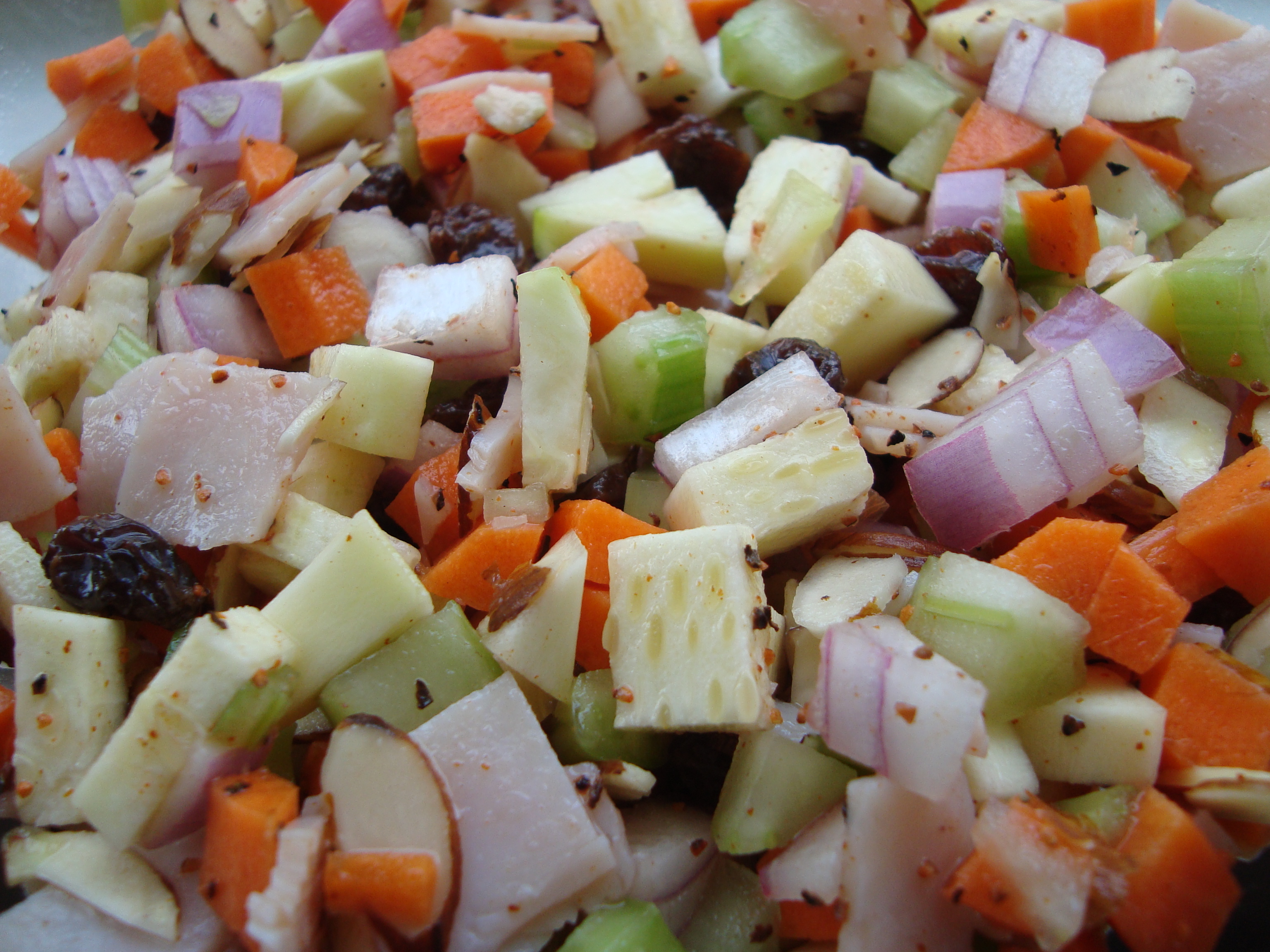
Can you guess all the goodies in here?
Quinoa Lettuce Wraps
By Alexia Lewis, MS, RD, LD/N
1 1/2 cups cooked Quinoa
1 raw zucchini, diced
1 slice red onion, diced
2 carrots, diced
1 large stalk celery, diced
2 slices nitrate-free turkey breast (optional)
Handful of sliced almonds
Handful of raisins
Red wine vinegar, to taste
Black pepper, to taste
Romaine lettuce leaves, rinsed
Simply mix together everything except the lettuce leaves, adding the red wine vinegar and black pepper in small increments until the dish has a flavor that you enjoy. Serve a spoonful on the raw romaine lettuce leaves. You can also serve with kale leaves, bok choy, or any other leafy vegetable that can act as a holder for the quinoa mixture.
I did not measure out the number of servings or do a nutrition information breakdown; but it makes a large amount (see below) and it includes the grains, protein, vegetables, and fruit so you have many food groups represented in a colorful dish – which equals nutritious!
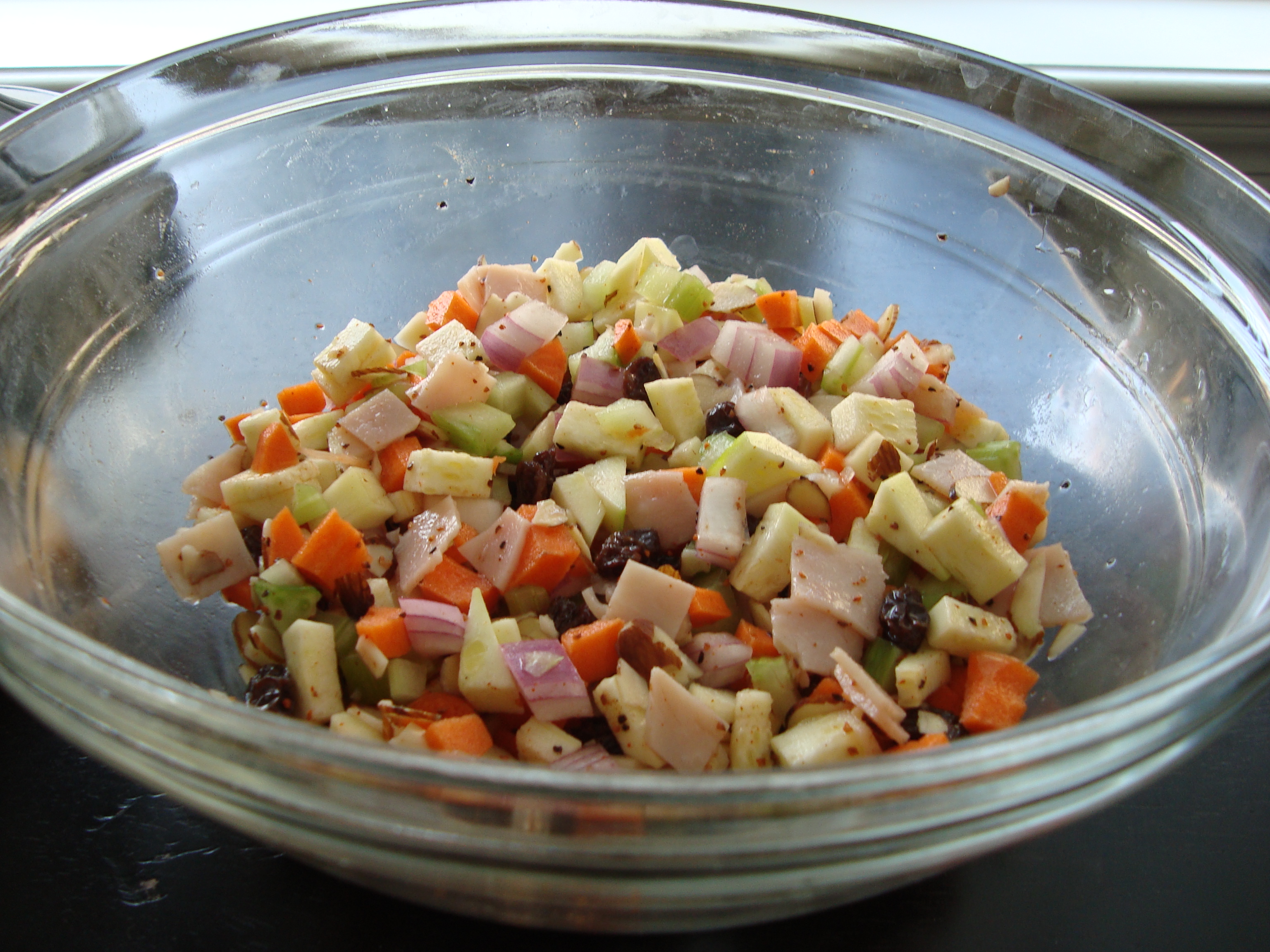
The finished mixture of yum!
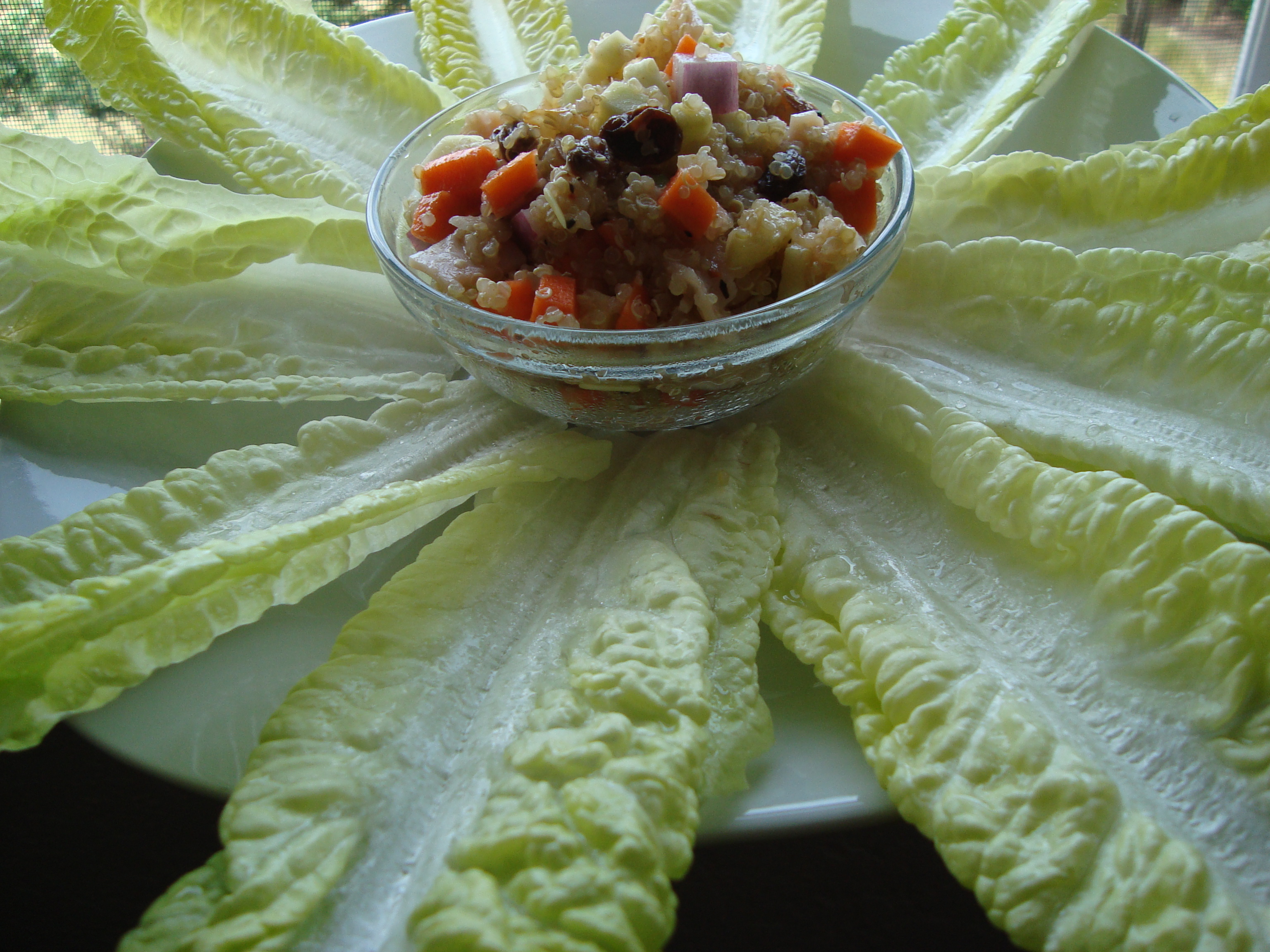
I served this up on a plate with the quinoa mixture in the middle and a ring of lettuce leaves. This dish is also husband-approved! Enjoy!
Serve in a small bowl surrounded by lettuce leaves
A new product, The Skinny Pizza, was announced in the latest issue of Food and Nutrition magazine. The information provided states this is a small thin crust margarita pizza with only 390 calories. Since it was listed in the “new products” section of a US-wide publication of the Academy of Nutrition and Dietetics, I assumed it was a new packaged food that would be available to most consumers.
I decided to blog about the nutrition content of this new product and to suggest alternatives for a whole food, non-packaged, homemade, low-calorie pizza because I know from experience that it’s fairly easy to make a mean homemade pizza!
It turns out this is not a packaged food. This is a menu selection from a pizza chain that has 25 locations. Only 18 of these locations are in the United States and 11 of them are in South Florida. Now, this called into question for me why this was listed as a new product in a magazine for dietitians with a demographic that covers the entire United States… But this is a topic for another day.
Let’s talk about “nutrition made easy” with a healthier homemade pizza!
Start by toasting either an English muffin, a pita, or this dietitian’s favorite, a Flat Out or other flat bread. You just want this to get a little bit crispy or the sauce will make the pizza soggy.
Once crispy, top with a little low-sodium tomato or marinara sauce, and by a little I mean a lot less than you think you need even if you like your pizza saucy like I do! If you want to keep it even more “clean,” then saute some chopped plum tomatoes in a little olive oil, garlic, and onion, mashing the tomatoes as they cook to make a bruschetta-like sauce.
Top with some shredded cheese, lean proteins, and as many vegetables or fruits as your pizza will hold and throw it back in the oven or toaster oven to warm the ingredients and melt the cheese. You may want to also saute the vegetables if you prefer a softer, cooked texture over a crunchy texture.
One of the favorite combinations in this household is chicken breast, BBQ sauce, red onions, mushrooms, a Mexican cheese blend, oregano, cumin, paprika, garlic powder, and red pepper flakes or Hot Shot! Another favorite is pineapple chunks and mushrooms.
The sky is the limit with combinations for this pizza and every person can get their own favorite combination! By limiting the portions, the amount of cheese used, and focusing on lean meats, vegetables, and fruits as toppings, you can keep this pizza low calorie, fiber- and nutrient-rich, and most importantly delicious!
I’m always looking for new flavor combinations and ideas so let me know what you put on your homemade pizza.
It’s kale cooking demonstration time! Tis the season to harvest greens and we have a lot of them from our organic Ogier Garden where I work so I decided to do a cooking demonstration showcasing our beautiful greens. Recipes included kale quinoa rolls and autumn vegetable soup.I found both of the recipes I used online (credit given with the recipes below) and I adapted them. Give these a try and let me know what you think!
Organic Greens
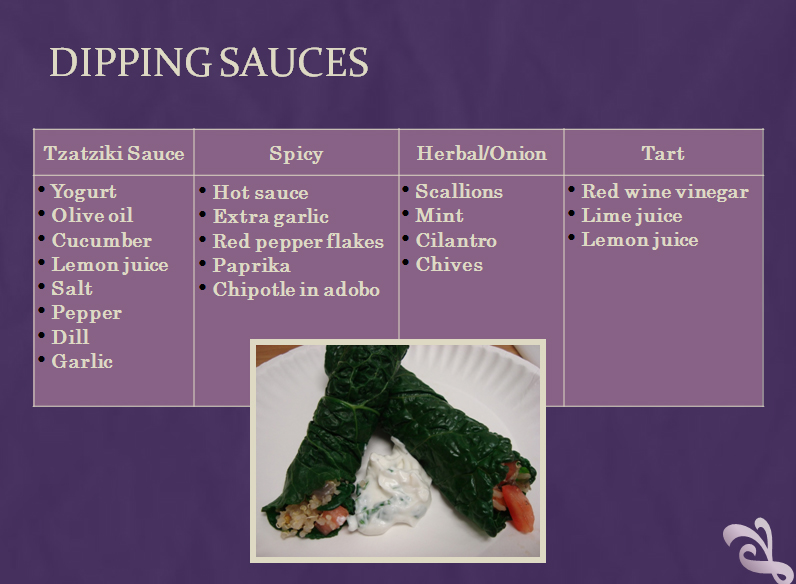
Both of these recipes are vegan. If you are a vegetarian, I do recommend a low-fat Greek yogurt dip for the rolls to increase the protein and calorie content of this meal. Here are some suggestions for flavoring the yogurt to make a yummy dipping sauce. Click to see the image larger in a new window.
Ideas for Greek yogurt dipping sauces
To begin, find some big kale leaves (dinosaur, lacinato or Tuscan varieties) or use collard greens which typically have large leaves. The curly kale will not give you enough leaf to roll with. Here in Jacksonville, Florida, I had no luck at the conventional grocery stores; but found a nice large bunch of organic lacinato kale at Fresh Market for only $2.50!
Preparing the greens is important and for the best results, you’ll want to blanche and devein the leaves. Blanching involves cooking the leaves in boiling water for a very brief time (~2 minutes) and then plunging them into an ice bath. I’ve used both a large bowl and my sink filled with ice-water with success. Blanching will make the leaves flexible enough to roll and brighten up their color. Wait until after blanching to devein the kale so you can preserve as many nutrients as possible, then take a small knife and simply cut out the thick part of the stalk, leaving the top of the leaf intact.
Kale Rolls with brown rice
I will also be packaging the complete cooking demonstration lesson plan, recipes, hand-outs, and evaluation forms into a package that will be available for purchase so you can take the work out of preparing for a cooking demonstration and just do the fun parts! Details will be posted soon.
25 kale leaves, preferably dinosaur kale (large leaves)
1 1/2 cup cooked quinoa
1/2 cup red onion, finely chopped
8 oz white button mushrooms, finely chopped
1 tomato, chopped
2 Tbsp parsley, chopped
1 Tbsp chives or scallions, chopped
1 Tbsp lemon juice
2 Tbsp canola oil, divided
salt and pepper to taste
Directions
Prepare Kale
Bring a large pot of water to a boil
Wash kale leaves thoroughly
Add leaves to boiling water and blanch until softened and flexible, about 2 minutes
Drain and rinse under cold water and pat dry
Remove about 2-3 inches of the thick middle stem from each leaf
This step can be done ahead of time. If not using kale immediately, after cooking, pat leaves dry to remove excess water, wrap all leaves gently in a paper towel, and seal in a plastic bag with air squeezed out in the refrigerator for up to 3 days.
Prepare Stuffing
Heat 1 tbsp canola oil in pan over medium heat
Add onion and cook, stirring frequently, 2-3 minutes
Add mushrooms and cook about 8 minutes, until the water the mushrooms give off has evaporated
Remove pan from heat and let cool
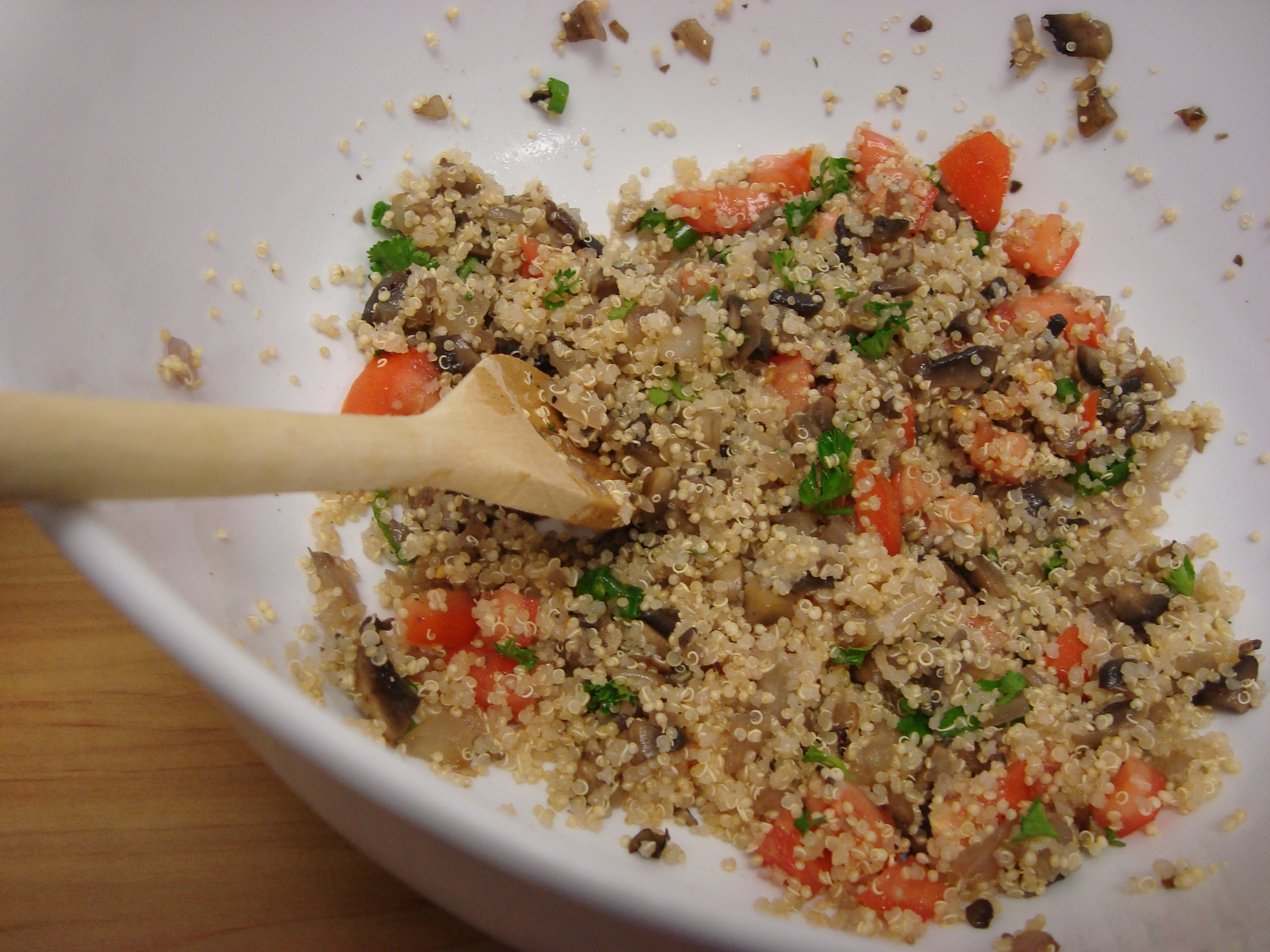
In a large bowl, combine cooked quinoa, cooled mushroom mixture, tomato, parsley, chives, lemon juice, and the remaining 1 tbsp canola oil. Season to taste with salt and pepper.
Cover and set aside
This step can also be done ahead of time. Store covered in refrigerator for up to 3 days.
Make Rolls
Place one kale leaf vein-side down and put 1-2 level tablespoons of the filling in middle of leaf
Fold the leaf from the bottom over the filling
Tuck one side of the leaf over (the other side will remain open)
Roll the leaf into a tight roll and place on plate/platter with edge of the leaf under the roll to keep roll from unrolling
Repeat with remaining rolls
These can be served warm or chilled and can be kept up to 3 days in the refrigerator. If any of the previous steps were done ahead of time, subtract the number of days those ingredients were already stored from the number of storage days.
Makes approximately 20 servings (1 roll per serving): 47 calories, 1.8 g fat (0.1 g sat, 0 g trans, 0.5 g poly, 0.9 g mono), 0 g cholesterol, 15 mg sodium, 202 mg potassium, 6.5 g carbohydrate, 1 g fiber, 2 g protein.
Bring broth and water to boil in large pan over high heat
Add kale, reduce heat, cover and simmer for 10-15 minutes
Add tomatoes and butternut squash, cover and simmer until squash is tender, about 15 minutes
Stir in black-eyed peas, cover and simmer about 2 minutes
Season with salt and pepper to taste
Makes approximately 20 servings (1 cup per serving): 70 calories, 0.5 g fat, 0 g cholesterol, 220 mg sodium, 373 mg potassium, 15 g carbohydrate, 3 g fiber, 3 g protein



















You must be logged in to post a comment.