Tag Archives: sodium

Salt: Where Does the Salt in Your Diet Come From?

This is Video/Blog # 2 in our Series: All About Salt.

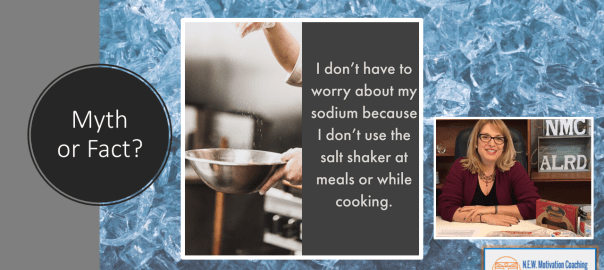
Myth or Fact? I don’t have to worry about my sodium because I don’t use the salt shaker at meals or when cooking?

When my clients want to reduce sodium in their diets, they typically focus on the salt shaker. They believe if they don’t add salt to their food at the table or when they are cooking, it is enough to keep their salt intake low.

Is it enough?

This is a MYTH!

Wait. What? Why???

Most of the salt in the average American diet – a whopping 71% according to the Centers for Disease Control and Prevention – comes from processed foods and restaurant foods – not from the salt we add during cooking or sprinkle on to our cooked steaks or vegetables!

In fact, the foods with hidden sources of salt are the biggest offenders since many do not realize they are so high in salt. The American Heart Association has dubbed these foods the “Salty Six.”

The Salty Six includes:

  • Breads
  • Deli lunch meats
  • Sandwiches
  • Pizza
  • Soups
  • Processed chicken products.

And, if they asked me, I would make it the Salty Seven and added

  • Sauces and condiments

Can you Trust the Food Packaging Claims?

You can always look at the nutrition information label to find the milligrams (mg) per serving – just be sure to notice how much is considered one serving of the food per the label.

Those nutrition claims on food packages are a little trickier. Let’s quickly go over what those nutrition claims really mean.

First, realize that some of the claims are based off comparing the lower sodium version to the regular version.

If you see “reduced sodium” on the label, that means there is at least 25% less salt than the regular version. So, if your food is a salty one – like soup that can have 2000 mg in one can, then reduced sodium may still have 1500 mg which is not what I would consider low in sodium at all.

Claims that mean low sodium include “low sodium” with 140 mg or less per serving, “very low sodium” with 35 mg or less per serving, and “salt / sodium free” which means less than 5 mg per serving.

Finally, “no salt added” means just that – salt was not added during the food processing. The food may or may not be high in salt naturally.

Check out the video where I review some food packages and talk about the salt in some common foods – including what you just might be eating for lunch today!

So getting rid of the salt shaker may not be enough to get you to your salt intake goals.

Which may make you wonder… just how much salt should I actually eating? I will answer that question with our next video!

To get these when they are released – subscribe to my YouTube Channel
Slide7

All About Salt: Sodium

I just finished sharing some information over on the N.E.W. Motivation Coaching Facebook page about salt and decided to post the information and links to the videos here.

Myth or Fact? Sea Salt has less sodium than Table Salt?

First up, we addressed a great question we hear from our clients a lot – does sea salt have less sodium than table salt.

This is such a confusing topic and I’ll share with you why this is so confusing.

One reason is there are nutritional differences in the different types of salts which is due to the source of the salt and how it is processed.

Sea salt comes, of course, from the sea and is typically processed through evaporation, meaning the food manufacturer takes the water away and what is left is your sea salt. Because of this processing, it has different minerals than table salt and may contain potassium, magnesium, phosphorus, and other trace minerals.

Table salt typically comes from salt mines and is stripped of minerals during processing but… typically it comes with added iodine since we used to have a pretty big goiter problem back in 1920s and this is how the powers that be decided to fix the problem. Nutritionally, 1 teaspoon of table salt has no calories and has very small traces of minerals found in sea salt. If you look at the label for table salt, you may see additives. Typically, calcium silicate is in there to prevent clumping and potassium iodide is the vehicle to get the iodine in salt.

But the big question is: DOES SEA SALT HAVE LESS SODIUM?

Slide1-less-sodium

And the answer is YES… and NO!

Oh, don’t you hate that! Well, this will help. Here’s why:

By weight, sea salt does NOT have less sodium than table salt!

However… by volume (when you grab a pinch or use a measuring spoon), sea salt HAS less sodium!

This is because sea salt – and kosher salt – usually has larger crystals so less fits in a spoon due to how the crystals fall against each other leaving little pockets of air in between them. Table salt is very fine and so there are no little pockets of air as the granules nest next to each other.

To compare:

  • 1 teaspoon of table salt has 2325 mg of sodium
  • 1 tsp of sea salt has between 1200 – 2360 mg
  • 1 tsp of kosher salt has between 2000 – 2360 mg

So it really all depends on how those little salt crystals settle.

Hopefully, now it makes a little more sense to you.

So… which one should you choose?

Well, Salt is a flavor enhancer which means it brings out the flavors and makes food more delicious. So, yeah, use a little salt when you cook!

Salt is also important in baking since baking is pretty much just a delicious form of chemistry so it is important to be precise to get good baked goods. For baking, follow the recipe to decide which type of salt to use.

For other cooking, professional and home chefs tend to prefer larger crystals but if you need the salt to dissolve a smaller crystal would be a better choice.

When it comes down to the nutrition, there is not much difference between the different types of salt and there are no magical health and healing properties in the more expensive or organic salts. However, the trace minerals or other fancy things that may be added to the more expensive salts may change the flavor.

In the end, choose whichever type of salt you prefer that best fits your budget.

Heart

Vegan Challenge – The Final Day

I did it! I ate completely vegan for five days! Well, except for that one bite of celery with ranch dressing that snuck into my mouth before my brain thought about it…

There are no pictures or foods listed for this day because it was an exact repeat of yesterday. There is a joy that comes with the easiness of using leftovers and I took full advantage! The only minor change was to my smoothie, in which I simply used pineapple and strawberries.

This final day was the first day that I was a little bit hungry between meals. The first four days, I was eating so often that I didn’t really move into full-on hunger; but on this afternoon, I did. I think I am learning to better meet my body’s needs for protein and calories and I have finally (yay!) adjusted to the increased amount of fiber in my diet.

Overall, I feel really good. I feel a little slimmer because of how my clothes are fitting, which may or may not be due to the vegan diet. It could be that this challenge has motivated me to keep up with my food journal and workouts. I also have slept through the night the last two nights, which is not at all typical for me.

Now that this challenge is ending, I am actually considering continuing a no-meat diet. I very much miss cheese, eggs, and milk so I will definitely add dairy back into my meals. I also, as an RD, am not comfortable with cutting out an entire food group. However, I’m not sure I want to go back to my old eating habits because I have found that I get to eat so much food and the nutrition quality of my diet has been stellar while eating like a vegan.

Initially, my vegan diet was low in protein, calories, and B12. By the end of the challenge, I was eating adequate amounts of these nutrients without using specialty foods. This has also reaffirmed my belief that vegans/vegetarians should consider a multi-vitamin since it can be difficult to obtain all the nutrients in the recommended amounts.

My vegan diet was also very low in cholesterol (obviously since it’s found in animal products), saturated fat, and sodium. These are the three main things to limit to eat heart healthy and reduce risk of some chronic diseases. Another heart- and cancer-healthy guideline is to focus on fiber and, as I’ve shared, this diet was definitely high in fiber.

I’m very happy that I decided to take part in this challenge. My goal was to better understand the challenges faced by vegans in planning for an optimally nutritious diet. I wanted to do this to help me when I counsel my vegan and vegetarian clients. I feel I have reached this goal. I think I will be a better nutrition counselor to my clients because of this challenge.

My final day was on May 24th and since then I have not yet eaten meat. I have been following a lacto/ovo vegetarian diet for the past week. I am one very happy camper to once again have cheese! I love cheese. 🙂 I’m still uncertain if I want to return to my previous omnivorous ways. Right now, my plan is to continue lacto/ovo and add seafood back in when I feel ready (there was an advertisement for a local restaurant’s deal on oysters that definitely peaked my interest!). But once I transistion into pescatarian, I may just stay there.

Don’t tell my husband! But he’ll probably read this blog…

Featured image from: http://office.microsoft.com/en-us/images/

Cheeseburger

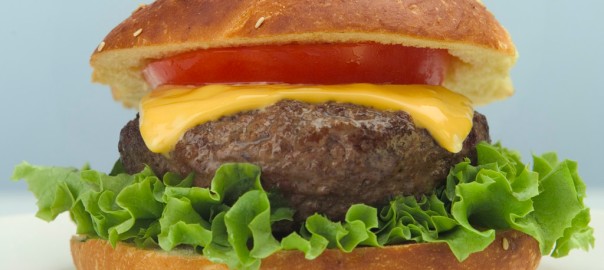
Fast Food: Cheeseburger Vs. Salad

Cheeseburger
Cheeseburger

I admit it. I watched part of The Doctors television show the other day. I caught a segment on how Americans eat and one of the doctors was working at a fast food drive-through window attempting to get customers to choose a healthy meal over the unhealthy meal they were ordering. It did not go that well for him. Only one person on the segment out of four changed their meal after he told them how unhealthy their selection was in terms of calories, fat, and sodium levels.

What stuck with me was that one woman said that a cheeseburger was kind of like a salad. Her point was that salads have vegetables and cheeseburgers have vegetables. Therefore, they are similar. The audience laughed good-heartedly and I groaned and laughed.

Then I got to thinking… Is a fast-food salad really that much better of an option than a fast-food cheeseburger? I turned to the restaurant’s Web sites to make some comparisons.


Let me start by saying that there are other choices than what I have compared below. If the Wendy’s Garden Side Salad with no croutons and low-fat dressing (70 calories, 0 g fat, 190 mg sodium) or the ¾-pound Dave’s Hot ‘N Juicy Triple Burger (1060 calories, 67 g fat, 2020 mg sodium) are your choices then yes, the salad is much healthier. However, I have tried to pick middle of the road choices that I think people would make in these examples.

First, I compared a regular McDonald’s Cheeseburger to their Premium Southwest Salad with Grilled Chicken (with and without the creamy southwest dressing). As the table below shows, the salad with dressing, which is how most people would order it, has 90 more calories, 2 more grams of fat, and 240 more milligrams of sodium than the cheeseburger. If you can go without the dressing for the salad, you are only saving 10 calories, 4 grams of fat, and 100 milligrams of sodium versus the cheeseburger. That is not a huge difference.

Food Calories Fat Sodium
Cheeseburger 300 12 750
Salad 290 8 650
Salad with dressing 390 14 990

Next, I moved to Wendy’s to compare the Jr. Cheeseburger Deluxe to their Apple Pecan Chicken Salad (with and without the pomegranate vinaigrette dressing). Again, the cheeseburger is the healthiest option in terms of calories, fat, and sodium. The salad with dressing has 210 more calories, 8 more grams of fat, and nearly 700 more milligrams of sodium. If you can go without the dressing, you will still have 100 more calories and 3 more grams of fat than the cheeseburger; but you will save almost 300 milligrams of sodium.

Food Calories Fat Sodium
Jr. Cheeseburger Deluxe 350 19 850
Salad 450 21 580
Salad with dressing 560 27 1540

I could continue; but I think the pattern is clear. The salad is not always the healthier choice at a fast food restaurant. We are still operating under the assumption that the salad is always healthier, or at least that audience and I were, and that is just not true! Now, there is a lot to consider when deciding which choice is healthier, such as the types of fats, cholesterol, and other nutrients such as the vitamins and minerals. But if I included all of that, you would have stopped reading by now…

My advice?

1. – Avoid the fast food places altogether. You can make a yummy salad or a healthier cheeseburger at home using a small portion of lean grass-fed beef, low-fat cheese, and lots of vegetables.

2. – If you cannot avoid the fast food restaurant, ask for the nutrition information before you order (many have handouts) or look at their Web site before you go. Most importantly, make your choice before you order at the register (where you can see the pictures and smell the food).

3. – Realize that what you think may be an unhealthy choice, may not be the unhealthiest choice on the menu. Sometimes, the cheeseburger may be better than the salad.


As always – enjoy your food!


Original publication date: December 10, 2011 at http://newmotivationcoaching.blogspot.com

Image from: http://office.microsoft.com/en-us/images