
In honor of American Heart Month, we are celebrating apples for heart health! Check out our newest recipe (Cinnamon Roasted Apples) and read on to learn why affordable, delicious apples are a great choice for your health and how to always pick the best apple from the bunch.
First, where did this “apple a day” idea come from? The expression originated in the United Kingdom, specifically, Pembrokeshire in Southern Wales. The original proverb was “To eat an apple before going to bed, will make the doctor beg his bread.” We found record of it first being published in the February 1866 edition of Notes and Queries magazine.
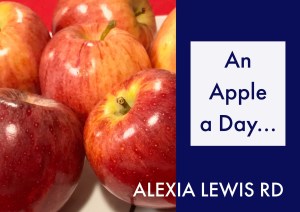
While there wasn’t really research done on apples way back then, they got it right about the possible health benefits of apples. Research shows many possible health benefits associated with apples due to some of the wonderful little phytochemicals (plant compounds) that are found in apples. For example, apples have:
- Phenolic Compounds which may have antimicrobial properties and are associated with reduced risk of tooth decay
- Flavonoids (specifically quercetin) which is associated with reduced risk of lung and colorectal cancer
- Pectin, phytosterols and polyphenols which are associated lowering cholesterol levels which can reduce risk of cardiovascular disease
- Flavonoids which may improve endothelial function (basically the ability of your blood vessels to expand and contract when they are supposed to) in people who are at risk for cardiovascular disease – which may reduce their risk for cardiovascular disease
So, yeah. apples, which happen to be the 2nd most eaten fruit (yay!) pack a powerhouse of nutrition-rich, health-promoting goodies!
All this being said. Please don’t rely on apples when you need to visit the doctor!
Good news – apples are available year-round and believe it or not, every single state in the USA grows apples. This could be thanks in part to Johnny Appleseed (remember him?) who planted apple trees on his trek as the United States were settled. And we are happy he did as the crabapple is the only apple native to North America.
Let’s talk real life here. You’re in the grocery store and looking at a huge selection of different types of apples. How do you know which apple to choose?
Well, we always say the best choice is the one you enjoy the most, so feel free to grab your favorite type of apple and call it a day!
After that, look to your food budget… which brings more good news: apples are affordable. If your food budget is your main concern, choose the least expensive type of apple.
If you want more details though…
In terms of picking out a good-quality apple, select ones that are firm, show no signs of bruising or decay, and don’t have broken or shriveled skin.
Great tasting apples should be ripe when picked, to maintain consistent flavor, texture, and make them last longer. You can speed up ripening by leaving them at room temperature, then store in the refrigerator when they are ripe.
There are many varieties of apples, each variety with its own distinct characteristics. For example, the Red Delicious, is excellent eaten fresh or in a salad, but does not do well in roasting. Some apples that are good for baking and/or roasting are the Fuji, Gala, Golden, Granny Smith, and the Rome Beauty. Click for more information on the different types of apple varieties and what they are best suited for.
Nutritionally:
One medium apple has just under 100 calories, 25 grams of carbohydrates, 4.5 grams fiber, and 14% of the daily value for Vitamin C. It has no fat, very little protein (1/2 gram), no cholesterol, and only 2 mg of sodium (yes, natural foods have sodium – check out our series of videos on salt!).
Don’t peel your apples! Pectin and about 2/3 of the nutritional goodness (fiber and antioxidants) are in the skin. Also, be careful when juicing. There are approximately 2 1/4 apples in an 8-ounce glass of juice so you can really get a lot of calories and natural sugars by juicing and won’t register fullness the same way you would if you ate 2 apples.
The N.E.W. Motivation Coaching criteria for heart healthy foods includes (1) has fiber, (2) low saturated/trans fat, (3) low sodium, (4) low added sugars, and (5) not too high in calories. Apples are a perfectly heart-healthy choice!
Post a comment and let us know your favorite type apple or apple recipe! We are partial to the Honeycrisp variety and love us some good apple pie… and our Recipes Page has our Cinnamon Roasted Apple recipe which mimics the flavor of apple pie! YUM!
This blog was researched and written by Millie Yeamans, UNF Nutrition Student and edited by Alexia Lewis RD. We support RD2BE students!
References:
- The Meaning And Origin Of The Expression: An Apple A Day Keeps The Doctor Away. Phrases.org.uk. https://www.phrases.org.uk/meanings/an-apple-a-day.html. Accessed February 13, 2018.
- Kalinowska M, Bielawska A, Lewandowska-Siwkiewicz H, et al. Apples: Content of phenolic compounds vs. variety, part of apple and cultivation model, extraction of phenolic compounds, biological properties. Plant Physiol Biochem. 84 (2014) 169-188. http://dx.doi.org/10.1016/j.plaphy.2014.09.006
- Boyer J, Liu RH. Apple phytochemicals and their health benefits. Nutr J. 2004;3:5. https://nutritionj.biomedcentral.com/articles/10.1186/1475-2891-3-5/.
- Bondonno N, Bondonno C, Croft K, et al. Flavonoid-rich apple improves endothelial function in individuals at risk for cardiovascular disease: a randomized controlled clinical trial. Mol Nutr Food Res. 2018 Feb;62(3). https://www.pubfacts.com/detail/29086478/Flavonoid-Rich-Apple-Improves-Endothelial-Function-in-Individuals-at-Risk-for-Cardiovascular-Disease.
- Drake BH, Shertzer JK. Selecting, Storing, and Serving Ohio Apples. https://ohioline.osu.edu/factsheet/HYG-5507. Published February 25, 2010. Accessed February 13, 2018
- McWilliams M. Fruits. Food Fundamentals. 10th ed. Pearson Education; 2014:120.
- Commodity Apples. https://www.agmrc.org/commodities-products/fruits/apples/commodity-apples. Accessed February 14, 2018.
- Apple Facts. https://extension.illinois.edu/apples/facts.cfm. Accessed February 14, 2018.
- Apples, raw, with skin. http://nutritiondata.self.com/facts/fruits-and-fruit-juices/1809/2. Accessed February 14, 2018.


You must be logged in to post a comment.