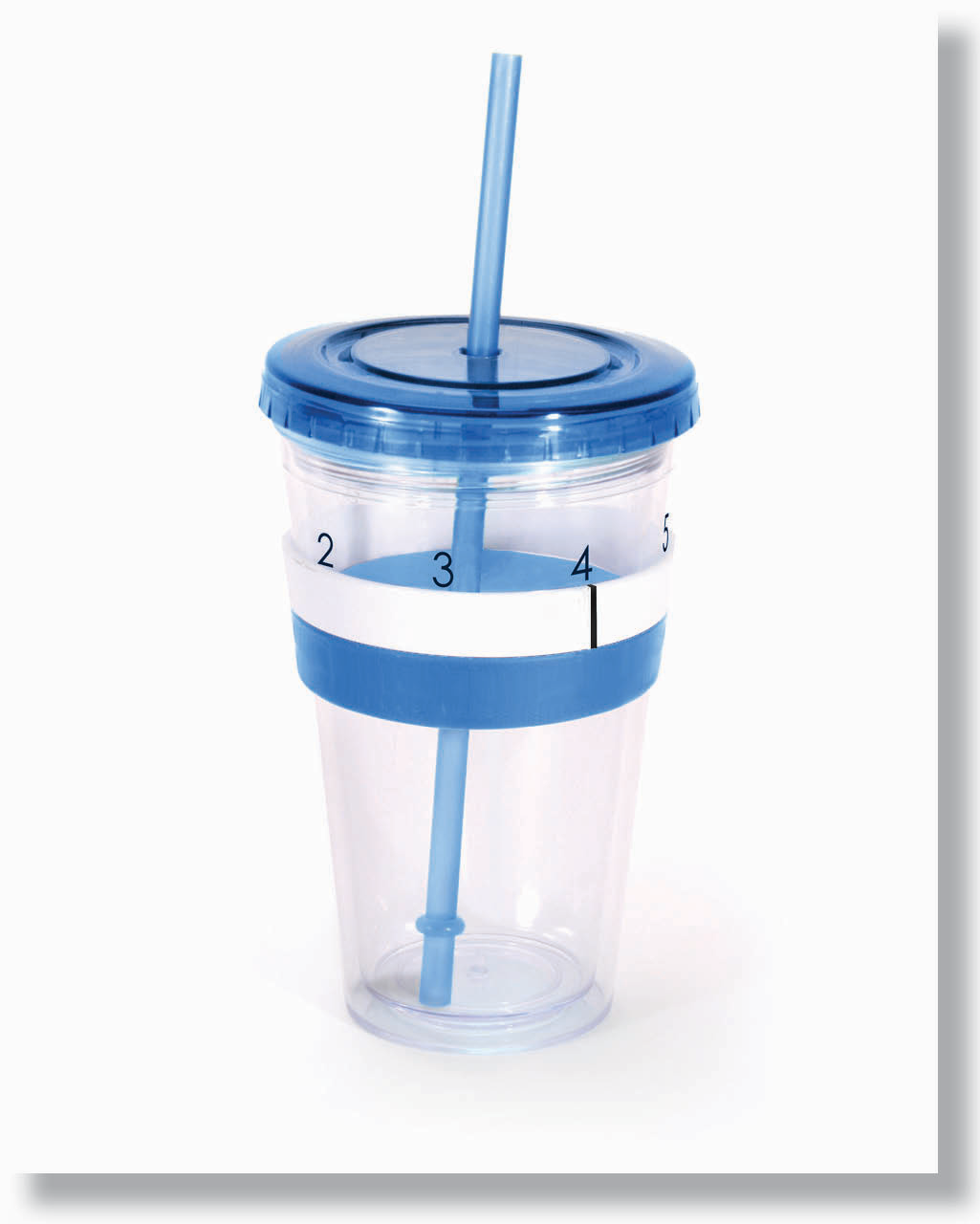
I’m a water drinker. In fact, I drink my cup of coffee in the morning, drink water all day, and occasionally enjoy a cup of tea in the afternoon or glass of wine or a beer in the evenings. That’s it. No soda, no juice, no fancy energy drinks for me. However, there are still days where I don’t drink that much water. So, I was excited to be able to review the AquaTally cup. The cup is a double-walled, hard plastic, sealed cup with a straw that has a moveable band that allows you to keep track of the number of cups of water consumed during the day. I wondered if AquaTally would help me to drink more water…
First, the basics of water and hyrdation:
Water is an essential nutrient, which means that we must drink water or enjoy other foods/drinks that provide our body with fluids. As I tell my clients, drinking enough water is important for many reasons. For more information, click here.
Interestingly, while researching how much water a healthy person should drink for optimal health, I learned that there is wide discrepancy on the amount. The eight 8-ounce glasses of water rule is a “rule of thumb,” an easy way to estimate and ensure people are getting enough to stay hydrated. The real goal is to drink enough water to replace what your body uses up every day. Your personal needs will vary based on activity level, temperature and humidity, altitude, health conditions, medications, and the water content of the foods you eat.
The two extremes with water are dehydration and intoxication. Dehydration happens when there is not enough fluid in the body. By the time you are thirsty, you have already lost approximately 2 cups of fluids! People who are chronically dehydrated may have a higher risk for heart problems, bladder or colon cancer, gallstones or kidney stones, and urinary tract infections. Water intoxication is when there is too much water in the body. This is very rare; but it is very dangerous.
Now back to the AquaTally cup.
The AquaTally Cup (Image from MyAquaTally.com)
I’m a fan of water cups with a straw since they are easy to drink from, there’s no reverse suction that you get with some squeeze bottles, and I tend not to dribble water all over myself using them like I do with wide-mouthed bottles. When AquaTally approached me to review their cup, of course I was interested since it’s the type of cup I prefer… and I’d recently dropped my current cup a few times and it was looking pretty scratched up and sad.
As soon as I got it, I took a good look at it and here’s what I found:
First thing I checked was the bottom of the cup and yes, it is BPA free!
It is exactly 2 measured cups when filled up
The ring used for tracking cups of water slides very easily; but doesn’t move around on its own
The cup seals easily– many of these type of design get off track and are difficult to twist on
The cup seals well – I filled it and tilted it and there was no leaking from the lid, of course, if tilted enough so the water hits the opening for the straw, it will leak from that hole
It keeps my water cold when I fill it with a few ice cubes and cold water
It accidentally got dropped on pavement and it didn’t break and barely got scratched at all – an important consideration for others like me who tend to be a bit clumsy
It’s a bit smaller than other cups of this design that I’ve had which means I can carry it more easily in my small hands and it fits in all the cup-holder-pockets on my bags without having to force it
I think this cup would be helpful for those trying to increase how much water they drink. My personal experience is that I did drink more water using this cup on some days. I found that if I was close to getting in 8 cups, the AquaTally cup helped me get to the goal because it brought my awareness to the fact that I was so close. I also think this cup would be useful for those who, for medical reasons, may be trying to limit the amount of fluids they drink or have others/caretakers monitoring their fluid intake. The cup comes in blue, green, or red and it currently sells for $11.95. For more information, check out their Web site at http://myaquatally.com
Overall, I give it a resoundingly positive review. The only negative thing I found about the cup was my disappointment that more people didn’t ask me about it!
Disclosure:
In exchange for reviewing an AquaTally cup, I received a cup from the company at no cost.
Sources:
Krause’s Food and Nutrition Therapy, 12th edition. L. Kathleen Mahan and Sylvia Escott-Stump.
Nutrition: Concepts and Controversies 11th edition. Frances Sizer and Ellie Whitney. 2008
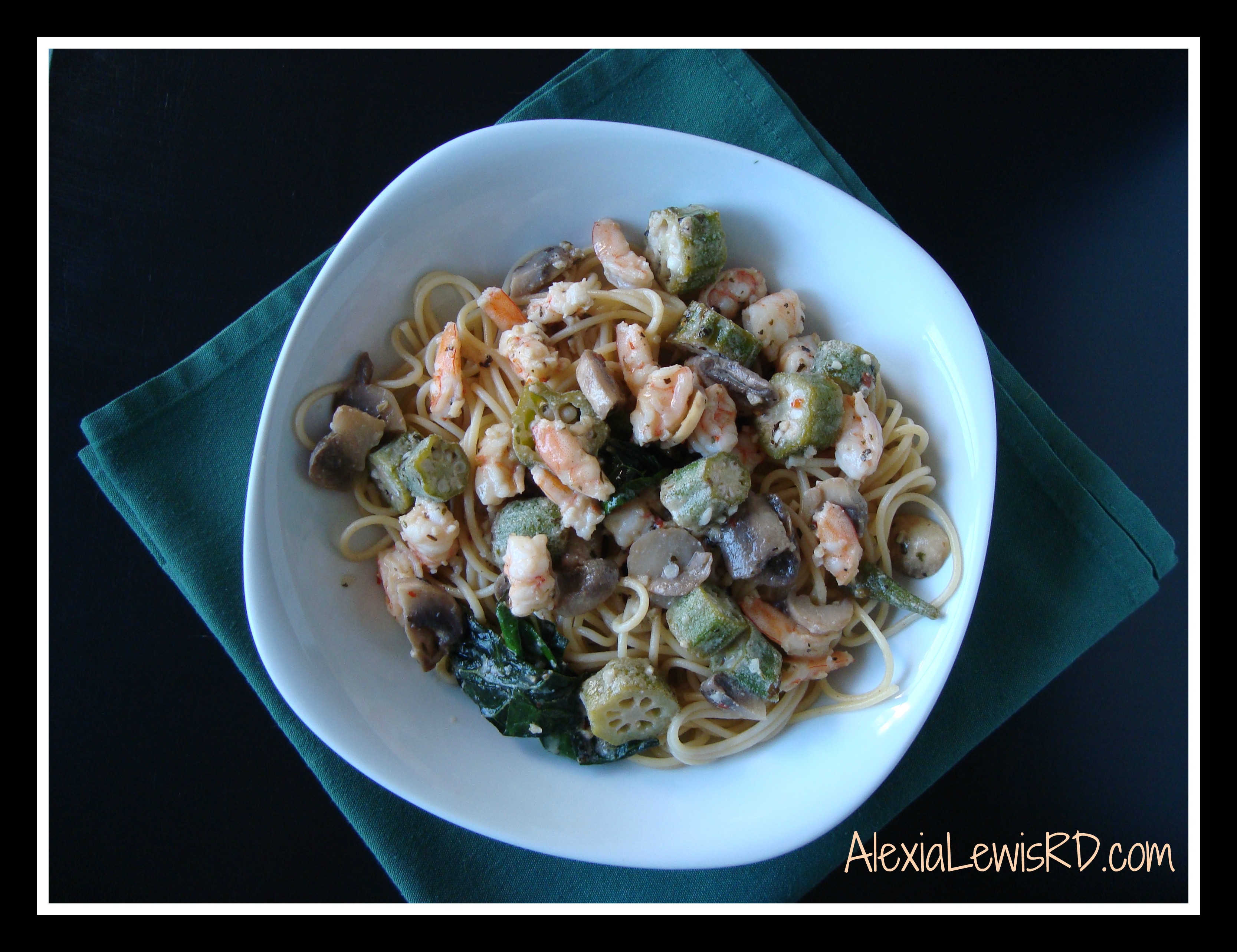
Yes, shrimp scampi can be heart healthy! With a few adjustments, this dish becomes low in saturated fat, cholesterol, and sodium and yet is still chock full of flavor.
I believe a traditional scampi would include lemon and butter; but I used what I had on hand from the wonderful UNF Ogier Gardens. I ended up with a scampi that has okra and kale. Since these are traditional southern ingredients, I named this southern scampi.
This recipe is one the came together as I cooked it and so the ingredients are estimations. I did not measure ahead of time and I ended up with 3 servings (an odd number for a recipe, I know!) and leftover spaghetti. If you want more or less of an ingredient or don’t think the consistency is right (too watery or too dry), please make adjustments to the amounts listed.
Yummy Southern Shrimp Scampi
Southern Shrimp Scampi
(Makes 3 servings)
Ingredients
1/2 package of spaghetti (I used Dreamfields but recommend whole wheat)
1 Tablespoon olive oil
1 1/2 Tablespoons minced garlic
6 okra pods, chopped into 1-inch pieces
1 cup low-sodium vegetable broth, divided
1/2 cup white wine, divided
3 large Dino (lacinato) kale leaves, stems removed, cut into 1-inch square pieces
3 button mushrooms, sliced
15 medium raw shrimp, peeled, deveined, each one cut into 3 pieces
Garlic powder, to taste
Italian seasoning, to taste
Pecorino-Romano cheese, grated, to taste
Directions:
Begin spaghetti by boiling water. Add spaghetti and cook to desired tenderness. Drain and set aside until sauce is prepared.
While pasta water is coming to a boil, begin sauce by heating oil in saucepan. When heated, add garlic and sauté 1 minute – do not let it brown.
Add okra and cook, stirring frequently for about 2 minutes. Add half of vegetable broth and white wine and simmer, stirring frequently until okra begins to soften, about 5 minutes.
Add kale and mushrooms and cook until kale begins to wilt.
Add shrimp and the remaining vegetable broth and white wine. Simmer and stir frequently until shrimp is pink and cooked through.
Sprinkle liberally with garlic powder, Italian seasoning and stir to combine.
To serve: top 3/4 cup of spaghetti with 1/3 of southern shrimp scampi sauce, sprinkle with a small amount of pecorino-romano cheese. Serve hot.
Per Serving: 310 calories, 7 grams fat, 2 grams saturated fat, 0 grams trans fat, 4 milligrams cholesterol, 290 milligrams sodium, 38 grams carbohydrates, 3 grams fiber, 14 grams protein
Let me know what you think. I’d love to hear about any adjustments you make!
Updated 01/30/2025 to included reducing added sugars and ultra-processed foods to “the basics of heart-healthy eating.”
The Basics of Heart-Healthy Eating.
You may hear about magical foods or failproof techniques that are touted as the way to improve heart health. Yah… no. If they existed, then heart disease would not have remained the number one killer of Americans for over 100 years. WHAT? Yes, heart disease first topped the charts back in 1921 (1).
If you know me (Hi, I’m Alexia, a dietitian and heart attack survivor!), then you know I like to simplify nutrition. While nutrition can become incredibly complex and nuanced, most people benefit from big-picture, easier-to-implement steps. To that end, here is my take on the basics of heart-healthy eating.
Of note: I do mention weight in this article. I am a strong believer that people can be healthy at many body sizes – and confident and beautiful (2). I promote and respect every individual’s choice regarding their weight. I believe we should continue to work towards doing better with providing non-biased health care. More on the weight and heart disease below.
Increase Fiber.
Dietary fiber plays many roles to help with heart disease. It helps with managing cholesterol, blood sugar, and with satisfying appetite, which can lead to reducing weight, which can lead to reducing blood pressure.
Many people would benefit from increasing dietary fiber intake. Unless, of course, you have health conditions or other concerns that limit your fiber intake. If you need to limit fiber, talk to a qualified nutritionist and skip on down to the next basic of heart-healthy eating.
Since we eat foods, not fiber: dietary fiber is found in fruits, vegetables, whole grains, and legumes (beans and peas).
Okay, true. There is also fiber in nuts, however, you would need to eat a lot of them to significantly contribute to your fiber intake, and they are the most calorie dense of the choices. In other words, one measured cup of dry roasted mixed nuts comes in at 9 grams of fiber and a whopping 595 calories (4). Absolutely include nuts in your diet for heart health… just not because of the fiber content!
Bottom line:
Eat at least one of type of food with fiber with every meal and snack.
Choose non-starchy vegetables for most of those food choices to load up on fiber without loading up on calories.
Which type of foods you choose depends on your preferences, health, and goals.
You have lots of choices for foods to include, so… no excuses! And I say this because according to the 2020-2025 Dietary Guidelines for Americans, a distressingly low 10% of women and 3% of men are eating enough the recommended amount of fiber (5).
You don’t eat grains, fine! Eat a starchy veggie.
You don’t eat vegetables, fine! Eat some beans. (Well, kinda “fine” on the veggies, I mean, eat some, yeah?).
You don’t eat beans, fine! Eat some fruit.
Need help including more foods with fiber or navigating all the confusing information on food packaging?
Change Up Your Fats.
The type of dietary fat you eat can have an impact on heart health. This happens because the type of fats you eat helps to reduce LDL (bad) and increase HDL (good) cholesterol. This has a positive impact on heart health.
Notice I didn’t say reduce your fat intake? (Unless, of course, you have a condition that requires eating a low-fat diet, then reducing dietary fat intake is also important.)
That’s because fats are delicious (#noshame), needed for some types of cooking, and needed for your body to absorb fat-soluble nutrients. Eating a fat-free salad? You are missing out on absorbing some of that salad’s nutrition!
Reducing saturated fat, on its own, has been shown to reduce LDL cholesterol.
Increasing unsaturated fat, on its own, has been shown to decrease LDL and increase HDL cholesterol.In incredibly simplified terms, HDL’s job is to help get rid of LDL (6). Boom.
Doubling down by replacing saturated fats with unsaturated fats can reduce LDL and increase HDL all with one dietary swap. It’s as easy as replacing butter with avocado oil for sautéing.
In addition, specific unsaturated fats, omega-3’s can reduce triglycerides and blood pressure. Your body cannot put together omega-3 fats (or omega-6s), so getting foods with these types of fats in your diet is important.
Eat more meatless/plant-based meals and use lower fat dairy foods to reduce saturated fats.
Enjoy nuts, seeds, olives, and avocados often including cooking with oils made from these foods to boost unsaturated fats. Just be mindful of portion sizes due to being high in calories and/or sodium – I’m looking at you delicious salty olives.
Add a meal with a food high in omega-3′ fats once or twice a week.
I didn’t mention trans fats because they were banned from our food supply in 2018 and food manufacturers were given until 2021 to get them out of their foods (9). So, you likely won’t see trans fats in most foods you buy now.
But it’s worth checking the back of your pantry to make sure older foods you may have do not have trans fats on the label (or partially hydrogenated oils listed in the ingredients). And, um, it’s 2025 as I write this, so yeah, check those use by and expiration dates too.
Need help with a virtual pantry and kitchen cleanout?
Do you remember from your early biology classes that water follows salt. I remember really struggling with osmosis. Who knew it would actually be relevant when I grew up?
So, water follows salt. If your salt intake is high, your body holds water to keep all things in balance. More water in your blood vessels makes your blood pressure go up, and that is a risk factor for heart disease.
Most of the salt in the Standard American Diet (yes, the acronym is SAD, which fits) comes from packaged foods, including canned foods. We know salt enhances flavors. It is also a preservative and a binder in foods, and it keeps the foods holding water too, which keeps them *insert the m-word here* so this tracks.
Check food labels to choose brands with less sodium.
Rinse canned foods when you can.
Choose more whole/unpackaged foods.
And salt really does wonders to improve foods flavor, so use it. Just stop shaking the shaker after a few shakes, whether used at the table or while cooking.
One very interesting piece of info is that not everyone is salt-sensitive. That means reducing salt in the diet will not impact blood pressure for those who are salt-resistant. Even so, reducing sodium is a positive food choice for many (10).
Of note, there are instances and conditions that may require limiting or consuming a specific amount of salt. In those cases, this info does not appy.
Need help making sure your meals are still delicious without salt?
Decrease Added Sugars.
Just like salt, most of the added sugar in our food isn’t added by us. It’s added by food manufacturers. And just like salt, sugar makes foods delicious. That’s likely why we are also eating too much added sugar in our foods.
Well, that and its “hiding” in many foods that aren’t especially sweet.
The recommendation from the American Heart Association recommends 6% of intake of added sugars, or 6 teaspoons a day for women and 9 teaspoons a day for men (13). The Dietary Guidelines allow for 12 teaspoons (if you eat 2,000 calories a day) (5). One study based on 100,000 people over 9 years found the highest risk of heart disease hits around 24 teaspoons of added sugar (14).
And, of course, as always, people managing specific health conditions or others may need to have different recommendations.
So, drumroll please… We eat 17 teaspoons of added sugars on average (15).
Sugar contributes to heart disease as it can increase blood pressure, inflammation, weight gain, and make it more difficult to manage diabetes/prediabetes.
Bottom line:
Do your best to reduce added sugars down to the recommendations.
Continue to enjoy foods with natural sugars.
Yes, you can eat fruit (and unsweetened dairy foods). Foods with natural sugars have other nutrients (fiber, protein, fat) which slows digestion, and the research doesn’t show that these increase heart disease risk.
Need help on finding the added sugars in your foods?
Reduce Ultra-Processed Foods.
In the hurry up, stay busy, no time to relax kind of culture that many of Americans live in, processed foods make it easier to get food on the table. #noshame. They are also generally less expensive. With a store-brand dozen of eggs now costing over $4.00, we all could use a little help with our food budgets.
While processed foods have been around for 1.5 million years. After all, cooking with fire is a form of processing. The 1800s saw the inventions of the tin can for foods and pasteurization (17). Then the 1900s saw a big boost in demand for processed foods, with Swanson’s frozen meals hitting the market in the 1920s and fast food starting to hit its stride in the 1950s (18).
Fast forward and we have gone from minimally processing foods (cooking, canning, salting, smoking, freezing, etc.) to the ultra-processed powdered meal replacement drinks of today.
Did I mention there is no food shaming allowed here?
So, yes. Ultra-processed foods can have a place in an otherwise generally healthy dietary approach. And yes, it’s going to be in moderation. Nutrition is not so unforgiving (for most of us!) that eating a small amount of these foods will wreck health. What matters is what we do most of the time.
That being said food exists on a spectrum of processing, and while processing can improve nutrition with fortification, they have been starting to get linked to many negative health outcomes. For example, increasing inflammation and reducing gut health. In terms of heart health, these foods can raise triglycerides, blood pressure, and body weight (20).
Bottom line:
Work to reduce ultra-processed foods that are of low nutrition quality as your time and budget allow. For heart health, assessing foods for the nutrients mentioned in this article may be a good start.
Look for processed foods that positively impact nutrition. For example, adding vitamins or fiber.
Eat whole and minimally processed foods when you can.
On the flip side, it’s also entirely possible to eat a diet of whole/minimally processed foods that have a negative impact on heart health. Food choices matter. And a healthy diet can include ultra-processed foods. After all, store-bought bread and flavored yogurt are both ultra-processed food under the NOVA classification system (21).
PS – Research is ongoing to learn more about if it is the quality of ultra-processed foods (high sugar, salt, fat, etc.) or the actual processing of the foods that matter most for health.
Need help with meal planning and/or prepping to reduce ultra-processed foods?
Bonus Basics of Heart-Healthy Eating.
For some extra steps to add to your basics of heart-healthy eating, you may also add more berries, nuts, avocado, and plant sterols and stanols (22) to your food choices.
Credible information is important. And putting that information into action is where the magic happens.
Small changes done consistently over time add up to big results. So just pick one or two changes to make right now. When you’ve got that down, add another 1-2 changes.
Work with Alexia on your heart health.
She can work with people in multiple states in the USA and accepts some health insurance plans through her partnership with Nourish. Learn more and start the scheduling process to see if your insurance is accepted and get an estimate of your out-of-pocket costs. (Note that Nourish handles the health insurance stuff, not Alexia!)
If she can’t work with you, you can choose another dietitian who can, or reach out for help getting connected with the right RD for you.
Planning a heart-healthy balanced meal can be a challenge. To help with the concept of balance, I bring you a Five Food Group (FFG) Friday meal.
I’ve based these FFG meals on the Choose My Plate model, which is the US Government’s initiative to promote healthy eating habits. MyPlate is an easy-to-understand visual of a healthy plate of food incorporating the five food groups: protein, grains, fruit, vegetables, and dairy.
Add balance to your meals with Choose My Plate
The rationale behind including all five food groups on the plate is that each food group provides different nutrients, all of which our body needs in order for us to be at our best. This is a very heart-healthy way of eating since it includes a nice amount of fiber by incorporating three food groups with fiber (fruits, vegetables, and grains). Making heart-smart choices for protein and dairy by choosing lean or reduced fat foods and including heart-healthy unsaturated fats kick the heart-healthiness of MyPlate up a notch.
It is not, however, always easy to get all five of those food groups on every plate. I counsel my clients to eat the food groups they miss at their main meals as their snacks. For example, if they have cereal with a banana for breakfast (grains, dairy, fruit), then to include a protein and vegetable snack (celery with peanut butter). That way, over the course of the day, all food groups end up in balance.
I am bringing you FFG Fridays to help with the difficult challenge of building a plate with all the food groups.
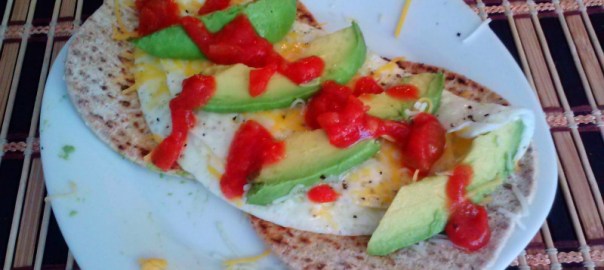
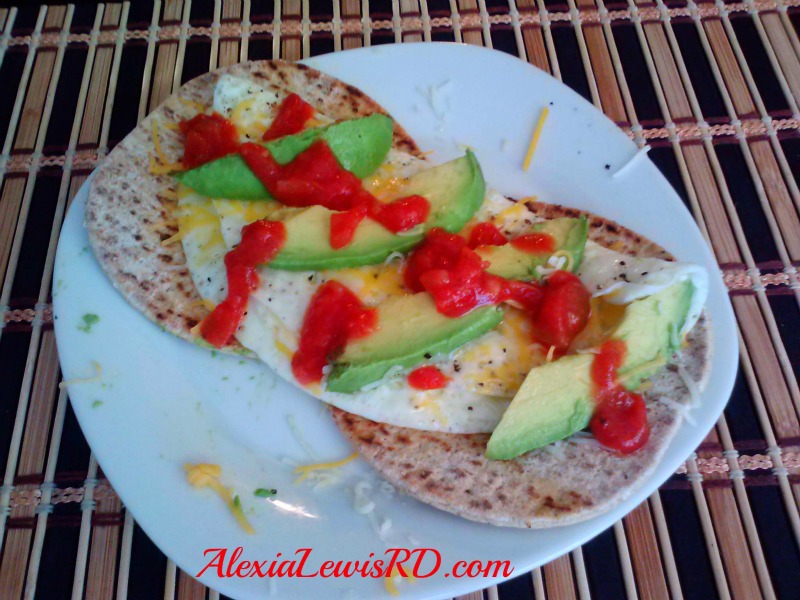
Introducing the FFG Omelet Sandwich – Huevos Delicioso!
Huevos Delicioso – A Five Food Group Friday Meal
This hearty breakfast is made from egg whites (protein), mushrooms, onions, salsa (vegetables), reduced fat cheddar cheese (dairy), a Flat Out fold-it (grain), and avocado (fruit).
Using egg whites and reduced fat cheddar make the dish more heart healthy by reducing the amount of saturated fat and cholesterol, while the avocado adds a nice amount of heart-healthy monounsaturated fats.
To make this yummy dish, use a non-stick pan to sauté 2-3 medium mushrooms and a thin slice of onion (both chopped) in a spritz of canola oil until soft then remove from pan. Add another spritz of canola oil and slowly pour in 1/2 cup of egg whites – if you pour down the side of the pan, you will reduce the places were the egg sticks. Once the egg starts to cook and set, add the cooked mushrooms and onions and sprinkle 1/8 cup shredded cheddar on one half of the egg only. I also add some ground pepper and garlic powder at this point. Use a spatula to loosen one edge and flip one half of the egg on top of the other to make the omelet. Slide out of the pan onto your Flat Out and top with 2 Tbsp salsa and 1/4 sliced avocado.
Per serving: 320 calories, 12 g fat, 3 g saturated fat, 0 g trans fat, 10 mg cholesterol, 835 mg sodium, 35 g carbohydrate, 10 g fiber, 26 g protein.
Suggestion: This dish may be a little high in sodium for some people due to the salsa. To reduce the sodium, use sliced tomatoes instead of salsa.
Today, I had my standards challenged and this was a good thing.
Fish is on the menu for this week – filets tonight and homemade fish sticks later in the week. I only buy fish or meats at one of the nicer grocery stores, so it was the last thing I needed to pick up to be completely food-ready for the week ahead. I decided to do something different. I decided to check out the little hole-in-the-wall, local-only seafood market.
As a registered dietitian, I consider myself fairly food savvy in terms of how food is grown, raised, processed, and packaged. Fish, however, is one item that always remains fuzzy in my mind. I know to do my part for fish happiness and to reduce disease, wild is preferable to farm raised. I know which fish are more healthful because they are a good source of omega-3 fatty acids, such as salmon or mackerel. I know which fish are better in limited amounts because of potential higher mercury levels, such as swordfish or shark. This, however, is all that my brain chooses to remember. Here’s a great link from the Food and Drug Administration about selecting, storing, preparing fish and some health concerns.
Today, I walked into a local fish market and asked for tilapia. I was happy to learn some more about fish from a friendly fish monger.
This may or may not be my local fishmonger
According to my local fishmonger, tilapia is not a fish that is local to my area (Florida) and since he only carries fish caught up the road in Mayport, he doesn’t have any. He added that most of the tilapia comes from out of the country (which equals a lot of food miles) and is farm raised, not wild caught. He definitely was not a fan of tilapia; but I had a meal plan to stick to so I asked for his recommendation and engaged in an educational conversation about fish.
According to the Monterey Bay Aquarium Seafood Watch 2012 report on tilapia, 95% of the tilapia eaten by Americans is imported from other countries. The fish that is raised in the US is mostly farmed in the West and Northeast regions of the country. Tilapia is the fourth most consumed fish in the USA after shrimp, tuna, and salmon. Most of the US-raised tilapia (75%) is farmed using closed recirculating systems. On the negative side, these fish are separated from other wildlife, ponds are typically overly full, it requires more to be put into the system than comes out (1.4 pounds of feed to produce 1 pound of fish) and many farms use drugs to treat/prevent disease or to change the fish’s gender to male to produce a larger fish. One the positive side, this method does have an overall low environmental cost (food miles excepted).
If you are curious, I happily purchased a more expensive, local, drug-free triggerfish, which is supposed to be similar to grouper. I will be baking this beautiful fish in the oven at 350 degrees for 15-20 minutes (until it flakes easily with a fork) after dredging the filets in egg whites and coating with a combination of breadcrumbs, crushed pecans, and oregano. On the side, will be homemade tartar sauce (mayonnaise and relish), fresh boiled corn on the cob, and oven-fried red potatoes sprinkled with salt, pepper, and garlic powder.
I did it! I ate completely vegan for five days! Well, except for that one bite of celery with ranch dressing that snuck into my mouth before my brain thought about it…
There are no pictures or foods listed for this day because it was an exact repeat of yesterday. There is a joy that comes with the easiness of using leftovers and I took full advantage! The only minor change was to my smoothie, in which I simply used pineapple and strawberries.
This final day was the first day that I was a little bit hungry between meals. The first four days, I was eating so often that I didn’t really move into full-on hunger; but on this afternoon, I did. I think I am learning to better meet my body’s needs for protein and calories and I have finally (yay!) adjusted to the increased amount of fiber in my diet.
Overall, I feel really good. I feel a little slimmer because of how my clothes are fitting, which may or may not be due to the vegan diet. It could be that this challenge has motivated me to keep up with my food journal and workouts. I also have slept through the night the last two nights, which is not at all typical for me.
Now that this challenge is ending, I am actually considering continuing a no-meat diet. I very much miss cheese, eggs, and milk so I will definitely add dairy back into my meals. I also, as an RD, am not comfortable with cutting out an entire food group. However, I’m not sure I want to go back to my old eating habits because I have found that I get to eat so much food and the nutrition quality of my diet has been stellar while eating like a vegan.
Initially, my vegan diet was low in protein, calories, and B12. By the end of the challenge, I was eating adequate amounts of these nutrients without using specialty foods. This has also reaffirmed my belief that vegans/vegetarians should consider a multi-vitamin since it can be difficult to obtain all the nutrients in the recommended amounts.
My vegan diet was also very low in cholesterol (obviously since it’s found in animal products), saturated fat, and sodium. These are the three main things to limit to eat heart healthy and reduce risk of some chronic diseases. Another heart- and cancer-healthy guideline is to focus on fiber and, as I’ve shared, this diet was definitely high in fiber.
I’m very happy that I decided to take part in this challenge. My goal was to better understand the challenges faced by vegans in planning for an optimally nutritious diet. I wanted to do this to help me when I counsel my vegan and vegetarian clients. I feel I have reached this goal. I think I will be a better nutrition counselor to my clients because of this challenge.
My final day was on May 24th and since then I have not yet eaten meat. I have been following a lacto/ovo vegetarian diet for the past week. I am one very happy camper to once again have cheese! I love cheese. 🙂 I’m still uncertain if I want to return to my previous omnivorous ways. Right now, my plan is to continue lacto/ovo and add seafood back in when I feel ready (there was an advertisement for a local restaurant’s deal on oysters that definitely peaked my interest!). But once I transistion into pescatarian, I may just stay there.
Don’t tell my husband! But he’ll probably read this blog…
I made two breakfasts on Day Four. It is rare that I make something that is inedible. Even my most crazy flavor combinations result in edible, even if unusual, dishes. This was not the case on this day. I had to toss my first breakfast. It was truly that bad. Most protein powders that I’ve used have anywhere from 16-22 grams of protein in a scoop. Since plants do not contain as much protein as the other foods used to make protein powders (whey, soy, etc.), the amount of powder that has to be used to get to 21 grams of protein is huge. It completely overpowered my usually-delicious pumpkin pie oatmeal. I couldn’t eat it. I almost forced myself since I dread throwing away food; but I just couldn’t make myself eat it.
So, here we go – food pictures!
Breakfast #1: Pumpkin Pie Oatmeal – adapted from Clean Eating Magazine. I’m sharing the recipe because if you make this with vanilla whey protein powder, it is very yummy!
First, start your oatmeal on the stove by boiling 2 parts water, adding 1 part whole oats (example: 2/3 cup water and 1/3 cup oats), and then simmering until the desired consitency. While simmering, mix one scoop protein powder with a tiny bit of water and stir into a paste. You can see the plant protein powder took up half the bowl!
Nearly half a bowl-full of plant protein powder to get 21 grams of protein
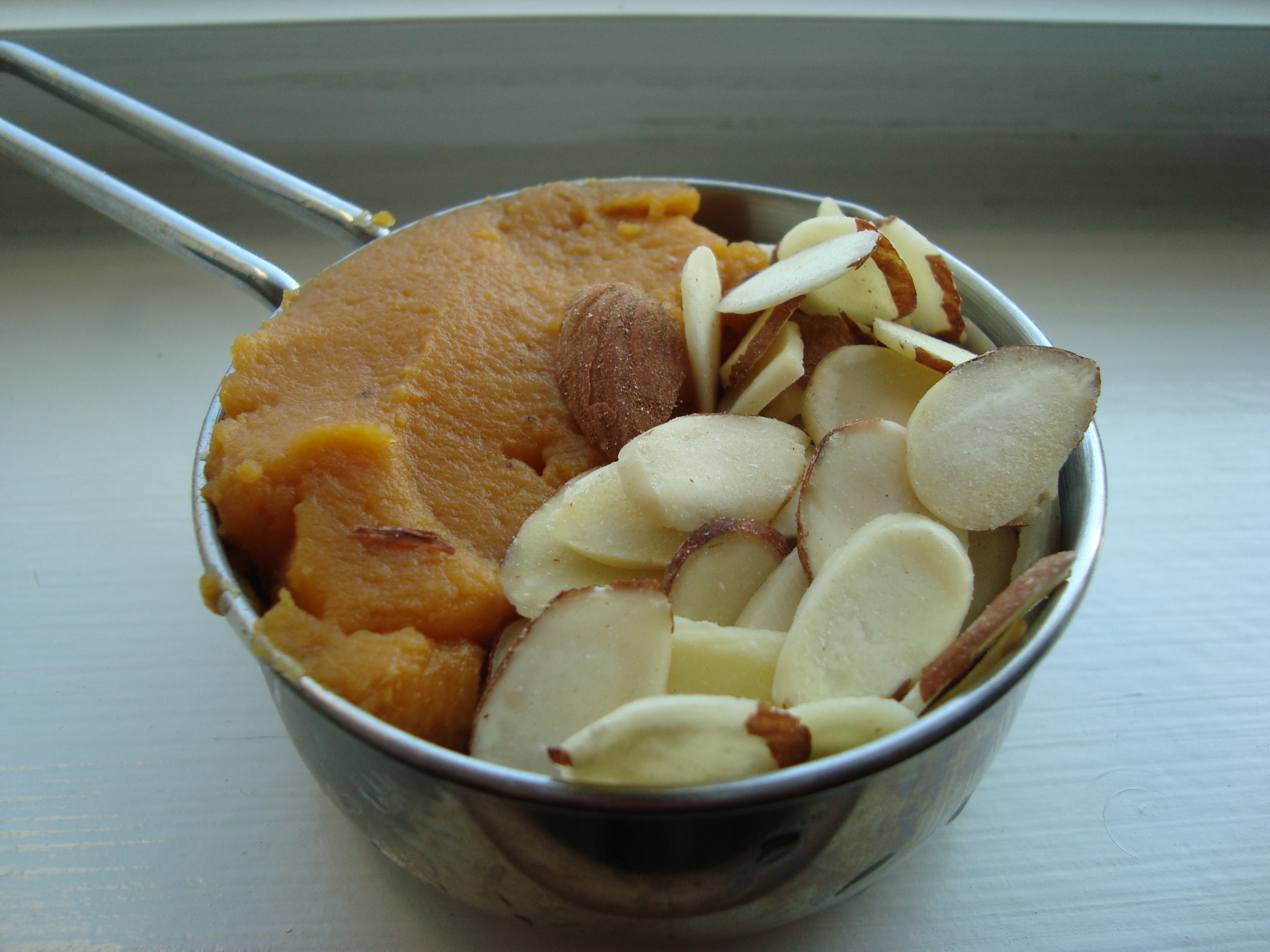
Next take the same measuring cup you just used for measuring your oatmeal and water, and fill it half with pumpkin puree (no salt) and half with sliced almonds. If you use the same measuring cup, then you can easily adjust this recipe for any amount of oatmeal without having to do any food math!
Pumpkin puree and sliced almonds
Once the oats are cooked, simply add them to the bowl with the protein powder and stir in the pumpkin and almonds. Top this with a dash of cinnamon, nutmeg, and ginger.
Pumpkin Pie Oatmeal
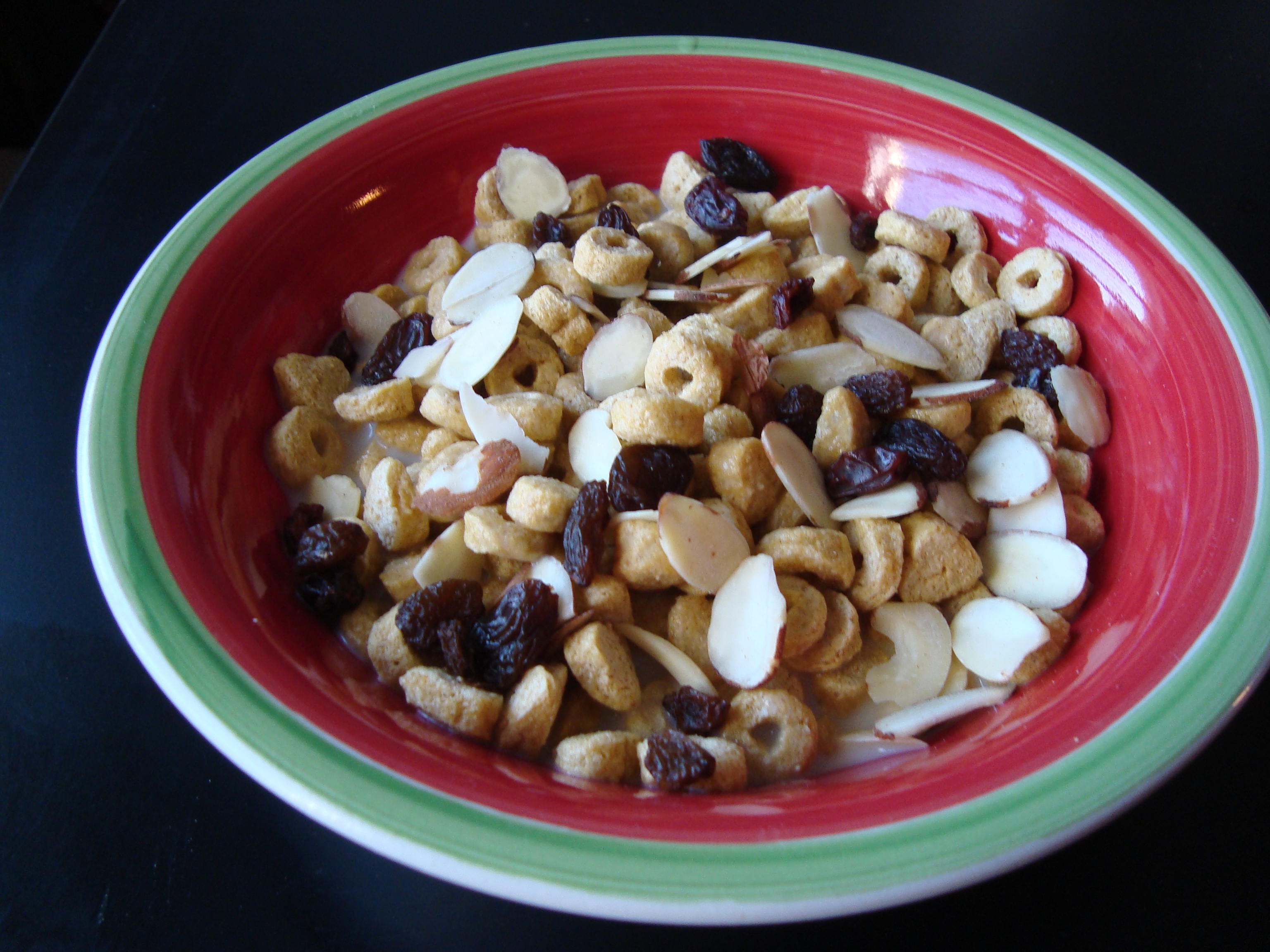
Breakfast #2: Kashi Heart to Heart Honey Toasted Oats cereal with almond milk, sliced almonds, and raisins. Coffee with almond milk and splenda. Thank you to Jason McDonald for commenting on my blog post to add nuts to cereal because it made me realize I can add some protein and fun to a basic cereal!
Pumped up cereal
Post-workout Snack: Smoothie made with banana, pineapple, peanut butter, and flaxseed. Blend with as much ice and water as it takes to get the volume and consistency that you like.
Smoothie in progress Smoothie completed!
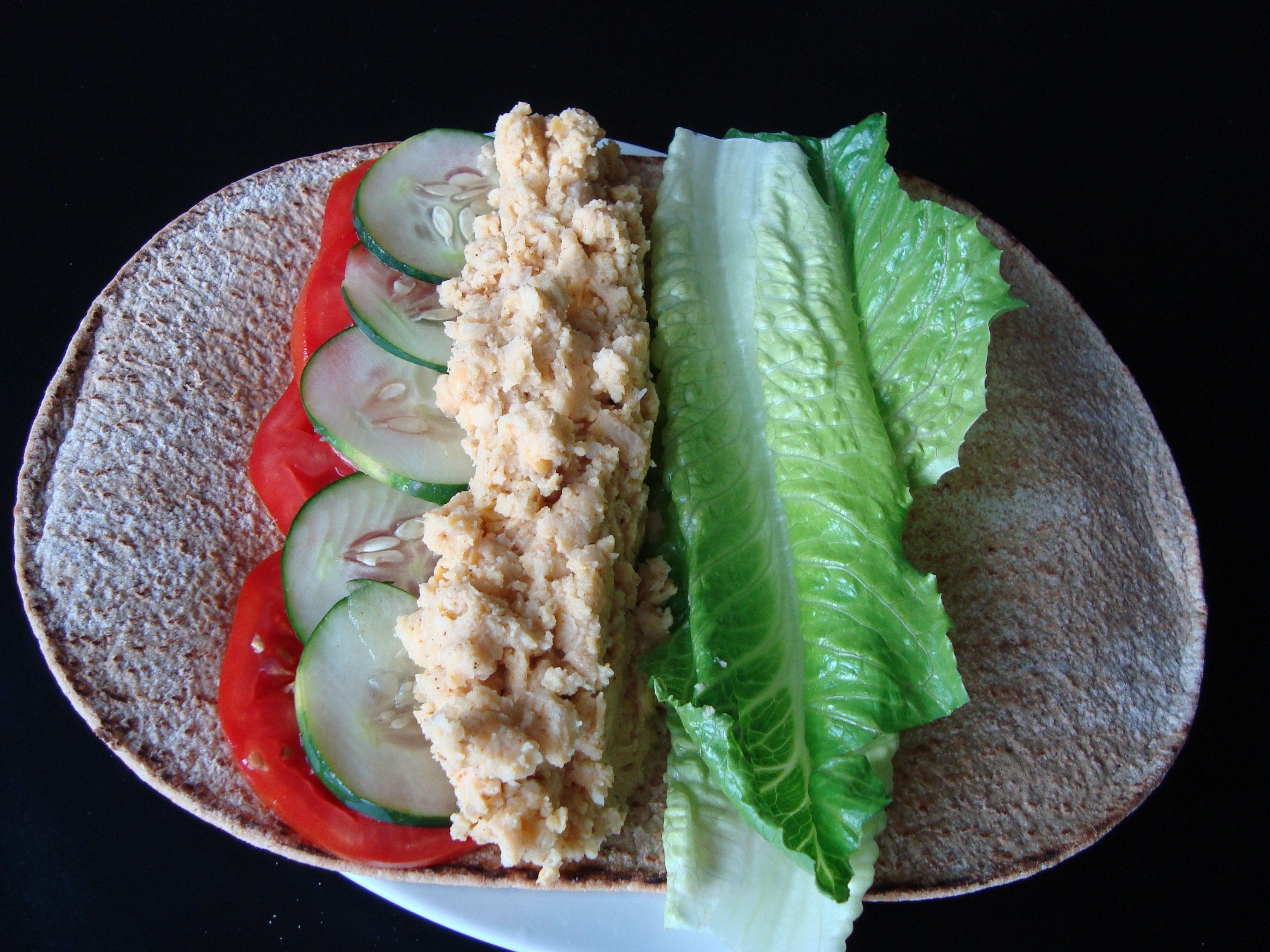
Lunch: Hummus wrap (homemade with chickpeas, olive oil, garlic, curry powder, and salt) with lettuce, tomato, and cucumber served with pretzel sticks.
The insides of the hummus wrap
Snack #2: almonds
Dinner: Whole wheat spaghetti with homemade sauce of onions, tomatoes, garlic, silken tofu, marinara sauce, garlic powder, Italian seasoning, red pepper flakes, and fresh basil served with sandwich thin garlic toast (olive oil, garlic powder, and Italian seasoning). For this, I first sauted the onions then added the chopped garlic and chopped tomatoes and let those cook just a little. Then I added the marinara sauce and tofu and cooked to heat through. Last step was seasoning with the spices. It looks a little weird as a sauce due to how the tofu stirred in to the sauce in a chunky way. If I make this again, I’ll blend the sauce as a last step to make it smooth. Regardless of what it looked like, it was good! I think this was extra yummy due to the organic onions and basil from the university’s garden!
Pretty tomatoes, onions, and garlic Vegan spaghetti Mangia!
One victory for today is the realization that my usual urge to (over)-snack on the days that I work from home is greatly diminished following this plan. That’s usually a huge struggle for me and I give in to the temptation to graze all day even thought I’m not hungry. Today, I had that urge for a minute and I was able to overcome it. Overall, I’m feeling good and strong; still gassy but my body is (finally!) adjusting to the extra fiber it’s starting to get a little better! My energy levels are normal for me and I can still think clearly and have strength for
yoga class.
In case you are wondering, I did live the vegan lifestyle for five days in a row. I’m just not the fastest blogger. It’s something I’m working on.
Nutrition information: 1415 calories, 235 grams carbohydrates, 46 grams fiber, 395 grams fat, 2 grams saturated fat, 0 trans fat, 0 cholesterol, 55 grams protein, and 1360 milligrams sodium. For the daily values, my numbers were 54% calcium, 77% iron, 30% vitamin D, 36% zinc, and 250% vitamin B12.
Once again, all images are my personal pictures. You may use them as long as you credit me (my name and a link back to my Web site).
Today, I realized that there is more to think about when following a vegan lifestyle than just meat and dairy foods. I have to admit to an unintentional slip today – ranch dressing! But I’ll get to that as I go through my meals in pictures.
Breakfast: Kashi Cinnamon Harvest cereal with almond milk, coffee with almond milk and splenda.
An easy vegan breakfast
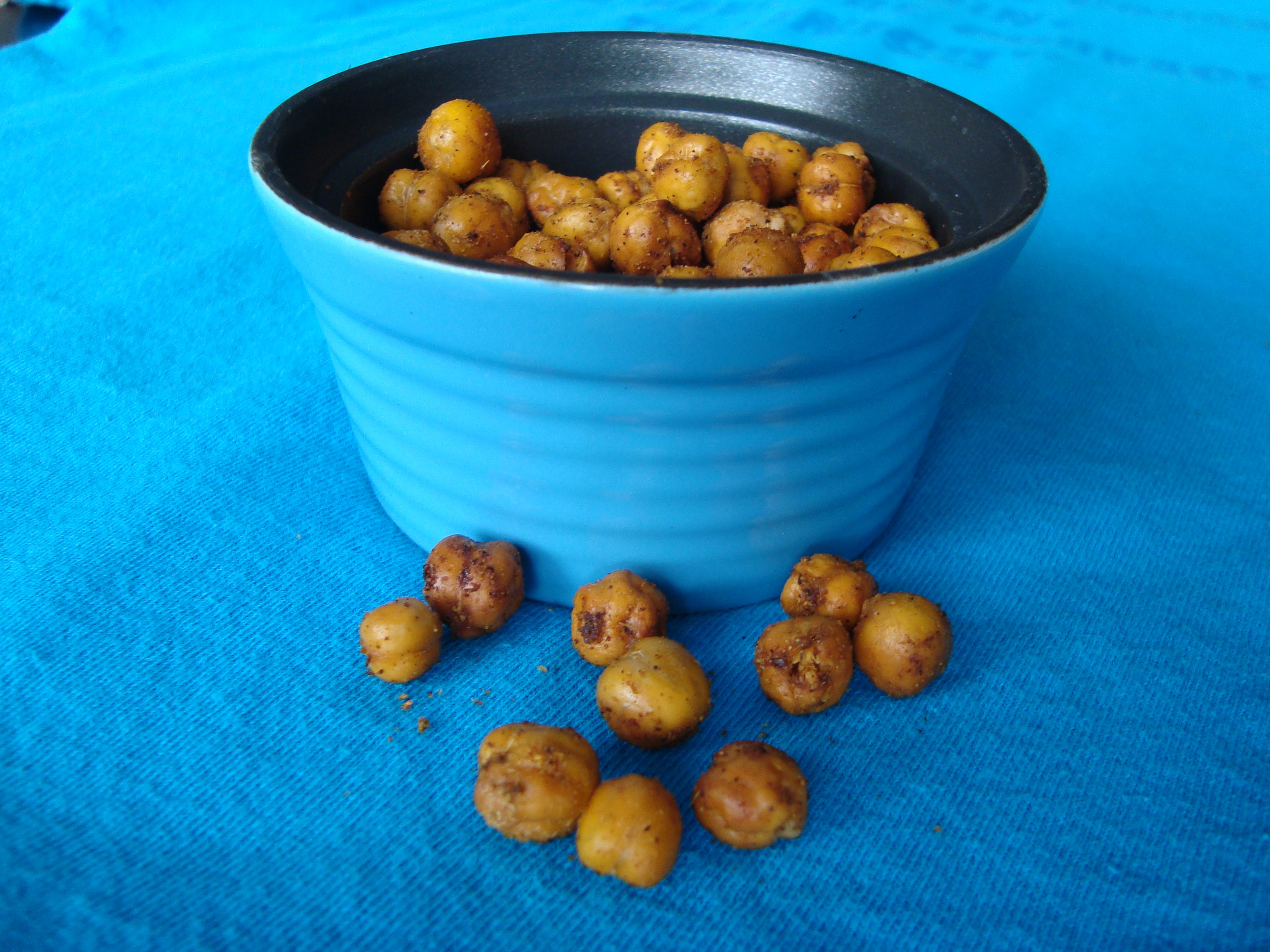
Snack: Roasted spicy chickpeas.
Roasted Spicy Chickpeas
This was a time-consuming recipe; but I’m working on stretching my food dollars so it was worth the effort. I started with a bag of dried garbanzo beans (chickpeas) and soaked and cooked them one day. The next day, I tossed the half of the cooked beans with a tablespoon of canola oil, a pinch of salt, and a fair amount of paprika, cumin, and a touch of cayenne pepper. Then I cooked them in the oven at 400 degrees for about an hour on a baking sheet lined with tin foil and sprayed with canola oil cooking spray. Cook the beans in one layer because the goal is to dry them out until they are a crispy crunchy treat. If you don’t cook them long enough, they will be mealy. I know this from my first attempt at this recipe! Per 1/2-cup serving: 135 calories and 7 grams of protein.
Post-workout snack: granny smith apple courtesy of my gym’s member appreciation day offerings.
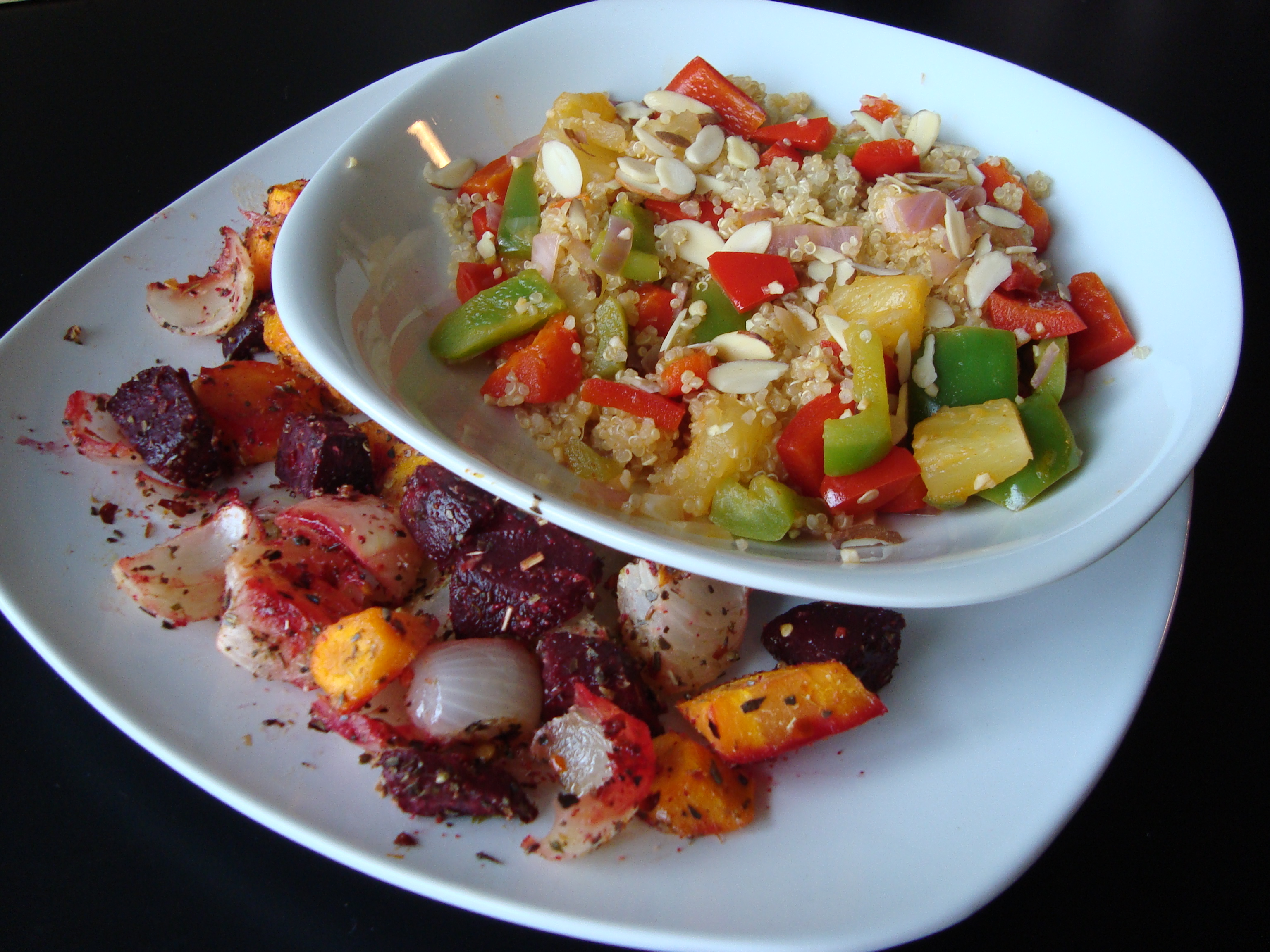
Lunch: Last night’s dinner leftovers: Quinoa with red/green bell peppers, red onions, garlic, pineapple, sliced almonds, and a dash of sriracha sauce served with a side of roasted vegetables (beets, carrots, onions) seasoned with canola oil, garlic powder, oregano, and red pepper flakes.
Quinoa bowl and roasted garden vegetables
Snack: Sweet Peanut Butter Smoothie!
I typically make my smoothies with either milk, yogurt, or almond milk depending on what I have on hand and how much protein and calories I would like to have. This time, I used water and ice instead of a milk or yogurt. I blended banana, pineapple chunks, and peanut butter with water and ice (adjusting to fill my cup and be the consistency and I wanted).
Snack: Celery and snap peas.
This is where I inadvertenly fell off the vegan wagon. I had an evening meeting to attend. The good news is that I brought the snacks and so could bring vegan alternatives. One thing I brought was a veggie tray with ranch dressing. I grabbed a celery stick and dipped it in the ranch dressing and as I was chewing, it hit me that the dressing was probably not vegan! I checked and I was correct – buttermilk is the second ingredient. This made me realize that there are more foods to limit that I realized. I wanted the convenience of the pre-made veggie tray… If only the grocery stores packaged veggie trays with hummus instead of dressing.
Dinner: Portobella mushroom sandwiches (mushroom, lettuce, avocado, mustard on sandwich thin) and Alexia sweet potato fries with ketchup.
Portobella sandwich with sweet potato fries
When making the Portobello sandwich, I was reaching for the mayonnaise when I realized that was also not vegan! This is more difficult than a vegetarian diet.
So, how am I feeling? Gassy! There is so much fiber in my diet now!
Otherwise, I’m feeling good and have energy for working out. I’m getting plenty of carbohydrates and calories; but I am still lacking in protein. I love how incredibly low my saturated fat, cholesterol, and sodium intake is following a vegan diet. Even with my one unintentional slip, I’m still going strong and feeling good about sticking with this challenge!
Nutrition information: 1360 calories, 204 grams carbohydrates, 43 grams fiber, 35 grams fat, 3 grams saturated fat, 0 trans fat, 0 cholesterol, 43 grams protein, and 725 milligrams sodium. For the daily values, my numbers were 60% calcium, 63% iron, 25% vitamin D, 8% zinc, and 0 vitamin B12.
All images are personal photographs. You may use them as long as you credit me (my name and a link back to my Web site).
Yesterday, I started the Vegan Experiment Challenge.
The day started off with a true challenge. The breakfast I had planned was mock scrambled eggs made with tofu. Unfortunately, I didn’t research any recipes before I shopped and I got the wrong consistency of tofu. This threw off my plan for my very first meal! Even with a bumpy start, my husband and I perservered and were 100% vegan on the first day of the challenge!
I felt tired; but I don’t think that was related to diet (more a poor night’s sleep and a busy day!). I felt like I ate a lot of vegetables and the 51 grams of fiber indicates I did indeed eat many vegetables yesterday. I hit my calorie range; but was low on protein. Meal details and nutrition information follow with all the numbers at the end of this post.
Breakfast: Kashi Cinnamon Harvest cereal with almond milk, coffee with almond milk and splenda
An easy vegan breakfast
Morning snack: almonds and raisins
Easy homemade snack
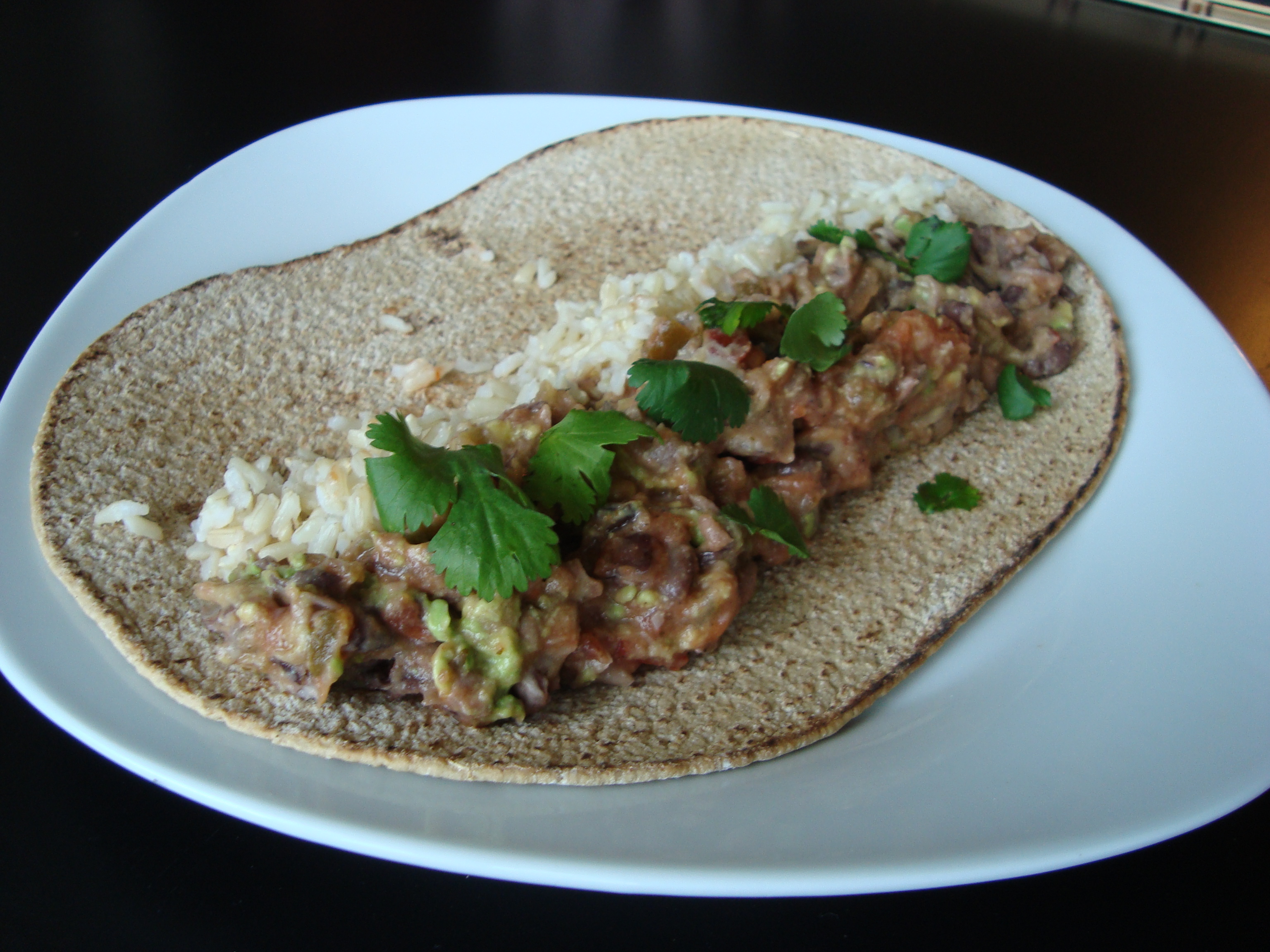
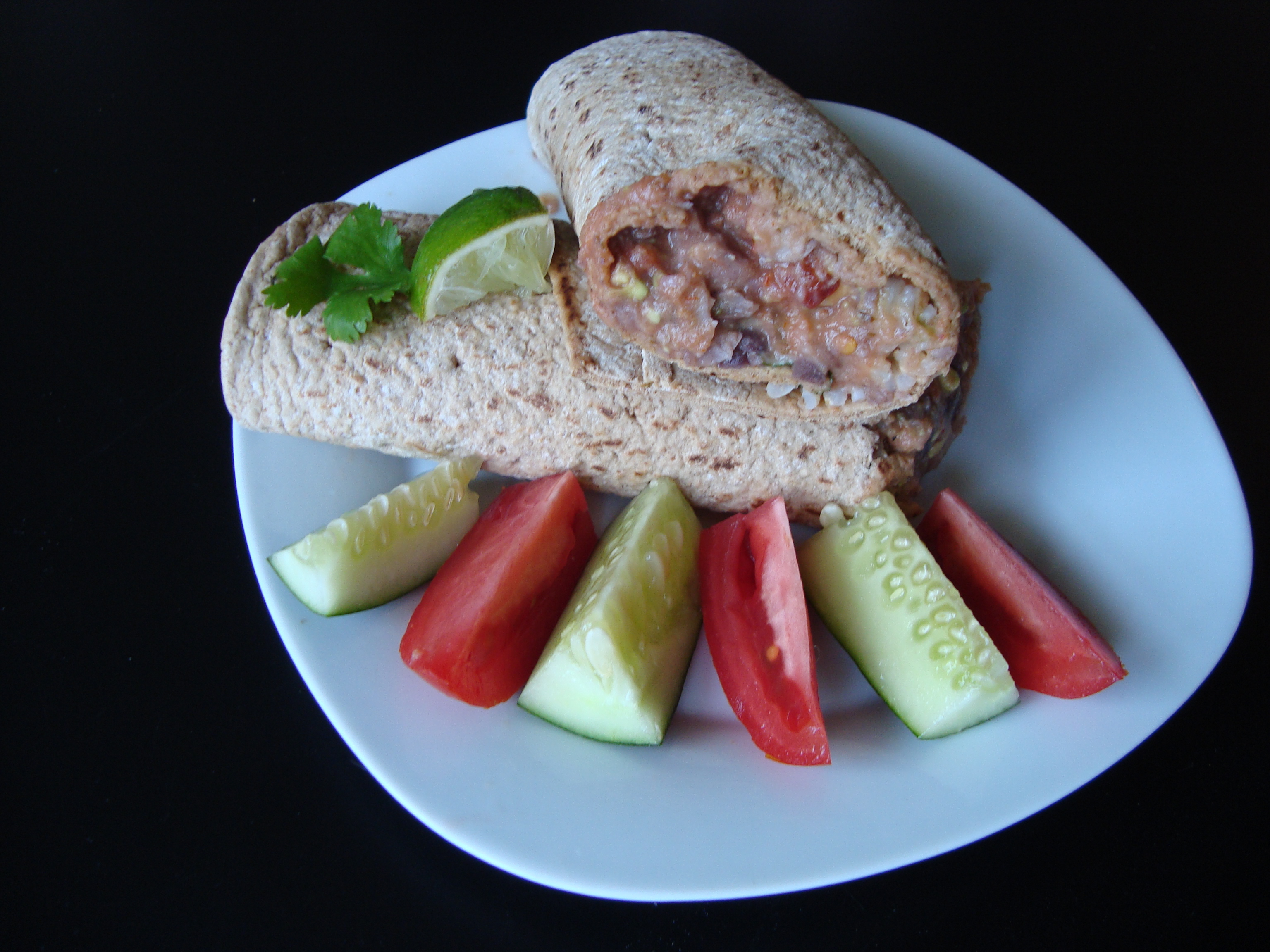
Lunch: bean burrito made from a Flatout wrap, mashed black/pinto beans, salsa, avocado, rice, cilantro, and lime juice served with tomato and cumumber slices on the side
Mash beans, avocado, and salsa together
Put mixture, rice, cilantro, and lime juice on wrap
Vegan Bean Burrito
Afternoon snack: while I hesitate to call it a snack, I must confess to having 2 beers while relaxing on the beach in the afternoon…
Dinner: Quinoa with red/green bell peppers, red onions, garlic, pineapple, sliced almonds, and a dash of sriracha sauce served with a side of roasted vegetables (beets, carrots, onions) seasoned with canola oil, garlic powder, oregano, and red pepper flakes
Quinoa bowl and roasted garden vegetables
For those of you out there who like the numbers, here you go!
1560 calories, 209 grams carbohydrates, 51 grams fiber, 37 grams fat, 3 grams saturated fat, 0 trans fat, 0 cholesterol, 47 grams protein, and 890 milligrams sodium. For the daily values, my numbers were 73% calcium, 71% iron, 31% vitamin D, 13% zinc, and 0 vitamin B12.
All images are personal photographs. You may use them as long as you credit (my name and a link back to my Web site).
I have found myself wondering if eating a vegan diet for five days will be more expensive than my typical diet. I believe there are two ways to go with vegetarian/vegan eating. One is to use whole natural foods and shop in the conventional grocery stores and one is to use the vegetarian/vegan-specific marketed foods and shop in the specialty grocery stores.
Now, that I write that, I realize that’s true no matter what type of diet one follows.
Today, I spent $55.33 at a conventional store on groceries for the next six days. I already have some staples on hand, such as quinoa and dried beans, and I just got a nice harvest (curly kale, carrots, onions, and basil) from the university’s organic garden. I am so looking forward to those kale chips I’ll be making tomorrow with the beautiful organic curly kale! I couldn’t find a soy-only protein powder, so I still need to pick that up for about $10-$12. Even if I had to purchase the quinoa, black beans, and garden vegetables and adding the cost of the protein powder, I think ~$75 to feed 2 people for six days is pretty darn good! That’s just $6.25 per person per day, or around $2 meal!
Here’s my list. Don’t worry – the meals and recipes will be coming over the next five days as I live this experiment!
Produce: avocado, bananas, green/red bell peppers, romaine lettuce, tomatoes, cucumber, portobello mushrooms, apples, limes, and canned pineapple


















You must be logged in to post a comment.