Tag Archives: nutrition

Make your own pizza!

Skinny Pizza? Go For Homemade!

A new product, The Skinny Pizza, was announced in the latest issue of Food and Nutrition magazine. The information provided states this is a small thin crust margarita pizza with only 390 calories. Since it was listed in the “new products” section of a US-wide publication of the Academy of Nutrition and Dietetics, I assumed it was a new packaged food that would be available to most consumers.

I decided to blog about the nutrition content of this new product and to suggest alternatives for a whole food, non-packaged, homemade, low-calorie pizza because I know from experience that it’s fairly easy to make a mean homemade pizza!

It turns out this is not a packaged food. This is a menu selection from a pizza chain that has 25 locations. Only 18 of these locations are in the United States and 11 of them are in South Florida. Now, this called into question for me why this was listed as a new product in a magazine for dietitians with a demographic that covers the entire United States… But this is a topic for another day.

Let’s talk about “nutrition made easy” with a healthier homemade pizza!

Start by toasting either an English muffin, a pita, or this dietitian’s favorite, a Flat Out or other flat bread. You just want this to get a little bit crispy or the sauce will make the pizza soggy.

Once crispy, top with a little low-sodium tomato or marinara sauce, and by a little I mean a lot less than you think you need even if you like your pizza saucy like I do! If you want to keep it even more “clean,” then saute some chopped plum tomatoes in a little olive oil, garlic, and onion, mashing the tomatoes as they cook to make a bruschetta-like sauce.

Top with some shredded cheese, lean proteins, and as many vegetables or fruits as your pizza will hold and throw it back in the oven or toaster oven to warm the ingredients and melt the cheese. You may want to also saute the vegetables if you prefer a softer, cooked texture over a crunchy texture.

One of the favorite combinations in this household is chicken breast, BBQ sauce, red onions, mushrooms, a Mexican cheese blend, oregano, cumin, paprika, garlic powder, and red pepper flakes or Hot Shot! Another favorite is pineapple chunks and mushrooms.

The sky is the limit with combinations for this pizza and every person can get their own favorite combination! By limiting the portions, the amount of cheese used, and focusing on lean meats, vegetables, and fruits as toppings, you can keep this pizza low calorie, fiber- and nutrient-rich, and most importantly delicious!

I’m always looking for new flavor combinations and ideas so let me know what you put on your homemade pizza.

References:

Pizza Rustica Launches Skinny Pizza. Available at: http://www.food-business-review.com/news/pizza-rustica-launches-skinny-pizza-081112. Accessed January 27, 2013.

Pizza Rustica Locations. Available at: http://www.pizza-rustica.com/locations. Accessed January 27, 2013.

Image from: http://office.microsoft.com/en-us/images/.

Cilantro!

And We’re Live!

Welcome! Today is the day I officially launch my Web site. (Wow that was a long time ago!)

To celebrate the occasion, I have just posted a cooking demonstration showing you how to make “mom’s homemade salsa” which makes a great snack or can be used in other recipes. You can find the video on my “Cooking Videos” page or on my YouTube page which is linked from the “Follow Me On…” page.

Please help me spread the word by sharing my site with others. I welcome all feedback so let me know if I help you with “nutrition made easy.”

Thanks!
-Alexia

Ready to cook!
Ready to cook!
healthy bread on table

Macronutrients – Those Confusing Carbs!

Carbohydrates

Sources:

Carbohydrates come from plant and animal sources. The food groups that contain carbohydrates include grains, fruits, dairy, and vegetables.

There are two main types of carbohydrates: simple carbohydrates (sugar) and complex carbohydrates (starch and fiber).

Sugar:

There are two types of sugars that people typically think of when talking about sugar in the diet. One type is the natural sugars that are found in foods in their natural and whole state. Examples are fructose and sucrose (in fruits) and lactose (in milk). The other type of sugar is the added sugars that are added to foods during processing or created from refining natural foods, Examples are high fructose corn syrup (in many products) or sucrose (refined into table sugar).

Starch:

Starches are long chains of sugars. Our bodies break down these long chains into simple sugars that our body can absorb to provide us with energy. Many foods that are starchy need to be cooked in order for our bodies to be able to digest them. Examples are potatoes, corn, and grain products such as bread, pasta, and rice.

Fiber:

Fiber is the indigestible part of the plant. Fibers are also long chains of sugars; but the way the chains are held together prevent our bodies from being able to digest them for energy. Fiber is important for health for many reasons. Fiber can be fermented by the bacteria in our gastrointestinal tract which promotes colon health. Insoluble fiber helps promote regularity and prevent constipation. Insoluble fiber includes whole grains (the outer bran layer) and the strings in celery. Soluble fiber can help to lower cholesterol and regular blood glucose levels. Soluble fiber includes oats, beans, and citrus fruits.

Functions:

The functions of carbohydrate include:

– Energy! Carbohydrates currently have a bad reputation; but they are the main and preferred source of energy for the body. Our bodies need carbohydrates to be at our best health.

– Help to lower cholesterol and regulate blood glucose levels (soluble fiber)

– Maintain digestive tract health (fiber)

Recommendations:

For a generally healthy adult, the range for carbohydrate intake is set between 45% and 65% of daily calories. A person consuming a 2,000 calorie diet would have a range of 900 – 1,300 calories. Since 1 gram of carbohydrate has 4 calories, this is a range of 225- 325 grams of carbohydrate per day. The minimum number of carbohydrate grams per day is 130 grams to promote good brain function.

Those trying to build muscle should be sure to consume enough carbohydrates to “spare protein” to be used for muscle growth.

Many people restrict carbohydrates due to the belief that “carbs make you fat.” In healthy individuals, carbohydrates trigger insulin and insulin lets the sugar into our body and cells. People mistakenly believe that this always means weight and fat gain. This is not true!

When we eat the appropriate amount of carbohydrates for our bodies, the sugar is used as a fuel source and burned. It is only when we overeat carbohydrates that weight gain results. Carbohydrates do not make you fat. Carbohydrates are an important part of the diet. Without carbohydrates, the body begins to break down fat storage and then body proteins. In extreme cases, metabolism slows drastically and both health and life can be jeopardized.

People with specific health conditions or concerns may need a different amount of carbohydrate in their daily diet or to time the consumption of carbohydrates throughout their day.

Other guidelines:

Whole grains: Consume whole-grain carbohydrates whenever you can. Recommendations are to make half of your grains whole. Read the food label and be sure the first ingredient is listed as a “whole” grain (example: whole wheat, not wheat flour).

Fiber: For those between 19 and 51 years old, females should consume 25 grams and men should consume 38 grams of fiber a day. Those over 51 should consume 21 grams (women) or 30 grams (men) per day. If you are increasing your fiber intake, do it slowly and drink lots of water or you may end up with a bout of constipation!

Added sugar: Limit the amount of added sugar in your diet. Many health risks are associated with added sugars and in general, Americans consume too much added sugar. The American Heart Association recommends no more than 100 calories (women) or 150 calories (men) of added sugars per day. Most natural sugars are generally not associated with health risks as these are consumed along with fiber which slows down the absorption of sugar and other vitamins, mineral, and phytochemicals which promote optimal health.

Original publication date: October 1, 2012 at http://newmotivationcoaching.blogspot.com.

Reference: Nutrition Concepts and Controveries, 12th ed. by Sizer and Whitney, 2012. ISBN-13: 978-1-1133-62818-7.

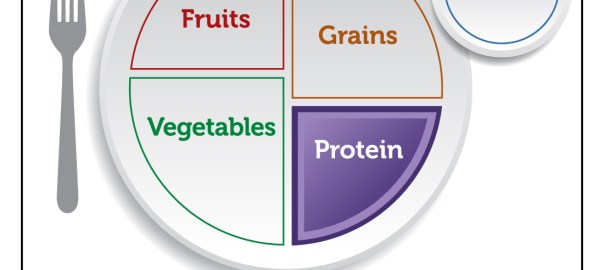
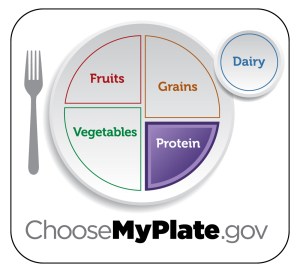
ChooseMyPlate.gov Protein Food Group

Macronutrients – The Beef on Protein

ChooseMyPlate.gov Protein Food Group

Updated 12/03/2024. One of the jobs I have held was as a wellness dietitian for a university. I loved that job. I was working on updating the nutrition info on the website and thought I’d share some of the things I’ve been updating. Enjoy!

I’m working on the macronutrients (aka macros). First up, the *beef* on protein (because I just can’t resist bad wordplay!)

Protein

Sources:

Protein comes from animal sources such as meat, dairy, and eggs and from plant sources such as beans, nuts, seeds, and even some grains.

Even your broccoli has protein, but you would have to eat nearly 3 cups to equal the protein in 1 ounce of meat. I’m stuffed just thinking about it. (And, oh, the gas!).

It is possible to consume enough protein for good health on a vegetarian or vegan diet if you plan your food choices well.

Functions:

Protein is an essential nutrient meaning that we must get it from our food. Proteins break down in our bodies to amino acids. Our bodies cannot make all the amino acids it needs to function and approximately 25% of amino acids are lost to other uses every day, which is why protein is an important part of the daily diet.

Protein has many functions including:

– Provides body structure by building and maintaining muscle, bone, and other body tissue

– Allows for movement (40% of body protein is muscle tissue)

– Regulates gene expression

– Integral part of enzymes, hormones, and neurotransmitters

– Immunity through antibodies

– Transports of vitamins, minerals, oxygen and other substances through the body

– Regulates fluid and electrolyte balance

– Maintains acid-base balance

– Necessary for blood clotting

– Used as fuel when other sources of energy are not available. (Cue the nightmare metabolism images from grad school).

– Protein is satiating – it helps us to feel full and satisfied

Recommendations:

For a generally healthy adult, the recommended daily allowance (RDA) range for protein intake is set between 10% and 35% of daily calories. A person consuming a 2,000 calorie diet would have a range of 200 – 700 calories. Since 1 gram of protein has 4 calories, this is a range of 50- 175 grams of protein per day.

Further, the recommendation for generally healthy adults is 0.8 grams per kilogram (8g/kg) of body weight. To convert pounds to kilograms, divide weight by 2.2. For example, a 150 pound person is (150 divided by 2.2) 68.18 kilograms. This person would consume around 54 grams of protein per day, which is the low end of the above range.

Now, that recommendation is based on nitrogen balance studies from way back when. It is the amount needed to prevent nitrogen deficiency. Those amino acids have a nitrogen molecule on them, which leads to a recommendation.

A recommendation that I think is too low. And I’m not the only one. For example, NASM recommendations go up to 2g/kg based on athletic training needs. And this article in the journal Nutrients questions if it’s time to update the RDA. 

People with specific health conditions or concerns may need a different amount of protein in their daily diet.

And bro, no matter how much protein you eat, you won’t build muscle without some form of resistance training.  

Updated: December 3, 2023. 

Original publication date: September 17, 2012 at http://newmotivationcoaching.blogspot.com.

Reference: Nutrition Concepts and Controveries, 12th ed. by Sizer and Whitney, 2012. ISBN-13: 978-1-1133-62818-7.

Image from: http://www.choosemyplate.gov

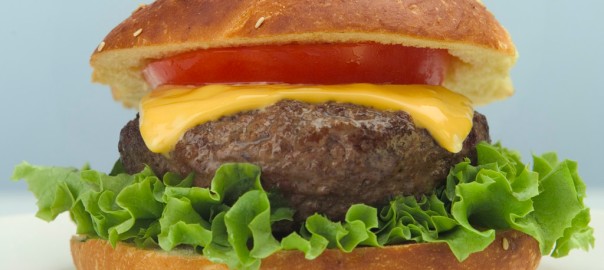
Cheeseburger

Fast Food: Cheeseburger Vs. Salad

Cheeseburger
Cheeseburger

I admit it. I watched part of The Doctors television show the other day. I caught a segment on how Americans eat and one of the doctors was working at a fast food drive-through window attempting to get customers to choose a healthy meal over the unhealthy meal they were ordering. It did not go that well for him. Only one person on the segment out of four changed their meal after he told them how unhealthy their selection was in terms of calories, fat, and sodium levels.

What stuck with me was that one woman said that a cheeseburger was kind of like a salad. Her point was that salads have vegetables and cheeseburgers have vegetables. Therefore, they are similar. The audience laughed good-heartedly and I groaned and laughed.

Then I got to thinking… Is a fast-food salad really that much better of an option than a fast-food cheeseburger? I turned to the restaurant’s Web sites to make some comparisons.


Let me start by saying that there are other choices than what I have compared below. If the Wendy’s Garden Side Salad with no croutons and low-fat dressing (70 calories, 0 g fat, 190 mg sodium) or the ¾-pound Dave’s Hot ‘N Juicy Triple Burger (1060 calories, 67 g fat, 2020 mg sodium) are your choices then yes, the salad is much healthier. However, I have tried to pick middle of the road choices that I think people would make in these examples.

First, I compared a regular McDonald’s Cheeseburger to their Premium Southwest Salad with Grilled Chicken (with and without the creamy southwest dressing). As the table below shows, the salad with dressing, which is how most people would order it, has 90 more calories, 2 more grams of fat, and 240 more milligrams of sodium than the cheeseburger. If you can go without the dressing for the salad, you are only saving 10 calories, 4 grams of fat, and 100 milligrams of sodium versus the cheeseburger. That is not a huge difference.

Food Calories Fat Sodium
Cheeseburger 300 12 750
Salad 290 8 650
Salad with dressing 390 14 990

Next, I moved to Wendy’s to compare the Jr. Cheeseburger Deluxe to their Apple Pecan Chicken Salad (with and without the pomegranate vinaigrette dressing). Again, the cheeseburger is the healthiest option in terms of calories, fat, and sodium. The salad with dressing has 210 more calories, 8 more grams of fat, and nearly 700 more milligrams of sodium. If you can go without the dressing, you will still have 100 more calories and 3 more grams of fat than the cheeseburger; but you will save almost 300 milligrams of sodium.

Food Calories Fat Sodium
Jr. Cheeseburger Deluxe 350 19 850
Salad 450 21 580
Salad with dressing 560 27 1540

I could continue; but I think the pattern is clear. The salad is not always the healthier choice at a fast food restaurant. We are still operating under the assumption that the salad is always healthier, or at least that audience and I were, and that is just not true! Now, there is a lot to consider when deciding which choice is healthier, such as the types of fats, cholesterol, and other nutrients such as the vitamins and minerals. But if I included all of that, you would have stopped reading by now…

My advice?

1. – Avoid the fast food places altogether. You can make a yummy salad or a healthier cheeseburger at home using a small portion of lean grass-fed beef, low-fat cheese, and lots of vegetables.

2. – If you cannot avoid the fast food restaurant, ask for the nutrition information before you order (many have handouts) or look at their Web site before you go. Most importantly, make your choice before you order at the register (where you can see the pictures and smell the food).

3. – Realize that what you think may be an unhealthy choice, may not be the unhealthiest choice on the menu. Sometimes, the cheeseburger may be better than the salad.


As always – enjoy your food!


Original publication date: December 10, 2011 at http://newmotivationcoaching.blogspot.com

Image from: http://office.microsoft.com/en-us/images