Tag Archives: heart healthy

All About Salt: Sodium

I just finished sharing some information over on the N.E.W. Motivation Coaching Facebook page about salt and decided to post the information and links to the videos here.

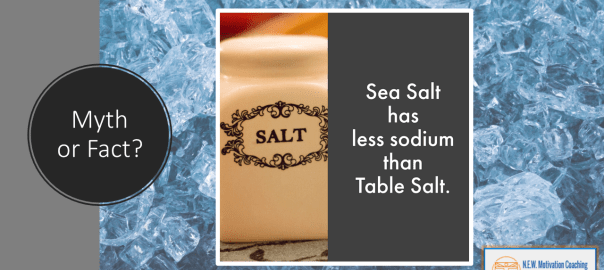
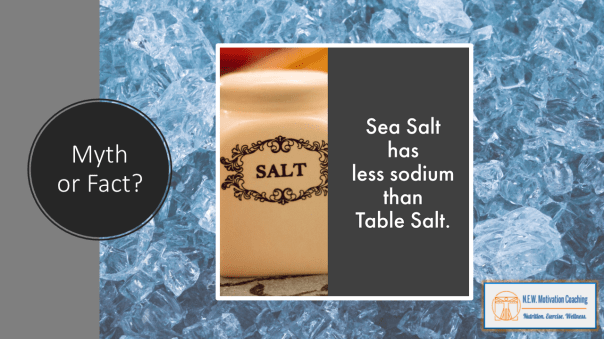
Myth or Fact? Sea Salt has less sodium than Table Salt?

First up, we addressed a great question we hear from our clients a lot – does sea salt have less sodium than table salt.

This is such a confusing topic and I’ll share with you why this is so confusing.

One reason is there are nutritional differences in the different types of salts which is due to the source of the salt and how it is processed.

Sea salt comes, of course, from the sea and is typically processed through evaporation, meaning the food manufacturer takes the water away and what is left is your sea salt. Because of this processing, it has different minerals than table salt and may contain potassium, magnesium, phosphorus, and other trace minerals.

Table salt typically comes from salt mines and is stripped of minerals during processing but… typically it comes with added iodine since we used to have a pretty big goiter problem back in 1920s and this is how the powers that be decided to fix the problem. Nutritionally, 1 teaspoon of table salt has no calories and has very small traces of minerals found in sea salt. If you look at the label for table salt, you may see additives. Typically, calcium silicate is in there to prevent clumping and potassium iodide is the vehicle to get the iodine in salt.

But the big question is: DOES SEA SALT HAVE LESS SODIUM?
Slide1-less-sodium

And the answer is YES… and NO!

Oh, don’t you hate that! Well, this will help. Here’s why:

By weight, sea salt does NOT have less sodium than table salt!

However… by volume (when you grab a pinch or use a measuring spoon), sea salt HAS less sodium!

This is because sea salt – and kosher salt – usually has larger crystals so less fits in a spoon due to how the crystals fall against each other leaving little pockets of air in between them. Table salt is very fine and so there are no little pockets of air as the granules nest next to each other.

To compare:

  • 1 teaspoon of table salt has 2325 mg of sodium
  • 1 tsp of sea salt has between 1200 – 2360 mg
  • 1 tsp of kosher salt has between 2000 – 2360 mg

So it really all depends on how those little salt crystals settle.

Hopefully, now it makes a little more sense to you.

So… which one should you choose?

Well, Salt is a flavor enhancer which means it brings out the flavors and makes food more delicious. So, yeah, use a little salt when you cook!

Salt is also important in baking since baking is pretty much just a delicious form of chemistry so it is important to be precise to get good baked goods. For baking, follow the recipe to decide which type of salt to use.

For other cooking, professional and home chefs tend to prefer larger crystals but if you need the salt to dissolve a smaller crystal would be a better choice.

When it comes down to the nutrition, there is not much difference between the different types of salt and there are no magical health and healing properties in the more expensive or organic salts. However, the trace minerals or other fancy things that may be added to the more expensive salts may change the flavor.

In the end, choose whichever type of salt you prefer that best fits your budget.

Recipe: Spicy Mexi-Bowl (Gluten-Free!)

Here is another delicious gluten-free, dairy-free, and vegan recipe. This spicy Mexican-inspired quinoa and beans bowl is a quick to prepare, heart-healthy, and nutrition-rich meal that can be made ahead for take-to-work lunches or you can mix up a big batch for a family dinner.  You could even top it with an over-easy egg and make it a breakfast (although it won’t be vegan with that egg on it!).

Spicy-Mexi-Bowl

And, before I forget – if you join up for our email newsletter before October 1, you will get a special offer on the Go Gluten Free or the Get Started Coaching Packages! Join today!

Here is the printer-friendly PDF: Recipe -Spicy Mexi-Bowl

Spicy-Mexi-Bowl

A Mason Jar Meal-Prep Workshop Recipe by Alexia Lewis RD / N.E.W. Motivation Coaching

Makes 1 serving

INGREDIENTS & SUPPLIES

1                          Mason Jar, 2-cup size

1 Tbsp                Red wine vinegar (or to taste)

1 tsp                    Lime juice

1/4 medium      Avocado (Florida), peeled and chopped

7                          Grape tomatoes, halved

1 Tbsp                Red onion, chopped (or to taste)

1 Tbsp                Jalapeño, deseeded and chopped

1/2 cup               Quinoa, cooked

1/2 cup               Black beans, low-sodium canned, rinsed or cooked from dry

1 tsp                   Cilantro, fresh, chopped

DIRECTIONS

  1. Layer all ingredients in mason jar in order listed.
  2. Store refrigerated for 3-5 days depending on quality of mason jar seal
  3. To serve, shake food from jar into a bowl, toss to combine, and enjoy!

Nutrition per serving:

365 calories, 10 grams fat (1.5 grams saturated fat, 0 trans fat), 0 cholesterol, 153 milligrams sodium, 59 grams carbohydrates, 13 grams fiber, 4 grams natural sugar, 14 grams protein.

Notes:

We recommend making four servings at once – that way you use up the whole avocado – and can cook 3/4 cup of dry quinoa which should give you about 2 1/4 cups cooked.

Ready for the Focus on Five media interview

Focus On Five for Heart Healthy Lunches that Stay Fresh

There is nothing more disappointing than taking the time to pack a heart healthy lunch and finding it a soggy mess by lunchtime. Last month, I shared my tips to pack a heart healthy lunch that will stay fresh until it’s time to eat on First Coast Living, a local new show (video since taken down unfortunately).

Ready for the Focus on Five media interview

My segment was inspired by an article that stated that even the 40% of children who are bringing lunches from home still fell short nutritionally. The 626 children (3rd-4th graders) had too many sweet and salty pre-packaged foods and too little fruits, vegetables, and dairy foods. Only 27% of the lunches had even three of the five food groups! More than half (59%) contained sandwiches. Armed with this information, I set out to find tips for improving the nutrition in our lunches without sacrificing on the yummy-factor.

The basics of a heart-healthy lunch are to (1) stock up on fiber and color by including whole fruits, vegetables, plant proteins, and whole grains, (2) keep the sodium and saturated/trans fats low by turning away from packaged or processed foods as well as high-fat meats and dairy foods, and (3) pack enough food to keep you satisfied and energized throughout the day.

My tips are simple – “focus on five” and plan/prepare ahead!

Focus on Five

Aim for all five food groups in your lunch bag!

  • A small amount of lean meats, a boiled egg, or plant proteins (beans, nuts, seeds) to get your protein, iron, and B12 (in animal products)
  • A small amount of whole grains (bread, crackers, etc.) for carbohydrates, fiber, and energy
  • Load up on whole fruits and vegetables (or ones packaged without added sugar or salt) for vitamins, minerals, and fiber
  • Include some reduced fat dairy foods (milk, cheese, yogurt) for calcium and vitamin D

Aim for at least five colors!

The trick with this tip is that in order to get five or more colors we have to turn to fruits and vegetables… because, yes, skittles do not count! Different colors have different vitamins, minerals, and phytochemicals (those wonderful little plant compounds that we are learning do so much for our health). If you eat the same colors every day, you may be missing out on some key nutrients.

Plan/Prep in Advance

Use the Focus on Five strategy to figure out what you will pack during the upcoming week and get your shopping done.

When you get home, do any chopping and washing as well as portioning out foods before you put them away. If you spend one hour chopping vegetables and portioning crackers into single serving baggies, you are well-positioned to meet your health goals during the week when our prep-time is typically more limited.

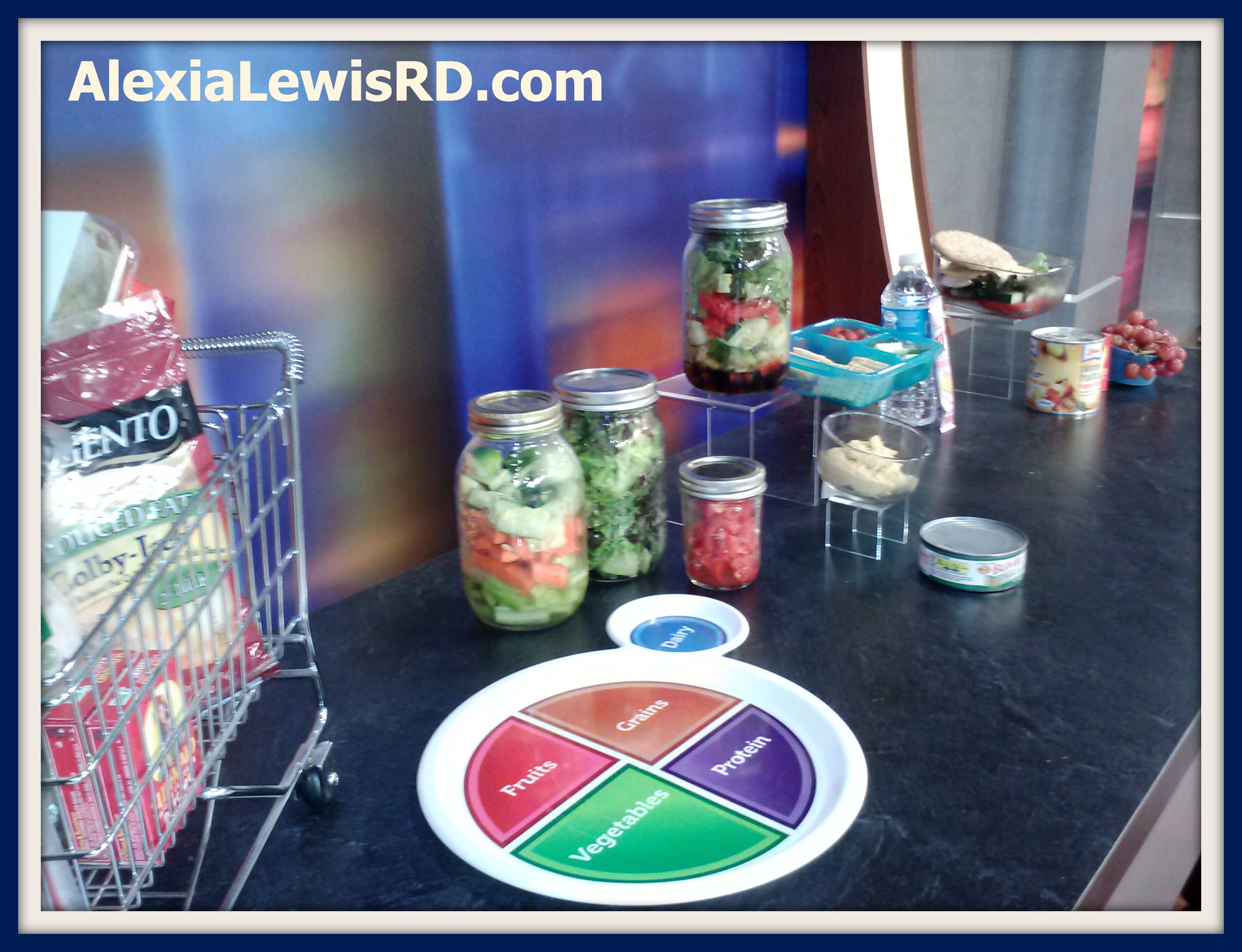
Pack lunches (and your pre-chopped foods) in a way that keeps them fresh. Mason jars are one of the best things I’ve found for maintaining freshness because the seal on these jars is air-tight. I showcased three options on the segment: a mason jar salad, a bento box, and a deconstructed sandwich. The trick to keeping your lunch fresh is layering! Always layer your dressing (if a salad) on the bottom and then the foods that will hold up to the dressing.  Carrots are a good choice because they can sit in dressing for days without changing. Next, layer your wet ingredients (tomato, cucumber, lettuce). Always make sure your lettuce is nowhere near the dressing or it will wilt. Finally layer your proteins, cheese, and (if a sandwich) bread on top. I have used lettuce on Friday that I rinsed, spun, and chopped on Sunday. This picture is the salad I made for the segment on Sunday, which I ate on Thursday!

Mason Jar Salad - one week later!
Mason Jar Salad – one week later!

Just be mindful of food safety and if it looks wilty, wet, or is mushy – toss it!

The Difference?

I compared my bento box to a very popular pre-packaged lunch any my bento box has 26% fewer calories, 33% less saturated fat, and 3 times more fiber for $0.87 less per meal.

I also compared my salad to a popular sandwich and salad restaurant and my salad had 44% fewer calories, 65% less total fat, 63% less sodium, and 150% more fiber!

Following these tips will save you time, ease the pressure on your wallet, and greatly improve the healthfulness of your delicious and easy lunches.

What other tips do you have to share?