Tag Archives: health goals

Picture of woman throwing glitter into the air with the words, "reach your health goals with environmental design.

Reach Your Health Goals with Environmental Design

April 2025. Life certainly has its rough patches, no? I’m in the middle of one right now.

It’s tempting to throw in the proverbial towel and just take a break from all the health goals when life laughs at your plans. And that certainly is a valid option. Sometimes taking a break is exactly what is needed to come back stronger.

But other times, continuing forward progress is what will help the most. Especially if you need a distraction from highly emotional times. (Hi, that’s me!). Keeping busy and staying focused on my goals is helping me to navigate this rough patch.

Enter environmental design. This is a strategy based on setting up your environment in a way that makes it easier to make the choice you decided to make when life wasn’t quite so rough. And if this resonates with you, be sure to check out my blog on how to never fail at your goals again.

I’m also sharing a simple, healthy, and delicious recipe for the hummus wraps I have been loving for quite a minute now. It’s best for those who can put together a wrap when it’s time to eat. That way the wrap doesn’t get soggy from the ingredients. It’s also vegan, but don’t let that scare you away. You can always add some meat!

Start where you are. Use what you have. Do what you can.” – The great Arthur Ashe 

Yours in good health,
Alexia Lewis, RD
Master’s Level Nutritionist
Registered Dietitian
Certified Health Coach

Graphic of review with words: DYK I currently have a 5-star rating (out of 5) based on 136 reviews?! Here’s one of my recent reviews. 

“I really enjoyed working with Alexia. Our sessions well exceeded my expectations, Alexia jumped right in and met me where I was at with tailored sessions. We strategized about my concerns, I always felt listened to, the sessions were prepared with responsive information, I learned so much and [now I] feel more empowered and confident in my journey. I appreciate you so much! Thank you!

Ever wondered what a dietitian eats? Surprise! It is not only super-healthy foods. This dietitian eats for nutrition and for pleasure. You can too. 


I’m having a food jag with my hummus wrap for lunch. #noshame. With just a little meal-prepping, I’m enjoying quick-to-make lunches that are nutrition-rich and delicious!

Colorful picture of hummus wrap on a kitchen counter.

The meal-prepping part:

  • Peel away the tunic (that’s the papery coating!) and slice one Vidala or another sweet onion.
  • Wash, remove seeds, and slice one or two bell peppers into strips.
  • Wash and cut one zucchini or yellow squash in half, then cut into large matchsticks.
  • Sauté these vegetables until they are cooked to your preference.
  • Store in the refrigerator for 3-4 days and grab them when it’s time to make lunch.

You can use any vegetables you like that will cook down to soft so they will roll up into a wrap. Cutting into slices or large matchsticks works best. 

The make-a-lunch part:

  • Get a burrito-sized flour tortilla. Heat using stovetop if not bendy. Do not get too close to the stove element or flame!
  • Spread your favorite hummus on one half of the wrap. May I recommend Lantana’s Sriracha Carrot Hummus – *chef’s kiss* (no affiliation).
  • Sprinkle nutritional yeast on the hummus for a little more protein and a little bit of a cheesy flavor. I use about a teaspoon, but there are no rules here.
  • Get those prepped veggies out of the fridge and place them on top of the hummus and nutritional yeast. It takes a little practice to get the right amount of veggies so the wrap isn’t sad, but not so much that it won’t wrap up or stay together.
  • Add a side of fruit. I love blackberries and fresh pineapple these days.

You can add meat or legumes like chickpeas, or tofu to boost the protein.

Give this recipe a try and let me know what you think! I would also love your suggestions for ways to jazz it up! Sometimes we all need a little #foodspiration.

You can catch a glimpse of what my coaching style is like in this section, where I share some of what I’m working with my clients on. 

This is based on my experience with my patients and is provided solely for educational purposes. It may NOT be appropriate for you. Please check with your healthcare provider before making changes based on the information provided here.


Here we are just over 3 months into the new year. So… how’s it going with your health goals?

The motivation that you felt in January is waning and things you could do easily in January are likely getting more difficult to do. #truestory. Life starts life-ing and we tell ourselves that we must grit our teeth, power through, suck it up, and get it done.

Yah. No. Willpower is not always the answer.

There is some cool research on willpower. It used to be thought that your willpower runs out over the day and with every decision you make. Now, they are finding that this is the case for some people, but not for others. Read up on this along with tips to increase your willpower.

I still stand by needing to use willpower a lot means you will not be able to maintain what you are trying to do for the long-term. It’s a great way to get started or a goal for that event in a few weeks. But if it’s your lifetime plan… oh, how exhausting to always be pushing that hard and likely having that negative internal voice beat you down.

Picture of a stack of big rocks alternating with small rocks that is perfectly balanced.

So, let’s talk about something that can help boost your willpower: environmental design. This is the idea that you build the environment around you (the triggers) to make the choice you want to make (the goal) easier.

Want some examples?

  • If your goal is to eat more veggies, it will be easier if they are washed and cut and stored front and center when you open the fridge. If that slice of cake is there instead, it is so much harder to eat the veggies.
  • If your goal is to take a walk after dinner, it will be easier if you put your walking shoes on before you sit down to eat and hang your jacket over your chair. If those things are back in the closet, well, out of sight, out of mind.
  • If your goal is to eat more regularly throughout the day, it will be easier if you have pre-planned what to eat and set a reminder when the time comes to eat.

Make sense?

At a minimum, assess your environment using the topics below. And if you want to do a deeper dive, this article on building an environment that supports you is filled with tips. Or, you know, reply to this email to see if I am licensed in your state then schedule an appointment with me through Nourish. Most people have no out-of-pocket costs.

People.  

Who supports you? Stick with them as much as you can.

Who doesn’t support you or takes you into situations with lots of temptations? Even if it’s a happy hour friend, alcohol lowers your food inhibitions so that seemingly harmless situation can drastically change your food choices.

For these people, what conversation do you need to have with them? Plan for it: what will you say, practice saying it, decide what they can do to best support you? Offer to support them with something too!

Hopefully, this will not apply BUT if these conversations could be potentially dangerous for you emotionally or physically, please seek appropriate guidance, support, and assistance. Do not endanger yourself – better safe than sorry. And getting help from a mental health therapist on boundary setting can make all the difference.

Start by asking your medical provider or insurance company representative for their recommended therapist. There are also some resources for the USA include Psychology Today’s directory, and there are many app-based services too like TalkSpace or BetterHelp. (No affiliations with any of these).

Places & Situations.

Think though where you go and the situations you typically encounter.

Ask yourself:

  • Which ones support your goals, and which ones derail you?
  • At home or in other places, what do you need to change?
  • Is your schedule making it more difficult, how could you change your schedule?
  • Are you going to social events that are full of temptation, how can you change your actions and choices at these events?

Things.

What things around you could you get rid of or put away somewhere to better support you?

What things that do support you can you put within view and make easy to reach? This is where moving the vegetables to the front of the fridge comes into play.

Try this out as an affirmation this week: When I set myself up for success, anything is possible!

Now, get going! Take a break from those gut-it-out goals and build your environment to support you.

Yes, RDs can help with designing your environment to support your nutrition goals, and lots of other behavior change strategies! You may be surprised at how much this can help.

My main jams are heart health, breaking food rules to improve people’s relationship with food, and weight loss including supporting those on weight loss medication and stopping binge eating (but not accepting diagnosed binge eating disorder).

If you are ready, let’s do it!

  • Reply to this email to ask if I am licensed in your state.
  • Go to my provider page, choose a date/time and start the scheduling process. NOTE: Even if I’m not licensed in your state, click to my page, then click Find Your Dietitian and filter using the drop downs at the top of the page.
  • One of the first screens will let know if your health insurance is accepted by Nourish.
  • Before you finish the booking process, you will enter your insurance information and get an estimate of the expected costs.
  • And 95% of people have no out-of-pocket costs!!

And, of course, you can reply to this email if you have questions or want to be hooked up with another amazing RD at Nourish. I’m happy to help! 

Hi there! I’m Alexia and I believe in science, humor, and delicious food.

I believe you shouldn’t sacrifice your mental health in pursuit of better physical health. You deserve to be both happy and healthy. You don’t have to choose just one. I’ve been working with people to improve this balance while still meeting their food and lifestyle goals since 2012.

I am a master’s level nutritionist who is also a registered and licensed dietitian in multiple states in the USA, a certified personal trainer, and certified health coach. I also invested in becoming a culinary nutritionist and weight management specialist. In other words, I got you.
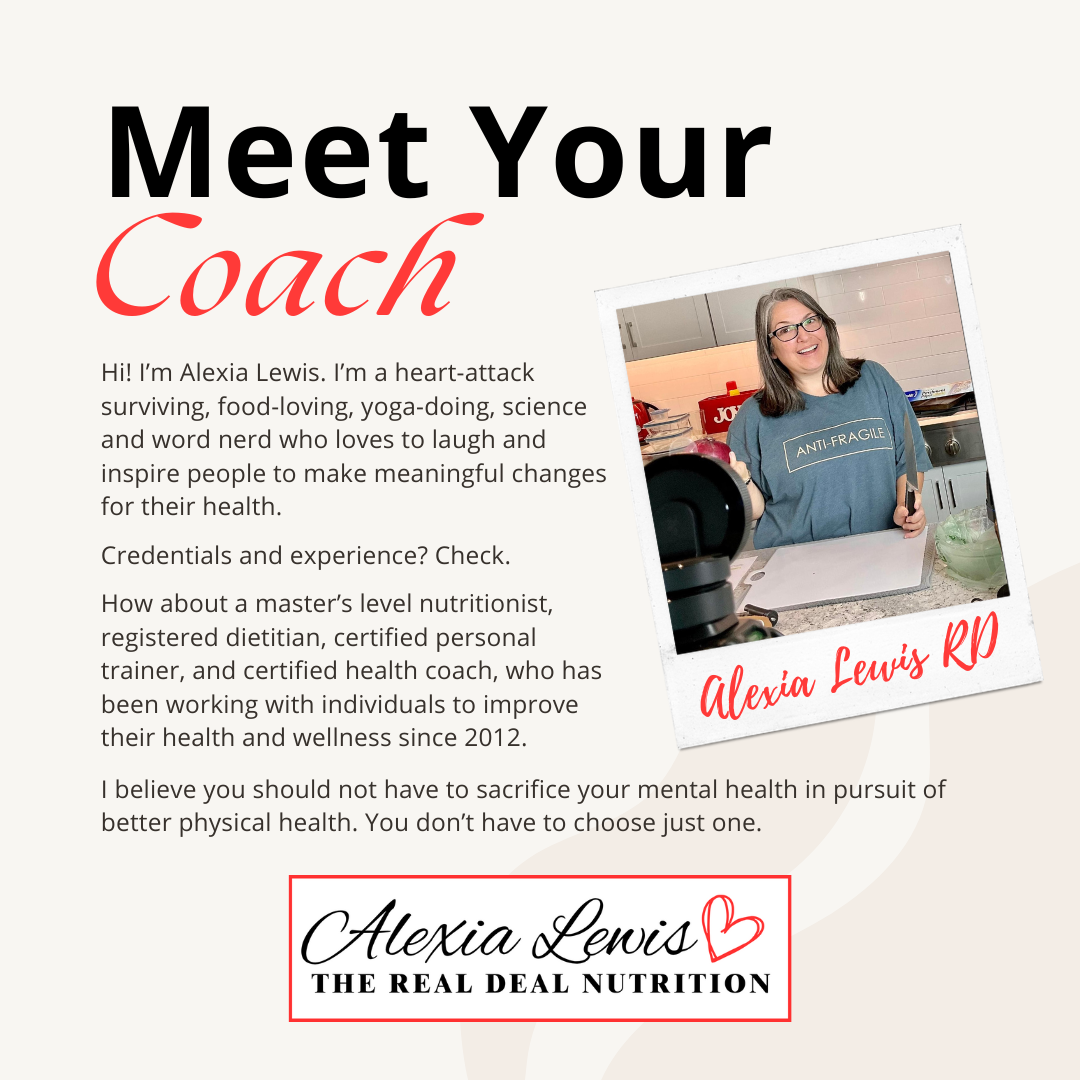
Graphic with image of Alexia.

References:

BBC. The Mindset That Brings Unlimited Willpower, published January 3, 2023.

Vitality Nutrition. How To Build An Environment That Supports Your Goals + Helps You Get “In Control” Of Your Cravings, published June 7, 2022.

A Gift: Enjoy the Holidays without Sabotaging Your Health

I am beyond excited to announce a gift to you from me and N.E.W. Motivation Coaching. Because I am so unhappy with the Diet Culture / Weight Loss wheels turning as we come to the end of another year, I am giving away – yes free – both a video course and a booklet this year. 

Survival-Guide-Image

Unfortunately, December is a month when many feel overwhelmed with stress and give up on their health goals believing they will return to healthy habits in January when they make their resolutions.

There is some good in this actually.

If you look at the research on willpower, it indicates that people are not as successful at white-knuckling it / sucking it up / using their willpower to [insert goal here: stick to their meal plan, exercise daily, go to sleep on time, etc] when they are either stressed or depressed.

The trick is to manage the stress or depression first and then re-focus on health goals. If you are stressed in December, then relaxing on your health goals may be 100% appropriate. 

Giving up entirely to eat like a jerk and couch surf for 4-6 weeks, however, can result in a pretty big back-slide on health complete with weight gain and loss of cardiovascular endurance and muscle mass/strength! Oh, and an increase in blood pressure, cholesterol, blood sugars, and those other health concerns that are totally impacted by your daily food and activity choices.

So, what do we do?

I’ve got an idea: Find a way to both enjoy the holidays and keep some focus on your health goals. It is so very possible to do with a few tricks & tips up your sleeve!

Planning

The free course gives you 5 realistic tips to coast through the holidays while staying true to your health – and weight – goals as well as 3 worksheets and a health coach walks you through making your personal strategy in the videos so you can enjoy the holidays without sabotaging your health!

You also get tips for making traditional holiday foods healthier AND a list of which herbs and spices pair best with which foods so you can reduce fat and sodium without sacrificing flavor.

This course is designed for:

Dieters who are tired of the repeated cycles of weight loss and regain who want to find peace with food, activity, and themselves so they can improve health and weight

Adults with – or at risk for – chronic lifestyle diseases who want to find realistic and enjoyable ways to approach lifestyle changes so they can reduce their risk for chronic diseases and live a healthier life.

People who are confused or overwhelmed with all the conflicting rules and information about nutrition and exercise who want to sort it out so they can find a lasting, realistic plan that works in their unique lives.

True-Health-Requires-Balance

I offered this information last year as an in-person class and just didn’t get to share it with enough people! So this year we are giving it away in order to get this good info into the hands of more people who need this type of support and guidance during the season.

Check it out – try some tips before the next big holiday meal in just a few short weeks – and share this with anyone you think may benefit from it! There is no limit on how many freebies we give away so share it as much as you would like to!

Here is the link text: https://new-motivation-coaching.teachable.com/p/our-favorite-5-tips-to-enjoy-the-holidays-without-sabotaging-your-health

So you know, this is only 50% of the tips we share in our Love Yourself Healthy Plan. We will be sharing more on that soon!

Yes, you can eat the pecan pie AND be healthy.

Who Is the Best Health Professional to Help with Creating New Lifestyle Habits?

With so many options for a finding a health professional to help you move towards your health goals, how do you know how to choose? Let me be clear that your medical doctor is your first partner but you only get so much in-person time there! Let your doctor help guide your decisions about what to work on; then find a health professional to find the best strategies to get it done!

First, figure out how you want to approach your goals – do you want to focus on nutrition, on activity, or on a combination of many things: sleep, stress, time management, consistency, overcoming your typical challenges? This will guide you to the best person to help you. Second – and so important – is to find someone who makes you feel comfortable. Finally, make sure they have relevant education and hands-on experience. You want to make sure it is safe before you put your trust and health in someone’s hands!

smileyfaces

Before jumping in to the many types of health professionals you can choose from, let me start with some key differences.

Nutrition Education / Nutrition Recommendations / Medical Nutrition Therapy.

Anyone, even you, can provide nutrition education as long as you are not paid. You can look up credible guidelines (American Heart Association USDA’s Choose My Plate,  etc.) and share the information one-on-one or in a group as “nutrition education” in general terms. Now, if you decide to charge people for the education, you should probably check out the laws in your state because that changes things. In the 46 states in the U.S.A. that have license laws for nutrition , only certain professionals can (legally) make nutrition recommendations or practice Medical Nutrition Therapy. A nutrition recommendation would be giving you a meal plan or recommending a specific food change/supplement. To illustrate the difference, giving education is saying, “What we know about X is Y;” making a recommendation is saying, “If you are concerned about X, you should do Y.”  Medical Nutrition Therapy / MNT is giving recommendations about a dietary/nutrition approach for any health condition from a gluten sensitivity to heart disease or cancer. This does not involve diagnosing health conditions but it does include dietary “treatment” for health conditions.

Exercise Education / Exercise Foundation / Exercise Training.

Exercise education is like nutrition education. Anyone can speak in general terms about credible information regarding exercise and activity if not paid. An exercise foundation is getting someone started with exercise. It may be assessing you for exercise readiness, screening you to find out you should talk to your doctor first, or helping you start a beginner’s program designed by an exercise agency/trainer, such as an easy walking program. It should not make you breathless, involve lifting anything, or be hands-on exercise guidance one-on-one or in a group setting. Exercise training (personal training) is making recommendations by giving you a workout routine they designed or doing hands-on instruction and guidance (leading you through a work out).

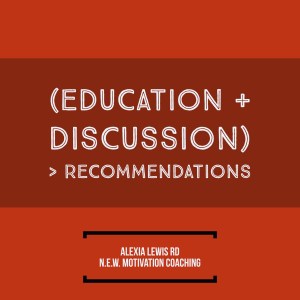
As an aside for both of these definitions of terms: many people are more successful when given education and having a discussion with their health professional about how to apply it. Getting a recommendation is what many people think they want, only to find out those recommendations don’t stick for long. We all know that someone else telling you what to do rarely works for long… we tend to start tweaking things or just straight-up stop, right? A health professional skilled in having the conversation with people about behavior and lifestyle changes can be just as – if not more – helpful in the long-term than someone who can make recommendations.

education plus discussion

Types of Health Professionals

Certified Health Coach. If you want to focus in many areas, this is your go-to professional! Just know that there are many different types of coaching certifications with some being intensive and some being laughable – so ask questions. The more intensive certifications can require a NCCA-accredited certification/license or an associate’s degree in a health-related field as a prerequisite, followed by additional education (classes, readings, practical videos, critiqued practice of coaching skills) and a proctored exam. They can coach you in many areas of health and wellness including nutrition education, exercise education (and possibly building your exercise foundation), sleep, stress, time management, consistency, overcoming challenges, etc. They should also be skilled in motivating you to change and dispelling health myths.

Certified Personal Trainer. For exercise, this is your go-to professional! The same agencies that certify Health Coaches may also certify Personal Trainers so the requirements for this certification are similar except that only a high school diploma and current CPR certification are required. Personal Trainers can do exercise education, foundation, and training. They will know how to work around any injuries you have; but they cannot diagnose or treat injuries (that’s medicine) or help with injury recovery (that’s physical therapy). They can lead you through workouts or design an exercise program for you to follow on your own. For nutrition, dig a little deeper into their training. Legitimately credentialed personal trainers will have some education in nutrition and they can obtain extra certifications in nutrition (quality of programs vary); however, they are limited to nutrition education.  They should also be skilled in motivating you to change and dispelling exercise myths.

Registered Dietitian / State-Licensed Nutritionist. For nutrition, this person is your go-to professional! They will have an undergraduate (or master’s) degree in health / nutrition science and have completed 1,200 hours of hands-on practical internships. They can do nutrition education, make recommendations, and provide MNT. “Registered Dietitian” and “Dietitian” are legally protected titles in most U.S. States. “Licensed Dietitian/Nutritionist” is a title for those who have a license from their state’s Department of Health (same as a medical or trades license). In terms of exercise, they can provide exercise education and let you know if your “calories burned” part of the energy equation is low; but they cannot do any exercise foundation or training work with you. They should be skilled in motivating you to change and dispelling nutrition myths.

Nutritionist / Nutritionalist / Nutrition Counselor / Etc. Go make yourself a web page and business card – I’ll wait – congrats you are now a nutritionist! Would you put your health in the hands of someone simply because they have a good eye for design and a compelling way with words? Or because some new and interesting eating or exercise thing they did worked for them? Please be smarter than this. Some “schools” will give people a nutritionist title and it may mean nothing (very little training) or it may be more intensive; either way, unless they are a “licensed nutritionist” they can still only legally do nutrition education in many states. Ask questions before working with someone with this kind of title.

Mental Health Counselor. At times (lots of times), food and exercise issues are rooted in emotional and mental health. The previously listed health professionals help you with the “outside work” (doing things) and can help you work through some of the smaller internal mental challenges with creating new lifestyle habits. They can also help you identify if some more involved “inside work” (thinking things) might be helpful and refer you to a therapist. This is a great person to have on your team; just be sure to find someone state-licensed.

Where do I fit in? I’m so glad you asked!

I am a Certified Health Coach (American Council on Exercise), Registered Dietitian, and State-Licensed Dietitian/Nutritionist (Florida); but my approach is different from many other RDs.

I have had clients tell me they were not interested in working with me because I am an RD; but they gave an RD one last try. After a while, they confessed this to me that all they got before were handouts and food rules and it was not helpful. There was no flexibility; just “here, do this.” Thankfully, I do not speak about all RDs here – as practitioners, we are as different as the people you will find in any other helping field.  You will not get a handout, some food rules, and a plan from me and I will not tell you how you should go about reaching your goals. Someone else’s plan (even mine!) will not work for you for long – and it certainly does not get you near the goal of making changes stick for a lifetime.

My job as I see it is to help you examine your goals and how they fit into your lifestyle, break your food rules, and explore the many options you have to reach your goals. Then we set about finding a few small, flexible, realistic ways for you to move towards those goals. I will not tell you what you should or should not do.

Don’t enough people already try to tell you what to do?

Yours in Good Health,

-Alexia Lewis RD

This article is Part 2 of 4 in “Health versus Weight as a Focus for Wellness.”

Part 1: The Continuum of Approaches to Health: Thoughts from a Curvy and Healthy Dietitian Health Coach

Part 3: If Diets Don’t Work, How Can a Health Coach Help Me?

Part 4: What Is This No-Diet / Anti-Diet Thing Anyway?

References & Resources:

Health Coach Certification, American Council on Exercise: https://www.acefitness.org/fitness-certifications/health-coach-certification/default.aspx

ACSM Certified Personal Trainer, American College of Sports Medicine: https://certification.acsm.org/acsm-certified-personal-trainer

5 Steps to Become a Registered Dietitian Nutritionist, Academy of Nutrition & Dietetics: http://www.eatrightpro.org/resource/career/become-an-rdn-or-dtr/high-school-students/5-steps-to-become-a-registered-dietitian-nutritionist