Tag Archives: healthy

Prepping for the Tart

Weekly Meal Plan: Puff Pastry Tart & Cottage Cheese Enchilada

This is the first in a new recurring post. My plan is to do my personal meal planning for the week and then share the recipes and tips from the week with you. My hope is that you will try something new and be inspired with your own weekly meal planning.

One of my recipes this week was based on the foods I had that needed to be used, specifically a big bag of spinach and thawed puff pastry. I found a recipe for a Sweet Potato, Spinach, and Caramelized Onion Tart with Balsamic Reduction that sounded delicious and I had every single ingredient on hand. I reduced the amount of oil from 3 Tbsp to 1/2 Tbsp only used when caramelizing the onions; but that can even be swapped out for starting the onions with cooking spray. If you are trying to improve your cholesterol numbers, use the olive oil and if you are trying to reduce calories, use the cooking spray. I also replaced the honey with agave syrup (what I had) and used about 1/2 Tbsp for the balsamic reduction, which thickened up beautifully!

Prepping for the Tart

I found this to be scrumptious… but… the toppings were too thick. If you make this, I’d recommend using half the spinach and onions (or make two tarts). I piled it up anyway and I think this contributed to the pastry being a bit doughy in the middle (or it could have been that I should have cooked it a little bit longer). I also recommend you serve this on a day that you’ve had enough protein (meat, dairy foods, eggs, beans, nuts, etc.) since it is low in protein. I served this with grape tomatoes that I halved and roasted with mozzarella cheese on top. One tart serves 2-4 people depending on their appetites and what else you serve it with.

Tart Ready for the Oven

My other new recipe this week was enchiladas. I’ve been playing with using cottage cheese in cooking. While I love cottage cheese on its own; I’m kind of enthralled with cooking with it right now. Last week, I made lasagna rolls and they were delicious. I’ll be tweaking that recipe and posting it here in the future. I found myself with 1-cup of cottage cheese and I found a Cottage Cheese Enchiladas recipe. I’m not a huge fan of corn tortillas so I had to purchase those and I need your advice on these (see below).

Of course, I modified this recipe as well. We were out of cheddar cheese so I used shredded mozzarella as the only cheese, I omitted the chives and lime wedge, and I made the enchilada sauce. The sauce was simple, I used diced tomatoes (what I had) and pureed those in the food processor, then added chipotle powder, cumin, garlic powder, red pepper flakes, cayenne pepper and a touch of Splenda. Perfection! To the filling, I added some boiled chicken I had since my dog is currently not feeling well and is on a chicken and rice diet. Omit the chicken to keep this vegetarian.

Enchilada Filling
Enchilada Filling

These were INCREDIBLE in terms of flavor; but they completely fell apart. So, readers, if you know how to handle corn tortillas so they don’t fall apart, please comment on this post – I need your help since I will be making this dish again. I served this with chips and salsa and a side salad of halved grape tomatoes, diced avocado, and lime juice. As you can see, it makes a hefty portion!

A Whole Lotta Enchilada

I do apologize for the quality of the photographs. My wonderful husband got me a Galaxy Tablet for the holiday and I am still learning how to best use the camera… and to be honest, hunger was a factor in not having the patience to get that perfect picture!

One Fish, Two Fish, Old Fish, New Fish

Today, I had my standards challenged and this was a good thing.

Fish is on the menu for this week – filets tonight and homemade fish sticks later in the week. I only buy fish or meats at one of the nicer grocery stores, so it was the last thing I needed to pick up to be completely food-ready for the week ahead. I decided to do something different. I decided to check out the little hole-in-the-wall, local-only seafood market.

As a registered dietitian, I consider myself fairly food savvy in terms of how food is grown, raised, processed, and packaged. Fish, however, is one item that always remains fuzzy in my mind. I know to do my part for fish happiness and to reduce disease, wild is preferable to farm raised. I know which fish are more healthful because they are a good source of omega-3 fatty acids, such as salmon or mackerel. I know which fish are better in limited amounts because of potential higher mercury levels, such as swordfish or shark. This, however, is all that my brain chooses to remember. Here’s a great link from the Food and Drug Administration about selecting, storing, preparing fish and some health concerns.

Today, I walked into a local fish market and asked for tilapia. I was happy to learn some more about fish from a friendly fish monger.

This may or may not be my local fishmonger

According to my local fishmonger, tilapia is not a fish that is local to my area (Florida) and since he only carries fish caught up the road in Mayport, he doesn’t have any. He added that most of the tilapia comes from out of the country (which equals a lot of food miles) and is farm raised, not wild caught. He definitely was not a fan of tilapia; but I had a meal plan to stick to so I asked for his recommendation and engaged in an educational conversation about fish.

According to the Monterey Bay Aquarium Seafood Watch 2012 report on tilapia, 95% of the tilapia eaten by Americans is imported from other countries. The fish that is raised in the US is mostly farmed in the West and Northeast regions of the country. Tilapia is the fourth most consumed fish in the USA after shrimp, tuna, and salmon. Most of the US-raised tilapia (75%) is farmed using closed recirculating systems. On the negative side, these fish are separated from other wildlife, ponds are typically overly full, it requires more to be put into the system than comes out (1.4 pounds of feed to produce 1 pound of fish) and many farms use drugs to treat/prevent disease or to change the fish’s gender to male to produce a larger fish. One the positive side, this method does have an overall low environmental cost (food miles excepted).

If you want to know which fish are local for you, check the Monterey Bay Aquarium Seafood Watch site.

If you are curious, I happily purchased a more expensive, local, drug-free triggerfish, which is supposed to be similar to grouper. I will be baking this beautiful fish in the oven at 350 degrees for 15-20 minutes (until it flakes easily with a fork) after dredging the filets in egg whites and coating with a combination of breadcrumbs, crushed pecans, and oregano. On the side, will be homemade tartar sauce (mayonnaise and relish), fresh boiled corn on the cob, and oven-fried red potatoes sprinkled with salt, pepper, and garlic powder.

Is it dinner time yet?

This may or may not be me in the kitchen tonight

Free images from: http://office.microsoft.com/en-us/images/

Muffins Ready for Baking

Veggies In Dessert – Eggplant Chocolate Chip Muffins

If you missed my segment on First Coast Living, you can watch me talk about Veggies in Desserts by choosing the tab for Food (click the right arrow to see more tabs) and then scrolling  to Wednesday September 26th UNF Nutrition.

I showcased three desserts during this segment: Red Velvet Beet Cupcakes (see previous blog post), Eggplant Chocolate Chip Muffins, and Black Bean Brownies. As I mentioned, none of these recipes were my creation and you can find them at these links:

Red Velvet Beet Cupcakes

Eggplant Chocolate Chip Muffins

Black Bean Brownies

The main points from my segment were:

1. Add vegetables to your day in any way you can!

Americans do not eat enough vegetables. The recommended amount for generally healthy adults is 2-3 cups per day and data shows we are eating 1.5-1.8 cups/day (2004 NHANES)! Sneaking vegetables into desserts can help us to baby-step our way towards the recommended daily amount – remember, it’s still dessert so it won’t get you all the way there!

2. Use vegetables to increase the nutritional content of your favorite desserts by reducing calories and fat, increasing fiber, and adding vitamins.

3. Methods (not covered in segment)

If using a puree, replace half of the fat with the puree. If it’s a liquid fat (oil) use 3/4 the amount that you are replacing and if it’s a solid fat (butter), use 1/2 the amount you are replacing. Reduce the oven temperature or check sooner than the recipe calls for or it might over-bake.

If using chopped vegetables, some have a high water content so you may need to reduce the other liquids in the recipe.

Now, on to my favorite of the three recipes – the eggplant chocolate chip muffins!

Start by making sure you have all the ingredients you will need on hand.

Ingredients for Eggplant Chocolate Chip Muffins

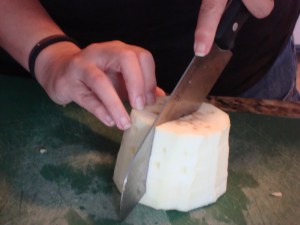
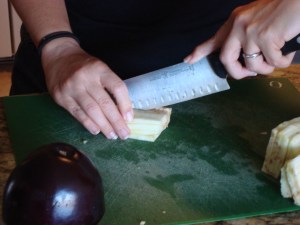
Next, figure out how to chop that eggplant! Here’s a suggestion, start by cutting into smaller sections with straight edges so the vegetable will sit flat when you start chopping.

How to Chop Eggplant

Now, peel the eggplant. Honestly, when I make my second batch of these muffins today (yes, they are that good!) I will not peel the eggplant and see how that goes… but the recipe called for peeling, so I did.

How to Chop Eggplant

Finally, chop the section in half (again to give you a flat edge for safer chopping) and make smaller and smaller cuts. These pictures show going from the whole section, to half the section, to slices, to matchsticks, to a small chop.

How to Chop Eggplant
Finally - Chopped Eggplant!
Finally – Chopped Eggplant!

Moving on to the other ingredients, you will end up with four bowls of goodies. Top left is the flour mixture, top right is the butter mixture, bottom left is the chocolate chips, and bottom right is the chopped eggplant.

Ingredients Ready to Mix

The beautiful thing about making muffins is that it is so easy! Simply make a well in your flour mixture (dry ingredients) and add your liquid ingredients. Be careful how much mixing you do! Gluten develops quickly once liquid is added to flour so you want to mix as LITTLE as possible while still combining the ingredients so there are NO DRY SPOTS of flour. Then fold in the extras (chips and eggplant) and mix just enough to distribute those extras throughout the batter. The mixture should be lumpy!

The Perfect Muffin Batter is LUMPY!

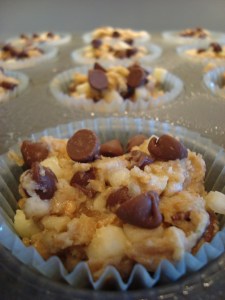
This recipe yields 24 muffins. Here they are before going in the oven

Muffins Ready for Baking

And after! YUM!

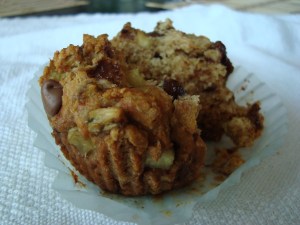
Eggplant Chocolate Chip Muffins

Compared to store-bought chocolate chip muffins, these have 50 less calories, 4 grams less fat, double the fiber, and we’ve added vitamins A and C.

Per muffin:

Calories 180
Carbohydrates (g) 26
Protein (g) 3
Fat (g) 8
Sat Fat (g) 3
Trans (g) 0
Cholesterol (mg) 30
Sodium (mg) 170
Fiber (g) 2.1
Vitamin A 3%
Vitamin C 7%
Calcium 2%
Iron 4%

Original publication date: September 30, 2012 at http://newmotivationcoaching.blogspot.com.

How To Be a Healthy Snacker

A large snack of cookies and milk
 

I am a snacker.

I typically do not leave the house without two things: a snack and my water bottle. Snacking used to have a bad reputation. The standard American diet consisted of three square meals a day, not snacks. Snacking was linked in people’s minds with overeating and weight gain. It was a bad thing to do.

Oh how things have changed. Snacking is no longer the exception, it is now the norm and it may help people to lose or maintain their weight.

I got to thinking about this because I came across an article entitled “Frequent Snacking Linked to Healthier Diet” (1). This article reports on a five-year study of over 11,000 people aged 20 and over which found that snackers consume more healthy foods such as whole grains, fruits, and milk products and less high-sodium foods. Well, it sounds like snackers do have healthier diets! As one reads on, the study also reported that snackers also consumed more sugar, solid fats, and alcohol along with fewer vegetables. Hmmm. Finally, the article reports on another study in a younger population (teenagers) that found that teen snackers also consumed more fruit and dairy products.
Another study on snacking from the November 2011 issue of the Journal of the American Dietetic Association (2) looked at women in the 30-60 age range and grouped them by BMI. The study found that normal weight women had the highest number of snacks (2.3 snacks/day), followed by those who had lost weight and were maintaining that loss (1.9 snacks/day), followed by those who were overweight (1.5 snacks/day).

This all seems to point to the fact that snacking may actually be beneficial in terms of BMI as long as we choose healthy snacks.

But is there a downside?

Let’s say that we eat a snack that includes carbohydrate-containing foods, such as fruit, milk, or grains. For most people, it takes 1 to 2 hours for all consumed food to move through the stomach and reach the small intestine where nutrients are absorbed. Absorption of glucose (blood sugar) from the carbohydrate-containing foods triggers the hormone insulin, which is needed move glucose into our cells for use.

If we graze all day or have large snacks of carbohydrate-containing foods in between meals, we are asking our bodies to continue to release insulin and our insulin levels do not have time to go back down in between meals. On the flip side, if we eat three big meals a day, we see a big spike of glucose after that big meal and we may overload insulin’s ability to be effective. Both overloading our insulin with high levels of glucose at one time and having constantly elevated insulin levels can lead to insulin resistance and potentially to type 2 diabetes. Insulin also promotes energy storage – in other words, it makes our bodies store fat.

What’s a snacker to do?

It sounds like moderation and balance are the keys. I think we have heard that somewhere before. Here are some guidelines to help you keep your snacking healthy.

1. – Respect your body and eat when you are physically hungry. If your stomach is grumbling and you have been drinking your water, then it is time to eat something.

2. – Pick your snacks wisely. Focus on healthy foods such as fruits and vegetables, low-fat dairy, whole grains, and lean proteins. If you decide to have a “fun food” for a snack, then pay attention to the next point!

3. – Watch your portion size. A snack should not be the same as a meal in size or calories.

As always – enjoy your food!

Original publication date: December 4, 2011 at http://newmotivationcoaching.blogspot.com.

References

1. Frequent Snacking Linked to Healthier Diet. Today Health Web site. Available at: http://today.msnbc.msn.com/id/45307103/ns/today-today_health/t/frequent-snacking-linked-healthier-diet/

2. Bachman et al. Eating Frequency is Higher in Weight Loss Maintainers and Normal-Weight Individuals than in Overweight Individuals. Available at: http://www.adajournal.org/article/S0002-8223(11)01376-9/abstract

3. Image from http://office.microsoft.com/en-us/images.