Tag Archives: healthy meal

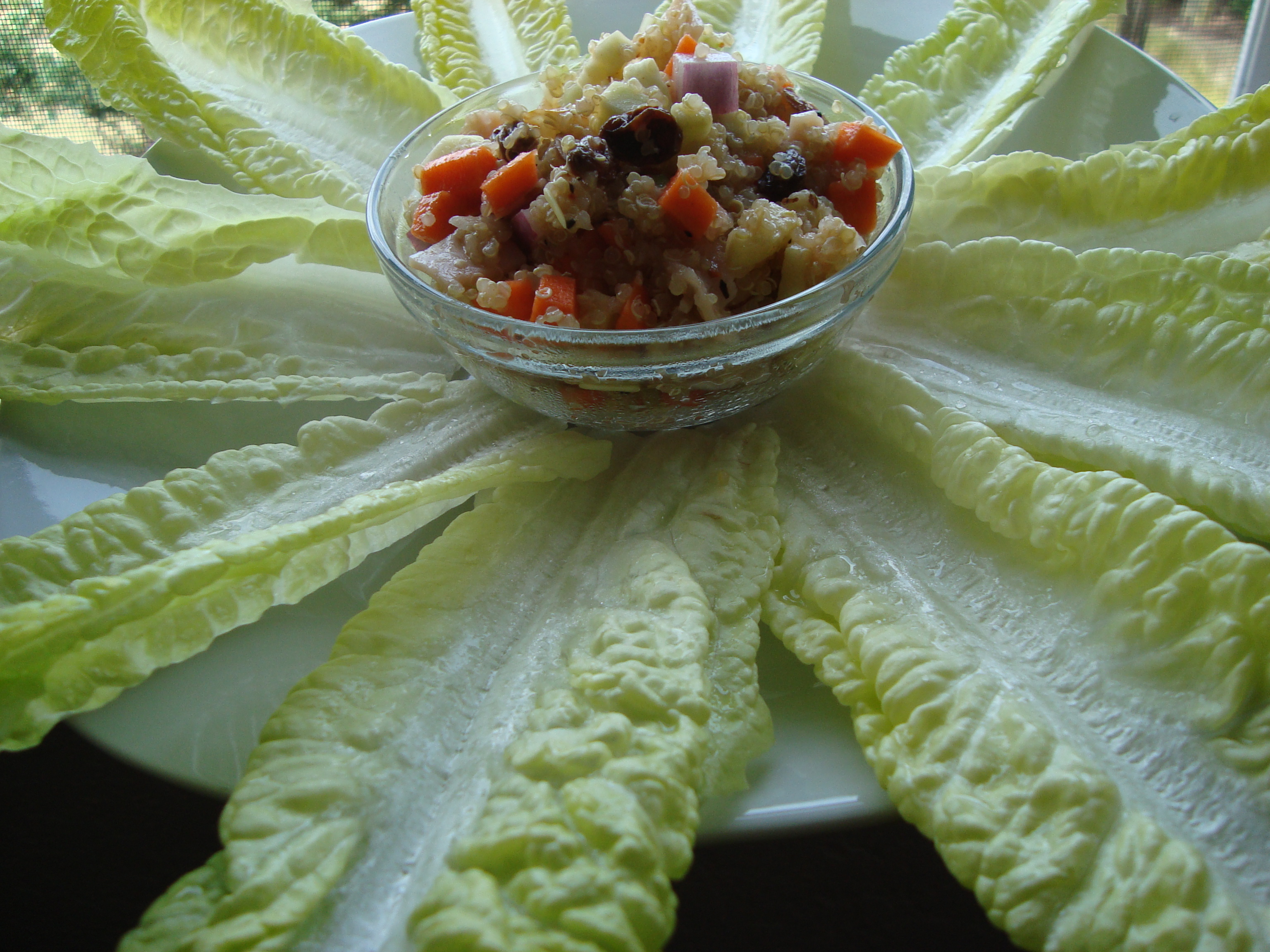
Serve in a small bowl surrounded by lettuce leaves

Quinoa Lettuce Wraps

I love quinoa. It is so versatile, it cooks quickly, and it’s a grain that is a complete protein as well! A complete protein has all of the essential amino acids that our bodies need, which is important for those who do not eat meat or other animal products (which are naturally complete proteins).

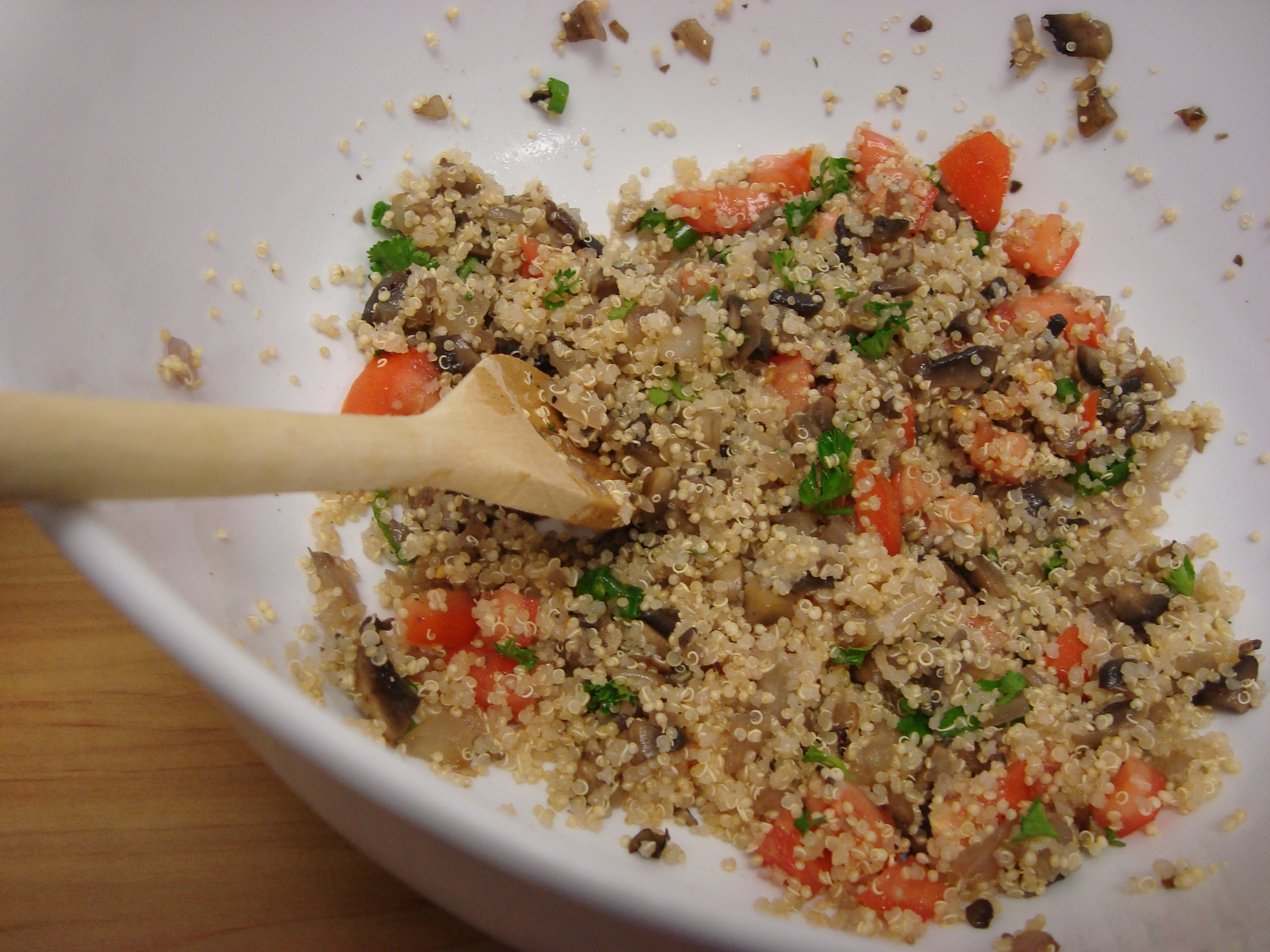
So, yesterday I was faced with a dilemma, what to do for lunch… I had quinoa and some vegetables sitting around so I threw together one of those “kitchen sink” recipes and it turned out so good that I decided to share it.

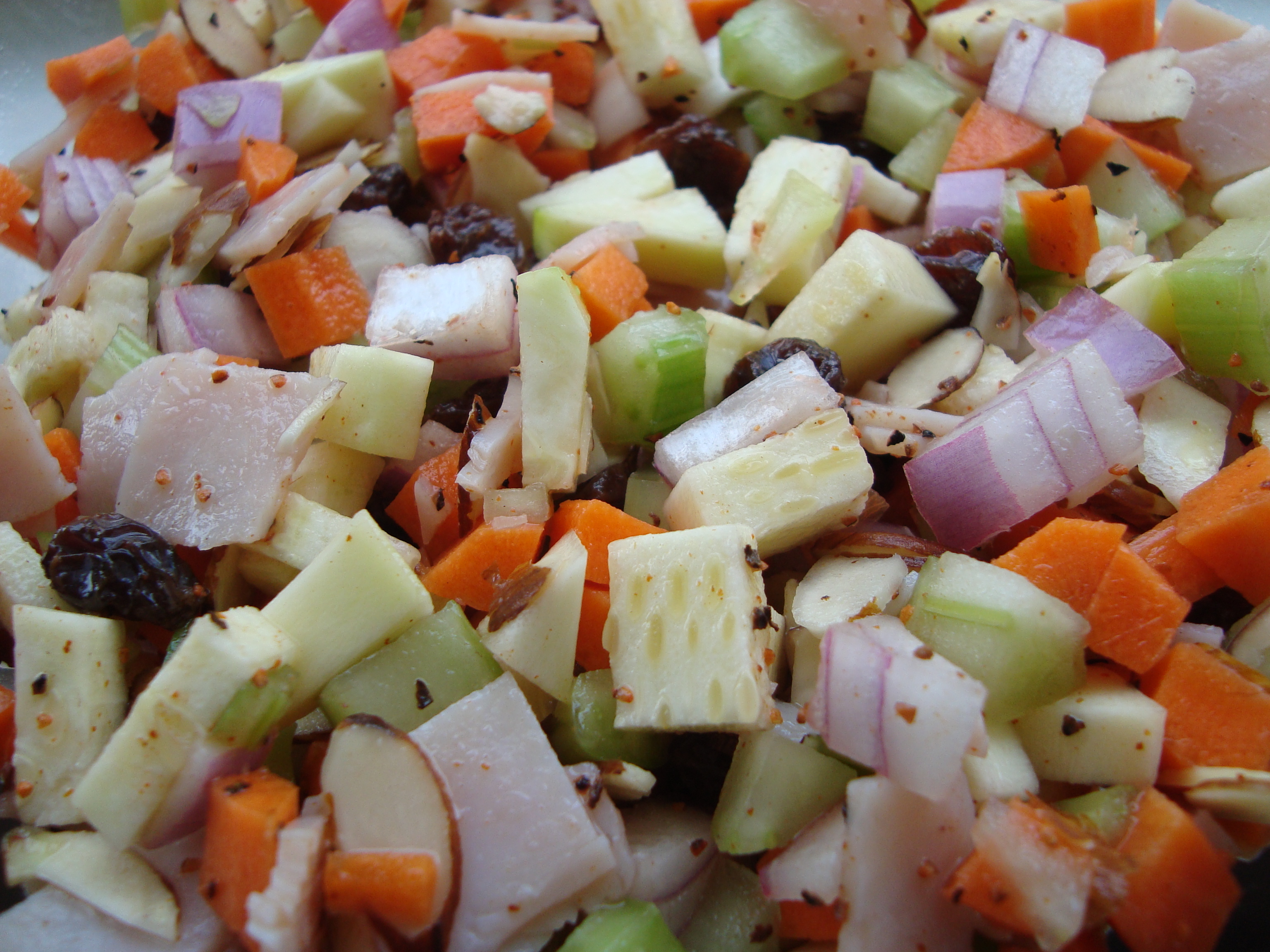
Can you guess all the goodies in here?

Quinoa Lettuce Wraps
By Alexia Lewis, MS, RD, LD/N

1 1/2 cups cooked Quinoa
1 raw zucchini, diced
1 slice red onion, diced
2 carrots, diced
1 large stalk celery, diced
2 slices nitrate-free turkey breast (optional)
Handful of sliced almonds
Handful of raisins
Red wine vinegar, to taste
Black pepper, to taste
Romaine lettuce leaves, rinsed

Simply mix together everything except the lettuce leaves, adding the red wine vinegar and black pepper in small increments until the dish has a flavor that you enjoy. Serve a spoonful on the raw romaine lettuce leaves. You can also serve with kale leaves, bok choy, or any other leafy vegetable that can act as a holder for the quinoa mixture.

I did not measure out the number of servings or do a nutrition information breakdown; but it makes a large amount (see below) and it includes the grains, protein, vegetables, and fruit so you have many food groups represented in a colorful dish – which equals nutritious!

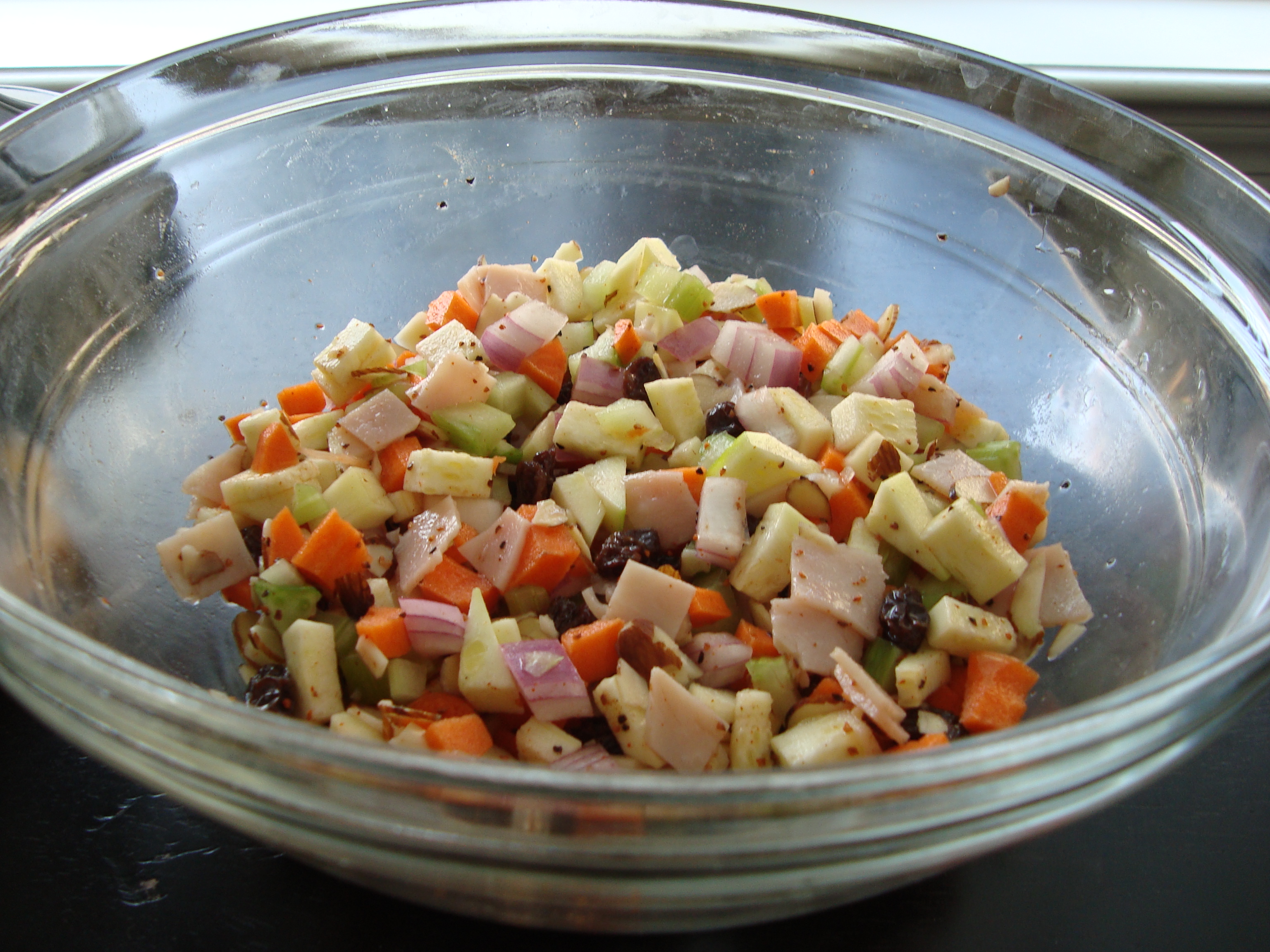
The finished mixture of yum!

I served this up on a plate with the quinoa mixture in the middle and a ring of lettuce leaves. This dish is also husband-approved! Enjoy!

Serve in a small bowl surrounded by lettuce leaves
Make your own pizza!

Skinny Pizza? Go For Homemade!

A new product, The Skinny Pizza, was announced in the latest issue of Food and Nutrition magazine. The information provided states this is a small thin crust margarita pizza with only 390 calories. Since it was listed in the “new products” section of a US-wide publication of the Academy of Nutrition and Dietetics, I assumed it was a new packaged food that would be available to most consumers.

I decided to blog about the nutrition content of this new product and to suggest alternatives for a whole food, non-packaged, homemade, low-calorie pizza because I know from experience that it’s fairly easy to make a mean homemade pizza!

It turns out this is not a packaged food. This is a menu selection from a pizza chain that has 25 locations. Only 18 of these locations are in the United States and 11 of them are in South Florida. Now, this called into question for me why this was listed as a new product in a magazine for dietitians with a demographic that covers the entire United States… But this is a topic for another day.

Let’s talk about “nutrition made easy” with a healthier homemade pizza!

Start by toasting either an English muffin, a pita, or this dietitian’s favorite, a Flat Out or other flat bread. You just want this to get a little bit crispy or the sauce will make the pizza soggy.

Once crispy, top with a little low-sodium tomato or marinara sauce, and by a little I mean a lot less than you think you need even if you like your pizza saucy like I do! If you want to keep it even more “clean,” then saute some chopped plum tomatoes in a little olive oil, garlic, and onion, mashing the tomatoes as they cook to make a bruschetta-like sauce.

Top with some shredded cheese, lean proteins, and as many vegetables or fruits as your pizza will hold and throw it back in the oven or toaster oven to warm the ingredients and melt the cheese. You may want to also saute the vegetables if you prefer a softer, cooked texture over a crunchy texture.

One of the favorite combinations in this household is chicken breast, BBQ sauce, red onions, mushrooms, a Mexican cheese blend, oregano, cumin, paprika, garlic powder, and red pepper flakes or Hot Shot! Another favorite is pineapple chunks and mushrooms.

The sky is the limit with combinations for this pizza and every person can get their own favorite combination! By limiting the portions, the amount of cheese used, and focusing on lean meats, vegetables, and fruits as toppings, you can keep this pizza low calorie, fiber- and nutrient-rich, and most importantly delicious!

I’m always looking for new flavor combinations and ideas so let me know what you put on your homemade pizza.

References:

Pizza Rustica Launches Skinny Pizza. Available at: http://www.food-business-review.com/news/pizza-rustica-launches-skinny-pizza-081112. Accessed January 27, 2013.

Pizza Rustica Locations. Available at: http://www.pizza-rustica.com/locations. Accessed January 27, 2013.

Image from: http://office.microsoft.com/en-us/images/.

Kale Rolls with brown rice

We’ve Got Greens!

It’s kale cooking demonstration time! Tis the season to harvest greens and we have a lot of them from our organic Ogier Garden where I work so I decided to do a cooking demonstration showcasing our beautiful greens. Recipes included kale quinoa rolls and autumn vegetable soup.I found both of the recipes I used online (credit given with the recipes below) and I adapted them. Give these a try and let me know what you think!

Organic Greens
Organic Greens

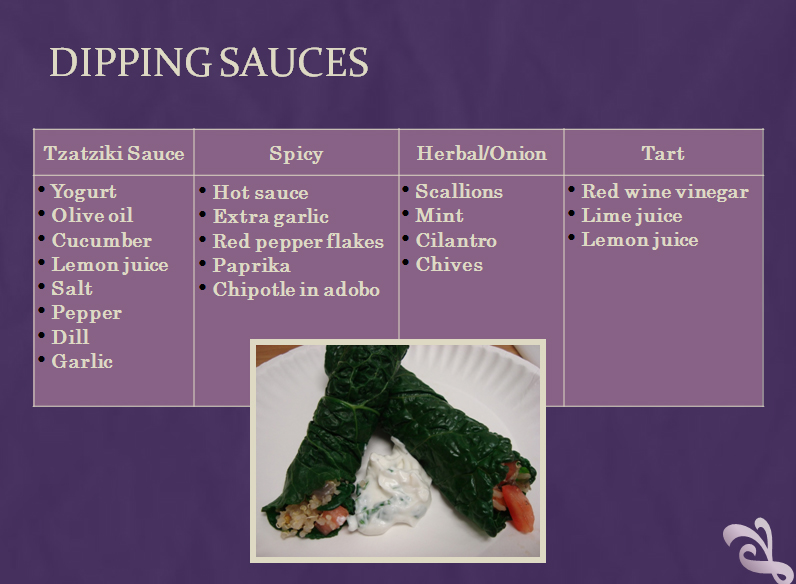
Both of these recipes are vegan. If you are a vegetarian, I do recommend a low-fat Greek yogurt dip for the rolls to increase the protein and calorie content of this meal. Here are some suggestions for flavoring the yogurt to make a yummy dipping sauce. Click to see the image larger in a new window.

Ideas for Greek yogurt dipping sauces

To begin, find some big kale leaves (dinosaur, lacinato or Tuscan varieties) or use collard greens which typically have large leaves. The curly kale will not give you enough leaf to roll with. Here in Jacksonville, Florida, I had no luck at the conventional grocery stores; but found a nice large bunch of organic lacinato kale at Fresh Market for only $2.50!

Preparing the greens is important and for the best results, you’ll want to blanche and devein the leaves. Blanching involves cooking the leaves in boiling water for a very brief time (~2 minutes) and then plunging them into an ice bath. I’ve used both a large bowl and my sink filled with ice-water with success. Blanching will make the leaves flexible enough to roll and brighten up their color. Wait until after blanching to devein the kale so you can preserve as many nutrients as possible, then take a small knife and simply cut out the thick part of the stalk, leaving the top of the leaf intact.

Kale Rolls with brown rice

I will also be packaging the complete cooking demonstration lesson plan, recipes, hand-outs, and evaluation forms into a package that will be available for purchase so you can take the work out of preparing for a cooking demonstration and just do the fun parts! Details will be posted soon.

Quinoa Filling
Quinoa Filling

                      Kale Roll Ups

Recipe adapted from Gooseberry Mooseberry

http://www.gooseberrymooseberry.com/2012/07/stuffed-kale-rolls-dolma.html

By Alexia Lewis, RD, Wellness Dietitian

Ingredients

  • 25 kale leaves, preferably dinosaur kale (large leaves)
  • 1 1/2 cup cooked quinoa
  • 1/2 cup red onion, finely chopped
  • 8 oz white button mushrooms, finely chopped
  • 1 tomato, chopped
  • 2 Tbsp parsley, chopped
  • 1 Tbsp chives or scallions, chopped
  • 1 Tbsp lemon juice
  • 2 Tbsp canola oil, divided
  • salt and pepper to taste

Directions

Prepare Kale

  1. Bring a large pot of water to a boil
  2. Wash kale leaves thoroughly
  3. Add leaves to boiling water and blanch until softened and flexible, about 2 minutes
  4. Drain and rinse under cold water and pat dry
  5. Remove about 2-3 inches of the thick middle stem from each leaf

This step can be done ahead of time. If not using kale immediately, after cooking, pat leaves dry to remove excess water, wrap all leaves gently in a paper towel, and seal in a plastic bag with air squeezed out in the refrigerator for up to 3 days.

 Prepare Stuffing

  1. Heat 1 tbsp canola oil in pan over medium heat
  2. Add onion and cook, stirring frequently, 2-3 minutes
  3. Add mushrooms and cook about 8 minutes, until the water the mushrooms give off has evaporated
  4. Remove pan from heat and let cool
  5. In a large bowl, combine cooked quinoa, cooled mushroom mixture, tomato, parsley, chives, lemon juice, and the remaining 1 tbsp canola oil. Season to taste with salt and pepper.
  6. Cover and set aside

This step can also be done ahead of time. Store covered in refrigerator for up to 3 days.

Make Rolls

  1. Place one kale leaf vein-side down and put 1-2 level tablespoons of the filling in middle of leaf
  2. Fold the leaf from the bottom over the filling
  3. Tuck one side of the leaf over (the other side will remain open)
  4. Roll the leaf into a tight roll and place on plate/platter with edge of the leaf under the roll to keep roll from unrolling
  5. Repeat with remaining rolls

These can be served warm or chilled and can be kept up to 3 days in the refrigerator. If any of the previous steps were done ahead of time, subtract the number of days those ingredients were already stored from the number of storage days.

Makes approximately 20 servings (1 roll per serving): 47 calories, 1.8 g fat (0.1 g sat, 0 g trans, 0.5 g poly, 0.9 g mono), 0 g cholesterol, 15 mg sodium, 202 mg potassium, 6.5 g carbohydrate, 1 g fiber, 2 g protein.

                      Autumn Vegetable Soup

Recipe adapted from Clean Eating Magazine

http://www.cleaneatingmag.com/Recipes/Recipe/Black-Eyed-Pea-Stew-with-Collard-Greens-Potatoes.aspx

By Alexia Lewis, RD, Wellness Dietitian

 Ingredients

  • 6 cups low-sodium vegetable broth
  • 6 cups water
  • 8 cups kale or other greens, chopped
  • 3 large tomatoes, beefsteak or vine, diced
  • 1 medium butternut squash, diced
  • 1 can black-eyed peas, low sodium, rinsed
  • Salt and pepper to taste

Directions:

  1. Bring broth and water to boil in large pan over high heat
  2. Add kale, reduce heat, cover and simmer for 10-15 minutes
  3. Add tomatoes and butternut squash, cover and simmer until squash is tender, about 15 minutes
  4. Stir in black-eyed peas, cover and simmer about 2 minutes
  5. Season with salt and pepper to taste

Makes approximately 20 servings (1 cup per serving): 70 calories, 0.5 g fat, 0 g cholesterol, 220 mg sodium, 373 mg potassium, 15 g carbohydrate, 3 g fiber, 3 g protein

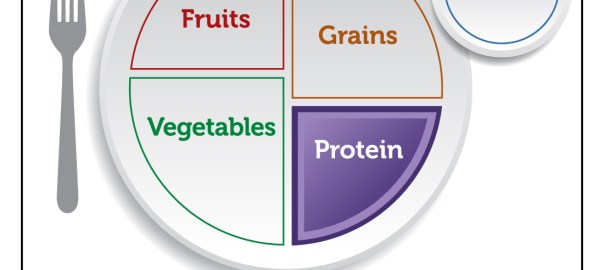
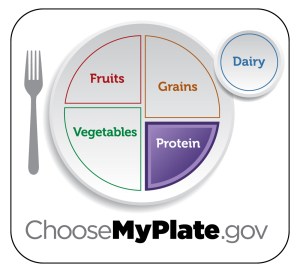
ChooseMyPlate.gov Protein Food Group

Macronutrients – The Beef on Protein

ChooseMyPlate.gov Protein Food Group

Updated 12/03/2024. One of the jobs I have held was as a wellness dietitian for a university. I loved that job. I was working on updating the nutrition info on the website and thought I’d share some of the things I’ve been updating. Enjoy!

I’m working on the macronutrients (aka macros). First up, the *beef* on protein (because I just can’t resist bad wordplay!)

Protein

Sources:

Protein comes from animal sources such as meat, dairy, and eggs and from plant sources such as beans, nuts, seeds, and even some grains.

Even your broccoli has protein, but you would have to eat nearly 3 cups to equal the protein in 1 ounce of meat. I’m stuffed just thinking about it. (And, oh, the gas!).

It is possible to consume enough protein for good health on a vegetarian or vegan diet if you plan your food choices well.

Functions:

Protein is an essential nutrient meaning that we must get it from our food. Proteins break down in our bodies to amino acids. Our bodies cannot make all the amino acids it needs to function and approximately 25% of amino acids are lost to other uses every day, which is why protein is an important part of the daily diet.

Protein has many functions including:

– Provides body structure by building and maintaining muscle, bone, and other body tissue

– Allows for movement (40% of body protein is muscle tissue)

– Regulates gene expression

– Integral part of enzymes, hormones, and neurotransmitters

– Immunity through antibodies

– Transports of vitamins, minerals, oxygen and other substances through the body

– Regulates fluid and electrolyte balance

– Maintains acid-base balance

– Necessary for blood clotting

– Used as fuel when other sources of energy are not available. (Cue the nightmare metabolism images from grad school).

– Protein is satiating – it helps us to feel full and satisfied

Recommendations:

For a generally healthy adult, the recommended daily allowance (RDA) range for protein intake is set between 10% and 35% of daily calories. A person consuming a 2,000 calorie diet would have a range of 200 – 700 calories. Since 1 gram of protein has 4 calories, this is a range of 50- 175 grams of protein per day.

Further, the recommendation for generally healthy adults is 0.8 grams per kilogram (8g/kg) of body weight. To convert pounds to kilograms, divide weight by 2.2. For example, a 150 pound person is (150 divided by 2.2) 68.18 kilograms. This person would consume around 54 grams of protein per day, which is the low end of the above range.

Now, that recommendation is based on nitrogen balance studies from way back when. It is the amount needed to prevent nitrogen deficiency. Those amino acids have a nitrogen molecule on them, which leads to a recommendation.

A recommendation that I think is too low. And I’m not the only one. For example, NASM recommendations go up to 2g/kg based on athletic training needs. And this article in the journal Nutrients questions if it’s time to update the RDA. 

People with specific health conditions or concerns may need a different amount of protein in their daily diet.

And bro, no matter how much protein you eat, you won’t build muscle without some form of resistance training.  

Updated: December 3, 2023. 

Original publication date: September 17, 2012 at http://newmotivationcoaching.blogspot.com.

Reference: Nutrition Concepts and Controveries, 12th ed. by Sizer and Whitney, 2012. ISBN-13: 978-1-1133-62818-7.

Image from: http://www.choosemyplate.gov

Cheeseburger

Fast Food: Cheeseburger Vs. Salad

Cheeseburger
Cheeseburger

I admit it. I watched part of The Doctors television show the other day. I caught a segment on how Americans eat and one of the doctors was working at a fast food drive-through window attempting to get customers to choose a healthy meal over the unhealthy meal they were ordering. It did not go that well for him. Only one person on the segment out of four changed their meal after he told them how unhealthy their selection was in terms of calories, fat, and sodium levels.

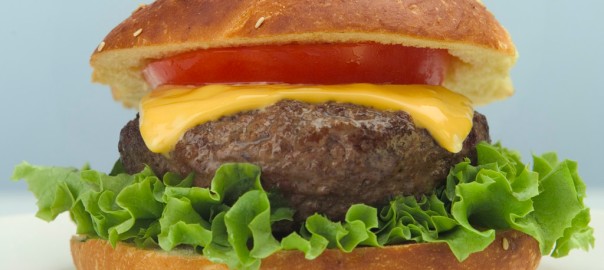
What stuck with me was that one woman said that a cheeseburger was kind of like a salad. Her point was that salads have vegetables and cheeseburgers have vegetables. Therefore, they are similar. The audience laughed good-heartedly and I groaned and laughed.

Then I got to thinking… Is a fast-food salad really that much better of an option than a fast-food cheeseburger? I turned to the restaurant’s Web sites to make some comparisons.


Let me start by saying that there are other choices than what I have compared below. If the Wendy’s Garden Side Salad with no croutons and low-fat dressing (70 calories, 0 g fat, 190 mg sodium) or the ¾-pound Dave’s Hot ‘N Juicy Triple Burger (1060 calories, 67 g fat, 2020 mg sodium) are your choices then yes, the salad is much healthier. However, I have tried to pick middle of the road choices that I think people would make in these examples.

First, I compared a regular McDonald’s Cheeseburger to their Premium Southwest Salad with Grilled Chicken (with and without the creamy southwest dressing). As the table below shows, the salad with dressing, which is how most people would order it, has 90 more calories, 2 more grams of fat, and 240 more milligrams of sodium than the cheeseburger. If you can go without the dressing for the salad, you are only saving 10 calories, 4 grams of fat, and 100 milligrams of sodium versus the cheeseburger. That is not a huge difference.

Food Calories Fat Sodium
Cheeseburger 300 12 750
Salad 290 8 650
Salad with dressing 390 14 990

Next, I moved to Wendy’s to compare the Jr. Cheeseburger Deluxe to their Apple Pecan Chicken Salad (with and without the pomegranate vinaigrette dressing). Again, the cheeseburger is the healthiest option in terms of calories, fat, and sodium. The salad with dressing has 210 more calories, 8 more grams of fat, and nearly 700 more milligrams of sodium. If you can go without the dressing, you will still have 100 more calories and 3 more grams of fat than the cheeseburger; but you will save almost 300 milligrams of sodium.

Food Calories Fat Sodium
Jr. Cheeseburger Deluxe 350 19 850
Salad 450 21 580
Salad with dressing 560 27 1540

I could continue; but I think the pattern is clear. The salad is not always the healthier choice at a fast food restaurant. We are still operating under the assumption that the salad is always healthier, or at least that audience and I were, and that is just not true! Now, there is a lot to consider when deciding which choice is healthier, such as the types of fats, cholesterol, and other nutrients such as the vitamins and minerals. But if I included all of that, you would have stopped reading by now…

My advice?

1. – Avoid the fast food places altogether. You can make a yummy salad or a healthier cheeseburger at home using a small portion of lean grass-fed beef, low-fat cheese, and lots of vegetables.

2. – If you cannot avoid the fast food restaurant, ask for the nutrition information before you order (many have handouts) or look at their Web site before you go. Most importantly, make your choice before you order at the register (where you can see the pictures and smell the food).

3. – Realize that what you think may be an unhealthy choice, may not be the unhealthiest choice on the menu. Sometimes, the cheeseburger may be better than the salad.


As always – enjoy your food!


Original publication date: December 10, 2011 at http://newmotivationcoaching.blogspot.com

Image from: http://office.microsoft.com/en-us/images