I have found myself wondering if eating a vegan diet for five days will be more expensive than my typical diet. I believe there are two ways to go with vegetarian/vegan eating. One is to use whole natural foods and shop in the conventional grocery stores and one is to use the vegetarian/vegan-specific marketed foods and shop in the specialty grocery stores.
Now, that I write that, I realize that’s true no matter what type of diet one follows.
Today, I spent $55.33 at a conventional store on groceries for the next six days. I already have some staples on hand, such as quinoa and dried beans, and I just got a nice harvest (curly kale, carrots, onions, and basil) from the university’s organic garden. I am so looking forward to those kale chips I’ll be making tomorrow with the beautiful organic curly kale! I couldn’t find a soy-only protein powder, so I still need to pick that up for about $10-$12. Even if I had to purchase the quinoa, black beans, and garden vegetables and adding the cost of the protein powder, I think ~$75 to feed 2 people for six days is pretty darn good! That’s just $6.25 per person per day, or around $2 meal!
Here’s my list. Don’t worry – the meals and recipes will be coming over the next five days as I live this experiment!
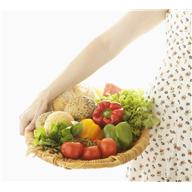
Produce: avocado, bananas, green/red bell peppers, romaine lettuce, tomatoes, cucumber, portobello mushrooms, apples, limes, and canned pineapple
I’ve been planning meals for my Vegan Experiment. As I mentioned in my last post, there are certain nutrients that vegetarians (and vegans) tend to eat in lower than recommended amounts.This may lead you to ask two questions. One – What exactly are nutrients? Two – Who makes these recommendations?
Nutrients are the nutritional substances we get from foods: carbohydrates, proteins, fats, vitamins and minerals, and even phytochemicals (or plant nutrients like resveratrol in wine/grapes).
The recommendations are made by the Food and Nutrition Board of the Institute of Medicine of the National Academy of Sciences. They are based on years of population studies and research. They have drafted the DRIs (dietary reference intakes), which include the RDAs (recommended daily amounts), AI (adequate intake) and TULs (tolerable upper limits) for specific nutrients.
In plain language, these all tell the general population (or health professionals who translate it!) how much of the nutrient meets the needs of the 98% of the healthy population over age 2 in order to prevent deficiencies. For certain nutrients, there is also an upper level to prevent toxicity. Personally, preventing deficiency and toxicity sound good to me. Remember though, if you are under two (and you’re reading this, I’m impressed!) or have any health condition, these recommendations may not apply to you. There’s some good information on the USDA’s Food and Nutrition Information Center. If you want to know the recommendations specifically for you, there’s an interactive tool; but I wouldn’t get too caught up in all those numbers if I were you!
Any person who cuts out entire food groups is going to be lacking in certain nutrients. There is a reason there are food groups as the basis of the ChooseMyPlate method of eating. It’s because different food groups provide different nutrients and our bodies function best when we eat all of them. Whether it’s grains (breads and other carbohydrate foods), proteins (meats), fruits and vegetables, or dairy (milk, cheese, and yogurt), cutting out a food group cuts out specific nutrients. Those who cut out meats are taking away a large chunk of the foods in the protein group and most of the sources of complete proteins (proteins that have all the amino acids our body needs and cannot make on its own).
Image from ChooseMyPlate.gov
Finally, on to my point!
For optimal health, I recommend that over the course of the day, vegetarians include foods that, when put together, make complete proteins and plan to eat enough foods that provide iron, calcium, zinc, omega-3’s, and vitamins D and B12. Iodine may also be a concern if iodized salt is not used in cooking or flavoring foods.
How to do this?
Complete proteins: Examples of foods that make complete proteins include: tofu and rice, corn and beans, rice and beans/peas, peanut butter and whole wheat bread, granola and soy milk, or a green salad with garbanzo beans and sunflower seeds. The idea is to match grains/seeds/nuts with beans/peas or to match vegetables with both grains/seeds/nuts and beans/peas. Simple enough! And to make it even easier, soy and quinoa are already complete proteins.
For the other nutrients listed, here are some examples of where a vegan can find these nutrients to include in their meals.
Iron: Beans (pair with vitamin C foods and avoid pairing with calcium foods to absorb more iron!) Examples might be: beans and rice with lime (vitamin C), cilantro, and salsa or a “loaded bowl” (see image below) with quinoa and black beans and vegetables including tomatoes (vitamin C).
Calcium: Fortified imitation milks (almond milk, soy milk, etc.) or dark leafy green vegetables (althought we don’t absorb as much from the vegetables!).
Zinc: Beans, peas, and nuts (I’m personally a huge almond fan and usually have a handful a day as a snack).
Omega-3’s: Walnuts and ground flaxseed. Add ground flaxseed to to smoothies, sauces, or sprinkle on salads – just watch out because it gets gummy when mixed with liquids, which is why it’s a great vegan egg replacement in baking.
I also recommend that someone who is following a vegetarian or vegan lifestyle, ask their physician to pull a “vitamin panel” to check their levels of vitamin D and B12 (and others) every now and again just to make sure that deficiencies are being kept at bay!
I hope you found this helpful. If you have other ideas or ways to incorporate these important nutrients, please post your thoughts, meal ideas, and recipes!
Images from: ChooseMyPlate.gov, Microsoft Free Images, and personal photographs.
The gauntlet has been thrown down and I said, “Challenge accepted!” The Academy of Nutrition and Dietetics has issued a challenge to dietetics professionals to live a vegan lifestyle for five days.
I am not doing this for the Vitamix blender that is the prize in this contest (although I would gladly accept it). I am doing this because I believe that a vegetarian or vegan diet can be just as healthful and complete as a diet that includes animal products. In my work as a wellness dietitian at a university, I always make my cooking demonstrations vegetarian, and vegan when possible, to show the community that vegetarian/vegan meals can be yummy and satisfying. I decided I would “walk my talk” for five days.
I mean, anyone can do anything for a mere five days, right?
Let’s start with the basics: what is veganism?
There are many levels of vegetarianism. I think the definition that many people think of for a vegetarian is a person who eats no meats. However, some vegetarians still include fish (pescatarians) and some still include dairy and/or eggs (lacto/ovo-vegetarians). If carnivores (meat-eaters) on one very end of the scale, then vegans are at the other end. Vegans do not eat any animal products – meat, poultry, fish, dairy, eggs, cheese, or butter. As a friend pointed out on my Facebook page, vegans may even decide not to eat honey since animals make honey.
For more information, see the Academy’s Web site, which includes a link to a PDF document that is their position on vegetarian diets. There is a wealth of information in the position paper.
Personally, I could easily become a pescatarian. For my health, since I have heart disease, I would choose to include fish due to the nice heart-healthy omega-3 fatty acids in some fish. But cutting out cheese and milk? I think I could live on tomatoes and cheese alone… so this will present a challenge.
Finally, since I am a registered dietitian, I am concerned about the nutritional quality of my vegan choices. I will have to do some planning. There are two things that I will be thinking about when I follow a vegan diet. One is to make sure I am combining foods in a way that makes complete proteins and the other is to get all the important nutrients about which vegans must be concerned (see the link to the Academy’s Web site above). Some nutrients are found mostly in animal products so vegans must have the knowledge to plan meals that include these nutrients.
I also personally tend to eat as clean as I can, so I doubt I will be including the packaged vegan alternatives. I have to look at the food labels; but the way I remember it, these products have a long list of ingredients that are not whole foods or natural flavors or preservatives. This is a personal choice; not a part of veganism.
I am beginning my planning this week. So far, I think I will try silken tofu as a scrambled egg replacement and I just bought a few bags of dry beans to play with. I would love any ideas so please post your comments and tell me about your favorite vegan recipes.



You must be logged in to post a comment.