
Updated 01/30/2025 to included reducing added sugars and ultra-processed foods to “the basics of heart-healthy eating.”
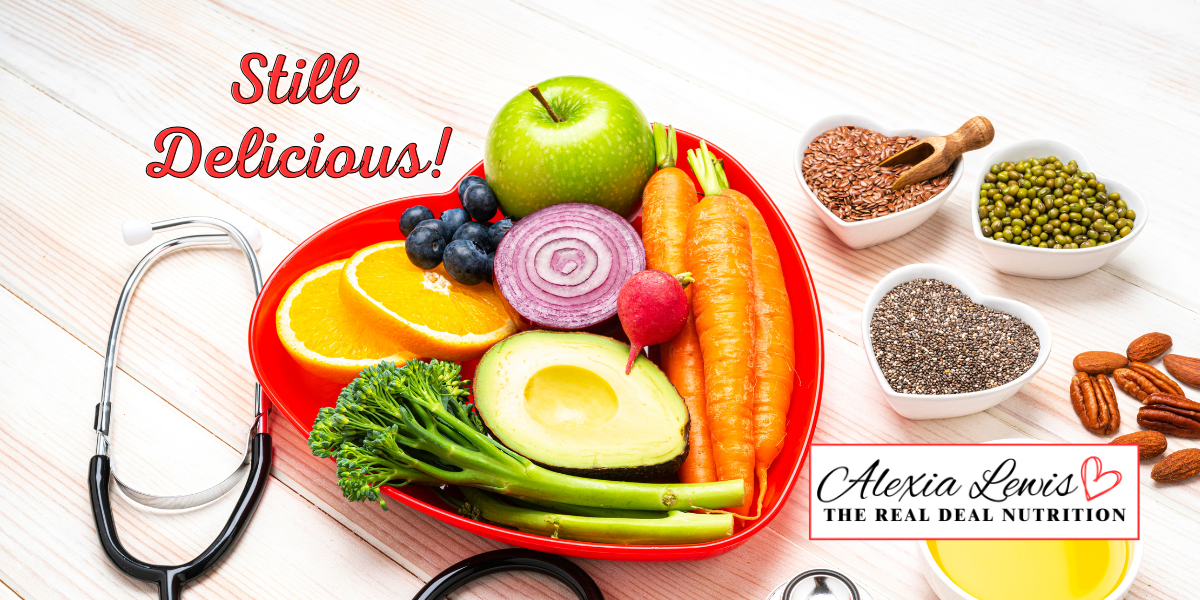
The Basics of Heart-Healthy Eating.
You may hear about magical foods or failproof techniques that are touted as the way to improve heart health. Yah… no. If they existed, then heart disease would not have remained the number one killer of Americans for over 100 years. WHAT? Yes, heart disease first topped the charts back in 1921 (1).
If you know me (Hi, I’m Alexia, a dietitian and heart attack survivor!), then you know I like to simplify nutrition. While nutrition can become incredibly complex and nuanced, most people benefit from big-picture, easier-to-implement steps. To that end, here is my take on the basics of heart-healthy eating.
TL:DR:
- Increase fiber.
- Change up your dietary fats.
- Decrease sodium.
- Decrease added sugars.
- Reduce ultra-processed foods.
- Bonus basics of heart-healthy eating.
Of note: I do mention weight in this article. I am a strong believer that people can be healthy at many body sizes – and confident and beautiful (2). I promote and respect every individual’s choice regarding their weight. I believe we should continue to work towards doing better with providing non-biased health care. More on the weight and heart disease below.
Increase Fiber.
Dietary fiber plays many roles to help with heart disease. It helps with managing cholesterol, blood sugar, and with satisfying appetite, which can lead to reducing weight, which can lead to reducing blood pressure.
Many people would benefit from increasing dietary fiber intake. Unless, of course, you have health conditions or other concerns that limit your fiber intake. If you need to limit fiber, talk to a qualified nutritionist and skip on down to the next basic of heart-healthy eating.
This excellent article from Mayo Clinic shares more about fiber, why to eat it, and when to avoid it (3).
Since we eat foods, not fiber: dietary fiber is found in fruits, vegetables, whole grains, and legumes (beans and peas).
Okay, true. There is also fiber in nuts, however, you would need to eat a lot of them to significantly contribute to your fiber intake, and they are the most calorie dense of the choices. In other words, one measured cup of dry roasted mixed nuts comes in at 9 grams of fiber and a whopping 595 calories (4). Absolutely include nuts in your diet for heart health… just not because of the fiber content!
Bottom line:
- Eat at least one of type of food with fiber with every meal and snack.
- Choose non-starchy vegetables for most of those food choices to load up on fiber without loading up on calories.
- Which type of foods you choose depends on your preferences, health, and goals.
You have lots of choices for foods to include, so… no excuses! And I say this because according to the 2020-2025 Dietary Guidelines for Americans, a distressingly low 10% of women and 3% of men are eating enough the recommended amount of fiber (5).
You don’t eat grains, fine! Eat a starchy veggie.
You don’t eat vegetables, fine! Eat some beans. (Well, kinda “fine” on the veggies, I mean, eat some, yeah?).
You don’t eat beans, fine! Eat some fruit.
Need help including more foods with fiber or navigating all the confusing information on food packaging?
Change Up Your Fats.
The type of dietary fat you eat can have an impact on heart health. This happens because the type of fats you eat helps to reduce LDL (bad) and increase HDL (good) cholesterol. This has a positive impact on heart health.
Notice I didn’t say reduce your fat intake? (Unless, of course, you have a condition that requires eating a low-fat diet, then reducing dietary fat intake is also important.)
That’s because fats are delicious (#noshame), needed for some types of cooking, and needed for your body to absorb fat-soluble nutrients. Eating a fat-free salad? You are missing out on absorbing some of that salad’s nutrition!
Reducing saturated fat, on its own, has been shown to reduce LDL cholesterol.
Increasing unsaturated fat, on its own, has been shown to decrease LDL and increase HDL cholesterol. In incredibly simplified terms, HDL’s job is to help get rid of LDL (6). Boom.
Doubling down by replacing saturated fats with unsaturated fats can reduce LDL and increase HDL all with one dietary swap. It’s as easy as replacing butter with avocado oil for sautéing.
In addition, specific unsaturated fats, omega-3’s can reduce triglycerides and blood pressure. Your body cannot put together omega-3 fats (or omega-6s), so getting foods with these types of fats in your diet is important.
The Australian Heart Foundation has a great overview with more details and food examples (7).
Bottom line:
- Eat more meatless/plant-based meals and use lower fat dairy foods to reduce saturated fats.
- Enjoy nuts, seeds, olives, and avocados often including cooking with oils made from these foods to boost unsaturated fats. Just be mindful of portion sizes due to being high in calories and/or sodium – I’m looking at you delicious salty olives.
- Add a meal with a food high in omega-3′ fats once or twice a week.
I struggle to cook salmon, but it always comes out well when I make this amazing salmon recipe (8).

I didn’t mention trans fats because they were banned from our food supply in 2018 and food manufacturers were given until 2021 to get them out of their foods (9). So, you likely won’t see trans fats in most foods you buy now.
But it’s worth checking the back of your pantry to make sure older foods you may have do not have trans fats on the label (or partially hydrogenated oils listed in the ingredients). And, um, it’s 2025 as I write this, so yeah, check those use by and expiration dates too.
Need help with a virtual pantry and kitchen cleanout?
Decrease Sodium.
While most of us aren’t eating enough fiber, we are eating too much salt. On average, Americans eat 1,100 milligrams more than the recommended amount, which is 2,300 milligrams a day (10).
Do you remember from your early biology classes that water follows salt. I remember really struggling with osmosis. Who knew it would actually be relevant when I grew up?
So, water follows salt. If your salt intake is high, your body holds water to keep all things in balance. More water in your blood vessels makes your blood pressure go up, and that is a risk factor for heart disease.
Most of the salt in the Standard American Diet (yes, the acronym is SAD, which fits) comes from packaged foods, including canned foods. We know salt enhances flavors. It is also a preservative and a binder in foods, and it keeps the foods holding water too, which keeps them *insert the m-word here* so this tracks.
For more info, check out this list of 16 high sodium foods (11) and tips for lowering sodium (12).
Bottom Line:
- Check food labels to choose brands with less sodium.
- Rinse canned foods when you can.
- Choose more whole/unpackaged foods.
- And salt really does wonders to improve foods flavor, so use it. Just stop shaking the shaker after a few shakes, whether used at the table or while cooking.
One very interesting piece of info is that not everyone is salt-sensitive. That means reducing salt in the diet will not impact blood pressure for those who are salt-resistant. Even so, reducing sodium is a positive food choice for many (10).
Of note, there are instances and conditions that may require limiting or consuming a specific amount of salt. In those cases, this info does not appy.
Need help making sure your meals are still delicious without salt?
Decrease Added Sugars.
Just like salt, most of the added sugar in our food isn’t added by us. It’s added by food manufacturers. And just like salt, sugar makes foods delicious. That’s likely why we are also eating too much added sugar in our foods.
Well, that and its “hiding” in many foods that aren’t especially sweet.
The recommendation from the American Heart Association recommends 6% of intake of added sugars, or 6 teaspoons a day for women and 9 teaspoons a day for men (13). The Dietary Guidelines allow for 12 teaspoons (if you eat 2,000 calories a day) (5). One study based on 100,000 people over 9 years found the highest risk of heart disease hits around 24 teaspoons of added sugar (14).
And, of course, as always, people managing specific health conditions or others may need to have different recommendations.
So, drumroll please… We eat 17 teaspoons of added sugars on average (15).
Sugar contributes to heart disease as it can increase blood pressure, inflammation, weight gain, and make it more difficult to manage diabetes/prediabetes.
Bottom line:
- Do your best to reduce added sugars down to the recommendations.
- Continue to enjoy foods with natural sugars.
Yes, you can eat fruit (and unsweetened dairy foods). Foods with natural sugars have other nutrients (fiber, protein, fat) which slows digestion, and the research doesn’t show that these increase heart disease risk.
This Harvard Health article on The Sweet Danger of Sugar is a nice resource for more info (16).
Need help on finding the added sugars in your foods?
Reduce Ultra-Processed Foods.
In the hurry up, stay busy, no time to relax kind of culture that many of Americans live in, processed foods make it easier to get food on the table. #noshame. They are also generally less expensive. With a store-brand dozen of eggs now costing over $4.00, we all could use a little help with our food budgets.
While processed foods have been around for 1.5 million years. After all, cooking with fire is a form of processing. The 1800s saw the inventions of the tin can for foods and pasteurization (17). Then the 1900s saw a big boost in demand for processed foods, with Swanson’s frozen meals hitting the market in the 1920s and fast food starting to hit its stride in the 1950s (18).
Fast forward and we have gone from minimally processing foods (cooking, canning, salting, smoking, freezing, etc.) to the ultra-processed powdered meal replacement drinks of today.
Did I mention there is no food shaming allowed here?
So, yes. Ultra-processed foods can have a place in an otherwise generally healthy dietary approach. And yes, it’s going to be in moderation. Nutrition is not so unforgiving (for most of us!) that eating a small amount of these foods will wreck health. What matters is what we do most of the time.
Speaking of most of the time, ultra-processed foods now make up 60% of the foods we eat (19). So, yeah, that’s more than “in moderation” and that makes for a different conversation.
That being said food exists on a spectrum of processing, and while processing can improve nutrition with fortification, they have been starting to get linked to many negative health outcomes. For example, increasing inflammation and reducing gut health. In terms of heart health, these foods can raise triglycerides, blood pressure, and body weight (20).
Bottom line:
- Work to reduce ultra-processed foods that are of low nutrition quality as your time and budget allow. For heart health, assessing foods for the nutrients mentioned in this article may be a good start.
- Look for processed foods that positively impact nutrition. For example, adding vitamins or fiber.
- Eat whole and minimally processed foods when you can.
On the flip side, it’s also entirely possible to eat a diet of whole/minimally processed foods that have a negative impact on heart health. Food choices matter. And a healthy diet can include ultra-processed foods. After all, store-bought bread and flavored yogurt are both ultra-processed food under the NOVA classification system (21).
PS – Research is ongoing to learn more about if it is the quality of ultra-processed foods (high sugar, salt, fat, etc.) or the actual processing of the foods that matter most for health.
Need help with meal planning and/or prepping to reduce ultra-processed foods?
Bonus Basics of Heart-Healthy Eating.
For some extra steps to add to your basics of heart-healthy eating, you may also add more berries, nuts, avocado, and plant sterols and stanols (22) to your food choices.
And, while weight on its own does not cause heart disease, losing 2% to 5% of excess weight (if overweight) or gaining weight (if underweight), can also help to reduce risk of cardiac disease and its management for those with existing heart disease (23).
Next Steps.
Credible information is important. And putting that information into action is where the magic happens.
Small changes done consistently over time add up to big results. So just pick one or two changes to make right now. When you’ve got that down, add another 1-2 changes.
Work with Alexia on your heart health.
She can work with people in multiple states in the USA and accepts some health insurance plans through her partnership with Nourish. Learn more and start the scheduling process to see if your insurance is accepted and get an estimate of your out-of-pocket costs. (Note that Nourish handles the health insurance stuff, not Alexia!)
If she can’t work with you, you can choose another dietitian who can, or reach out for help getting connected with the right RD for you.
References & Links.
- American Heart Association Newsroom: More Than Half of US Adults Don’t Know Heart Disease Is Leading Cause of Death Despite 100 Year Reign, posted 01/24/2024.
- Alexia Lewis RD article: Weight Does Not Equal Health, posted 06/05/2017.
- Mayo Clinic: Nutrition and Healthy Eating: Dietary Fiber: Essential for Healthy Diet, posted 12/11/2024.
- USDA: Food Data Central: Food Details: Mixed Nuts, posted 04/01/2019.
- USDA & DHHS: Dietary Guidelines for Americans: 2020-2025, posted 12/2020.
- Harvard Health Publishing: How It’s Made: Cholesterol Production In Your Body, posted 02/06/2017.
- Heart Foundation (Australia): Fats, Oils, and Heart Health, updated 03/19/2024.
- Keeping Healthy Simple Club: KHSC Festive Salmon recipe, posted 01/2025.
- US FDA: Trans fat, current as of 04/30/2024.
- Harvard T.H. Chan School of Public Health: The Nutrition Source: Salt and Sodium, reviewed 03/2023.
- Fresenius Kidney Care: 16 High Sodium Foods, n.d.
- US FDA: Sodium in Your Diet, current as of 03/05/2024.
- American Heart Association: Added Sugars, reviewed 08/02/2024.
- Hartford Health Care, St. Vincent’s Medical Center: Not-So-Sweet Link Between Sugar and Heart Disease, posted 02/22/2023.
- Harvard T.H. Chan School of Public Health: The Nutrition Source: Added Sugar, reviewed 04/2022.
- Harvard Health Publishing: Heart Health: The Sweet Danger of Sugar, posted 01/06/2022.
- Automated Process Equipment Corporation: The History of Food Processing: How We Got to What We Eat, posted 10/05/2023.
- Institute of Food Technologists: Food Processing, n.d.
- Diabetes: Volume 72, Issue Supplement 1: 1374-P: Ultra-Processed Food Consumption and Cardiometabolic Risk in Individuals With and Without Type 1 Diabetes Mellitus, published 06/20/2023.
- British Heart Foundation: Ultra-Processed Foods: How Bad Are They For Your Health? updated 04/12/2024.
- News-Medical Net: The NOVA Method of Food Classification, updated 10/17/2024.
- Cleveland Clinic: Phytosterols, reviewed 07/30/2022.
- Clevelend Clinic: Health Essentials: How Weight Affects Your Heart, posted 02/19/2024.






You must be logged in to post a comment.