Updated 12/03/2024. One of the jobs I have held was as a wellness dietitian for a university. I loved that job. I was working on updating the nutrition info on the website and thought I’d share some of the things I’ve been updating. Enjoy!
I’m working on the macronutrients (aka macros). First up, the *beef* on protein (because I just can’t resist bad wordplay!)
Protein
Sources:
Protein comes from animal sources such as meat, dairy, and eggs and from plant sources such as beans, nuts, seeds, and even some grains.
Even your broccoli has protein, but you would have to eat nearly 3 cups to equal the protein in 1 ounce of meat. I’m stuffed just thinking about it. (And, oh, the gas!).
It is possible to consume enough protein for good health on a vegetarian or vegan diet if you plan your food choices well.
Functions:
Protein is an essential nutrient meaning that we must get it from our food. Proteins break down in our bodies to amino acids. Our bodies cannot make all the amino acids it needs to function and approximately 25% of amino acids are lost to other uses every day, which is why protein is an important part of the daily diet.
Protein has many functions including:
– Provides body structure by building and maintaining muscle, bone, and other body tissue
– Allows for movement (40% of body protein is muscle tissue)
– Regulates gene expression
– Integral part of enzymes, hormones, and neurotransmitters
– Immunity through antibodies
– Transports of vitamins, minerals, oxygen and other substances through the body
– Regulates fluid and electrolyte balance
– Maintains acid-base balance
– Necessary for blood clotting
– Used as fuel when other sources of energy are not available. (Cue the nightmare metabolism images from grad school).
– Protein is satiating – it helps us to feel full and satisfied
Recommendations:
For a generally healthy adult, the recommended daily allowance (RDA) range for protein intake is set between 10% and 35% of daily calories. A person consuming a 2,000 calorie diet would have a range of 200 – 700 calories. Since 1 gram of protein has 4 calories, this is a range of 50- 175 grams of protein per day.
Further, the recommendation for generally healthy adults is 0.8 grams per kilogram (8g/kg) of body weight. To convert pounds to kilograms, divide weight by 2.2. For example, a 150 pound person is (150 divided by 2.2) 68.18 kilograms. This person would consume around 54 grams of protein per day, which is the low end of the above range.
Now, that recommendation is based on nitrogen balance studies from way back when. It is the amount needed to prevent nitrogen deficiency. Those amino acids have a nitrogen molecule on them, which leads to a recommendation.
A recommendation that I think is too low. And I’m not the only one. For example, NASM recommendations go up to 2g/kg based on athletic training needs. And this article in the journal Nutrients questions if it’s time to update the RDA.
People with specific health conditions or concerns may need a different amount of protein in their daily diet.
And bro, no matter how much protein you eat, you won’t build muscle without some form of resistance training.
Updated: December 3, 2023.
Original publication date: September 17, 2012 at http://newmotivationcoaching.blogspot.com.
Reference: Nutrition Concepts and Controveries, 12th ed. by Sizer and Whitney, 2012. ISBN-13: 978-1-1133-62818-7.
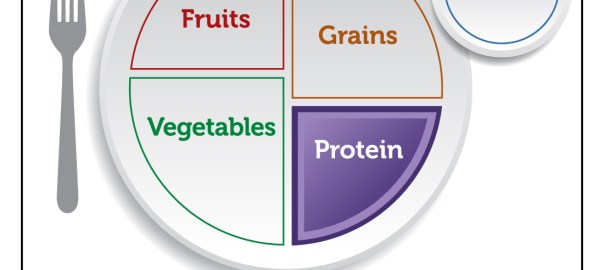
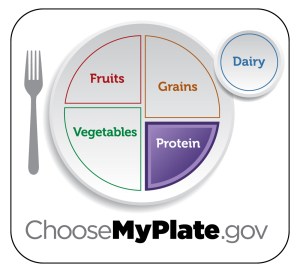
Image from: http://www.choosemyplate.gov

1 thought on “Macronutrients – The Beef on Protein”